Tim Anderson’s ITWriting

Tech writing blog

June 13th, 2008

Now it’s YahGoog

Yahoo has signed up for Adsense:

By offering Google’s industry-leading technology to Yahoo!, the whole system becomes more efficient, and everyone benefits.

This is efficient in the same way that having everyone run Windows is efficient. Hmmm.

Google observes that the deal is non-exclusive; Yahoo can still sell its own ads, etc etc. I tend to agree with Om Malik, who says:

In my opinion, with this deal, Yahoo has publicly acknowledged that Google is superior to them when it comes to search & contextual advertising.

Yes. But how much does that matter? Outsourcing what you are less good at, in order to concentrate on core competencies, can be a smart business move.

The snag here: advertising is Yahoo’s primary business activity. Here are its revenue figures for the first quarter 2008:

  • Marketing services: $1,818 million
  • Fees: $245,milion

Outsourcing the core of your business is bad PR.

Technorati tags: , ,
May 21st, 2008

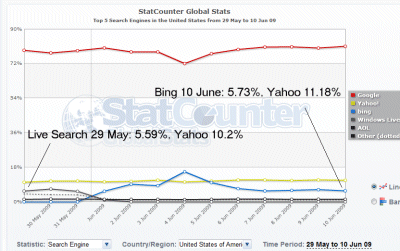
Microsoft: forget the Live Search Cashback, just improve the engine

Microsoft is paying users to use its search engine with a new search cashback scheme. Looks like an affiliate scheme where the commission is paid back to the customer. US only.

I think Microsoft should focus on improving its search engine. This morning, I needed to call a local electrician and figured that search would be quicker than using a phone book. I entered the name of the retailer and the town. For some reason, this stymied Live Search: the result I was looking for was not on the first 10 pages. Identical search on Google: the first four results matched, and the address and telephone number were at the top of the page with a little map.

In a poll last year 51% thought Google delivered the best results for an example search, while 35% preferred Live Search and 31% Yahoo. That’s an inconclusive result, and this is not an exact science; but personally I find Google almost always delivers better results, sometimes (as in the case this morning) dramatically so.

If Microsoft managed to reverse this I would switch to Live Search in a heartbeat.

Technorati tags: , , , ,
May 4th, 2008

Microsoft to Yahoo: Forget it, then

Microsoft is walking away. The right thing to do in my opinion.

Could Microsoft have bought Yahoo? Clearly, it could have done - for more money:

In our conversations this week, we conveyed our willingness to raise our offer to $33.00 per share, reflecting again our belief in this collective opportunity. This increase would have added approximately another $5 billion of value to your shareholders, compared to the current value of our initial offer. It also would have reflected a premium of over 70 percent compared to the price at which your stock closed on January 31. Yet it has proven insufficient, as your final position insisted on Microsoft paying yet another $5 billion or more, or at least another $4 per share above our $33.00 offer.

It follows that the withdrawal of the offer is a strategic decision, not just a victory for Yahoo, its insistence on a higher price, and its dalliance with Google.

I suspect many voices within Microsoft were saying that the deal would not deliver the benefits the company sought - namely, to pull closer to Google in the search market.

We are also seeing some interesting internal developments, from Silverlight to Popfly to Live Mesh - that suggest Microsoft does have an internet story, albeit still an uncertain one.

I wonder how this saga will look twelve months from now?

March 7th, 2008

Steve Ballmer: post Yahoo, we will be a PHP shop

Steve Ballmer took a few questions yesterday at Mix08 in Las Vegas, and I asked him what Microsoft would do with all Yahoo’s PHP applications if its takeover bid succeeds, especially where they duplicate home-grown applications that are running on ASP.NET.  PHP is deeply embedded into Yahoo’s culture, and Rasmus Lerdorf, who invented PHP, works at Yahoo as Infrastructure Architect.

He gave me a fuller answer than I expected, which is worth quoting in its entirety:

There’s really two different questions. In a number of areas, and I won’t go into specifics, but we will have to make some kind of integration plans after presumably we reach deal and it will be appropriate to talk to the Yahoo guys. We shouldn’t have two of everything. It won’t make sense to have two search services, two advertising services, two mail services, and we’ll have to sort some of that through. Some of that technology undoubtedly will come from Microsoft’s side, and some will undoubtedly come from Yahoo’s side, whatever technology comes, it will also come with an infrastructure that runs it.

You ask what we will do with those PHP applications? I’m sure a bunch of them will be running, at high scale and in production for a long time to come.

I think there’s going to be a lot of innovation in the core infrastructure which we have on Windows today with ASP.NET, and Yahoo have in Linux and PHP today, and over time probably most of the big applications on the Internet will wind up being rebuilt and redone, whether those are ours, or Yahoo’s, or any of the other competitors. But for the foreseeable future we will be a PHP shop, I guess if we own Yahoo, as well as being an ASP.NET shop.

One of the things I love which we got into the new Windows Server, is that we put a lot of attention in to making sure that PHP applications run well on Windows Server. That’s not the current Yahoo environment and I’m not suggesting that we would transition that way, but for those of you who do have PHP skills, we are going to try and make Windows Server the best place to have PHP applications in the future.

It was a good answer, though I’d still expect integration to be difficult. One danger is that post-merger infighting over what gets preserved and what gets scrapped could stifle innovation. Microsoft’s Live platform actually looks increasingly interesting, as we’ve learned here at Mix, and I imagine that some of these teams will be nervous about what will happen to their efforts in Microsoft-Yahoo becomes a reality.

|