Microsoft has “no plans to litigate”

According to Bill Hilf, general manager of platform strategy, Microsoft is not planning to litigate against open source after all. In an interview for Infoworld he says:

Our strategy from everyone in the company — from [Steve] Ballmer to Brad Smith to me and everyone in between — has always been to license and not litigate as it relates to our intellectual property. So we have no plans to litigate. You can never say we’ll never do anything in the future, but that’s not our strategy.

I am not surprised – for the reasons I stated earlier. Of course, the other side of the coin is that if Microsoft doesn’t intend to enforce its patents, then all this patent waving is little more than bluster. It is shadow-boxing. We will see plenty more of it on both sides.


Technorati tags: , ,

Eclipse, WebSphere winners in latest Java survey

BZ Research has released its latest survey of Java tools. Let’s start with the caveats:

  • The survey is based only on subscribers to SD Times.
  • Out of 19,623 subscribers invited to take part, only 758 (3.9%) completed the questionnaire.

I’m not surprised: I get bombarded with requests to take part in surveys, and rarely do so. Even so the results are interesting, and the year-on-year comparisons may be indicative of trends.

On to the results (note that percentages are non-exclusive so sum to more than 100):

  • Eclipse increased its usage slightly to 69.6%; NetBeans climbed to 2nd place with 23.3% (up from 17.9%).
  • Oracle’s JDeveloper is up from 15% to 19%.
  • IBM RAD has a decent showing, up from 10.8% to 19.5%, not far behind its WSAD at 22.1%.

The survey also covers app servers. Here, all the shares are down, implying more diverse usage than last year. WebSphere is first with 36.9%, then JBoss with 32 %, then BEA WebLogic at 23.7%. Oracle and Sun are 4th and 5th.

Overall, nothing dramatic to report, though the gain for NetBeans shows that Sun’s investment in this IDE is having some success.

CodeGear’s JBuilder doesn’t feature in the top 5, nor does the excellent IntelliJ IDEA.


A bad experience with Windows Live

The main problem I have with Windows Live is lack of confidence that it will actually work as advertised. There is a rational explanation for this kind of hunch. It is formed from previous experiences, and once formed, it hard to shake off.

Here’s what happened today. I wanted to contact a Microsoft blogger who hosts his blog on http://spaces.live.com. I couldn’t see an email address (understandably), so I clicked on the button that said Send a message. I was prompted to sign into Windows Live, which I did, and then after a bit of screen flashing and approving of ActiveX controls I had a form into which I could type.

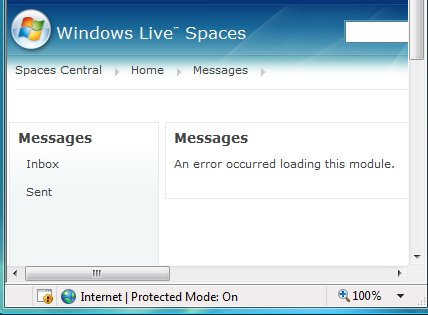
I typed the message. Then I did something which reflects my lack of confidence: I copied the message to the clipboard, in case something went wrong and I had to type it again. Finally, I clicked Send. This is what I got:

Note that all my text was zapped. I closed the browser, restarted it, signed in again, returned to the message form, pasted in my text, and clicked Send again. Same result.

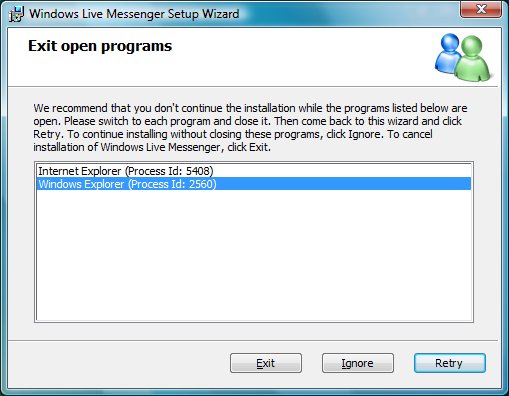
I’d noticed during the process that this messaging system has some relationship with Live Messenger. I figured therefore that upgrading Messenger to the latest version might help, especially since Messenger nags me on this subject whenever I start it up. So I fired up Messenger and allowed it to update itself. During the install I got this dialog:

Frankly, I will not take anything Microsoft says about user experience seriously until the company stops inflicting this kind of dialog on its users. Look at it. It recommends that I close some open programs, but does not say what the consequences will be if I do not. It is a vague threat that something might not work right. But that’s not all. Internet Explorer was not visibly open at the time. I had to go into Task Manager and end the process. Many users would not make it that far.

It gets worse. I’m being asked to close Windows Explorer. This is the application that forms the Windows desktop. If you close it, you lose the Start menu, taskbar, desktop icons, pretty much everything except the background.

Still, I didn’t want to risk a bad install. I went into Task Manager and ended the explorer.exe process. No more desktop. Then I continued the Messenger setup. It went through fine (except that no, I don’t want msn.com as my home page, but thanks for asking). Finally, I restarted Explorer. Task Manager – New Task – type Explorer – hit Enter. Yes, I’ve been here before. Zing! back comes my desktop.

Back to Live Spaces, paste in message, click send, and … you’ve guessed it.  “An error occurred loading this module”. Never mind.


Amazon and the future of music downloads

What’s the significance of Amazon’s announced DRM-free music download store?

Amazon is a major internet property for which I have a lot of respect. It had to decide between Microsoft DRM (“Plays for Sure”) or none, and it went for the latter. I think this is the end of the road for Plays for Sure. Apparently nobody can compete with iTunes. There is Zune, of course, but Zune isn’t even Play for Sure.

So it is DRM-free vs iTunes. As for iTunes, it will do both. Where we go from here?

Amazon’s problem is limited inventory. Of the major labels, so far only EMI is willing to go DRM-free. Users who purchase music downloads will stick with iTunes if they can’t get the songs they want.

Amazon’s prospects therefore hinge on whether or not other major labels follow EMI. That in turn will depend on how it works out for EMI. If it is seen to be growing its market share because it offers a better download product, others will abandon DRM and Amazon downloads can prosper. On the other hand, maybe EMI is devaluing its product. Perhaps the public will now perceive EMI music as free music, and actually buy less of it. In this case DRM, and Apple, are the winners.

While Apple has won the DRM-encumbered download war, it won’t necessarily have an easy ride in future. There are several interesting issues. One is how many users will bother paying for music at all. I’d love to know the age profile of iTunes customers. When I asked a teenager whether she ever paid for downloads, she just laughed. Yet music execs have told me that most customers buy less music as they age. If you follow the logic through, it implies that iTunes may be squeezed by an up-and-coming generation that doesn’t regard music as something you need to purchase, and an older generation moving into a time of life when they stop acquiring music.

A second factor is whether the music labels will continue to tolerate Apple as a middle man. In this respect, there’s an intriguing Reuters report which says that “the paid download video market is a dead end”. The report is a bit confusing, but seems to predict that free online video supported by advertising will win over paid-for downloads. The fundamental question is whether content providers will continue to let their customers interact with iTunes, giving Apple a cut of the proceeds, when they could interact with their customers directly. Although this report is about video, similar considerations apply to music.

Perhaps we should identify three phases in music “ownership”. Phase one was when you purchased a physical item – vinyl or CD. Phase two was when you downloaded music file by file. Phase three is when you just play music, leaving it to the system to work out whether it is played from a locally cached file or streamed from the internet.

Phase three is the one that makes sense in the digital era; phase two is a short-lived transition period. Phase two exists for two reasons. First, when connectivity and bandwidth is limited streaming does not work well. Second, it reflects the difficulty we have mentally adjusting to new technology. Paying for a download is physical media thinking translated to the Internet age.

That’s why I still think the subscription model is the only one that makes sense, long term. Either that, or I suppose everything may become free, which is the subscription model with zero fee. Amazon’s store may have some success for a year or two, but in due course nobody will pay for individual downloads.