Why Google Gears? Thoughts from Google Developer Day

Google Gears is a browser plug-in to support running web applications offline. It has several components:

A local server – not a complete web server, but a cache for web pages. One of its benefits is to solve versioning issues. For example, what if you had an application that retreived one page from the cache, complete with Javascript, and another from the Web, including some updated Javascript? The app would likely break. The Gears local server lets you define a set of pages as an application, so you can ensure that either all or none of the pages are delivered from the cache.

A local database. SQLite of course. I can think of many uses for this – whether or not your application needs to work offline. Searching and displaying data from a local database will be quicker than retrieving it remotely. In the current beta, there is no limit to the size of the database you can download or create on the user’s machine.

A WorkerPool for running Javascript in a background thread. Again, there are many possible applications, but a key reason for its inclusion is so you can do long-running synchronization tasks in the background.

A Javscript library to enable access to all these goodies.

Synchronization

Synchronization is integral to the Gears concept. The idea is that your web application works the same online and offline; and then when you reconnect, any changes you made offline are transparently synched back to the server. Google’s demo app for Gears is Reader, a blog reader app, but you can see how this would work nicely with Documents and Spreadsheets, removing one of the disincentives for its use. I’m reminded of comments from James Governor and others about the Synchronized Web – cloud storage, but with full offline capability.

Gears vs Apollo

How does Gears impact Adobe, which is promoting offline web applications in the guise of Apollo, desktop applications running on Flash? You can argue this either way. On the one hand, you could say that Gears removes the need for Apollo. Now any web application can work offline. On the other hand, you could say that Gears is not targetting the same space. Apollo is for desktop apps; Gears is for web applications that happen to work offline.

My take is that Google is making its pitch for ubiquitous web apps which break the offline barrier. The attraction of Gears is that it is seamless, at least for the user. Look at the reader example: it’s the same app, but now it works offline. As I see it, Google is saying that you don’t need Apollo (or WPF, or Java) for compelling apps that work connected and disconnected. That said, it’s not against Flash; there are even handy Google Javascript APIs for simplifying SWF hosting.

Another twist is that Adobe says it is supporting the Gears API in Apollo. That presumably means Apollo now has a fast embedded SQL database engine, which must be a good thing.
 

SQLite will be everywhere

One of the core components in Google’s new Gears API is SQLite, an open source database engine. I’ve been an enthusiast for SQLite for a while now – I first blogged about it in 2003. I’ve also worked a little on SQLIte wrappers for Java and Delphi.

It’s a superb embedded database engine and I’m pleased but not surprised to see it now picked up by Google. It’s part of PHP 5.x, and also used by Apple for Core Data and Spotlight search in OS X. Now it is part of Gears and I imagine will be widely deployed. Google is also apparently contributing to the project – Full Text Search has been mentioned here at Developer Day – though I’ve not yet looked at this in detail. Congratulations to the primary author D. Richard Hipp, truly a star of the open source world, and thanks to him for making SQLite “completely free and unencumbered by copyright“.


Google’s offline problem

Here at Developer Day I attended the workshop on new Maps API features. Unfortunately I was one of the last into the session and could not connect to the internet. I suspect a problem with IP number allocation but I don’t know for sure. I spend some time trying to get it working, then gave up and returned to the blogger lounge, where the wi-fi worked perfectly.

A let-down; yet nicely illustrates the reason why we need Gears.

That said that, even Gears isn’t going to enable offline Geocode lookup.

Next up is the session on Gears.


Technorati tags: , ,

My question to Google

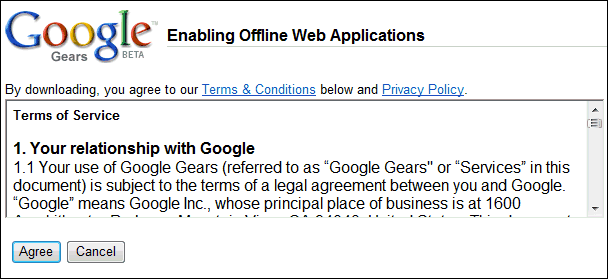
I grabbed the first question after the opening keynote today. It was prompted by my visit to the Google Gears site – I’d intended to install the beta. I was confronted with this dialog:

I asked:

Why does Google display an 8-page agreement in a box 7 lines high?

More significantly, why does it include this clause which strikes me as unreasonable:

12. Software updates
12.1 The Software which you use may automatically download and install updates from time to time from Google. These updates are designed to improve, enhance and further develop the Services and may take the form of bug fixes, enhanced functions, new software modules and completely new versions. You agree to receive such updates (and permit Google to deliver these to you) as part of your use of the Services.

Of course I’ll have to install Gears; I can’t do my job otherwise. But I’m inclined to do so in a virtual machine, because I prefer to keep control of what gets installed.

There’s plenty more in the agreement that you might object to- have a read and see.

It all sits uncomfortably with the stuff we’ve heard about how much Google loves open source, Creative Commons licenses and so on.

My question wasn’t answered, but Chris DiBona invited me to email him with the question, which I’ve done, referencing this post.

Technorati tags: , ,

Google Developer Day begins

I’m early to the London event; but registration is open and I get a flimsy red bag with oddments including a tin of “Goo” which turns out to be thinking putty. The event is at The Brewery in the heart of the City. We are ushered into the Blogger Lounge – stylish, with bright-coloured cushions, soft pastel lighting, fresh-squeezed orange juice and no chairs. A quick glance around the room tells me that Macs outnumber Windows by about 4 to 1.

The event will kick off with a keynote from Chris DiBona “Developer message” and Ed Parsons “Geo Message”. Then I’ve got API workshops – lots of AJAX and Maps – and closing with another keynote live from Mountain View.

I’m already familiar in a broad sense with Google’s developer offerings, but what is the strategy? Getting closer to that is one reason to be here. The other to assess how useful all this stuff is in the real world – to developers that is, rather than to Google.

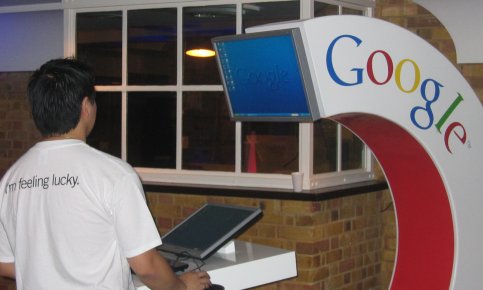
Delegate using laptop station at Google dev day in London

More as it happens.

Technorati tags: ,