Radiohead’s pay-what-you-like download: 160kbps MP3

Radiohead’s distribution experiment, in which customers are invited to pay what they like for the band’s latest album, In Rainbows, in digital form, will be available from tomorrow as 160kbps DRM-free MP3s.

That bitrate is likely to be sufficient for most listeners. 128kbps is sometimes considered the minimum acceptable for reasonable fidelity in MP3. Audiophiles will prefer to purchase the “discbox” which includes a CD, a bonus CD, and vinyl formats, or wait in the hope that a conventional CD release will appear, as it probably will.

My earlier comment is here.

Technorati tags: , , ,

An SLA for Amazon S3

Amazon has announced an SLA (Service Level Agreement) for its Simple Storage Service (S3).

S3 is great, and I noticed how it kept getting mentioned at the Future of Web Apps conference last week. The fact that people are using it, and liking both the performance and the price, says far more about it than any amount of PR.

The lack of an SLA was a snag for enterprise users who need assurance of reliability. So now there is one – but how much is it worth? Not much. The SLA guarantees 99.9% uptime, but you only get between 10% and 25% discount on your usage fees if it slips below that. There’s no coverage for consequential loss:

…your sole and exclusive remedy for any unavailability or non-performance of Amazon S3 or other failure by us to provide Amazon S3 is the receipt of a Service Credit

Given the keen pricing of S3 that’s not surprising. Still, the SLA does have some value, if only for setting expectations about what level of service S3 is likely to deliver.

Update: WordPress is now using S3 as its primary store, but Matt Mullenweg says the SLA means little to him. 

Technorati tags: , , , ,

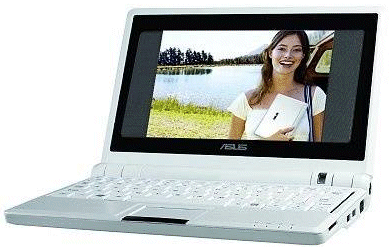
RM’s Linux miniBook

Palm may have abandoned its Foleo; but others are willing to take a crack at the sub-notebook market. Educational suppler RM has partnered with Asus to offer a Linux miniBook starting at £169.00 (around $300). That’s substantially cheaper than a Nokia N800 internet tablet. Here are the specs:

  • Mobile Intel Celeron-M ULV 900MHz processor
  • 7″ TFT screen
  • 256MB or 512MB Memory, 2GB or 4GB Solid-State Hard Drive, SD card reader
  • Integrated Modem and LAN, Internal wireless 802.11g
  • Integrated webcam, microphone and speakers
  • 3 USB ports, VGA out port

According to the press release:

Students will be able to use the RM Asus miniBook to send and receive email, create and edit documents, view photographs, play videos and MP3 files, browse the Internet, listen to online radio and participate in instant messaging.

It caught my interest because I am constantly frustrated at having to carry a relatively bulky laptop in order to get my work done. So I could be in the market for one of these, though it is aimed at students. Bluetooth is not mentioned, which is a shame as this helps with mobile phone integration. According to this post, based on a preview, Windows may be available as an optional extra – I presume this would be Windows Mobilethis article says Windows XP.

If the category succeeds, of course there will be others like it. Why will this be different than other failures or semi-failures, such as the Windows CE Handheld form factor, Tablet PC, or UMPC? Price, mainly. The mass market is reluctant to buy a sub-notebook when there are much more powerful laptops available for the same or less money. That’s now changing, and at this level it just might catch on.

Technorati tags: , , , , , ,