Adobe has released AIR and you can download the runtime and SDK now, as well as FlexBuilder 3, the official IDE for AIR. Just to remind you, AIR is a way of running Flash applications on the desktop, supplemented by SQLite, a fast local database manager.
Among the most interesting case studies I’ve seen is from LMG, which runs loyalty schemes including the Nectar card and Air Miles. The big deal for the retailers is that using your loyalty card lets them identify who is buying what, providing mountains of data which can be mined for trends and the like. I do mean mountains. Nectar is used by Sainsburys. Between 25 and 40 million “basket items” are added to the database each day, and the database holds 2 years of data.
LMG’s Self-serve is an app in development which enables Sainsburys and its suppliers to analyze this data; it could potentially be used by other retailers too. “The application answers questions like how’s my brand performing, who’s buying my brand, what else are they buying,” says Garth Ralston, LMG’s Business Intelligence Development Manager.
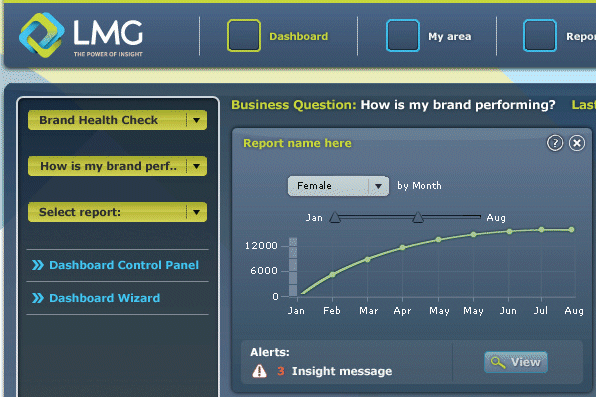
Self-Serve is built with AIR and Flex. “Excel spreadsheets, which some of our competitors use, and the pie charts than you can create within them, are so 1990’s”, says Ralston. “We’re looking for a little bit more of the Wow factor.”
A couple of things particularly interested me. One is that SQLite is critical for the app, which works by downloading large chunks of data and manipulating it on the client. This means that Self-Serve would not work as a browser application, unless possibly with Google Gears, which also uses SQLLite. Another is the importance of offline working. “The ability to have a user run the app, run a report, download the data to their system, take the laptop on the train and continue to work is an absolute business requirement”, says Ralston.
James Governor, Redmonk analyst, told the press that BMC will be using AIR as a front-end to integrate its mainframe management offerings, and SAP will be using it. “Frankly, I think this will be the front-end for all SAP business applications,” he said. In other words, AIR is not just consumer fluff.
Governor is just back from Sun, as I am, and while I was there I picked up some anxiety at the way Flash and now AIR are doing what Java was intended to do – provide a rich cross-platform client. Has Adobe stolen Sun’s market? “Sun is quite capable of stealing its own market”, he said. “Java just hasn’t delivered the kind of rich desktop experiences that we would expect and hope.” That said, note that FlexBuilder is a Java application, Adobe’s server-side LiveCycle data services are Java, and Adobe’s ColdFusion runs on Java, so there are pros and cons here for Sun’s technology.
Actually, I suspect you could build Self-Serve in Java without much difficulty. The big win for AIR is that it’s home territory for multitudes of Flash designers. This is as much about designer and developer communities as it is about technology. The same applies to Microsoft’s Silverlight, which is ideal for Visual Studio developers to whom Flash is foreign.
I still have reservations about AIR, though there is also much to like. It’s early days of course; I’m looking forward to trying it for real. I also love the way these new initiatives are making us rethink the design of essential applications that have remained essentially unchanged for years.