Microsoft’s Office UI patent trap: watch out with that MFC update

I installed the Visual Studio 2008 Feature Pack today – which, by the way, you will not find if you use Check for Updates on the Visual Studio 2008 Help menu – and noticed this paragraph in the setup agreement:
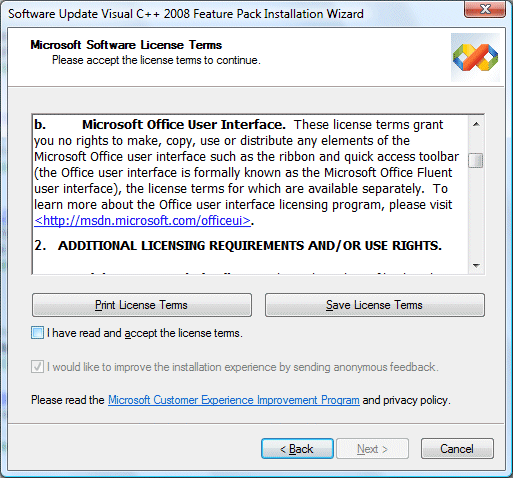
What’s this all about? Microsoft has not said so, but it seems likely to be part of the company’s war against OpenOffice. The efforts of Sun and others to improve OpenOffice, along with all the XML standardization brouhaha, prodded Microsoft into delivering the most significant Office upgrade for many years. One of its intentions was to increase the differentiation between Microsoft Office and OpenOffice. The strategy would not work if some future OpenOffice just copied the feature, hence the license.

The unintended consequences concern me.

Until now, you could pretty much use the out-of-the-box UI components in Visual Studio and not worry about licensing. That has now changed. According to Microsoft if you use any element of the Office user interface, for which the feature update supplies new classes, then you have to agree to a separate license.

Is this a burden? Well, the licensing page is now out of date, because it says “The program does not involve code”, but the feature pack provides what it calls “MFC C++ library source code for the Microsoft Office Fluent User Interface. However, Microsoft says that the license is free and covers:

…applications on any platform, except for applications that compete directly with the five Office applications that currently have the new UI (Microsoft Word, Excel, PowerPoint, Outlook, and Access)

What does it mean, to “compete directly”? It sounds like the sort of thing lawyers could have fun with. Further, if you read the license details and FAQ, it is clear that you take on a further obligation, which is to comply with Microsoft’s Office Design Guidelines, and even to update your application if Microsoft changes them:

Your Licensed UI must comply with the Design Guidelines. If Microsoft notifies you that the Design Guidelines have been updated or that you are not complying with the Design Guidelines, you will make the necessary changes to comply as soon as you reasonably can, but no later than your next product release that is 6 months or more from the date you receive notice.

OK, so let’s say you are developing some software for a customer. You deliver the app; customer pays you. Now Microsoft brings out Office 2009, changes the guidelines, and says you must update the app, even though the customer is happy with it as-is. Who will pay? I guess you would need to agree beforehand; but it is a disincentive to using the fluent UI.

Presuming you do not want to sign up, avoid all the CMFCRibbon* classes. Microsoft has helpfully commented these with a paragraph that says:

License terms to copy, use or distribute the Fluent UI are available separately.

Would any of this stand up in court? I have no idea, but I’d be reluctant to sign up or to use these classes lest I might have to find out.

Will Microsoft abandon DRM?

Ars Technica quotes an email apparently sent to customers of MSN Music:

As of August 31, 2008, we will no longer be able to support the retrieval of license keys for the songs you purchased from MSN Music or the authorization of additional computers. You will need to obtain a license key for each of your songs downloaded from MSN Music on any new computer, and you must do so before August 31, 2008. If you attempt to transfer your songs to additional computers after August 31, 2008, those songs will not successfully play.

Microsoft may not care about MSN Music any more, but this decision undermines all its DRM content sales and those from its partners.

Or will Microsoft abandon DRM? Seems unlikely; yet when I quizzed Microsoft on this general subject (what happens to DRM content when you switch PCs), the reply from Adam Anderson, Sr. product manager for Windows, included this phrase twice:

Music content providers and online music stores are increasingly moving to DRM-free downloadable tracks

As Anderson noted, this will “diminish user issues regarding rights restoration”. So will Microsoft follow this same principle in some future version of the Zune store, for example?

If it did, it might also do the right thing for its MSN Music customers, which would be to provide a tool to unlock the DRM on their purchased files. I suppose its agreement with the copyright owners does not allow for that; yet as the industry now seems willing to offer music DRM-free, it just might be possible.

Incidentally, I’d love to hear from anyone who has purchased music protected with Microsoft DRM, such as tracks purchased from Napster, CD Wow or HMV.com. Happy? Or if not, what problems have you had? I’m looking for examples for a future article.

Technorati tags: , , ,

Fixing Vista: Microsoft’s third-party problem

Ed Bott has a post on how he fixed a Sony Vaio running Vista, when the user had dismissed it as an unusable brick. Bott reasoned that it was all to do with drivers, configuration, and unnecessary pre-installed applications. He proved his point, making the machine usable. The owner made a video about what he thought of the reconfigured machine. Key points:

1. He thought it was much improved

2. He’s sticking with the Mac as his primary machine

The problem wasn’t only that Sony originally stuffed the machine with unwanted trialware. Bott’s new install also benefited from Service Pack 1 and a bunch of updated drivers.

Still, it’s a good demonstration of how big manufacturers like Sony have neglected the user experience for the sake of a few pennies of royalty, or a quicker rush to market, and in doing so lost both sales and credibility. The public mood on this has changed, perhaps because both Apple and the Linux folk are offering better alternatives in this respect.

Incidentally, all my Vista installs have been clean installs, so I haven’t personally suffered from death by trialware, though I have seen it frequently on other machines. Consumer products are worse than those aimed at businesses, but both categories are affected.

Technorati tags: , , , ,

Microsoft: Live Mesh or Live Mess? Here’s what to read.

Here’s what I suggest you read to get to grips with Live Mesh:

Amit Mital’s introduction (he’s the General Manager)

Mike Zintel’s Live Mesh as a Platform (he’s Director of Service Infrastructure)

Mary Jo Foley’s Ten things to know and the helpful stack diagram.

I have a few initial comments. First, it’s the platform that matters, not the Live Desktop which is the first thing Microsoft is delivering and which you will find presented at mesh.com. Microsoft is finally showing us what it means by the “software plus services” thing it has been talking about for so long. It involves a new “Mesh Operating Runtime” which has both cloud pieces and client pieces, a MeshFX API, and an identity system which is Live ID (formerly Passport).

As far as I can tell, Microsoft is delivering an API which we will be able to use to build internet-based data, document and configuration into either desktop or web applications, with synchronization to local storage for offline use. Zintel adds:

… customers will ultimately license applications to their mesh, as opposed to an instantiation of Windows, Mac or a mobile account or a web site.  Such applications will be seamlessly installed and run from their mesh and application settings persisted across their mesh

It sounds good, though the obvious question is whether Microsoft is overstating the importance of the client in an attempt to preserve its core market. Do we need this special client piece? Here’s a paragraph from Zintel’s piece that caught my eye:

A key design goal of the Live Mesh data synchronization platform is to allow customers to retain the ownership of their data that is implicit with local storage while improving on the anywhere access appeal of the web. The evolution of the web as a combined experience and storage platform is increasingly forcing customers to choose between the advantages of local storage (privacy, price, performance and applications) and the browser’s implicit promise of data durability, anywhere access and in many cases, easy sharing.

Can Microsoft improve on the “anywhere access appeal of the web? Zintel says we need to combine it with the advantages of local storage, but the advantages Zintel identifies are not all that convincing. Let’s look at them:

Privacy: maybe, but local data is vulnerable to worms, trojans, viruses; well secured Internet data accessed over SSL is arguably more secure. Data not connected to the Internet is nice and secure, but can’t participate in the Mesh.

Price: I don’t see how Mesh helps here. Yes, local storage is cheap, but as soon as data enters the Mesh it is on the Internet and we are paying for data transfer as well as possibly Internet storage. I realise that Microsoft (among others) offers generous Internet storage for free, but that is just a way of buying market share.

Performance: Granted, some types of application work faster with local storage. Still, there are non-Mesh ways of getting this from web applications in a fairly seamless manner, such as Google Gears or Adobe’s AIR.

Applications: This is perhaps the big one. Many of us are reluctant to do without traditional local applications such as Office. Well, mainly Office. Still, web equivalents get better all the time. One day they will be good enough; and new technology like Silverlight is bringing that day closer. 

What about identity management and permissions? Zintel says:

A side effect of the competition to store customer data in the cloud and display it in a web browser is the fragmentation of that data and subsequent loss of ownership. Individual sites like Spaces, Flickr and Facebook make sharing easy, provided the people you are sharing with also use the same site. It is in fact very difficult to share across sites and equally difficult to work on the same data across the PC, mobile and web tiers.

True; but Mesh currently identifies users by their Live ID. Isn’t that the same as Spaces?

If Microsoft delivers a bunch of useful web services, that’s great. If it tries to somehow replace the web with its Mesh, it will fail.

Mary Jo Foley also asks the question: to what extent is Microsoft extending, and to what extent is it replacing, existing Live services such as Office Live or the excellent Skydrive? Making sense of all this is a challenge.

Now let’s mash all this up with Yahoo! (maybe). Ouch.