Silverlight on Linux: Moonlight or moonshine?

Microsoft’s press release for Silverlight 2.0 says this:

Cross-platform and cross-browser support. This includes support for Mac, Windows and Linux in Firefox, Safari and Windows Internet Explorer.

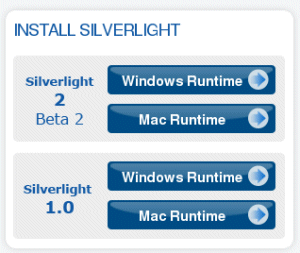
The use of the present tense for Linux support is … misleading, to be generous. I tried visiting the official Silverlight site on Ubuntu. Here’s what I’m offered as downloads:

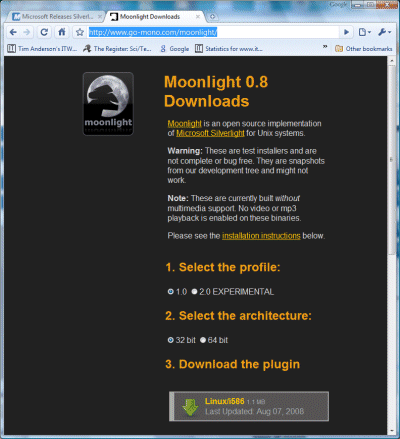
Hmmm. If I go to the official Moonlight site, I see this:

Note that not even Silverlight 1.0 is fully released; further, it says “no video or mp3 playback is enabled”. The installers are said to be incomplete.

I asked about this at the press conference; the answer was “we’re working on it” and “as soon as possible” and “Miguel is speaking at PDC”.

That’s fair enough and I understand that these things take time. But if you read the press release, you might suppose that a Linux user could use it now. Other than for geeky and experimental users, that is not the case.

Silverlight 2.0 is released, Eclipse tools for Silverlight announced

Microsoft’s Scott Guthrie has announced the final release of Silverlight 2.0, its browser plug-in which includes a cross-platform implementation of the .NET runtime as well as a multimedia rendering engine. It will be available for download tomorrow.

Not really a surprise, but nonetheless a significant moment for Microsoft. I have been watching the project closely since it was first announced at PDC 2005 as Windows Presentation Foundation Everywhere. I am particularly interested in the cross-platform aspect. When .NET was first released in 2001, as Microsoft’s answer to Java after falling out with Sun, it had obvious cross-platform potential, yet the company held back form any commercial implementation outside Windows. Miguel de Icaza took independent action to create an unofficial open source Linux implementation, that also runs on Mac and Windows, called Mono. Microsoft was initially wary of Mono, but in my view the company had more to gain than to lose by supporting it. That now appears to be recognized, with Microsoft working formally with Mono to support Moonlight, Silverlight on Linux, and to provide it with multimedia codecs.

Microsoft has also announced Eclipse tools for Silverlight, in partnership with Soyatec, the idea being to enable Java developers to develop for the Silverlight client within Eclipse.

One clarification: although the press release says “This includes support for Mac, Windows and Linux”, the Mac support for Silverlight 2.0 is Intel Mac only, and the Linux version lacks multimedia support and the 2.0 version is described as “Experimental”; it is a long way from full release. Although Microsoft is now working with Mono, cross-platform currently means Windows and Intel Mac, though this does account for a large proportion of active Web users.

Press release is here.

Technorati tags: , ,

Future of Web Applications wrap-up: check out the Open Stack

I attended two great sessions at day two of FOWA London on Friday – which I guess makes it a good day. The first was from Tim Bray, about which I posted last week. Bray was alone in suggesting that the current economic climate will change the tech world deeply; it’s speculative, but I’m inclined to agree with him, though not on every detail of his analysis. He says recession will boost open source – it might, though I can also imagine companies cutting back on the number of staff they dedicate to open source projects like Eclipse – a large amount of open source development is done by professionals on company time. I asked Bray how he thought Sun (his company) would fare in the downturn; he said it would be better off than software companies which are not committed to the open source model, but again that’s speculative; what will be tested is the business model, and that is one thing Sun has never been able to explain satisfactorily.

I was amused that Tim Bray sneaked “Flash is bad” into his talk, as well as talking about “the Microsoft disaster” and “the Oracle disaster”.

The other high point was Kathy Sierra doing her piece on passionate users; I guess it is what she always says, but none the worse for that, especially as I had not heard here speak before. I’ll be posting again on this, here or elsewhere. I was sorry that her talk came just before the Diggnation silliness which meant no chance for questions.

There were disappointments too. Mark Zuckerberg and Dave Morin spoke about Facebook Connect and a few other things; I would have liked some sort of debate about Connect vs Google’s OpenSocial; my observation is that Google is doing a better PR job in persuading us that it supports the “open web” as opposed to some kind of walled garden.

Although I have an intense interest in things like Adobe AIR, Salesforce.com, and Amazon’s web services, the sessions on these were disappointing to me, being high level and mainly marketing. There was probably more detail in the “University” mini-sessions but one cannot attend everything.

Despite its absence from the main stage, there seemed to be a fair amount of interest in Microsoft’s stand and mini-sessions on Silverlight; nevertheless, if the fowa crowd is wary of Flash it is even more suspicious of anything from Microsoft. Fowa is biased towards open technology; only Apple gets a pass because its laptops and iPhone are well liked.

As for significant clues about, well, the future of web applications, I’d point to David Recordon’s session on the “Open Stack”, about which I posted on Friday. If this, or something like it, wins serious adoption it will have a huge impact.

Many of the sessions have been posted as videos here.