Some technical debates are so polarised that it is hard to believe there can be sane people on both sides. One such is that over whether high resolution audio is audibly superior to CD.
First, a little orientation. A standard redbook CD stores music encoded as 16-bit PCM (Pulse Code Modulation) sampled at 44,100 Hz. This standard was first published in 1980 and the first production CD player appeared in 1982.
Technology has moved on a long way since then, and around 10 years ago there was an industry format war over what higher resolution disc should replace CD. Sony championed SACD, which uses Direct Stream Digital, a 1-bit system with samples at 2822.4 kHz. Meridian and the DVD forum supported DVD Audio, offering a variety of possible formats up to 24-bit PCM sampled at 192 kHz.
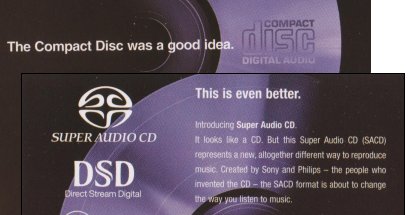
Bigger numbers, better quality, right?
The 16/44 transparency test
Maybe, maybe not. Some audio engineers maintained that even 16/44 was more than adequate to convey audio with an accuracy greater than the limits of human hearing, at normal listening levels. In 2007, Brad Meyer and David Moran put this theory to the test. They conducted a series of listening experiments using high-resolution sources, testing one simple proposition: if you convert the audio signal to 16/44 digital and back during playback, is the difference in quality detectable?
Meyer and Moran wrote up their results in a paper published by the Journal of the Audio Engineering Society. Unfortunately the full paper is only available to AES members, but the results are well known and widely discussed. Their tests, which used double-blind testing techniques where neither listener nor tester knew which signal was being played, showed that no listener could reliably detect when the additional 16/44 conversion was inserted into the signal path.
On the face of it, this shows that no matter how good a stereo SACD or DVDA disc sounds, it could also be encoded onto a CD and sound the same to human ears. There was an unimportant caveat. If the volume was whacked up to very high levels, you could hear a difference in the noise floor.
What the transparency test does not prove
It’s worth noting that the Meyer/Moran test only covers one point: that 16/44 is (or is not) acoustically transparent. It does not prove that high-resolution audio is pointless; in fact, it has obvious value in production (as opposed to delivery), since production means digital processing, which degrades the sound; it makes sense to work in a resolution much better than you need for final output. I guess the same argument can be applied even to the distribution format, if the player is processing the sound to apply equalisation or bass management, for example.
Even if the test result is correct, it may still be that SACDs sound better than the same music on CDs, maybe because it is mastered better, or the player performs better with SACD, or maybe better source tapes were used for the SACD. In fact, Brad Meyer says:
Those who have read the JAES paper written by me and David Moran may remember that we too thought that the high-bit recordings we heard sounded, as a class, really exceptionally good. Our experiment, however, made a very good case for the theory that the reason for this lies not in the extra bits but in the market niche these recordings occupy.
Your rant against what you call square-wave recordings (i.e. ones in which the dynamic range is very heavily compressed to make the average level higher, which is a common mastering practice) is one I quite agree with, but it too has nothing to do with the number of bits in the recording. Our experiment showed that those awful-sounding things could just as easily have been issued as SACDs — and conversely that the excellent sounds we heard from our test material could have been issued in 16/44.1 without audible degradation.
Here’s how I think it works. SACDs are issued to a tiny niche market that is known to use good to excellent equipment, and to be fanatically devoted to realistic timbres and dynamics. Because the big guys in the record companies don’t care at all about such a tiny niche and are financing these SACDs because it’s the modern thing and sort of prestigious (and the other companies are doing it), they leave the engineers and producers alone, and the latter just make the stuff sound good on their own studio monitors and good home systems, and send ’em on out there.
And guess what? If a skilled engineer has as his only goal making something sound good enough to show off to his colleagues, you’re gonna think it’s pretty damn good too.
It is also worth mentioning that both SACD and DVDA are not solely about high-resolution stereo. They are also for surround sound, something which a CD does not support.
In a nutshell: you could agree with the test result and still want to invest in SACD discs and hardware.
Does it matter?
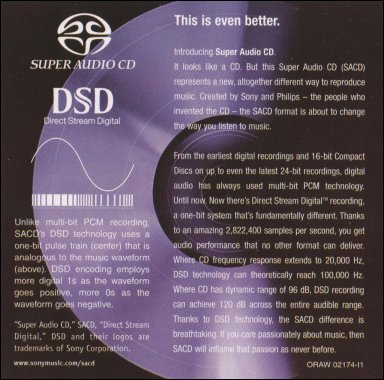
Does it matter? Well, a considerable part of the marketing behind SACD and DVDA is that the sound quality is better than ordinary CDs. Unfortunately Sony has back-pedalled so much on SACD that I can no longer find its marketing material online; but it emphasised that Direct Stream Digital is more analogue-like than PCM as well as higher resolution. I am not focusing here on the benefits of DSD over PCM, which are also contested, but will mention that the transparency test casts doubt on this as well as on high resolution sound itself. This is from a leaflet tucked into early SACD releases:
The SACD format is about to change the way you listen to music … thanks to an amazing 2,822,400 samples per second, you get audio performance that no other format can deliver. Where CD frequency response extends to 20,000 Hz, DSD technology can theoretically reach 100,000 Hz. Where CD has dynamic range of 96 dB, DSD recording can achieve 120 dB across the entire audible range. Thanks to DSD technology, the SACD difference is breathtaking. If you care passionately about music, then SACD will inflame that passion as never before.
and
Unlike multi-bit PCM recording, SACD’s DSD technology uses a one-bit pulse that is analogous to the music waveform.
You can also get a flavour of it here, an unofficial FAQ, including this statement:
…the difference between regular audio CD and the high-density layer of SA-CD can be quite easily perceived, even to untrained ears
There is still an SACD market, though the format has disappointed in an absolute sense, and Sony (and others) still sell high-end SACD players. There are also audiophile sites where you can purchase high-resolution downloads, such as HDtracks and Linn Downloads. The high resolution downloads cost more; so if nothing else, Meyer and Moran might save you some money even if you want the best no-compromise sound.
Industry and community reaction
Meyer and Moran’s paper has been widely debated, though considering the implications for high-end audio perhaps not as much as you would expect. Many audiophiles simply disbelieve the result. They are happy that earlier papers such as this one [pdf] by J Robert Stuart of Meridian present technical arguments why 16/44 is not enough:
The CD channel with 44.1kHz 16-bit coding (even with noise shaping to extend the resolution) is inadequate. Even 48kHz sampling is not quite high enough.
Hi-fi critic Robert Harley says that the conclusions of the test prove that double-blind testing does not work:
Every few years, the results of some blind listening test are announced that purportedly “prove” an absurd conclusion. These tests, ironically, say more about the flaws inherent in blind listening tests than about the phenomena in question.
The latest in this long history is a double-blind test that, the authors conclude, demonstrates that 44.1kHz/16-bit digital audio is indistinguishable from high-resolution digital. Note the word “indistinguishable.” The authors aren’t saying that high-res digital might sound a little different from Red Book CD but is no better. Or that high-res digital is only slightly better and not worth the additional cost. Rather, they reached the rather startling conclusion that CD-quality audio sounds exactly the same as 96kHz/24-bit PCM and DSD, the encoding scheme used in SACD. That is, under double-blind test conditions, 60 expert listeners over 554 trials couldn’t hear any differences between CD, SACD, and 96/24. The study was published in the September, 2007 Journal of the Audio Engineering Society.
I contend that such tests are an indictment of blind listening tests in general because of the patently absurd conclusions to which they lead.
Reactions like this are to be expected from parties that are heavily invested in the merits of some facet of technology. Hi-fi is particularly problematic for several reasons, for example:
- We have difficulty in separating our enjoyment of the music from the quality of the technology.
- There are known placebo effects which make sighted tests suspect. Our brain tells us something should sound better, and therefore it does sound better; even if science or blind testing later proves that it was not for technical reasons.
- Differences such as a slight increase in volume may be perceived as an improvement in quality; hi-fi demonstrators are well aware of this. Exact matching of volume is difficult to do at home.
Others have advanced different reasons for the Meyer/Moran results. Perhaps the equipment was not good enough. Perhaps the testing was not rigorous enough, or they used the wrong source material. The test authors posted some more information so that others could form an opinion about this. The equipment looks reasonable to me, though it is not at the ultra high end of hi-fi.
Still, what is surprising is that (as far as I’m aware) nobody has repeated the tests correcting such flaws and obtaining a different result. Of course that may yet happen; but the lack of such counter-tests so far strikes me as equally as significant as the test itself.
I asked Harley about this and he replied:
I’m not aware of any formal DBT of standard-resoution digital audio with high-resolution digital audio. The difference between 44.1kHz/16-bit digital audio and 176.4kHz/24-bit is obvious, in my experience. It is, in fact, so obvious that no one (no one that is a disinterested experimenter, that is) has bothered to organize and conduct it.
Your last sentence reminds me of the cartoon by B. Kliban showing a professor at a blackboard full of mathematical equations in front of a classroom in which all the students are fish. The caption is “Proving the Existence of Fish
Is it obvious? The resources section below offers some samples in both 16/44 and 24/96 that you can try and I’ve also done my own experiments, though comparing such samples is not quite the same test that Meyer/Moran conducted. I’d contend though that the difference is not so obvious that it needs no argument and I would not put money on my ability to tell them apart under blind conditions.
Mastering matters more
The Meyer/Moran test is persuasive, but I am open to the idea that some further research may prove it to be not the last word on the transparency of 16/44. Still, I’d expect the audible differences between 16/44 and higher resolutions to be subtle at best, and I am sceptical of any claims otherwise (like Harley’s above).
A bigger concern is that the focus on high-resolution formats, or minutiae like whether an SACD player converts DSD to PCM during its output processing, distracts from what matters more: the way the music is recorded and mastered.
Thanks to the ongoing loudness wars some audiophiles seek out early CDs from the eighties, or even vinyl records, to get the best-sounding versions of favourite albums. Some of those old CDs do indeed sound stunningly good; not only because of greater dynamic range, but also because a light touch was applied to mastering in the early days so that a CD was close in sound to the master tape. Not all old CDs sound good of course; sometimes bad tapes were used or damaging noise reduction applied; but the fact that some twenty-year old CDs can out-perform modern pressings shows that mastering decisions count for more than digital technology or resolution.
Resources
The Meyer/Moran paper with brief discussion
Discussion of Meyer/Moran paper on AVSForum
Discussion of Meyer/Moran paper on Hydrogenaudio
HDtracks offers a free sample of various styles of music in both 16/44 and 24/96
Sample from Barry Diament’s Soundkeeper Records comparing 16/44 to 24/96
VERY GOod article on cd vs sacd vs dvd a
http://www.iar-80.com/page128.html
more accurate than most articles based on useless opinions.
Has anyone performed a test where two signals, one a pre-16/44.1K conversion analog signal and the other post-conversion, are fed together out of phase? Any visible noise on equipment (scope or other analyzer) or audible sound would indicate differences introduced by the conversion. The two chains could be set up with identical equipment, cables, etc., apart from the conversion. If there were tiny timing differences, they could be adjusted to fully time-sync the signals.
Perfect and inaudible conversion should result in a complete null, right?
I bought a few multichannel SACDs some years ago; in most cases I preferred stereo. I couldn’t hear any audible improvement over CD. There are differences, but that doesn’t mean SACD is better. SACD to me had an obviously different mix, that’s all. Not something that interested me enough to spend a lot of money sourcing rare deleted titles.
Double blind tests are the only way to tell if A is better than B. Read this to see how many ways we can fool ourselves…
http://www.mendosa.com/bratman.htm
The most important factor in audible differences in any given format is the clarity of your sinuses and hearing path through your ears. I am a classical performing musician and have been an audiophile for 45+ years. This is an industry so full of misinformation, dishonesty & marketing garbage that over time if one becomes aware of what is really going on, one is sickened!
Bottom line is 44.1 16bit recording is more than sufficient to obtain sonic nirvana if your hearing path and sinuses are clear. The best way to increase dynamic range and improve sound quality from any system, format or medium is simple: EAT LESS CHEESE!!! I rest my case.
I couldn’t agree more. Indeed the whole marketing around SACD is garbage. From the signal processing theory point of view, DSD is a bad solution. The only advantage is for the labels as there is no practical way of making digital copies (but who needs that?)
In addition to healthy hearing and sinuses, get you a decent auditorium of decent hardware and good recordings, it matters.
Here technical details about DSD signal processing.:
https://issuu.com/disclord/docs/sacd-is-bad
Hello, I agree that Mastering decisions for CD is more important than technology, although you have to realize that some mastering techniques are better now than they use to be. Some Cd’s sound better than others because the transfer to CD was carefully done with not one step in the process failing. That is why K2 and XRCD sound good. They are very deliberate in the mastering and transfer. RC
It is hard to tell at the surface, but yeah I think that high resolution audios like sacd’s are better than cd’s
If you can’t hear the difference between Redbook and HighRes, then:
1: Your hearing is gone.
Or
2: Your equipment is not good.
Or
3: Your equipment is not setup correctly.
Or all of the above.
I am NOT involved in the business of audio and I have tinnitus and I can hear a dramatic difference.
Vc, must respectfully disagree. If double-blind studies showed people unable to distinguish between 44khz and higher sample rates, then I seriously don’t think one has to be half deaf or have junk or badly set up equipment to not hear a difference. My guess? As they said may happen in OP, that you’ve got a disc where the high-res has better mixing than the CD — some CDs do have absolutely horrible levels and mixing decisions.
One study. I’ve only recently started listening to SACDs using Audirvana connected to a V90 DAC. Even though this converts DSF to PCM I can hear a difference. I can hear greater clarity versus Apple Lossless using my Apple Earphones when the tracks are reduced to 24/44.1kHz. Now, this might be better mastering on the SACD – but if so, when I switch between USB cable [DSF>24/88 and Apple Airport Express 16/44, the former consistently sounds better? I say all of this because:if 51/100 people agreed with me, it would be a second study disproving the first one…
Dramatic difference between what exactly? I posit from a bunch of conferences I used to attend that unfortunately those kind of conclusions are pretty much never possible, since the SAME EXACT MASTERING is never available in different formats. For instance, I heard a demo where Foreigner’s bass sounded better in 96/24 than the CD, but the 96/24 was newly done for DV-A. Even hybrid SACD you cannot assume is the same mastering since often the CD layer was the old CD master but the DSD layer was a new scraping from a (now older than for the CD!) analog tape. A dumber example, “Dark Side Of The Moon” had clipping on the CD layer but not the SACD! Now, I suppose Telarc and some boutique labels *might* have made CD and SACD from exactly the same master but I don’t know that there is any way to tell. Alpine once made a demo DVD with tracks truncated from 96/24 to 44/16 but that was a long time ago. I suppose now software should be available for us to make our own version of these tests, but if the tests aren’t blind psychological effects similarly prevent any type of scientific conclusion.
@vc I kind of agree with you, I can indeed hear dramatic differences, but certainly not the way you meant it.
Imho CD is still superior to DSD. As to the high-res I have made recordings 96/24 and the fornat is very practical to setup your equipment (I work with the DAP 4040 gold mikes), but compared to the down converted signal there is audibly no difference.
Mastering is THE key.
I’ve got many of the same albums across many formats (SACD, CD, Blu Ray audio, DVD-a, HDCD, CD, standard vinyl, half-speed mastered vinyl cut at both 45rpm and 33rpm), and my findings, listening through £20K equipment, is that mastering is the primary determinant of sound quality.
So, for example, some subjective findings on albums I have listened to numerous times across some or all of the above formats:
Sea Change – Beck (Blu Ray audio in 5.1 and then the 2ch 24/192kHz are best I’ve ever heard. CD also pretty good particularly the HDCD encoded version).
Wild Honey – The Beach Boys (stereo remaster vinyl 2017 version and 2001 CD twofer).
Street Legal – Bob Dylan (2003 SACD by a country mile).
Blood On The Tracks – Bob (Mobile Fidelity vinyl)
Behaviour – Pet Shop Boys (2018 CD)
The above sample is to illustrate, at to my ears, that each format can have its day. All the above were “tested”against one or more formats.
It all comes down to this:
It might be that hi-res i s better, it may not. It might actually be the fact that mastering is performed better on a specific HiRes album compared to its CD counterpart and not the technology per se.
Who cares ?
Do YOU hear a difference?
Do YOU like it?
Are YOU willing to pay for it?
The End
I’m in my second surround sound theater system from sony capable of playing SACDs and with four equal speakers with two mid-range and two tweeters on towers, a center channel with two smaller medium cones and a center small tweeter, and a subwoofer, covering, in all, 20 to 20000 hz. All my hand-picked sacd’s are of classical music with at least the multichannel layer. Whem heard as a multichannel, without any surround added digital processing, as all have masterly recording and editing, there is simply no comparison even to the stereo high-res layer on some of them. Hearing the soundstage as captured the way the sound engineers wanted, with specific instruments in clearly different positions, and a sound so absolutely pure and of such range extension and at a high dynamic range, has no comparison possible to the experience of high-rez stereo, let alone a common cd. Even on my simple, not expensive but high quality theater system the difference, the feeling of being in a central seat of a concert hall or church, with real sounds, echos recorded from the real acoustic of the place of recording, is an unsurpassed experience. Double blind A/B tests as studies is something, but I’m interested in my comparisons in my home. Is there bias? I don’t care, because my experience is real to me, and it’s what I care for. I doubt the reproducibility and methodology of these so few studies, and I don’t listen papers, but music. SACD is way beyond CD, and the Dolby Atmos etc are for movie productions. For a Bach concert, for an Alessandro Scarlatti opera, I stick to my SACDs.Sony never knew how to market their products, always the best.
*actually, 20 to 50000hz
I do hear a difference between 16/44.2 and 24/48 with most material.
I have problems to distinguish between 24/48 LAME MP3 and 24/48 FLAC, but can do so.
I do have a Metrum Amethyst non-oversampling DAC, which has resolutions up to 24bit /384khz.
So at the moment, 24/48 is my favourite “high rez” resolution and I like to listen to downsampled SACDs (no gain!) and LP rips as well as official downloads.
I do check the mastering I a file appears to be loud.
I like the SACD masterings as far as I have encountered them, as they appear not be touched by the loudness war.
Just to add my 2 cents:
I’ve been able to hear the difference in detail at least between 16 and 24 bit when recording a single track. I was auditioning certain segments of the recording for which that kind of detail was important. So — I have to wonder, then, if the double-blind tests were conducted by listening to an entire song from the very beginning, if the brain “normalizes” its expectation based on what it hears from the beginning, and/or simply can’t compare the relevant differences because they’re too distant from each other in time. If that makes sense.
You could construct a new double-blind test, then, with (for example) a segment of audio with lots of vocal esses or cymbals from drums, and see if people could tell the difference between 4-second clips. I bet you’d see much higher detection rate.
I once read an article that sought to explain why we were kidding ourselves that higher sampling rates allowed us to hear more of the song.
The author started out by talking about the human eye and the range of wavelengths that are detectable to it. He followed it up by showing that he pointed the sensor end of his television remote at the lens of his digital camera in a dark-as-he-could-get-it room, hit a button on the remote, took a picture with the camera then transferred it to his computer. He compared it to a photo of the same dark room taken by the camera without any light.
The photo where the remote was being activated was a blur of light. He did this to demonstrate that holding the remote to his eye and activating it in the dark room produced no effect, because his eye cannot detect that wavelength of light. The camera did capture it though, because it was able to detect that wavelength, in addition to the regular wavelengths the eye can detect.
He stated that we have yet to meet the human whose eyes are capable of detecting current, out-of-human range wavelengths.
He said it was no different with human ears. In best case ears, 22khz can be heard but beyond that, people cannot detect frequencies. He likened the digital camera to a bat or whale, able to hear ultrasonic frequencies, versus the human eye and ear that have comparatively speaking limited wavelength and frequency detection ability.
Now – that isn’t to say that recording styles don’t sound different to different people and I don’t think he addressed the idea that ultrasonic frequencies influence how a person feels about a recording but that article has always stuck with me.
Too many misunderstand the concept. Yes, in most cases it is *easy* to hear the difference between hi-rez and CD audio, even with the same mastering. However, it is exactly the sign of problems with the equipment.
The ONLY way to compare and exclude these problems is what “The 16/44 transparency test” did – have a hi-rez source, with one path converted to 16/44 and then back to hi-rez, then alternatively listening to these 2 signal paths.
Both are the exactly same hi-rez signals, except one has been temporarily converted to 16/44.
This is the test many oppose, because their golden ears may be put to the real test.
When testing as described by you the original source resolution is equal in both cases and the final conversion from digital to analog is made from the same digital resolution as well. So what that test proves is that intermediate signal conversion to a lower resolution and back does not have any audible consequences.
However, as you mention, listening to Hi-Res Audio vs. CD shows clearly audible differences. That suggests that it may be favorable if D/A conversion is done from digital information stored at higher resolution (even if the original resolution was lower). This may be due to cut-off filters being further out of the audio-band and/or less steep, etc. In such a case high-res formats may well make sense for the consumer.
Placebo effect? I’ve been there and got the blushes to prove it. Deciding between two pre-amps for my voice recording work, I set up an A/B switch, taking care to be blind to which side was which. I’m BBC-trained and quite critical.
Consistently and strongly I came down in favour of box ‘B’.
Then I checked the switch. Not connected!!!
I think the arguments for better mastering are convincing and that yes, more frequently THOSE recordings and isseus will be done with greater care and effort towards sound quality . To some degree subscribing to hi res streaming services like Tidal and Qobuz and having a streamer than can play whatever they serve up (say 24/192 at best) ends the search and anxiety for audiophiles. I can VERY quickly listen to 10 versions of say Beethoven’s 6th or some Keith Jarrett and just color in the star or heart when I am happy with one This quickly ends all the agonizing over format, and goes back to whatever makes you feel most thoroughly good when listening . A majority but not all of my picks have been above red book, but listening to Jarrett or say V. Olafsson piano in ANY of the formats sounded awful damn good, though to my ear the higher resolutions seemed better. On the other hand I’ve had more musical pleasure from a series of Tchaikovsky symphonies and concerto’s in red book from Pletnev/Russian National Symphony than any hi rez versions. No sonically not as refined but the whole here is greater than the sum of its parts. So it ALL counts, and with streaming you just get to quickly find what you like best after comparing many. Which is all that counts – the sheer pleasure of listening delivered to me!
The mastering on LP is better due to using older valve technology CD tend to used emulated software to master rather than real machines.
Though with SACD is highly likely that engineers will spend more time mastering it.
Robert Harley is a subjectivist–the sort that would have been imbibing (or worse, selling) snake oils of all kinds before regulators came along and required objective proof. His indictment of blind testing, at least of the quality done for peer-reviewed journals, is really an indictment of the audiophile industry and people like himself. It’s the same sort of objection that people in the nutritional-supplements industry have to randomized, blind, placebo-controlled, and replicated studies of their products. Those don’t usually go well for them, and that means they must not be valid. (It is true that 44.1 kHz sampling of higher-frequency square waves is miserably inaccurate; it’s just that human ears also struggle to detect that inaccuracy–not to mention that music is rarely just a high frequency square wave requiring reproduction.)
Another common marketing myth about DSD vs. PCM is that when blind listening tests were done comparing DSD to PCM, there was a consensus that PCM had a fatiguing quality and DSD had a more analog-like quality. This was proved to be total marketing BS. One way that marketing lie was perpetuated was with hybrid SACDs that have DSD64 and 16-bit 44.1KHz PCM on the same disk. The DSD64 tracks have roughly 33 times the resolution of the 16-bit 44.1KHz tracks so that they could make DSD sound better than PCM in comparisons. The truth is that in recent blind studies they’ve proved that high-resolution PCM and DSD are statistically indistinguishable from one another. Considering that nearly all DSD recordings were edited, mixed, and mastered in PCM, it is no wonder.