What’s new in IE8: Activities and Web Slices, developer tools

Here at Mix08 in Las Vegas, IE head honcho Dean Hachamovitch has introduced Internet Explorer 8, which he told us will be available for beta download later today.

The big features are CSS 2.1 standards compliance (now the default), and two new things called Activities and Web Slices.

Activities are a way of installing browser add-ons that enables new instant links. You can select text in a web page, right-click, and get links for things like “buy on eBay” or “see user reviews”. This is enabled by an XML specification called the OpenService Architecture, which is being released under the Microsoft Open Specification Promise.

Web Slices are a way of subscribing to page fragments, or perhaps pagelets (my term). This then appear as links in the IE8 toolbar. Examples we were shown were an eBay auction, and Facebook feeds. Like Activities, this is enabled by an XML specification, this one called the Web Slices Specification. The page author determines what content ends up in the pagelet.

If the specifications catch on, I imagine other browsers could easily implement them.

Activities remind me of the almost-dead Smart Tags, in the way that they enable a new in-page menu of options related to a keyword or phrase. The difference is that there is no auto-recognition; the user has to select some text and right-click.

Finally, we saw some great developer tools for debugging JavaScript and CSS. In particular, I liked the feature which lets you select an element and discover which CSS rule is winning in the rendered page.

Note: Post edited to clarify how Activities work. I misunderstood these at first, thinking they were extra links authored into a page. Apparently they are not: you have to select some text and then use a pop-up menu. The advantage is that we will not get pages festooned with extra links. The disadvantage is that you can easily select text that returns no meaningful result.

I rather liked the idea of multiple destinations for a single link, but it seems this isn’t it.

Technorati tags: , , , ,

Moonlight update: Silverlight 2 on Linux hardly started

Miguel de Icaza has an update on Moonlight, a third-party but official implemention of Silverlight for Linux.

Although progress is rapid, it is disappointing to read that a Silverlight 2.0 implementation is hardly started:

Silverlight 2.0 Other than the JIT support for Silvelright 2.0 at this point we have not done any work on it (well there are 3 classes stubbed privately).

There are two reasons for this: the updated 2.0 API is not public and although we have access to it, it is a bit of a mess to try to keep two separate trees (public and private) to support this and since Mix is just around the corner, we will just wait until next week.

The second reason is that we want to focus on shipping 1.0, completing the media pack integration and working on the configuration aspects of Moonlight (auto-update configuration for instance).

Good reasons; but the question it raises is this: by how long will Linux implementations lag the Windows and Mac releases of Silverlight? Silverlight 2.0 is hugely important because it enables .NET code to run. I constantly meet folk who are developing for Silverlight but waiting for version 2.0 as the real thing. Version 1.0 is browser JavaScript only.

More positively, at least we know that Mono already has a decent desktop implementation of .NET, so the fundamentals are there.

Technorati tags: , , ,

Latest stats: Video web growing fast

Nielsen Online has released statistics about the most popular social networking sites in the UK and their growth year-on-year:

Rank
Jan 08

Rank Jan 07

Website

UK Unique Audience (000s) Jan 08

UK Unique Audience (000s) Jan 07

Change in UA Jan 07 – Jan 08

Social media type

1

2

YouTube

10,426

6,667

56%

Video

2

1

Wikipedia

9,557

7,758

23%

Information

3

18

Facebook

8,513

1,048

712%

Network

4

4

Blogger

5,145

3,697

39%

Blogging

5

3

MySpace

5,026

5,513

-9%

Network

6

8

Bebo

4,090

2,670

53%

Network

7

16

Slide

3,355

1,092

207%

Add-on tool

8

10

Yahoo! Answers

3,319

2,111

57%

Information

9

6

Windows Live Spaces

3,127

2,716

15%

Network

10

9

TripAdvisor

2,364

2,186

8%

Travel reviews

Source: Nielsen Online, UK NetView, home & work data, including applications, Jan 2007 – Jan 2008
E.g. YouTube was visited by 10.4 million Britons in Jan 08, 56% more than in Jan 07

Three things I found interesting. First, huge growth for Facebook and a decline for MySpace – but this is a volatile market and Facebook may the the next site to beome less fashionable.

Second, the huge reach of these sites. Neilsen reckons that 20.8 million Brits visited at least one of these sites in January, representing 63% of those online.

Third, the growth of video. I think this is the most reliable long-term trend. You can see it more clearly in Neilsen’s figures for the fastest growing sites, five of which are video sites (vidShadow, Veoh, Youku (Chinese site), Tudou (Chinese site) and Video Jug), as well as in the rise of YouTube to first place.

Is the Internet moving towards video in the same way as traditional media (print -> radio -> TV)? Possibly.

There is a technical story here too. I’m at Mix08 this week, where Microsoft is promoting its Silverlight plug-in for video and rich visual content. However, all these sites currently use Adobe’s Flash plug-in, which will be hard to shift. Without the ubiquity and ease of installation which Adobe has achieved with Flash, I doubt we would be seeing this growth in video content.

Mix08: Rich Internet the Microsoft way

I’ve just registered here at Microsoft’s Mix08 conference in Las Vegas. I’ve heard a lot from Adobe recently, with Adobe AIR just launched, so this is a great opportunity to get Microsoft’s angle on the Rich Internet Application concept. Silverlight 2.0 will be prominent, as will Internet Explorer 8. I asked a developer on the plane what he likes about Silverlight compared to Flash. He told me that it is much easier to create Silverlight content dynamically at runtime, thanks to XAML. Silverlight renders XAML, whereas Flex compiles MXML – a significant difference.

In the Mix “Sandbox” lounge I got my first glimpse of Microsoft surface, which looks compelling. I hope to have  a better play later.

This evening O’Reilly is launching a new book by Christian Lenz called Essential Silverlight 2 Up-to-date. It is a new concept from O’Reilly, using a kind of ring binder (not actually a ring, but you know the kind of thing). The book which I saw is 50% blank pages; but the idea is that you will be able to receive or download additional pages and insert them into the book to keep it up-to-date. Not a new concept, but still an interesting attempt to address the problem of technical books quickly becoming out-of-date. It is particularly suitable for Silverlight 2.0 which is not done yet. At the same time, I can imagine this being a considerable hassle, and pages bound like this don’t turn quite as easily. I hope to review the book in due course.

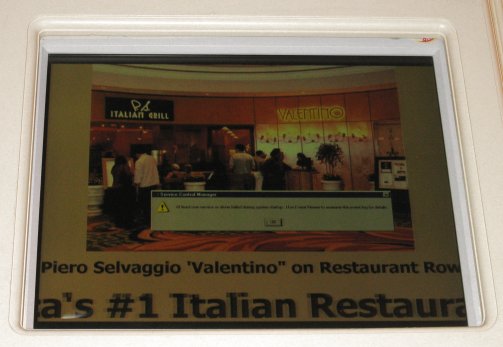
It turns out that the Venetian Hotel and Casino, where Mix takes place, is a Microsoft customer. How do I know? Well, many of the rooms sport screens over the door advertising various hotel attractions, and I spotted one that has a distinctive Microsoft flavour.

Which goes to show that wherever you are in the world, you are never more than 12 screens from a Windows error message.

If you’re at Mix and would like to chat, by all means get in touch.