This is both an easy and a hard book for me to review, because it echoes some (not all) of my own journey of running; I am not sure how the book will come across for non-runners.
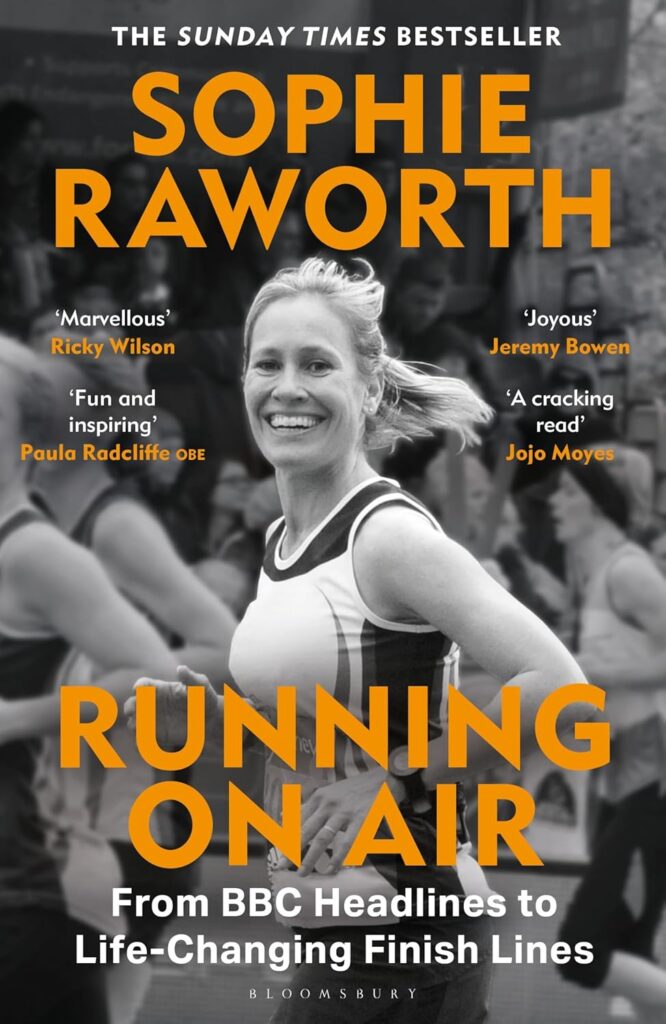
Sophie Raworth is a BBC broadcaster and something of a celebrity; I tend to be impatient with books by celebrities but I make an exception for this one because it is almost entirely a book about running rather than a book about being a well-known TV presenter. There are a few pages about questioning former UK prime minister Boris Johnson in February 2022 about “partygate,” a political scandal relating to government parties during COVID lockdown, but Raworth argues that marathon training and running was what prepared her for such high-stress tasks – though she got no answers.
Raworth began with running in 2006, aged 38, when she was invited to be a celebrity runnier in the Great North Run, a popular half marathon. She ran in 2 hours and 5 minutes, felt “utterly elated” to have finished the race, then stopped running until 2010, when she was inspired by an acquaintance of her own age to sign up for the London Marathon. “The training takes over my life,” she writes. Her BBC colleagues tease her about always talking about running; if she mentions it more than once a day, she has to buy all the tea.
In 2011 Raworth ran London, and this is how the book opens, with a collapse on the London Embankment at around mile 25, caused by heatstroke. It is related to inexperience but not to undertraining; she had a coach and trained hard. Rather than giving up on running, she doubles down, completing all six of the Abbott World Marathon Majors by 2017.
Chapters 4 -6 describe what is perhaps the centrepiece of the book, Raworth’s adventure running the Marathon des Sables, a gruelling 6-day run across 250K of Sahara desert, including a mention of a runner chasing a scorpion out of his tent. This does not appeal to me at all, but is an example of the amazing capabilities of the body after training, even starting relatively late in life.
Raworth was in her early forties when she took up running in earnest, I was in my sixties. I have never run an ultra, but nevertheless relate to what she describes, that endurance running leads to unthought-of achievements, new friendships, almost a new identity, even for someone who never thought of themselves as an athlete at all.
Running is a great leveller. “No one asked me about my job or treated me any differently because I was on TV. I was just another runner,” Raworth writes of a running group she joined. “We didn’t discuss careers and work. It took me years to find out what some people actually did when they took their trainers off. Yet I knew everything there was to know about their fastest times, their running niggles, and their race plans and dreams for the months ahead … I found a new easy kind of camaraderie that required no front.”
This is my experience too. It also happens that our running times are similar. Raworth’s best parkrun is 20:31. Mine is 20:37. We are both good for our age, but not race winners; and it does not matter.
The book is quite short (248pp) and an easy read, though emotional in places, particularly as she describes the physical decline of her parents and the death of her father. “How will I age,” Raworth asks herself.
I enjoyed the book, it is nicely written, warm, human and honest.
I have a few quibbles. Running is not bad for your knees, Raworth argues in chapter 8, based mainly on the research of a physio called Paul Hobrough. And in chapter 12 she describes a stress fracture caused, she says, by training too much in carbon-plated shoes which “weaken your intrinsic muscles,” according to a podiatrist she saw. These are important but complex questions and I am not sure there is scientific or medical consensus on either matter; I find Raworth too confident in giving these verdicts, though it is good to see the topics covered.
That said, I liked the real-world accounts of running injuries and the emotional lows that come with them; something most runners will relate to. I loved the race reports, the self-awareness of becoming a bit obsessive, the description of the agony and elation that characterises the sport. Recommended.
Running on Air by Sophie Raworth (Bloomsbury ISBN 978-1-399-42633-6)