Microsoft has revised its document describing Five Misunderstood features in Windows Vista.
I’m not going to analyse the revisions, as others have done that, though I will mention in passing that Adobe Acrobat’s Compare Documents feature does a nice job of showing the revisions:
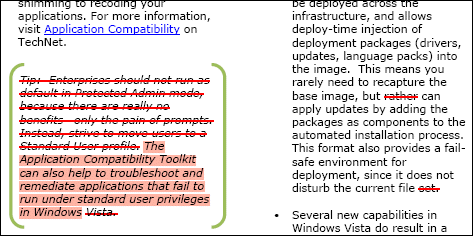
However, I would like to highlight this comment to Steven Poole’s post, from Microsoft’s Brandon Paddock:
Those changes were made because the original article was written without the involvement of the engineering teams and so it contained a great deal of inaccuracy.
Quite a confession.
The trouble is, even fixing inaccuracies doesn’t rescue the document from its faulty presumption that Vista’s poor public image is all down to misunderstandings. That ain’t straight talking. That’s spin.
The irony is that some features of Vista are misunderstood – UAC especially. Here’s some real straight talking on the subject, from Marc Russinovitch:
The bottom line is that elevations were introduced as a convenience that encourages users who want to access administrative rights to run with standard user rights by default. Users wanting the guarantees of a security boundary can trade off convenience by using a standard user account for daily tasks and Fast User Switching (FUS) to a dedicated administrator account to perform administrative operations. On the other hand, users who want to forgo security in favor of convenience can disable UAC on a system in the User Accounts dialog in the Control Panel, but should be aware that this also disables Protected Mode for Internet Explorer.
Perfect.