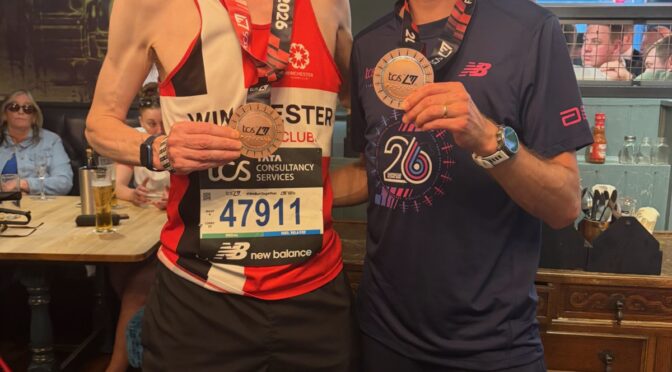
On April 26th 2026 I ran the London Marathon. The following is my race report; if you are not interested in the injury story skip to Race Day!
The day before
Tomorrow I run the London Marathon. To be one of what is said to be 59,000 runners may not seem remarkable, but this has been my running dream since Autumn 2023, after I ran the Winchester half marathon and asked myself, what next? It felt like I had two choices, one being to settle for half marathon as my maximum distance, and the other to go for a marathon; there was no real choice, I had to try. And of all marathons, London, the most prestigious marathon in my home country, was the one I wanted to run.
After studying the entry options for London it seemed to me that securing a “good for age” place was my best chance. These places are easier to get as you age, and when I booked my first marathon (Abingdon in October 2024) I set this as my target. An October 2024 time is a qualifier for London 2026. When I uploaded the result to Strava I put simply, “got my goal time.”
So here I am, in a hotel room near Waterloo, reflecting on a training block that has not gone well. Most marathon training plans are between 18 and 12 weeks long. In early January, 16 weeks before London, I ran a cross-country 10K in spiked shoes, my first run in spikes, and I think that is what triggered an injury. It seemed minor at first. I could run, but with a bit of pain in my right foot, in my arch and heel pad. Oddly, it was worse after running. It didn’t seem too bad, but equally was not getting better. The day after running it seemed fine, but next time I ran, it returned.
In mid-January I decided to take two weeks off running, to fix what still seemed somewhere between a niggle and an injury. My idea was to get it sorted, then resume with a 12-week plan for London in place of the 18 weeks originally intended. End of January I ran 14 miles at an easy pace; but the foot issue was just the same.
I figured that if not running did not cure it, I might as well resume. I also decided to book a visit to a physio and was given an NHS appointment at my doctor’s surgery for Feb 26th. In the meantime I continued training but with increasing pain, though I did not want to admit it.
The physio diagnosed plantar fasciitis. I asked her if she was sure, as I have had this before (in the left foot) and it did not seem the same. I was not experiencing the early morning heel pain typical of plantar fasciitis, and the pain was in a different place. She said she was sure, and reassured me that it was not what I had dreaded, a stress fracture that would stop me from running completely. However, just when we were finishing, she asked if I would like to be referred to the physio team at the local hospital. Yes please, I said. That was arranged for March 10th.
My running nadir was a race called the Solent Half Marathon in early March. I ran it in 1:48, not a terrible time for my age category, but 10 minutes slower than in October 2024, when I was running it somewhat gently two weeks ahead of Abingdon. This time, I wasn’t sure if I could run all 13.1 miles. I told myself, the more miles I run, the less walking I will have to do. I finished.
After the Solent Half I could barely walk. I shuffled my way back to the car park, unfortunately about a mile away. Other runners passed me, some expressing sympathy or concern.
Two days later I went to the hospital. Normally I would walk but walking was still difficult enough that I hobbled to the bus stop instead. The physio examined my walking gait and my feet, comparing left with right. “I think it is the flexor hallucis longus tendon,” she said. She gave me some simple exercises, which take no more than 10 minutes to do. I am so grateful to that physio and for the correct diagnosis, which has made so much difference.
I did the exercises three times a day. Four days later I ran a parkrun 5K and the foot seemed improved. The following week I resumed training and on 21st March ran 20 miles; I had some discomfort afterwards but felt I was on the mend and that I would be able to run London, though not in the time I had originally hoped. London was just 5 weeks away, three of which were meant to be taper.
It was then a matter of how much training I could get in. My weekly mileage increased to 35 miles, then 50, then 61. It went fine and I was beginning to forget about the injury, but had lost crucial weeks of training. I hoped I had some residual fitness from November, when I ran New York. But when an email from the London marathon organizers asked us to review our projected times, I increased mine by 10 minutes, about 20 seconds per mile. I would aim for around 8:12 pace (5:06 km), though even that felt optimistic. I set myself a second target of finishing in 3:45, 20 minutes slower than my best time but still, I felt, respectable.
The day before the race I did Winchester parkrun at roughly marathon pace – well, slightly faster (8:00) because I lack discipline. Generous pasta lunch, plenty to drink including fruit smoothie, lightish supper with veggie pizza and alcohol-free lager. Garmin was annoying because it considered the day to be too energetic and that I was not recovering well. But what does Garmin know?
When I took up running in summer 2022 it was easy. Nobody expected anything of me, and I got steadily faster. Now though, I feel the pressure of expectation, that I will get a great time for my age, because I did in my previous 4 marathons. I explain that I am under-trained and uncertain how it will go, but runners are always full of excuses and then often out-perform. I hope to be under four hours. I hope to be under 3:45. But … I have no idea, I know only that I will do my best and also try to enjoy running the race I have planned for so long.
Race day
Light supper, early night, and I slept reasonably until about 5:30am. Went out to get coffee to bring back to the hotel (kettle in room but I am fussy!), then a couple of morning rolls laden with blackcurrant jam. I follow a very careful diet on race morning, the idea is to get through the race without interruption or discomfort!
Left the hotel around 7:15 for the railway station, Waterloo East to Blackheath. Travel all free for marathon runners, a nice touch. Train full of runners and the atmosphere was building. Journey seemed long and I was thinking, if it takes this long on a train how will we ever run back?
I was in Blue Wave on Blackheath, start area was not too crowded though it got busier as my start time (10:00am) approached. Suncream, Vaseline, dropped my bag. I carried nothing other than gels though I am thinking about adding a hand-held bottle in future, not sure.
I found the 3:35 pacer and had a chat, he said he would run even splits. I made sure to start behind him so that if I crossed the line ahead, I would be within the time. And off we go.
Congestion
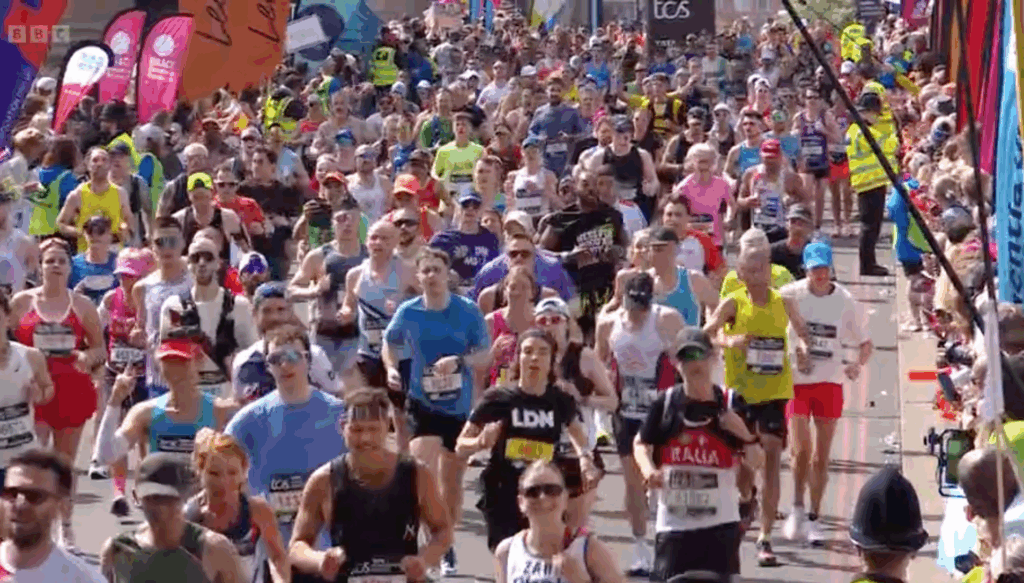
The congestion was unrelenting. This was the worst thing about the race. It would not have been so bad if we had been running at a similar pace, but this was not the case. I was honest about my predicted time and in a wave with the matching pacer, yet I seemed to be constantly overtaking people, who were either starting off particularly slowly, or had no chance of coming close to that time. Maybe the wave had a wide range of predicted times, I am not sure.
The course varies in width and there are bottlenecks. From time to time there would be a wheelchair which needed that bit of extra space.
From my point of view, it made it difficult to keep with the pacer, though there didn’t seem to be a big group around him. It was just that the congestion forced me to slow down, then I would make an effort with a bit of weaving to catch up, then it would happen again.
I did manage to run alongside the pacer about 12 miles in and asked if the congestion was like this all the way. He said that it does improve after half way as there are fewer people of the same pace who started ahead of you. It was true; by about 18 miles there was a bit less congestion though by then there was weaving around those suffering fatigue or injury issues and walking, so it never fully let up.
Crowd support
The crowd support was amazing. I do not know how the spectators do it, the cheers seems loud and continuous all the way round. In one of the tunnels it was almost deafening. I did not have my name on my bib but heard shouts for “Winchester” which was on my vest. If any spectators read this – thank you!
Three great moments in the London Marathon
There are three great moments in this race, I reckon. The first is when you round a corner and see the beautiful and dramatic Cutty Sark, which appropriately was among the fastest tea clippers of its time (1870s). The ship looks magnificent and lifts your spirits, though it is only about 10K in so you should be feeling fresh (I was).
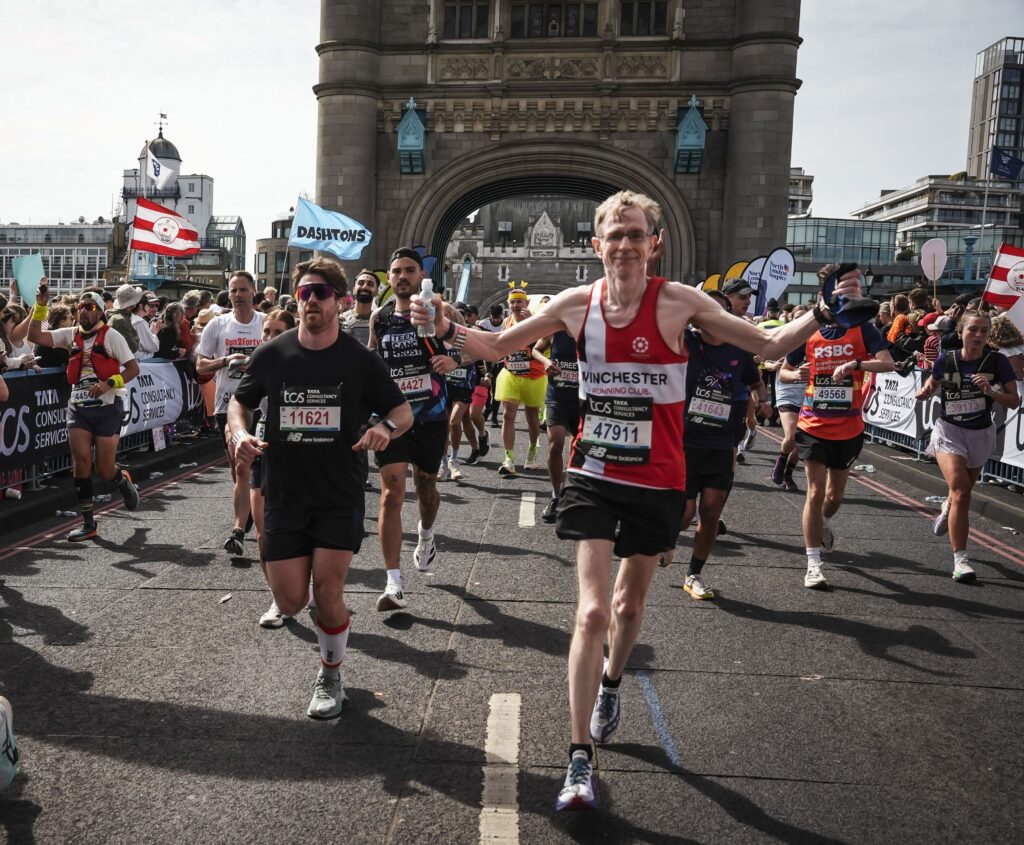
The second is Tower Bridge, about half way in. The bridge is lovely, half way is a big moment, and you are crossing to the north side of the Thames. I felt good here, though of course after crossing the bridge you turn right, away from the finish, heading towards the Isle of Dogs.
The third is from Big Ben to the finish on the Mall. More later.
Losing pace
My marathon was a classic case of everything being fine until about 15 miles, then fatigue began to slow me down. Mile 16 was 8:14, slightly below target pace, and it got worse. My slowest mile was mile 25 in 9:02. I was not really surprised, considering all those critical weeks of training I had missed. I did sums in my head. Even if my pace slipped to 10 minutes per mile (an easy calculation! ) I could still beat 3:45. I tried not to get depressed at the 3:35 pacer drifted into the distance.
I was dutifully taking gels but not enjoying them, though did not suffer from the nausea I experienced in New York. At about mile 18 I consumed most of a SIS beta gel and decided, no more, though I carried on drinking water.
The last 6 miles
I told myself I would speed up for the last 10K but my legs would not do it. Still, I kept my pace under 9 minutes per mile and do not consider that I “hit the wall” though people use this term in different ways. This is where you pass people walking, and I also observed people slipping on discarded bottles. The crowding, insufficient bins, and thoughtlessness of runners, all contributed. I believe London may go cup-only and I understand the reasons though I much prefer bottles as you can sip from them and run a distance holding them. This is why I will consider a hand-held bottle in future. As it turned out, I ran a lot of the race holding a bottle, and even finished with one; I did not spot any bin at all past mile 25.
The finish
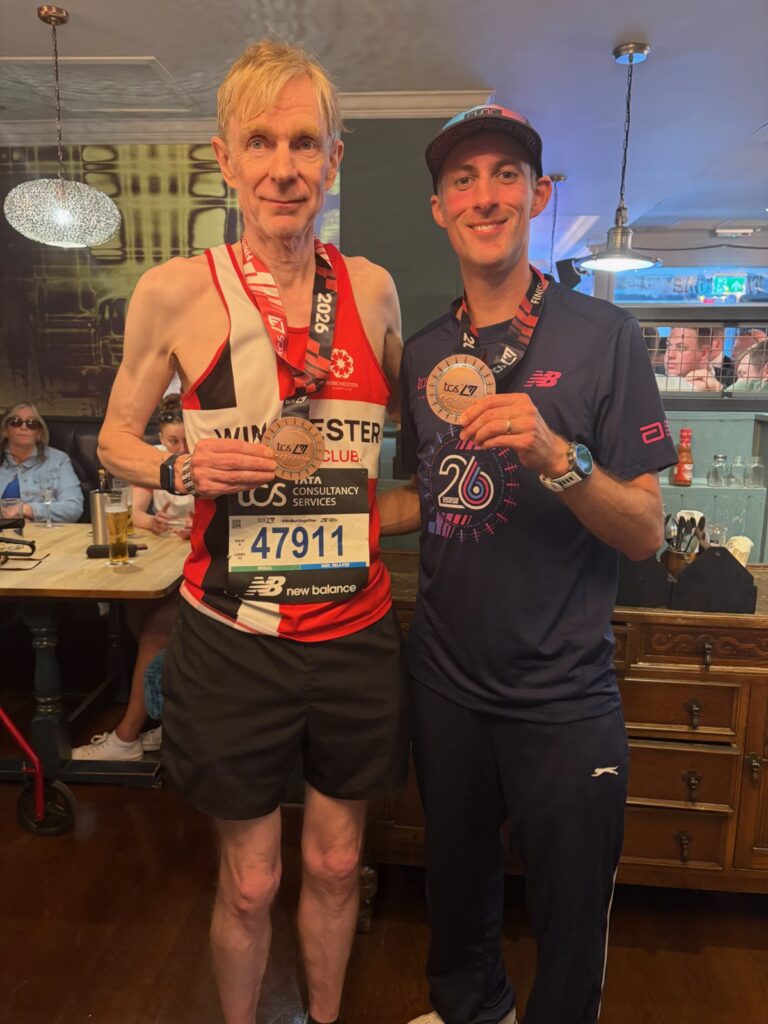
The finish is amazing, beginning really where you turn right from the Victoria Embankment. I know London quite well, having lived and worked there in the past, and it is emotional simply seeing famous streets dedicated to runners, just for one day. Past Big Ben, along Birdcage Walk, then a big sign, “only 385 yards to go.” Round a corner and there is the finish. I ran across the line grateful to have made it and without anything hurting other than sore feet and extreme fatigue. Got my medal, took a Go Pro strawberry yoghurt drink which went down well, retrieved bag, and wandered around a bit figuring out how to cross the run route to get to Victoria Street and the pub we had arranged.
It’s a very well organized race though I feel the congestion is too much; there were record numbers this year. The organizers are trying to put on a two-day event next year and one understands the reasons; I have mixed feelings as it seems to me that one of the days (probably the Saturday) which feel a bit like second-best, though opening it up to more runners is a good thing.
How much training did I lose?
Slowing down in the second half is not unusual, but I managed to keep pace pretty well in my first three marathons (of five). I tend to blame the training but of course cannot be sure. Weekly mileage is apparently the best predictor of marathon performance so here is what mine was in the 12 weeks before the race:
| Weeks to go | Mileage | ||
| 12 | 31.87 | ||
| 11 | 27.14 | ||
| 10 | 41.4 | ||
| 9 | 51.46 | ||
| 8 | 25.74 | ||
| 7 | 17.5 | ||
| 6 | 35.51 | ||
| 5 | 50.32 | ||
| 4 | 61.1 | ||
| 3 | 44.21 | Taper begins | |
| 2 | 44.27 | ||
| 1 | 25.37 | Excluding marathon | |
The figures do not tell the whole story. Some of these miles were run in pain which I feel does impact the training though I’m not sure how. During the lean weeks I did do other cardio exercise including indoor bike and elliptical, which likely helped, and continued with strength training generally.
Mile splits
Note: the following sums to about 3:40:00 but my time was 3:40:41, the reason for the difference is that I knocked into someone (or they knocked into me) which inadvertently paused my Garmin, I noticed and resumed after less than a minute. I don’t think this impacts the paces, just a little distance was lost.
| 1 | 08:01 |
| 2 | 08:09 |
| 3 | 08:10 |
| 4 | 08:04 |
| 5 | 08:19 |
| 6 | 08:08 |
| 7 | 07:59 |
| 8 | 08:00 |
| 9 | 08:02 |
| 10 | 08:04 |
| 11 | 08:03 |
| 12 | 08:05 |
| 13 | 08:01 |
| 14 | 08:00 |
| 15 | 08:10 |
| 16 | 08:14 |
| 17 | 08:17 |
| 18 | 08:20 |
| 19 | 08:41 |
| 20 | 08:25 |
| 21 | 08:41 |
| 22 | 08:42 |
| 23 | 08:45 |
| 24 | 08:35 |
| 25 | 09:02 |
| 26 | 08:55 |
| 27 | 09:02 |