Developer Stavros Kasidis has released a new cross-platform IDE for .NET applications, called Codalus and open source on GitHub under the MIT license.
I installed it in a VM on both Windows and macOS for a quick look. My immediate reaction was that it is impressive but not ready for production use, despite hitting version 1.0 two days ago. The IDE is built with the Avalonia cross-platform framework and runs on .NET 11, performance is snappy and the initial experience is polished, complete with an option to select what kind of AI to use, or none.
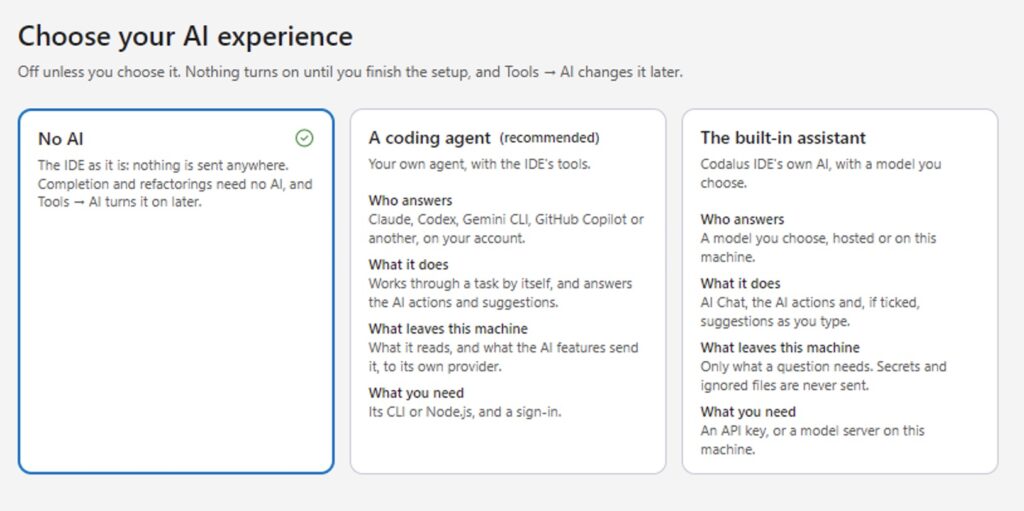
I chose to work without AI, and created a desktop application for Mac using an Avalonia template. The editor has some smart features, including hints when one hovers the mouse pointer over an element and suggestions when typing, but I also saw some odd behaviour such as text getting deleted as if some kind of overwrite mode were on. I was able though to write a little bit of code, and debug the application with a breakpoint, including local variables and call stack.
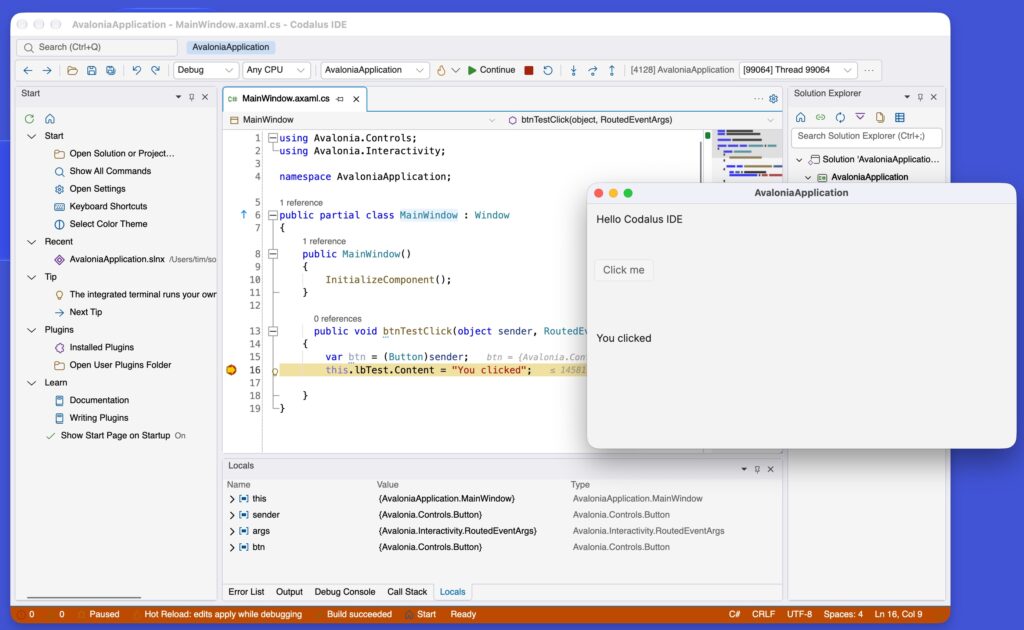
That said, the first time I tried this I got a crash, a factor in my feeling that this is not yet ready for serious use.
Creating a full-featured IDE is a huge undertaking and some defects are to be expected. The Changelog describes a few limitations but also a rich range of features including hot reload while debugging; C#, F# and Visual Basic support; remote development using SSH, WSL (Windows subsystem for Linux) or containers; integration with GitHub, GitLab and Azure DevOps; and support for project types including .NET Framework, ASP.NET Core, Blazor, .NET MAUI, Windows Forms, WinUI 3, WPF (Windows Presentation Framework), WinUI 3, Avalonia and Aspire.
Potential users will want to know what sort of future is likely for Codalus and what is the business model behind it. According to Kasidis there is “no business model in the sense of monetising it. Free for everyone.” His target, he told me in an email, is people who like Visual Studio but want to work on their Mac or Linux desktop. Visual Studio Code (VS Code) is not good enough, he said, while JetBrains Rider is a commercial product that is very different from Visual Studio.
He has been working on the project for just 2 months and it would not have been feasible without AI, he said. GitHub shows three contributors: himself, github-actions, and Anthropic Claude.
Although Kasidis promises to continue with the project, it would be healthy to have more contributors and this may well come if it gains momentum.
One attraction of a project like Codalus is that (unlike Visual Studio or VS Code) it is dedicated solely to .NET development. Further, it has no legacy baggage to carry.
Microsoft disappointed many developers when it discontinued Visual Studio for the Mac, particularly as this began as an open source project but had somehow become proprietary. The whole .NET ecosystem suffers from a certain bias towards Windows, despite its cross-platform capabilities. Codalus could be a welcome move towards wider take-up by those on other platforms.
The cost so far of Codalus in terms of Claude credits is unknown, but may be substantial. Even so, the project is another demonstration of how far AI coding has come, that a complex application can be conjured out of nothing by one person in a few months. Other examples of AI-driven rapid development include the Artcraft range, which offers applications inspired by Microsoft Office, Adobe Photoshop and others; and Cloudflare’s Next.js rebuild Vinext and WordPress-inspired CMS EmDash.
Although AI is involved, all the above examples (including Codalus) have worked in part because of the involvement of skilled software engineers. It is not so much that AI replaces software development skills, but rather than those with the skills can in the right circumstances work at a remarkably accelerated pace.
It is early days for AI coding. It is not clear how this will play out, but it is obvious that the ability to build custom applications in double-quick time with AI will have a big influence on the future IT landscape.