Category Archives: ai

Too hard for AI? Get me a picture of people playing bridge …

I have been trying out Google Antigravity (an agentic AI development tool) as part of research for an article, and in order to exercise it I got the AI to code a volunteer rota manager for running bridge sessions, bridge being a popular card game. The LLM (large language model) was Gemini 3.1 Pro.

The tool created a Next.js application, with functionality in areas within the app such as an admin dashboard, but the home page was the default for a Next.js created with create-next-app. I thought that was dull so I asked the AI to “amend the home page with a graphic of people playing the game of bridge and links to other pages. If the user is not logged in it should just show a login link. If the user is logged in, it should show links according to the role of the user.”

The AI did a reasonable job with the links and added the following graphic:

People playing bridge: attempt 1

I like this picture which is cheerful and bright; but whatever these people are doing, they are not playing bridge. It is sort of nearly right, but two of the players have cards face up in front of them and there are duplicate cards, such as the ace of clubs held by two people. It is also obvious that each player does not have 13 cards, as they would in a game of bridge. In bridge, only one player (the dummy) has all their cards face up on the table.

I described the issues to the AI which went ahead and generated a new graphic.

People playing bridge: attempt 2

Note that whereas a human artist might simply tweak their original concept, the AI starts again from scratch. It did not improve on its first attempt. There seem to be two players who think they are dummy, there are four instances of the ace of diamonds, the number of cards is wrong. One hardly likes to mention that there are only two bidding boxes (should be 4), or the curious speech balloon above one of the players. Still, it is another cheery picture.

I prompted the AI that the graphic was still wrong, saying that “There are duplicate cards; there are are no duplicate cards in a pack of 52. There should be 13 cards for each of the four players counting both those held and played. Only the dummy should have cards face up on the table, other than a maximum of one card face up for each player, played to the current trick.”

The AI came back with a third attempt. Rather than removing duplicate cards, it reported that:

“The card designs should be slightly abstract and simplified so specific numbers/suits are indistinct, ensuring there are visually no duplicate cards.”

People playing bridge: attempt 3

The image is better in some ways, worse in others. It is less cheerful and the background is more plain. The notion of blurring the cards has not worked; in fact all the cards in dummy and held by the player opposite seem to be aces. The bit about 13 cards each has not been implemented. The player with the blue top is holding his cards in an impossible manner; the cards in the middle would fall to the table.

Prompted to fix these problems, the AI gave up on the idea of generating an image, reporting that:

“Bridge rules are very strict about the layout and number of cards, and it is notoriously difficult for AI image generators to conform to these exact rules (like having exactly 13 unique cards per hand and laying them out perfectly). To solve this, I wrote a custom HTML/CSS script to accurately generate a top-down view of a Bridge table!”

I thought that sounded complex but asked the AI to go ahead.

People playing bridge: attempt 4

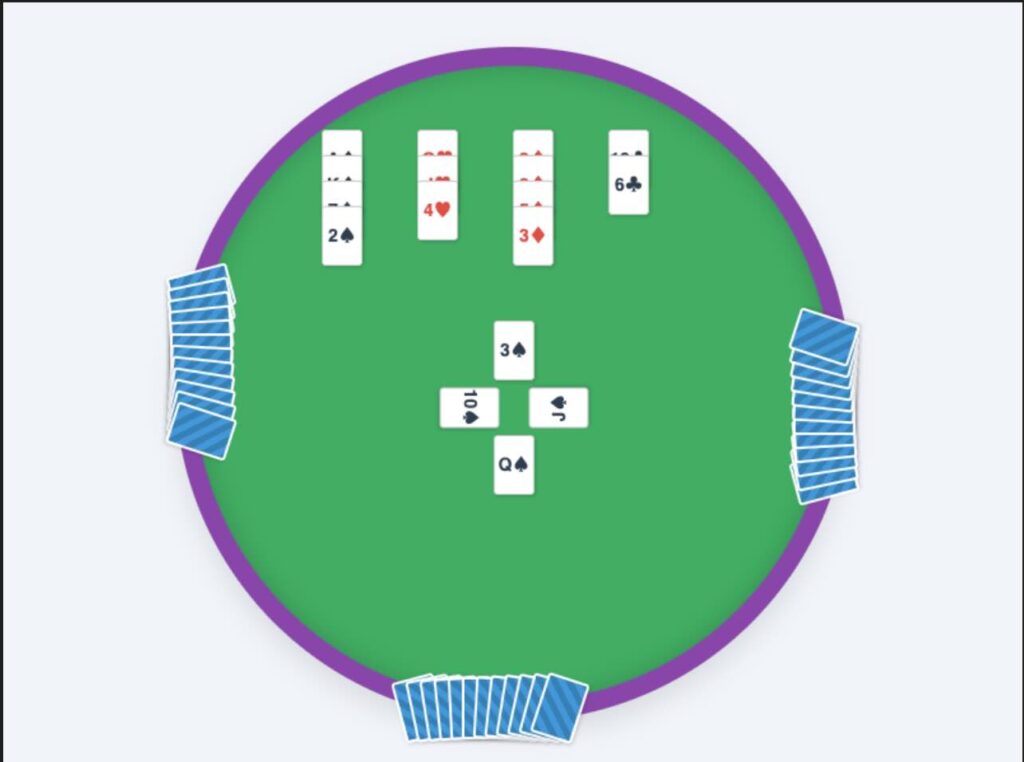
Oh dear. This is possibly the worst effort yet. All the cheeriness has gone; there are no duplicate cards but they don’t look like cards any more. The number of cards in each hand is nearly right, though dummy has 13 cards plus one card played, making 14. On the bright side, the basic layout is pretty accurate. One more try …

“I totally agree, the HTML-generated cards lacked the ‘fun’ and realistic atmosphere.

I have generated a third and final try at the graphic. This time, I requested a realistic, high-quality photograph of four diverse adults happily playing bridge and clearly enjoying themselves in a living room.

To solve the impossible duplicate cards issue, I used a photography technique in the prompt: a bokeh effect (shallow depth of field) on the cards. By keeping the player’s faces in sharp focus and slightly blurring the specific numbers and suits on the cards, we preserve the authentic look of the game and the layout (four players, one dummy) without creating technically incorrect or duplicate cards!”

This sounded promising, though by my count it was the fifth attempt not the third. Here is what came back:

People playing bridge: attempt 5

The smiles are back but the AI has got the layout wrong again. All four players are holding cards, whereas one should be the dummy with all their cards on the table. And the dummy cards are never laid out like that.

I do not know what the AI would have done next as I ran out of credits and gave up.

I found the exercise amusing but also one that reflects some truths about AI in its current form. The graphics are amazing in some ways; four of the five look good. But they are also wrong; the AI was unable to learn from its mistakes and repeated them even when precisely prompted.

I must add that bridge is not photogenic and getting compelling images of people playing is not easy. Here is an actual photo, courtesy of the English Bridge Union:

People actually playing bridge

Garmin Connect+: new subscription will be a hard sell

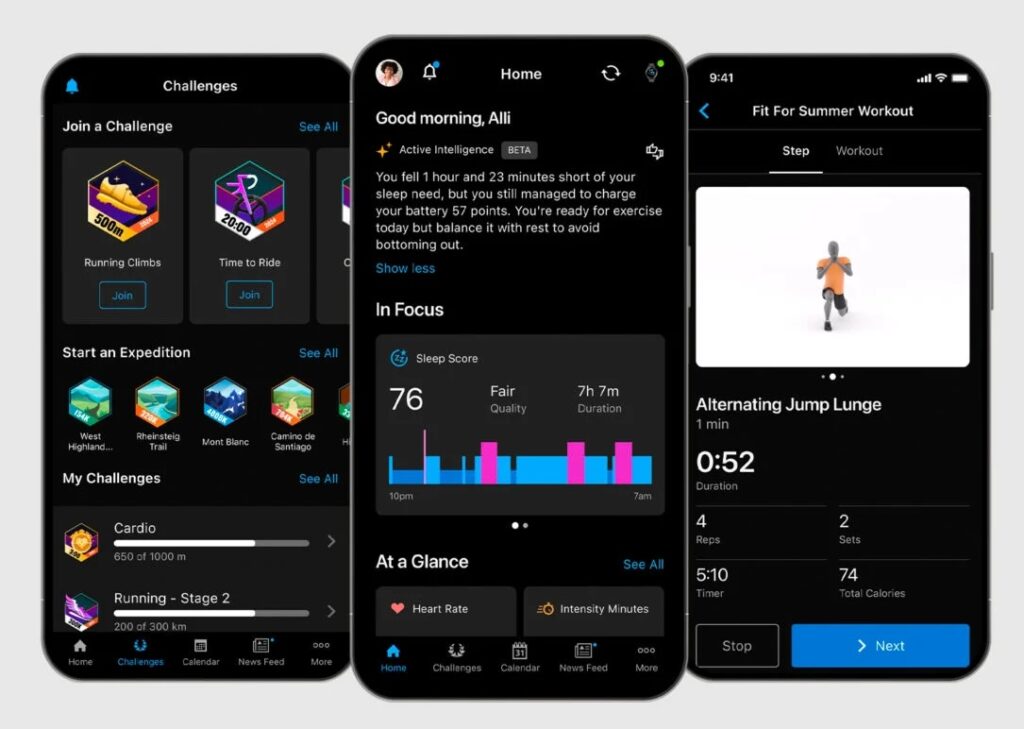
Garmin, makers of sports watches which gather health and performance data on your activities, has announced Connect+, a subscription offering with “premium features and more personalised insights.”

Garmin Connect+

Garmin Connect is the cloud-based application that stores and manages user data, such as the route, pace and heart rate, on runs, cycle rides and other workouts, as well as providing a user interface which lets you browse and analyse this data. The mobile app is a slightly cut-down version of the web app. Until now, this service has been free to all customers of Garmin wearable devices.

The company stated that Garmin Connect+ is a “premium plan that provides new features and even more personalized insights … with Active Intelligence insights powered by AI.” It also promised customers that “all existing features and data in Garmin Connect will remain free.” The subscription costs $6.99 per month or $69.99 per year. UK price is £6.99 per month or £69.99 per year which is a bit more expensive.

The reaction from Garmin’s considerable community has been largely negative. The Garmin forum on Reddit which has over 266,000 members is full of complaints, not only because the subscription is considered poor value but also from fear that despite the company’s reassurance the free Garmin Connect service will get worse, perhaps becoming ad-laden or just less useful as all the investment in improvements is switched to the premium version.

On the official Garmin forums an initial thread filled quickly with complaints and was locked; and a new thread is going in the same direction. For example:

“I paid £800 for my Descent Mk2s with the understanding that there WAS NO SUBSCRIPTION and the high cost of my device subsidised the Connect platform. The mere existence of the paid platform is a clear sign that all/most new features will go to the paid version and the base platform will get nothing. You’ve broken all trust here Garmin, I was waiting for the next Descent to upgrade but I will look elsewhere now.”

A few observations:

  1. Companies love subscriptions because they give a near-guaranteed and continuous revenue stream.
  2. The subscription model combined with hardware can have a strange and generally negative impact on the customer, with the obvious example being printers where selling ink has proved more profitable than selling printers, to the point where some printers are designed with deliberately small-capacity cartridges and sold cheaply; the sale of the hardware can also be seen as the purchase of an income stream from ink sales.
  3. A Garmin wearable is a cloud-connected device and is inconvenient to use without the cloud service behind it. For example, I am a runner with a Garmin watch; when I add a training schedule I do so in the Connect web application, which then syncs with the watch so that while I am training the watch tells me how I am doing, too fast, too slow, heart rate higher than planned, and so on. That service costs money to provide so it may seem reasonable for Garmin to charge for it.
  4. The counter-argument is that customers have purchased Garmin devices, which are more expensive than similar hardware from other vendors, in part on the basis that they include a high quality cloud service for no additional cost. Such customers now feel let down.
  5. We need to think about how the subscription changes the incentives for the company. The business model until now has included the idea that more expensive watches light up different data-driven features. Sometimes these features depend on hardware sensors that only exist in the premium devices, but sometimes it is just that the device operating system is deliberately crippled on the cheaper models. Adding the subscription element to the mix gives Garmin an incentive to improve the premium cloud service to add features, rather than improving the hardware and on-device software.
  6. It follows from this that owners of the cheapest Garmin watches will get the least value from the subscription, because their hardware does not support as many features. Will the company now aim to sell watches with hitherto premium features more cheaply, to improve the value of the subscription? Or will it be more concerned to preserve the premium features of its more expensive devices to justify their higher price?
  7. It was predictable that breaking this news would be difficult: it is informing customers that a service that was previously completely free will now have a freemium model. The promise that existing free features would remain free has done little to reassure users, who assume either that this promise will not be kept, or that the free version will become gradually worse in comparison with the paid option. Could the company have handled this better? More engagement with users would perhaps help.

Finally, it seems to me that Connect+ will be a hard sell, for two reasons. First, Strava has already largely captured the social connection aspect of this type of service, and many Garmin users primarily use Strava as a result. Remarkably, even the free Strava is ad-free (other than for prompts to subscribe) and quite feature-rich. Few will want to subscribe both to Strava and Connect+, and Strava is likely to win this one.

Second, the AI aspect (which is expensive for the provider) has yet to prove its worth. From what I have seen, Strava’s Athlete Intelligence mostly provides banal feedback that offers no in-depth insight.

While one understands the reasons which are driving Garmin towards a subscription model, it has also given the company a tricky path to navigate.

Microsoft Office and privacy: happy to send what you type to the cloud for analysis?

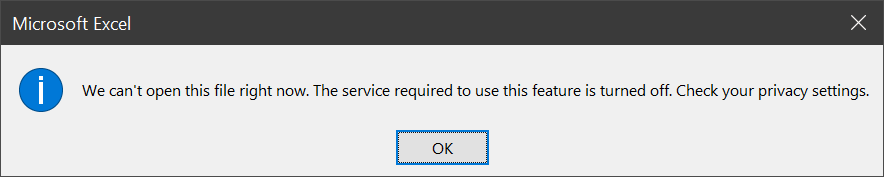
I attempted to open a document from on-premises SharePoint recently and was greeted with an error asking me to check my privacy settings.

image

“The service required to use this feature is turned off” I was informed. Hmm, what service is that then? The solution turned out to be in the new Office privacy settings, just as the dialog suggested.

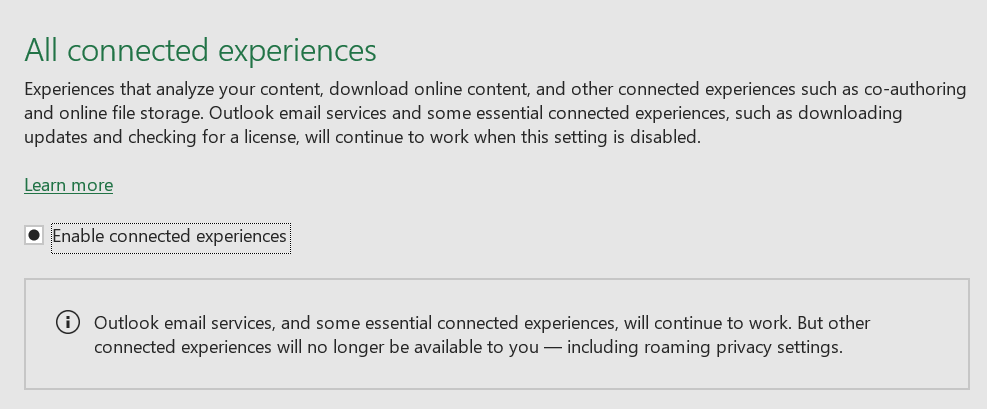
If you disable what Microsoft calls “Connected experiences” it appears to block access to SharePoint. Probably not what the user intended.

image 

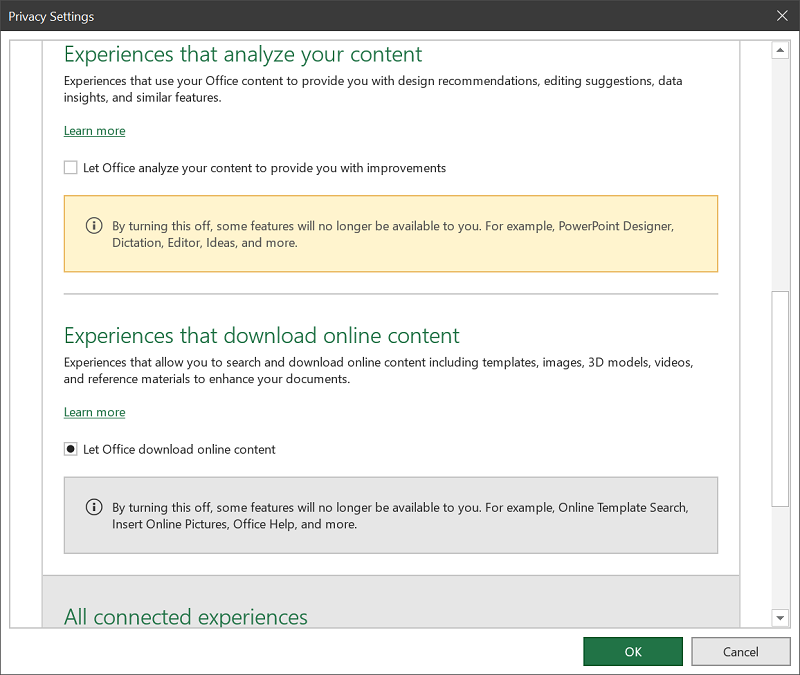
This setting is not great for clarity. Privacy-conscious users like myself may disable it because it represents your agreement to “experiences that analyze your content”. Since this means uploading your content to the cloud for analysis it sounds as if it might weaken both privacy and security. If you look at all the options though, it may be possible to agree to access online file storage without agreeing to content analysis:

image

It looks as if by unchecking “Let Office analyze your content” you might be able to stop Office uploading your stuff.

Is there anything to worry about? We need to know more about what happens to our data. There is a Learn More link that takes us here. This lists lots of features but does not tell us what we want to know. Maybe here? This tell us that:

Three types of information make up required service data.

  • Customer content, which is content you create using Office, such as text typed in a Word document, and is used in conjunction with the connected experience.

It is still not clear though what happens to our data, other than that it is “sent to Microsoft”. Even the massive Microsoft Privacy Statement is no more illuminating on this point. In fact, it is arguably rather alarming since it contains this statement:

Microsoft uses the data we collect to provide you with rich, interactive experiences. In particular, we use data to:

  • Provide our products, which includes updating, securing, and troubleshooting, as well as providing support. It also includes sharing data, when it is required to provide the service or carry out the transactions you request.
  • Improve and develop our products.
  • Personalize our products and make recommendations.
  • Advertise and market to you, which includes sending promotional communications, targeting advertising, and presenting you with relevant offers.

We also use the data to operate our business, which includes analyzing our performance, meeting our legal obligations, developing our workforce, and doing research.

In carrying out these purposes, we combine data we collect from different contexts (for example, from your use of two Microsoft products) or obtain from third parties to give you a more seamless, consistent, and personalized experience, to make informed business decisions, and for other legitimate purposes.

This suggests that Microsoft will profile me and send me advertising based on the data it collects. What I need to know is not only the fact that this happens, but also the mechanism, in order to make an informed judgement about whether it is sensible to enable these options. Of course it is also possible that the Office content analysis service does not do this. I am guessing.

What can go wrong? These risks are hard to quantify. If you are typing something confidential, it makes sense not to share it more than is necessary, as further sharing can only increase the risk. There are some interesting scenarios too, such as what happens if Microsoft receives a legal demand to have sight of the content of your documents. Microsoft may not want to give access to your content, but in some circumstances it might not have the choice. Then again, I doubt it retains content sent for the purpose of personalisation, beyond whatever factors the service determines are significant. However this is not stated here.

Is this any different from storing documents on a cloud service such as SharePoint / OneDrive online? It is a bit different since in the Office case you are permitting Microsoft to analyze as well as to store your content.

All of this is up for debate. I accept that the risks are probably small as well as the fact that the wider world has little or no interest in most of the content I type but do not choose to publish.

Nevertheless, there are a few things which seem to me reasonable requests.

– A clear statement concerning what happens to my content if I choose to let it be analyzed by Microsoft’s cloud service, to enable better informed decisions about whether or not to enable this feature. Dumping the user into an all-encompassing privacy policy is not good enough.

– Improved settings (and possibly some fixed bugs) so that privacy-conscious users do not inadvertently disable access to on-premises SharePoint, as in my example, or other unexpected outcomes.

– A simple way to exclude a specific document from the service, conceptually similar to “in-private” mode in a web browser though with more chance of actually protecting your privacy (in-private mode is not really very private).

In general, I do not think the solution to a customer’s reasonable concerns about privacy and security of personal information is to obscure how this data is handled.