Contemplating an in-place upgrade to Server 2008? Read this first

Microsoft evangelist Neil Hutson has a detailed post describing what happens when you upgrade to Windows Server 2008. As with Vista, the new upgrade procedure is actually a clean install into which your old stuff gets copied afterwards:

Instead of just installing new versions of binaries over those of an existing computer, the new operating system is installed side-by-side with the older operating system. Then the data and settings are migrated from the older version to the newer version, and then the source is deleted. While this is architecturally more correct and certainly build a clean OS install, this does cause some obvious complications that you should be aware of.  Secondly in Windows Server 2008 the upgrade process is destructive to the pre-existing operating system state.

My instant reaction: there’s enough that go wrong, that a true clean install looks a great deal more attractive.
Technorati tags: ,

Microsoft promises WPF DataGrid, big performance improvement for .NET clients

Microsoft’s Scott Guthrie posts about coming service updates to client-side .NET (Windows Forms and Windows Presentation Foundation). He says we can expect:

  • A new, quicker and more efficient setup framework
  • 25%-40% faster start-up for applications using .NET 2.0 and higher, and smaller runtime footprint
  • More hardware acceleration in WPF, plus better video performance and data-handling improvements
  • A DataGrid, Ribbon, and Calendar/DatePicker for WPF
  • Improved WPF designer for Visual Studio 2008

These address common real-world complaints. I’m sceptical; when version 1.0 of the .NET Framework came out, Microsoft said it was working to reduce the runtime memory footprint for Windows Forms applications, but it never happened. Let’s hope this time it will be different.

Mono at Mix08

Back in 2003, I blogged about how Miguel de Icaza could not get his proposed Birds of a Feather session approved at Microsoft’s Professional Developers Conference.

There’s always been ambivalence at Microsoft about Mono. Extending the value of .NET – good. Making it possible to ditch Windows – bad. Mono events at Microsoft conferences have tended to be off-site affairs in nearby hotels.

Viewing the sessions for Mix08, it’s clear that Mono has been pretty much welcomed into the fold. The catalyst for change was Moonlight, which solves a problem for Microsoft by enabling Silverlight to run on Linux. Miguel de Icaza is participating in a panel discussion on open technologies (with Andi Gutmans at Zend and Mike Schroepfer from Mozilla), and has his own session on Moonlight, subtitled “Come experience .NET on Linux”.

Don’t expect Microsoft to open source Office any time soon. That said, the company has changed significantly since 2003. Yes, it’s been forced by the market; but it’s a welcome development nonetheless.

If the Yahoo deal goes ahead, open source at Microsoft will get even more interesting.

Google the “official innovation provider” for Republican convention

Google is to be the “official innovation provider” for the Republican Convention, according to the convention’s official web site. Thanks to Valleywag for the link. “It’s another huge step in making our convention the most high-tech savvy in history”, enthuses the Convention President Maria Cino.

The convention’s official website, www.GOPConvention2008.com, will eventually feature a full-range of GoogleTM products, including Google Apps, Google MapsTM, SketchUpTM, and customized search tools, which will make navigating the site easier. The convention’s YouTube channel will enable visitors to upload, view, and share online videos. These innovative technologies will also help the GOP streamline convention organization and expand its online reach across websites, mobile devices, blogs, and email.

Looks like a Google blunder to me. The problem is not that the political convention is using Google technology; the problem is the way it is being presented, as a proud partnership. It is particularly unpleasant for a company which is supposed to offer a ruthlessly neutral search engine. Was Google expecting this, I wonder? Is it, as Valleywag suggests, “trying to beef up its GOP lobbying”?

As an aside, plastering the Google brand all over its convention web site does nothing to persuade me that the Republican party is “high-tech savvy.”

Politicising your brand is stupid. Further, Google’s California base was not a hot-bed of Republicanism last time I looked; though frankly a similar deal with the Democrats would be equally daft.

Technorati tags: ,

Writing for a global readership

Seeing the Comscore report on British media sites (which confirms the amazing reach of the BBC web site), and the amusing commentary from  Chris Matyszczyk, prompted me to check out my the stats for this site and blog, which I track occasionally through Sitemeter.

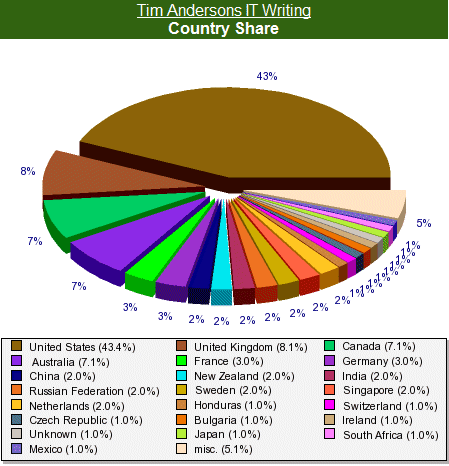
Stats: 43% US, 8.1% UK, 7% Canada, 7% Australia

I was aware of writing for a global readership, but was surprised at the extent of it: according to these figures, just 8.1% of you are from the UK. In case you can’t see the chart, it shows 43.4% US visits, followed by the UK as stated, then Australia and Canada at 7.1% each.

At Sun’s Global Media Summit recently, we were separated into regions for one of the sessions. In my feedback I said I was more interested in the global perspective; the above chart shows why.

After all, this is the Internet.

Update

Sitemeter doesn’t say exactly what period its stats cover (at least, I can’t find this). It seems to be quite short, so the stats vary considerably. The chart above understates the UK readership and therefore overstates others. I’d have to take several snapshots at different times to get a truer picture. Still interesting though.

Technorati tags: ,