Category Archives: .net

Silverlight 2.0 is released, Eclipse tools for Silverlight announced

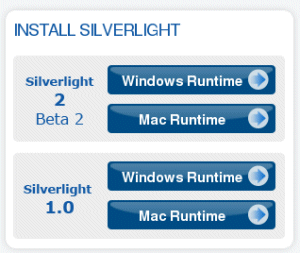
Microsoft’s Scott Guthrie has announced the final release of Silverlight 2.0, its browser plug-in which includes a cross-platform implementation of the .NET runtime as well as a multimedia rendering engine. It will be available for download tomorrow.

Not really a surprise, but nonetheless a significant moment for Microsoft. I have been watching the project closely since it was first announced at PDC 2005 as Windows Presentation Foundation Everywhere. I am particularly interested in the cross-platform aspect. When .NET was first released in 2001, as Microsoft’s answer to Java after falling out with Sun, it had obvious cross-platform potential, yet the company held back form any commercial implementation outside Windows. Miguel de Icaza took independent action to create an unofficial open source Linux implementation, that also runs on Mac and Windows, called Mono. Microsoft was initially wary of Mono, but in my view the company had more to gain than to lose by supporting it. That now appears to be recognized, with Microsoft working formally with Mono to support Moonlight, Silverlight on Linux, and to provide it with multimedia codecs.

Microsoft has also announced Eclipse tools for Silverlight, in partnership with Soyatec, the idea being to enable Java developers to develop for the Silverlight client within Eclipse.

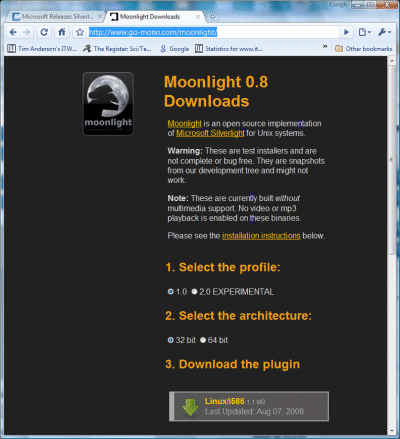
One clarification: although the press release says “This includes support for Mac, Windows and Linux”, the Mac support for Silverlight 2.0 is Intel Mac only, and the Linux version lacks multimedia support and the 2.0 version is described as “Experimental”; it is a long way from full release. Although Microsoft is now working with Mono, cross-platform currently means Windows and Intel Mac, though this does account for a large proportion of active Web users.

Press release is here.

Technorati tags: , ,

What’s new in .NET Framework 4.0?

Good question. There are a few things we know about Microsoft’s managed application runtime and class library:

There will be major updates to the Windows Communication Foundation (WCF) and Workflow Foundation (WF). According to this announcement along with this post by Steven Martin we are going to see “better support for Web 2.0 technologies like REST, POX and ATOM” and a 10x performance increase in WF.

The table shown here also mentions a bigger role for XAML:

Seamless integration between WF and WCF and unified XAML model. Build entire application in XAML from presentation to data to services to workflow.

There will be a new application server codenamed Dublin, which hosts WF/WCF applications and manages messages, long-running transactions, state management. Dublin extends Internet Information Services (IIS) and will run on Windows Server – probably Server 2008 only.*

Dublin supports Oslo, which is Microsoft’s latest attempt at model-driven development. I guess Dublin is the host for Oslo applications, as this post implies. XAML is a good fit with modelling, because it is both declarative and well-suited for visual representation. Models do not have to be visual, and Oslo includes a new textual language which could also be based on XAML (?), but nevertheless there is synergy between modelling and visual designers.

Putting this together, we have a new take on Microsoft’s end-to-end stack, developed in Visual Studio with XAML supplemented by procedural code where needed, hosted on Dublin, and using WPF or perhaps Silverlight(?) for the presentation layer. Thanks to the new REST support, or the old SOAP support, you could also use other clients including JavaScript or Java.

It is all a bit perplexing if you currently think of the .NET Framework as the runtime engine and class library for C# and Visual Basic. It sounds as if .NET Framework 4.0 is enterprisey, more JEE than Java. We are seeing increasing fragmentation or more positively, diversification, in Microsoft’s .NET story. There are micro versions, cross-platform versions (Silverlight), desktop versions (client profile), and more and more pieces that only belong on servers.

How much of Oslo and the Dublin application server is likely to be implemented in Mono, I wonder? I suspect not that much, since Mono has focused in the past on the common language runtime and ASP.NET. There was no WPF support in Mono until Moonlight.

All this begs the question: is .NET becoming too complex? I interviewed Scott Guthrie, Corporate VP Developer Division, at the Remix conference in Brighton last month. I asked him about Oslo, thinking that he must be closely involved in what is, according to some at Microsoft, a major step forward in application development. His reply: “That’s not my world”.

Guthrie is a simplifier. He was one of the original developers of ASP.NET, along with Mark Anders, and as I recall, when asked what modelling tool he used he replied, “a whiteboard”. I spoke to Anders about the early days of ASP.NET and he emphasized the value of simplifying what already exists; see also How ASP.NET began in Java.

Microsoft also claims that Oslo/Dublin will make complex things easier for developers, but looking at all these pieces I’m waiting to be convinced. PDC 2008 is where we will find out more.

*According to this post “Dublin” actually refers to the next version of Windows Server itself, though this announcement says “a set of enhanced Windows Server capabilities codenamed ‘Dublin’ that will offer greater scalability and easier manageability.” I guess this comes to the same thing, and that preview versions of Dublin could either be early releases of the entire OS, or preview bits that install into Server 2008.
Microsoft’s cloud platform, multi-touch Windows 7: mining the PDC schedule

I’ve been looking at the PDC Session schedule, as posted so far. Microsoft is serious about its new cloud computing platform. For a start, count the sessions.

Out of 180 posted so far, here are the subjects with 10 or more sessions:

  1. Cloud services [33]
  2. Windows 7 [22]
  3. SQL Server [16]
  4. Visual Studio [16]
  5. Silverlight [13]
  6. Live Platform [11]
  7. ASP.NET [10]
  8. Languages [10]

That’s a huge focus on the cloud. Microsoft’s problem: the company is not perceived as a leader in cloud computing. It has two distinct challenges: first, getting the technology in place, and second, winning developers to its new platform. In mitigation, it is in theory well placed to migrate users from on-premise Windows and Office to cloud equivalents.

Here’s a few snippets about Microsoft’s cloud platform:

A lap around Cloud Services: … Learn about the pillars of the platform, its service lifecycle, and see how they fit with both Microsoft and non-Microsoft technologies. Also, hear about the services roadmap over the next few years.

Cloud Computing: Economics and Service Level Agreements: … Topics include the pricing model for the cloud computing platform, how to monetize a service, and how to reduce the total cost of ownership.

Connecting Active Directory to Microsoft Cloud Services: … Manage and secure end user access to cloud services using your existing investment in Active Directory. Enable end users to access cloud services through existing Active Directory accounts, the same way they access your intranet-hosted software today. Hear how to enable existing software to use new service capabilities without re-writes, and do it all through the use of open and standard protocols.

That last item is a big deal. Managing separate user identities for local and cloud services is horrible.

What else can we glean from the PDC schedule. Here’s a few items that intrigued me:

Windows 7: Web Services in Native Code … Windows 7 introduces a new networking API with support for building SOAP based web services in native code.

Windows 7: Developing Multi-touch Applications … This session highlights the new multi-touch gesture APIs and explains how you can leverage them in your applications.

Oomph: A Microformat Toolkit … a toolkit from the MIX Online Team, that is aimed at web developers and designers to make it easier to create, consume, and style Microformats on the web. See also here.

Concurrent programming: Microsoft Visual Studio: Bringing out the Best in Multicore Systems … demonstrations of the parallel performance analysis and optimization tools in the next release of Microsoft Visual Studio. .

Oslo of course: A Lap around "Oslo" … “Oslo" is the family of new technologies that enable data-driven development and execution of services and applications. Come and learn how to capture all aspects of an application schematized in the "Oslo" repository and use "Oslo" directly to drive the execution of deployed applications.

Generics and constructors in XAML: Microsoft .NET Framework: Declarative Programming Using XAML … Learn about XAML additions like: support for generics, object references, non-default constructors, and more.

Instant cloud apps: Research: BAM, AjaxScope, and Doloto … Hear how BAM can turn a simple specification into a web-based cloud application with the click of a button. Learn how AjaxScope and Doloto automatically instrument and rewrite your web applications’ JavaScript code for end-to-end monitoring and optimization.

Office, a big feature of PDC 2005 when the ribbon was introduced, only has 3 sessions posted so far, though there may be more to come. Normally a new version of Office accompanies each new version of the Windows client.

Another question: what is in .NET Framework 4.0, to merit a full new version number? There is surprisingly little mention of it so far.

Microsoft’s open source breakthrough

Microsoft’s integration of jQuery and Visual Studio/ASP.NET is significant and I wrote about it on the ITJobBlog. I’ve included some comments from Scott Guthrie about ASP.Net AJAX vs jQuery.

Miguel de Icaza, who works on open source versions of .NET, also says it is a “first time for Microsoft”.

Rick Strahl, who is an ASP.NET MVP and writes an excellent technical blog, says in a comment to Guthrie’s original post:

To me jQuery has easily  the most game changing component in Web Development since ASP.NET originally was released.

It is a breakthrough; but note that it comes from the developer division, which is more inclined towards open source than other divisions running Windows and Office.

Microsoft’s design crisis: Interview from Remix Brighton

The Reg has posted my interview with Bill Buxton, in which he talks about the challenge of getting Microsoft to put design at the core of its products. It has a great quote where Ballmer apparently told the company conference “Change or we die”. Can Microsoft change? That’s the big question; and one commenter has already given his opinion. I have more to say on this issue; but for now do read the interview; I find it a fascinating topic.

Technorati tags: , , ,

A few notes on ASP.NET MVC

Here at Remix in Brighton Scott Guthrie is presenting on ASP.NET MVC (Model View Controller). This is an alternative to web forms, the classic ASP.NET programming model.

What is ASP.NET MVC better for? Here are the things that Guthrie highlights:

  • Clean code separation presentation/logic
  • Clean URLS, SEO and REST friendly. For example, URLS like: yoursite.com/products/beverages
  • Better for unit testing. Ability to test model, view, controller separately. Guthrie demos some tests; all the main .NET test frameworks are supported inlcuding Nunit as well as Team System.
  • Closer to the HTTP/HTML model. For example, you don’t handle a button click event on the server as web forms allow; rather, you handle a form submission.

ASP.NET Preview 5 is available now; beta soon; full release by the end of the year (That timing strikes me as tight).

I think this will prove popular among ASP.NET developers.

Silverlight: 1.5 million installations per day, says Microsoft

Scott Guthrie, Corporate VP Developer Division at Microsoft, spoke at Remix in Brighton about Silverlight deployment. He says there are around 1.5 million installations per day, and that version 1.0 will auto-update to version 2.0 when it is released, which he says is “shortly”.

Wide deployment is critical for Silverlight, though a limitation of version 2.0 (the one with the .NET runtime included) is that it does not work on PowerPC Macs.

Guthrie also mentioned Internet Explorer 8, which he says will ship “towards the end of the year”.

Microsoft Remix in the UK

I’m in sunny Brighton (honest) for Microsoft’s Remix conference, which is loosely intended as a local version of the Mix event held in Las Vegas earlier this year. A contrast after Google Developer Day earlier this week. Corporate VP Scott Guthrie, who is in charge of the .NET Developer Division, is giving the keynote along with Bill Buxton, Principal Researcher. More news as it happens. Got any questions for Scott Guthrie? If so, comment here or email and I’ll try to slip them in.

Technorati tags: , ,

Parts of EcmaScript 4 deemed unsound for the Web

This was the conclusion of an EcmaScript meeting in Oslo last month. Specifically, as Brendan Eich explains, three features – packages, namespaces and early binding – were considered too heavyweight unsuitable for a browser scripting language. Here is Eich’s “Executive summary”:

The committee has resolved in favor of these tasks and conclusions:

1. Focus work on ES3.1 with full collaboration of all parties, and target two interoperable implementations by early next year.

2. Collaborate on the next step beyond ES3.1, which will include syntactic extensions but which will be more modest than ES4 in both semantic and syntactic innovation.

3. Some ES4 proposals have been deemed unsound for the Web, and are off the table for good: packages, namespaces and early binding. This conclusion is key to Harmony.

4. Other goals and ideas from ES4 are being rephrased to keep consensus in the committee; these include a notion of classes based on existing ES3 concepts combined with proposed ES3.1 extensions.

This means that the evolution of JavaScript is now on a new path, focused for now on a more modest enhancement to the language called EcmaScript 3.1.

Given how loudly Eich protested about EcmaScript 3.1 last October, it is a surprising turn of events. Was Eich convinced by the arguments of Microsoft and Yahoo in support of a more lightweight JavaScript?

What this means is that JavaScript 2.0 won’t happen as previously envisaged. John Resig:

… you can forget a lot of what you learned about ECMAScript 4, previously. Many of the complicated concepts contained in the language have been tossed. Instead there is a considerable amount of effort going in to making sure that new features will be easily duplicable through other means.

Eich and Resig are keen to stress that JavaScript will still be a highly capable language. Still, the obvious conclusion is that this will be good for plug-ins which support more powerful languages: Adobe Flash, Microsoft Silverlight, Sun Java or Java/FX. Personally I’m disappointed.

It is also presenting Adobe with a tricky problem, as it implemented much of an earlier specification for EcmaScript 4 in ActionScript 3. Rather than being a standard language, as Adobe had planned, it looks like this will now be more of an Adobe language. I doubt this will have much practical impact on developers.

PS Brendan Eich has commented below.

What’s new in Delphi 2009

Today I viewed David Intersimone’s Live Webinar on what’s new in Delphi 2009, code-named Tiburon.

This is a Win32-only release. I think you will want it (if you use Delphi), if only for the new language-level features: generics, anonymous methods, and unicode strings. I grabbed a few screens from the presentation. Generics:

Unicode – here’s the TEncoding class:

and Unicode in action:

There are also some new components, such as a neat collapsible panel called TCategoryPanelGroup, TBalloonHints, and Office-2007 style ribbon controls.

The ribbon controls interested me because I am wary of Microsoft’s Office ribbon patent. CodeGear/Embarcadero seems to be wrapping Microsoft’s controls*, as used by the CMFCRibbon* classes, which as I understand it are not the actual controls used in Office 2007 but share their look and feel. You therefore have to agree to Microsoft’s license for the Fluent UI in order to use the controls.

There are also major changes to the DataSnap middleware but DavidI didn’t go into this much in the presentation.

During the Q&A at the end there were the inevitable questions: what about 64-bit (coming in a later version); what about Mac/Linux (nothing to announce); what about the dreadful online help (errrmmm we’re working on it); what about .NET (coming in a later version). Some of the language changes seem to be making ready for .NET 2.0 compatibility.

No announced release date; but the roadmap shows this as a 2008 release; and if it’s being webinared now that suggests it won’t be too long a wait.

Delphi is still absolutely my favourite Win32 development tool and this should be a strong release. At the same time, it is all rather old-school: win32, native code, fat client. You can do web applications in Delphi, and there is an updated “VCL for the Web” in this release, but why would you?

Nevertheless, if there are any Delphi developers still hanging on to Delphi 7 (the last version with the old IDE), perhaps these important language changes along with what is now a mature new-generation IDE will be sufficient to persuade them to migrate.

*Update: Although DavidI said that Delphi’s ribbon controls wrap Microsoft controls, Nick Hodges says here that this is not the case. He is probably right as I’m not sure what controls Delphi could wrap. If the MFC team could not use the actual Office controls, but had to create its own implementation, then I should think a third party would be in the same position. I wondered if the VCL was actually using the MFC code but I doubt that would be straightforward either. This may be a confusion caused by the licensing requirement.
