Tim Anderson’s ITWriting

Tech writing blog

May 7th, 2008

Codegear sold to Embarcadero

CodeGear, Borland’s developer tools business, is to be acquired by Embarcadero; though to be more precise, CodeGear is being acquired by the owner of Embarcedero, a private equity company called Thoma Cressey Bravo.

Embarcadero has a range of database and data modeling products, including ER/Studio, EA/Studio, RapidSQL, PowerSQL and DBArtisan.

This is the end of a long road - CodeGear was put up for sale in 2006.

Good news? Insofar as it ends a long period of uncertainty, yes. On the other hand, I sense that many of CodeGear’s customers have valued its renewed focus on software development, as opposed to application lifecycle management, modeling, change management and all those other enterprisey things. Embarcadero just might take it back in that direction. From the press release:

Customers and partners will benefit from Embarcadero’s ability to help fully integrate their application development lifecycle, automate error-prone tasks and dramatically increase their productivity.

Talk of “dramatically increased productivity” is bound to strike fear into the hearts of those who like their dev tools mean and lean.

The problem from a business perspective is that enterprise sales are where the money is, and plain old IDEs and compilers are thoroughly commodotized. Eclipse, NetBeans, Visual Studio Express…

That said, CodeGear still has some interesting products, and increased resources for things like quality control and documentation would do them no harm at all.


December 3rd, 2007

CodeRage sessions available for download

You can now download the content from last week’s CodeRage, the virtual developer conference laid on by CodeGear. The downloads use Camtasia and Flash and work well.

A few that I recommend are Ravi Kumar’s session on JBuilder Application Factories from Day 5, and Joe McGlynn on 3rd Rail, an IDE for Ruby on Rails, from Day 3. For Delphi futures (64-bit, generics, concurrent programming, hints about cross-compilation to other operating systems) check out Nick Hodges’ session on Day 1. I’ve not viewed everything, so there are no doubt other excellent sessions.

Nevertheless, I have mixed feelings about this CodeRage. The keynotes were weak, with too much high level waffle about how CodeGear is committed to developers etc etc. The conferencing software was no more than adequate, did not work properly for me on Vista, and did not support Mac or Linux. That may explain why attendee numbers in some sessions were embarrassingly small.

I am struggling to make sense of this. CodeGear claims to have 7.5 million registered users; yet only 2100 registered to attend the free CodeRage, and some of those no doubt never turned up. If that is representative of the level of interest in new CodeGear products, as opposed to legacy users, then that is a worrying sign.

November 27th, 2007

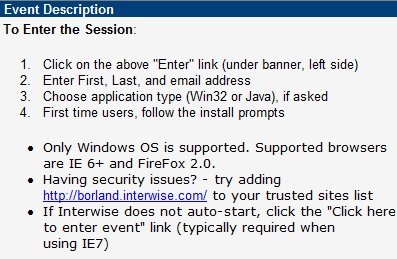
CodeRage II: Windows only, login problems

I was surprised to learn that CodeGear’s online conference is apparently closed to Mac users, or anyone not on Windows:

coderage_mac

That’s odd, since the company has Java and Ruby development products that run cross-platform.

Further, even Windows users have had problems logging in. The conferencing software CodeGear is using is limited to 1500 attendees per session, but thanks to a glitch sessions were reported full even when they were not. A message posted to the borland newgroup explains:

It turns out the problem was that only the first 1500 people who registered for CodeRage were successfully registered to attend all of the InterWise events because of a 1500 person limitation for iSeminar events. Unfortunately, this meant that 1500 attendance spots were reserved for those 1500 email addresses even though less than that we’re actually attending. Long story short, I’ve removed all IW registrations from individual events so anyone should be able to get in.  You shouldn’t see anymore “Exceeded max number of participants” error messages unless we really hit 1500 people for any given session.

I had problems myself - I am not sure if it was this limitation, or just the Interwise conferencing software which, like so much out there, appears to be uncomfortable with Windows Vista/UAC and presented a variety of error messages. I didn’t record all the details, but I was constantly being told I had cancelled the setup when I had done no such thing.

Hmmm, I seem to recall technical problems with previous Borland/CodeGear online events as well. Surely it’s time the company got these things right?

Technorati tags: , ,
November 20th, 2007

Is CodeRage the future of tech conferences?

CodeRage 2007 starts next week. It’s a technical conference covering CodeGear’s products, including Dephi, JBuilder, C++ Builder and 3rdRail, the new Ruby on Rails IDE.

The conference is both free and virtual.

A virtual conference is no substitute for human contact. I’ve learnt this paradox over many years: even if the same content is freely available on the Web, there is substantial benefit in physical attendance. You are more focused, you learn more, you can easily ask questions, and you pick up all those indefinable signals from others who are attending.

Equally, the global fuel crisis and concern about the environmental cost of travel surely means that virtual conferencing is an idea whose time has come. Another benefit is that it includes an array of people for whom a typical tech conference is just not feasible, for financial or other reasons.

I’d like to see more of these.

Technorati tags: , , , ,
September 17th, 2007

CodeGear’s Ruby on Rails IDE is released

CodeGear has released its IDE for Ruby on Rails. Called 3rdRail, it installs an instant Ruby on Rails environment, and features code completion, project management, refactoring and integrated debugging. The Eclipse-based IDE runs on Windows, Mac and Linux, and a 30 day trial is available. I’m downloading it now.

Technorati tags: , , , ,
June 22nd, 2007

CodeGear puts 64-bit on the roadmap

CodeGear has updated its Delphi Roadmap. Newly added is Delphi codename “Commodore”, set for Winter 2008, which is to include native 64-bit development. After that the company is promising to focus on multi-core/multi-threaded development.

What else is coming? Delphi ”Highlander”, due later this year, is a belated update to Delphi .NET, will support .NET 2.0, and has a new .NET database called SQL Datastore (likely some sort of port of JDataStore). No word on WPF or LINQ though - CodeGear is still playing catch-up here.

Delphi “Tiburón”, due next year, will bring another long-requested feature: full Unicode compatibility in the Win32 Delphi language and VCL (Visual Component Library), along with parameterized types. C++Builder “Barracuda” will follow, bringing the same features to C++.

The really interesting stuff comes at the end. CodeGear is “researching” a number of areas includes development for mobile devices, Rich Internet Applications, and cross-compilation to other operating systems. All this is at the “sometime, never” end of the time scale, so don’t get too excited.

All the above will be welcomed by Delphi developers, though I fear most of the potential .NET market has already been ceded to Visual Studio.

It’s not a bad roadmap though. That said, to my mind the most critical issue for CodeGear is quality control. Poor quality is what spoilt the launch of Delphi for PHP earlier this year. I discussed this issue with the new CEO Jim Douglas and EMEA product Director Jason Vokes when I was researching a recent article for The Register, and got the sense that the familiar pressure of having to release product (ready or not) to hit particular financial quarters is still a problem. Still, Delphi 2007 was a smoother launch than Delphi 2006, and that was miles better than Delphi 2005, so leaving aside Delphi for PHP things are improving.

May 11th, 2007

JBuilder 2007 comes to the Mac

Codegear has announced a new JBuilder 2007 release which includes Mac, Vista and RedHat support (the earlier release only ran on Windows). It is to be made available later this month (May 2007).

There are three editions, Turbo (free), standard and Enterprise. Enterprise has “Team Server” features, with tracking and source code management; it’s not clear from the release how this ties in with existing team offerings from Codegear/Borland. The standard edition replaces both Developer and Professional editions in the previous range; the release says there is: 

Special upgrade pricing of $250 and new user pricing of $499

You would have thought this would be a free upgrade for existing JBuilder 2007 users, since cross-platform support should have been there from the beginning, but the release doesn’t say that it is. I’d like clarification.

This of course is the “JBuilder” based on Eclipse. I was interested in a discussion on one of the JBuilder newsgroups about Eclipse updates. Eclipse is a platform for add-ins, each of which is constantly being updated. The idea is that you run the update manager from time to time to get the latest version of each add–in, or perhaps install new ones. There are multiple dependencies with obvious potential for conflict. Borland’s JBuilder is a tailored build of Eclipse, and in consequence it is apparently dangerous to use the update manager. One user complained about this and drew the following comment from JBuilder expert David Orriss:

Do not try to use the Eclipse updater in JBuilder 2007. It can lead to problems, as you have seen. I’ll agree that it could have been documented better, but to try to effectively block the updater [which] (via plugins or code modifications) causes problems in the Eclipse platform.

It is a significant point. On the plus side, one of the attractions of JBuilder 2007 is that it offers a consistent, supported build of Eclipse unlike an uncontrollable open-source installation. On the minus side, blocking the update manager blocks the key Eclipse benefit: its extensibility and continuous improvement.


April 29th, 2007

AppForge: a product activation nightmare

Nobody likes product activation, but it is used increasingly by software vendors in search of more effective anti-piracy measures. Microsoft is the most prominent example, but many smaller vendors do the same. Codegear, for instance, use activation for Delphi. Even if you have a valid registration key, you cannot use the product until it has checked in with Codegear’s license server.

Last month Appforge went bust. The company made a development tool called CrossFire, which lets you code in Visual Basic or C# but cross-compile for numerous platforms including Palm, Nokia’s Series 60 and Series 80, Blackberry and Windows Mobile. A useful tool, but AppForge has an activation system that applies both to the development tool and in many cases to the client runtimes.

The AppForge license server is now offline. Result: developers with CrossFire applications and fully paid-up licenses can no longer deploy their products.

AppForge has been acquired by Oracle, but apparently Oracle has no interest in continuing the CrossFire product. Here’s what Oracle says:

Please note that Oracle’s acquisition of AppForge’s intellectual property did not include the purchase of the company as a whole, or the purchase of other AppForge assets including its customer contracts. Accordingly, Oracle does not plan to sell or provide support for former AppForge products going forward.

Former customers are fighting back. There is talk of a competition to crack AppForge activation: money for the prize is being put on the table.

What about Oracle? Is it really so difficult to resurrect the AppForge license server? Ending all support and development for a product is bad enough; robbing existing users of the right to use it seems extreme.

There may yet be a happy ending. But for now, this really is the nightmare scenario that opponents of the product activation concept feared. No, I don’t think something similar could happen to Windows and Office; but clearly there are real risks when using products from smaller vendors.

A solution is to use some form of escrow where unlocked versions of the software are guaranteed to be made available in the event that the original company can no longer offer activation services. The AppForge saga suggests that customers should insist on this or some alternative protection before committing to activation-protected software.


April 5th, 2007

Why the change of CEO at CodeGear?

CodeGear has a new CEO. But why? There’s the usual bland stuff in the press release:

Today we made a change to the leadership team at CodeGear.  Jim Douglas is joining as CEO of CodeGear.  Jim will be responsible for driving CodeGear to the next level, building on the solid foundation and momentum achieved by the CodeGear team under Ben Smith’s leadership.

Departing CEO Ben Smith has a blog entry that is no more revealing.

Judging by comments on the Borland newgroups, developers are fearing the worst. The problem: a change of CEO is a sign of instability, when CodeGear customers need reassurance that their preferred tools are in good hands. I didn’t see any previous suggestion that Smith’s appointment was intended to be short-term.

To make matters worse, there are signs that both Delphi for PHP (see here) and Delphi 2007 (see here) were released too quickly - especially Delphi for PHP. Strategically unwise.

There’s still nothing to touch Delphi for native Windows (if you don’t need 64-bit). And tackling PHP tools is a great idea. But in a difficult market the company cannot afford many slip-ups.


March 17th, 2007

Delphi 2007 is done

CodeGear says it has completed Delphi 2007, its RAD development tool for Windows. What’s notable about Delphi 2007? First, it’s Win32 only. Borland CodeGear hasn’t yet won over many .NET developers, so it took the decision to concentrate on native code in this release, although CodeGear is not abandoning .NET completely.

Second, it builds apps that work right on Windows Vista.

Third, there’s a new database API (CodeGear calls it an “architecture”) called DBX4; I’ve not investigated this yet. 

Fourth, it’s mostly binary-compatible with Delphi 2006 so that existing add-ins should work.

Fifth, it uses MSBuild (same as Visual Studio 2005), which is good news for anyone with a non-trivial build process.

Delphi 2006 was a huge improvement over the two previous versions (Delphi 8 and Delphi 2005). Version 8 was for .NET only, bypassed by most Delphi developers. 2005 brought .NET and Win32 together, but the IDE was barely usable. 2006 is pretty good; it looks as if 2007 may be better still. Although the feature set is not particularly exciting, the product is said to be faster and more reliable, which is what Delphi developers care about most. I will be reviewing the release shortly and will post links when available.


Technorati tags: , , ,