JetBrains publishes an annual developer survey with a large number of respondents, and the 2026 edition of nearly 29,000 developers is just published.
Note: the survey comes with some caveats. There is an inevitable bias towards JetBrains products (including the Kotlin language); and the primary means of data gathering was via social media. This year, the company advertised the survey using “unbranded creatives,” according to the published methodology, which apparently made the responses more representative, but harder to compare with previous years. Further, because of the large number of questions, not every question was shown to every developer.
JetBrains is a tools company and always asks about IDE usage, but curiously these stats are omitted from the published report summary. That said, the raw data is also available, from which I derived the following table of IDEs with more than 100 users. Unlike some of the questions, this is meant to identify the “Main IDE” so it is only one per respondent. Some developers left this blank, perhaps for that reason. For example, many developers use Apple Xcode, but not as their main IDE.
| Visual Studio Code | 8372 |
| IntelliJ IDEA | 5229 |
| PyCharm | 1872 |
| Visual Studio | 1582 |
| Android Studio | 1320 |
| PhpStorm | 1259 |
| Rider | 1211 |
| Cursor | 1083 |
| WebStorm | 823 |
| Zed | 602 |
| Google Antigravity | 548 |
| Neovim | 480 |
| Clion | 389 |
| GoLand | 325 |
| Notepad++ | 314 |
| IPython/Jupyter Notebook | 283 |
| Xcode | 273 |
| Eclipse or an Eclipse-based IDE | 203 |
| Vim | 199 |
| Sublime Text | 122 |
| RustRover | 103 |
| Arduino IDE | 101 |
It is apparent then that Visual Studio Code retains its lead in IDEs, though if you sum IntelliJ IDEA with all the variants like PyCharm and PHPStorm then JetBrains pulls ahead.
Regarding programming languages, JetBrains reports that “the big four are declining, based on falling usage of JavaScript, HTML/CCSS, SQL and Java. This is misleading though, as TypeScript continues to grow, and TypeScript compiles to JavaScript. In addition, neither HTML/CSS nor SQL belong in the same category as general-purpose programming languages. What is notable is that Python is firmly in the top spot; and that despite the buzz around Rust, it remains well down the list – though it tops the charts in a further list of “languages developers want to adopt next.”
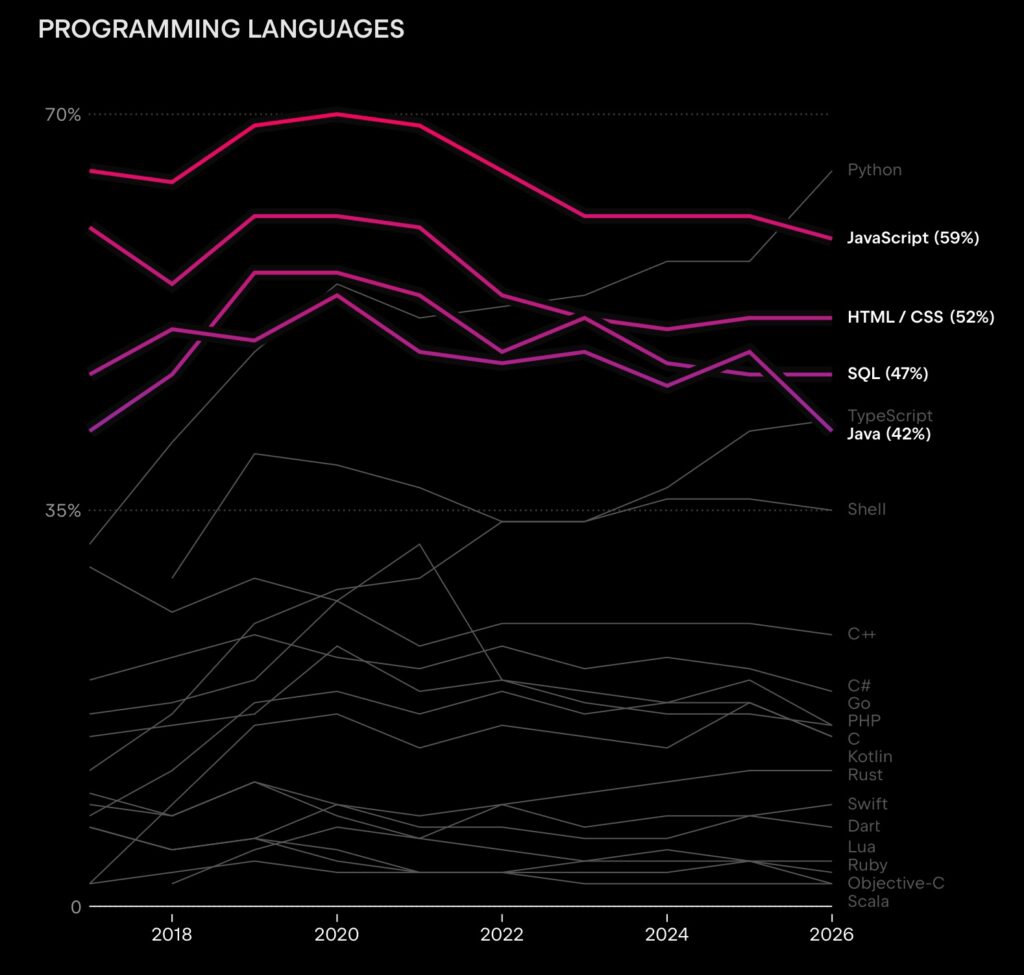
My guess is that AI coding will be a big influence on language choice in future though I am not sure which direction it will take. Logically we might see more use of the most efficient languages such as C++, C, Go and Rust, though it is also possible that AI will simply cement the current rankings because of the higher volume of training data avialable.
Regarding AI, I did not find the survey as illuminating as I had hoped. Anthropic Claude Code has the biggest usage (39%), following by GitHub Copilot (21%) and ChatGPT (17%). Developers vary a lot in usage of AI agents, though overall it is high: 71% report doing more than 40% of their development tasks with agents.
A list of barriers to adoption for AI agents shows data privacy and security as the biggest concern, followed by expense, lack of expertise, and concerns about intellectual property. All of these are valid reasons for caution.