Category Archives: software development

Adobe’s Flex Builder to Flash Builder name change does not go far enough

As expected, Adobe is strengthening its “Flash Platform” strategy by renaming the forthcoming Flex Builder 4 (codename Gumbo) to Flash Builder 4:

This change will provide better naming consistency for the Flash family of tools and position Flash Builder as the development tool for the Flash Platform.

This is only a name change, nothing more. Flash Builder will still be based on Eclipse, and the original Flash Professional IDE, also part of Creative Suite, will continue as before.

My question: why doesn’t Adobe go further in clarifying and promoting its Flash brand? The current situation is still confusing:

Flash Builder vs Flash Professional: the names give you no clue about the difference. Why not Flash Developer and Flash Designer?

Adobe AIR (Adobe Integrated Runtime): non-techie people do not realise this has anything to do with Flash. Flash Desktop Runtime would be better, though I guess that would not reflect the option for HTML applications. It would do a lot to promote Flash as more than just a browser plug-in.

Flex SDK: why retain the Flex brand at all? I presume the name was originally a contraction of Flash and XML, but since it is a language that compiles to Flash, this could just be called the Flash SDK.

Name changes themselves are confusing of course, so I’m surprised that Adobe is not being more thorough now rather than risking more piecemeal changes later.

Delphi moving towards cross-platform, 64-bit

Embarcadero’s Delphi Live conference is running this week, and there are some interesting reports coming out. Robert Love has the best summary I’ve found so far. As I understand it, the next Delphi is codenamed “Weaver” and adds Windows 7 support, including the Touch APIs. More interesting is that this will be followed at some point by “Project X”, a cross-platform native code compiler for Windows, Mac and Linux. There is also mention of “Project Commodore”, which brings full 64-bit support.

Project X is the one that particularly grabs my attention. Cross-platform Delphi has been tried before, with Kylix, Delphi for Linux. Although promising, Kylix suffered on the technical side from Wine dependencies and on the marketing side from lack of demand for Delphi desktop applications. I do not have any technical information about Project X yet, but on the marketing side Mac OS X (and perhaps iPhone) is a great deal more promising than Linux.

After suffering from under-investment for many years, it is great to see Delphi now getting a new lease of life in its new home, and I’m looking forward to finding out more.

Yahoo’s mindshare problem

Last weekend I attended Yahoo’s Open Hack Day in London.

It was excellent. I wasn’t hacking myself; but enjoyed the tech talks. I also had an opportunity to interview execs including co-founder David Filo, Cody Simms who does Product Management for Yahoo Open Strategy, and Sophie Major the head of the International Developer Network.

Highlights for me were Rasmus Lerdorf talking about smart PHP tricks, and a session on the amazing Yahoo Query Language which really does make the Internet look like one giant database which you can query.

I wrote up some of my interview for The Register, concluding:

Open Hack Day certainly showcased some impressive technology. The question is whether Yahoo! still has the marketing muscle to reverse its declining influence and truly to unsettle the likes of Google and Facebook and disrupt the market.

Events this week proved this exact point. During Open Hack Day there were talks on Microformats, RDFa and Yahoo Search Monkey. Search Monkey reads data on your site that includes semantic mark-up in order to present more meaningful search results.

On Tuesday Google announced Rich Snippets:

To display Rich Snippets, Google looks for markup formats (microformats and RDFa) that you can easily add to your own web pages.

So were the headlines “Google catches up with Yahoo”? Not at all; most of the world apparently thought Google had invented something new and amazing. Timothy O’Brien reported on it for O’Reilly and apparently was not aware of Yahoo’s earlier initiative. He added a postscript:

We’ve had some response about failing to mention Yahoo’s SearchMonkey which also supports RDFa and Microformats. Google is certainly not the first search engine to support RDFa and Microformats, but it certainly has the most influence on the search market. With 72% of the search market, Google has the influence to make people pay attention to RDFa and Microformats.

Correct; though I also suspect Yahoo could do a better job of marketing its technology. Talk of disrupting Google seems fanciful at this point. Having said that, Twitter is doing it just a little bit: somehow it is easier for a tiny organization with a bright idea than for a giant from the past.

In the meantime, take a look at YQL. It’s brilliant.

New York Times switches from WPF/Silverlight to Flash and AIR for Reader 2

The New York Times has released Version 2 of its Times Reader, for seamless online/offline viewing of its content. It’s interesting from a media perspective, but hardly a breakthrough, since it is not new. What’s more interesting to me is that the Times switched from a hybrid approach using WPF (Windows Presentation Framework) on Windows and Silverlight on the Mac, to Adobe AIR. Switches like this are bad PR for Microsoft, since it gives the impression that the developers were sufficiently unhappy with WPF/Silverlight, or so strongly attracted to AIR, that they were willing to throw away much of their previous development effort.

I’ve been tracking Times Reader for some years. It was presented at Microsoft Mix07 and I wrote up a panel discussion on the subject:

I asked about the cross-platform issue. According to Bodkin a Silverlight implementation is on the way, which includes most of the features in the full version, in “a matter of months.”

That was optimistic; but a Silverlight version was delivered and I used it successfully on the Mac; though it lacked some features of the WPF edition. It also attracted hostility from Mac users who are Microsoft-averse, as I reported here, and apparently ran into further problems because of incompatibility with Safari 4.

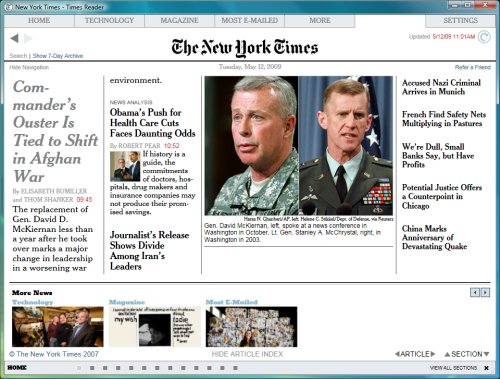
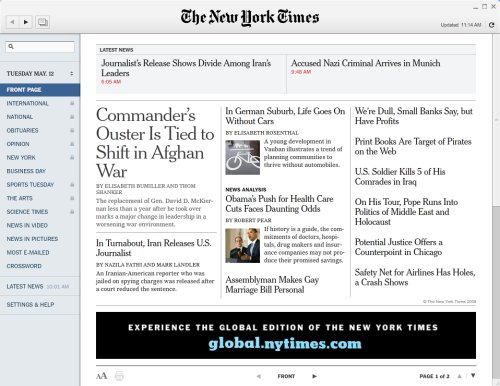
I tried the new AIR edition and it seems pretty good, though my impression is that it is not quite as smooth as the old WPF version. I might be wrong, since I could not install both on the same machine. The new version does add video support. Here’s the old one:
and this is the new effort:
I think this is a fascinating case study which demonstrates a number of things.

First, that cross-platform support is not an optional feature any more (if it ever was) for this kind of public application. Let’s assume here that the WPF version was just fine for Windows users, but was not viable long-term for lack of cross-platform support. It was inevitable that the Times would eventually either use Silverlight on both Windows and Mac, or abandon both WPF and Silverlight for a cross-platform alternative.

Second, that Silverlight is not yet mature enough for this kind of application. Although the Times developers were able to deliver a Silverlight version, it required a bit of hackery for offline support (embedded Safari on the Mac) and apparently ran into version problems when Apple upgraded Safari. Silverlight is also known to be poor for text rendering – a Google search for “blurry text Silverlight” brings back plenty of hits. Adobe also made a big improvement to text handling in Flash player 10, with the new flash.text.engine.

Third, that offline support really is a big deal. Would Silverlight 3.0 have been good enough? Possibly, though I haven’t seen any suggestion that Silverlight 3.0 offline apps will be able to run in the background while showing just an icon in the notification area, to support continuous synchronization.

It is possibel that these problems may be fixed in Silverlight 4.0. That’s a long time to wait though, when you need your application out now (and your industry is in crisis).

It would be silly to extrapolate this case study into a broader statement about the superiority of Flash over Silverlight. For the specific needs of the New York Times though, it is easy to see why Adobe AIR appeals.
Is Zend really the PHP company?

I’m at Yahoo! Hack day in London – not hacking, but here for sessions on topics such as YUI (Yahoo! User Interface Library) and PHP.

I had a brief chat with Rasmus Lerdorf who is speaking later. I asked him about Zend, which presents itself as the PHP company (that is actually the slogan on its web site). Is it really?

Lerdorf says Zend has no special status. While acknowledging its contribution, he says there are 1300 PHP committers, and only 6 work for Zend. He emphasises that PHP is a community project and that decisions are made by consensus, influenced by who is actually willing to write the code, not by Zend or any company.

I also asked about PDT (PHP Development Tools), the Eclipse-based open source IDE. Lerdorf says there are lots of PHP IDEs, and people who use generic editors for PHP, and none has any more status than any other; he doesn’t use PDT.

From my perspective as press, there are only two organizations who ever encourage me to write about PHP. One is Zend; the other is Microsoft, keen to establish Windows as a credible PHP platform (Lerdorf says PHP on Windows has made enormous progress in the last couple of years). Zend does seem to do more than any other company to promote PHP for commercial and corporate development.

Lerdorf is not surprised. We’re developers, he says, we don’t do PR.

Zend’s effort is broadly beneficial to the PHP community – provided that it does not give a false impression of who owns PHP.

Silverlight: developer win, designer fail?

I posed this question in a post over on itjoblog. There are several reasons why Silverlight struggles to get designer attention, including:

1. Designers are pragmatic and target the runtime that is already deployed most broadly, ie. Flash.

2. Flash is already good enough so why bother?

3. The tools: Adobe’s designer tools are a de facto standard, target Flash, and run on the Mac.

Developer is another matter. The cross-platform .NET runtime is Silverlight’s big advantage; and this time the tools tip the balance towards Microsoft (Visual Studio) – not for everyone, but for the substantial Microsoft platform community. That’s going to be further reinforced by Visual Studio 2010 which gets full visual designer support, plus of course Silverlight 3.0.

Microsoft does have a problem with Silverlight out of the browser. Developers need a way to have these run with more local permissions, subject to user consent, otherwise they will turn to Adobe AIR. Actually the whole Silverlight on the desktop story is confused, since you can also do Silverlight Mesh-Enabled Web Applications, or stick Silverlight content in a desktop gadget or other embedded browser. No, not the one in AIR (nice idea though): Adobe only includes Flash support and the PDF plug-in.

The tension behind this is that ultimately developers and designers need to work on the same applications, so this remains a fascinating contest.

First baby steps for Moonlight 2.0: Silverlight for Linux

Miguel de Icaza has announced the first preview release of Moonlight 2.0. This is the one that counts, in that it brings the .NET runtime to Silverlight applets running on Linux:

This is the ECMA VM running inside the browser and powering C# and any other CIL-compatible languages like Ruby, Python, Boo and others. You can use Moonlight/Silverlight as a GUI (this is what most folks do) or you can use it as the engine to power your Python/Ruby scripting in the browser.

The download page has plenty of health warnings:

Keep in mind this preview release is not feature complete. Most importantly not all security features are present or fully enabled in this release. Even existing security features have, at this stage, received only minimal testing and no security audit of the source code (mono or moonlight) has yet been done.

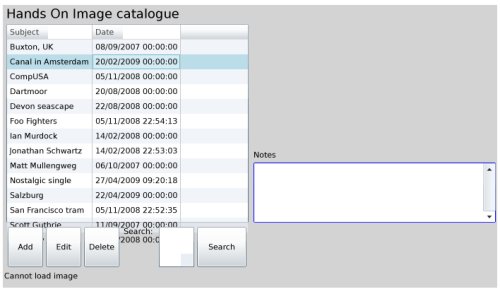
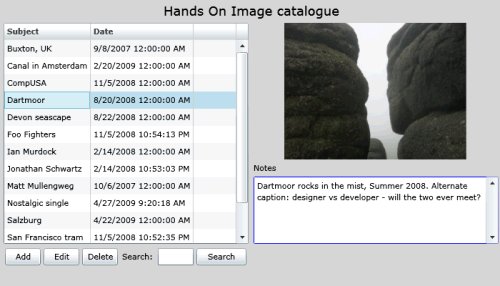
Undeterred, I installed it into FireFox 3.0, running on Ubuntu Linux. The download is under 9 MB. My first effort was unsuccessful; the plug-in appeared to load OK, but no Silverlight apps displayed. My second attempt in a VM worked. Naturally I went along to my Silverlight database example which as it happens runs on Mono. Here it is:

This is what it should look like (Silverlight on Windows):

Well, it is only an alpha preview, and it shows. On the plus side, the data is displayed, the search works, and the buttons operate. It is a considerable achievement. But don’t plan to move your users onto Moonlight applications just yet.

Flex Builder for Linux on hold: another sign of financial stress at Adobe?

On 21st April Adobe’s Ben Forta told a user group that Flex Builder 3 for Linux is on hold, citing lack of requisition, which is corp-speak for lack of demand.

Note that the Flex SDK does run on Linux. It is just the official IDE that is in question.

Linux is a free operating system, and this could be evidence that users of a free OS are less likely to purchase software than users of a paid-for OS. Or it could simply reflect poor market share for Linux outside servers. Even if it has just hit 1%, as hitslink reports, it is still barely more than 10% of the Mac share and a little over 1% of the Windows share. Some of those Linux machines will also be netbooks – secondary systems for users with a Windows or Mac for serious work such as design and development.

Nevertheless, I suspect there is more to it than that. I suspect Adobe would like to support Linux, because it wants to portray Flex as an open platform – the SDK is open source, though managed by Adobe, but the runtime engine is closed-source and proprietary. This may be another sign of Adobe’s financial stress. The company reported reduced quarter-on-quarter revenue for the the 3 months ending February 2009, and has been cutting staff numbers.

The backdrop to this, in contrast, is that Adobe is having great success with its Flash platform. There is no sign of Microsoft’s Silverlight denting the popularity of Flash on web sites, either for applets or media streaming.

The recession then? Partly; but this is also about Adobe’s business model. Adobe does not break out its figures in detail as far as I know: the last financial statement merely shows that its revenue is nearly 95% from product sales, the rest being services and support. Still, I’d guess that the largest component of its product sales must be Creative Suite. In other words, its business model is based on selling tools and giving away runtimes. When 47 million people watch Susan Boyle on YouTube, Adobe doesn’t make a penny, even though they are almost all using Flash to do so.

The tools market is a difficult one for various reasons, including competition from free products and the fact that the number of people needing development or design tools is always much smaller than the number needing runtimes. In a recession, deferring a tools upgrade is a obvious way for businesses to save money. Remaining primarily a tools company is a limit to Adobe’s growth and ultimately its profitability.

This is of concern to all Flash platform users. Adobe has proved to date a good steward of the technology. Some of us would like the balance of proprietary vs open tilted further towards open, but I doubt many would welcome a takeover or merger such as we have seen with Sun and Oracle (and there are a few parallels there).

There would also be many cries of “foul” if Adobe sought to further monetize Flash by starting to sell, say, a premium version of the Flash runtime.

Adobe is still a profitable company, and maybe when the economy recovers all this stress will be forgotten. Still, I’d guess that long-term Adobe will want to shift away from its dependency on sales of tools; and how and what it does to achieve that will have a big influence on the future of its RIA (Rich Internet Application) platform.

A Silverlight database application with image upload

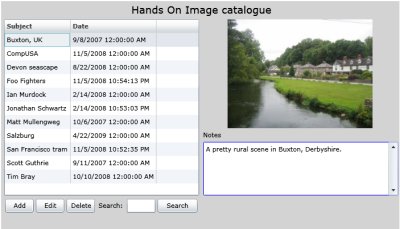
I’ve been amusing myself creating a simple online database application using Silverlight. I had this mostly working a while back, but needed to finish off some pieces in order to get it fully functional.

This is created using Silverlight 2.0 and demonstrates the following:

  • A bound DataGrid (as you can see, work is still needed to get the dates formatted sensibly).
  • Integration with ASP.NET authentication. You have to log in to see the data, and you have to log in with admin rights to be able to update it.
  • Create,Retrieve,Update,Delete using ASP.NET web services.
  • Image upload using Silverlight and an ASP.NET handler.
  • Filter a DataGrid (idea taken from here).
  • Written in Visual Studio 2008, and hosted on this site, which runs Debian Linux, hence Mono and MySQL. Would you have known if I had not told you?

You can try it here. I’ll post the code eventually, but it will be a couple of months as it links in with another article.

MVP Ken Cox notes in a comment to Jesse Liberty’s blog:

Hundreds of us are scouring the Internet for a realistic (but manageable and not over-engineered) sample of manipulating data (CRUD operations) in a Silverlight 2 application. There are promising pieces of the puzzle scattered all over the place. Unfortunately, after investing time in a sample, we discover it lacks a key element – like actually saving changed data back to the database.

I can safely say that mine is not over-engineered, and that yes, it does write data.