Category Archives: software development

What’s new in Subversion 1.5

The team behind the open source SCM (Software Configuration Management) tool Subversion released version 1.50 last month. Karl Fogel, president of the Subversion Corporation, says:

Measuring by new features alone, Subversion 1.5 is our biggest release since version 1.0 became available in February 2004.

I am a contented Subversion user, so took a look at the changes. Top of the list is “merge tracking”, though it is described as “foundational” which means that although the basic support is there, there is performance and feature work which remains to be done. From the user’s perspective, the difference is that branching and merging is just easier than before, as explained by Ben Sussman:

Notice how I never had to type a single revision number in my example: Subversion 1.5 knows when the branch was created, which changes need to be synced from branch to trunk, and which changes need to be merged back into the trunk when I’m done. It’s all magic now. This is how it should have been in the first place.

Other changes include sparse checkouts (when you only want to grab a small part of a repository), and changelists, a client feature which lets you tag a set of files under a changelist name and work on them as a group. There are also improvements aimed at making Subversion better suited to large-scale deployments using multiple servers. Subversion is still a centralized rather than a distributed SCM system, but 1.5 is better suited for use in a distributed manner. No doubt the Subversion team is aware of the increasing interest in Git, a distributed system. There are also numerous bug-fixes and performance tweaks. The changes are described here.

I want to move to Subversion 1.5 but it is not that easy. Compatibility is good, in that older clients work with 1.5 servers and vice versa, the main proviso being that you cannot mix several versions of the Subversion client with the same working copy. That is not likely to be a problem for most users.

The difficulty I encountered is that mainstream Linux distributions still have older versions of Subversion in their stable repositories. Ubuntu, for example, has version 1.4.4. My most-used Subversion repositories are on a Debian server, which also has an old version. I don’t want to switch the server to sid, Debian’s development distribution, and mixing packages is often problematic. I could do a manual installation I guess; but instead I will be patient.

I did install 1.50 on Windows, for an intranet repository. I used the Collabnet download. All I needed to do was to inform the installer of the location of my existing repository, and then copy a few lines from the old Apache 2.0 configuration file to the new Apache 2.2 configuration file. Everything works fine. I also updated TortoiseSVN on the Windows clients.

One of the advantages of Subversion (or any SCM) repositories over synched folders like those in Microsoft’s Live Mesh or Apple’s MobileMe (as I understand it) is that you get version history. I regard this as a key feature. The problem with synchronization is that you might overwrite a good copy with a bad one. It is easy to do; it might be caused by user error, or a bug in your word processor, or a failing hard drive. Automatic synch (un)helpfully replicates the bad copy all over. Versioning means you can just rollback to the good one.

Canon’s bad dialog, weak Linux support

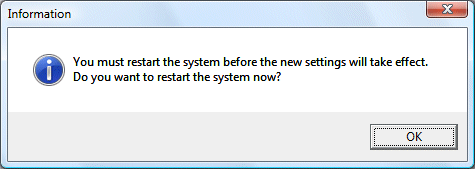
While installing Canon’s MX700 all-in-one printer on Windows, I spotted this for my collection of bad dialogs:

do you want to restart the system now?

Hint: if you ask the user a question, it’s good to allow for more than one answer. Even if you close the dialog by clicking the x at top right, it still reboots the system.

I was also interested to see whether the printer works with Linux. Canon doesn’t offer Linux drivers. Nor does it seem keen to hear from customers about this:

Linux printing for other printers

The CAPTCHA test always presents 8 zeroes, which it then rejects as invalid.

I haven’t quite given up.  There are Linux drivers for the Pixma MP520 which are rumoured to work somewhat. When I have a moment I’ll give it a try.

Technorati tags: , , ,

Microsoft accused of reinventing EJB – ouch!

There is a lot of discussion around Microsoft’s object-relational efforts right now. There are a couple of key issues:

  • Is Microsoft really committed to Linq to SQL, or is it shifting its attention to Entity Framework?
  • Is Entity Framework being pushed out before it is ready? A “vote of no confidence” open letter along those lines has been signed by over 300  including more than a dozen MVPs (Most Valued Professionals), experts in Microsoft data technologies.

Now a post from MVP Ian Cooper makes the frightening suggestion that Microsoft is ignoring the lessons of Java’s problems with EJB:

The .NET community had a huge amount to gain from this experience. Ports of Hibernate and Spring offered the community the chance to avoid the mistakes of the past. However, seemingly unaware of the lessons of history the EF team embarked on a project to produce a complex framework, of which persistence is just one aspect, reminiscent of the EJB initiative. So the reaction against the EF comes from its failure to learn lessons that another community has struggled with around complexity and ambition.

Microsoft’s success with .NET has been partly enabled by over-complexity in the Java world. Microsoft’s secret sauce is enabling developers to build stuff that works quickly and easily – which, incidentally, is why I am really disappointed that Visual Studio 2008 is still such a mess for quick database applications.

My own knowledge of the Entity Framework is rather thin. I’ve treated it as a layer that you have to generate in order to use ADO.NET Data Services, a REST API that I really like. It has to be said though – Microsoft’s data story is getting confusing. Roger Jennings is doing a great job of tracking developments.

Windows server compromised by PHP application

Susan Bradley has posted her analysis of how her Windows server was hacked.

This is interesting to me, as Bradley is an expert on server administration and patching; I’m glad she has had the courage to post all these details, thus benefiting the community, rather than pretending the server was down for emergency maintenance or the like.

She thinks it was a security bug in IceWarp Web Mail. This appears to be a PHP application. Although the bug has been fixed, she was running an old version because the new one broke some important features.

The explanation sounds plausible to me. So is it applications rather than operating systems that form the most critical security weaknesses today? Yes, but both are involved. I would be interested to know whether the same bug in a Linux installation of IcwWarp would have been equally easy to escalate to the entire OS.

Technorati tags: , , ,

Adobe’s Acrobat.com REST API

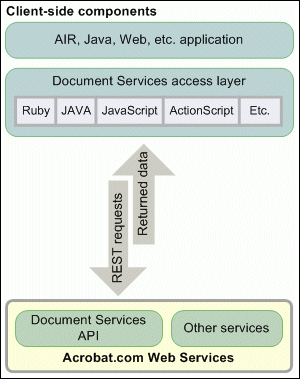
I wrote a piece for IT Week on Adobe Acrobat 9. One aspect of the new Acrobat.com collaboration site that has not received much attention (by way of evidence, the developer forum is currently quiescent) is the document services API. This is a REST API which lets you integrate Acrobat.com services into an application. You can use pretty much any programming language that can talk HTTP. There are some similarities with Amazon’s Simple Storage Service: file upload and download, and management of access control lists based on Adobe IDs (email addresses registered with Adobe). The API reference is here; there are also some wrapper libraries for Java, ActionScript, Ruby, Python and Cold Fusion. No C# yet.

It strikes me as a useful API. For example, imagine you have an application that creates a sales report. The application could upload the report to Acrobat.com and email a group of colleagues with the link.

Another obvious application is a utility to synchronize local and online files. While there are no specific synchronization APIs, you can get the last modified date of a file which would be enough for something simple.

The service will get more useful as other pieces emerge. Flash 10 has a rich text editor with some useful features such as multi-columns with text flow, multi-language and bi-directional support. Put this together with AIR and the Acrobat API and you have all you need to make your own cross-platform offline word processor with online storage. Adobe itself intends to provide this in a future offline version of Buzzword.

Native code client coming for CardSpace as .NET runtime too demanding

I spoke this morning to Paul Mackinnon and Steve Plank at Microsoft, about Information Cards and CardSpace. CardSpace is part of .NET Framework 3.0 and higher. It enables uses to authenticate on web sites by presenting a virtual card, instead of typing in a username and password.

The CardSpace concepts strike me as sound, but as far as I can tell adoption has been minimal. I expressed my frustration; why is it that 18 months after the 1.0 release even Microsoft is not using it to any noticeable extent? I still see username/password dialogs whenever I need to sign into a Microsoft property like MSDN subscriptions or Live Mesh. Actually there is a beta service which lets you sign in with CardSpace – but I believe my point is still valid – how many people even know about this?

I was told that it is still early days and that we will hear more about the Live ID service when it comes out of beta. Mackinnon also mentioned that Microsoft is working on a native code client for CardSpace. Currently users need at least .NET Framework 3.0 which is a huge download and can be problematic. A native code client will be a small download with few dependencies. There is no firm date for release, though it is at least a year away (maybe previews before then).

Technorati tags: , ,

Ruby interpreter flaws make the case for JRuby?

The official Ruby blog reports:

Multiple vulnerabilities in Ruby may lead to a denial of service (DoS) condition or allow execution of arbitrary code.

More discussion here and here. The community is fixing the problems energetically; but they do appear serious, and some are struggling with compatibility issues.

Since these seem to be bugs in the interpreter, it strikes me that this makes a good case for JRuby or in due course IronRuby, on the grounds that the Java and .NET runtimes are more mature. When I spoke to ThoughtWorks about its extensive Ruby work, I was told that JRuby is almost always used for deployment, partly because enterprises are more comfortable with it.

Technorati tags: , , ,

Where is your SQL Server CE Database?

Maybe not where you think. Now, I admit I am three years late with this bug strange feature of Visual Studio but it wasted some of my time today so it is still worth reporting.

I’ve been writing about creating database applications in Visual Studio. Specifically, I was looking at what happens if you download Visual Basic Express and take the quickest, easiest route to knocking together a database application.

The default local database engine these days is SQL Server Compact 3.5:

When you create applications, the preferred local database is SQL Server Compact 3.5.

says MSDN.

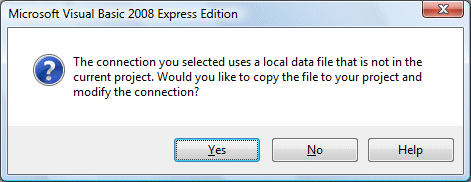
OK, so you add a new database to your project and accept various defaults. The wizard then asks you whether you would like to “copy the file to your project and modify the connection”?

Sounds reasonable, if you can figure out what it means. Default is Yes, so OK do it.

Mistake. Don’t do that. Not, at least, without reading and understanding this document. But I digress. Next up, you are asked another question:

Storing connection strings in your application configuration file eases maintenance and deployment … do you want to save the connection string to the application configuration file?

It’s another option that sounds good. OK, do it.

Now you set up a little table or two, add some data-bound controls, and off you go. Run the app, enter some data, save it. Run the app again … and all your data has disappeared. Why?

Well, it has to be either that the updates are silently failing; or that the database file is getting overwritten. It’s the latter. It turns out that VB is treating your database like any other resource, and copying to bin/debug when you run the app. This is the copy you are connecting to, you update it, but next time you build and run it gets overwritten.

None of this is obvious, because when you look at the connection string in the application settings (which VB hides by default, sigh), it shows the database file in the root of your project folder. Click Test Connection, all is fine. The only warning sign is that the connection string looks like this:

Data Source=|DataDirectory|\test.sdf

So where is |DataDirectory| set? That’s not obvious either. Read here for the answer. It’s an application property that is not visible anywhere, that gets set to different values depending on how you deploy the app. I can see why someone thought this was a smart idea; but the implementation is horrible. It gives you the illusion of having one database file, when in fact you have multiple copies (source, debug, release etc) overwriting one another, and during testing you are never editing the correct one.

Once you have worked this out you can fix it, of course. But here’s another problem. You are the single user of a database. You insert a record and save it, using all the generated data-bound stuff that Visual Studio provides. Works fine. Then you edit the record you just inserted, and save again. Boom. Concurrency exception. Why?

It is all do to with a limitation of SQL Server Compact 3.5. It can’t handle multiple SQL statements. This means that a feature of the ADO.NET TableAdapter, called Refresh the Data Table in the configuration wizard, is not available. This option kicks in when you have an identity column that auto-increments, which is by the easiest way to create a primary key. In this scenario, the actual value of the identity column is not known until after you make the insert, because it is generated by the database engine. Normally, the TableAdapter would retrieve it with a Select statement immediately after the Insert statement. However, with SQL Server Compact 3.5 that does not work.

The result is that saving a record works fine, but next time around the row has an incorrect primary key in the DataSet. No wonder you get a concurrency exception.

You can work around this in code, of course. But what surprises me is just how hard Microsoft has made all this for the kind of newbie programmer who might pick up VB Express. In fact, easy database programming in VB has marched backwards since Visual Basic 3 back in 1993.

By the way, I also dislike the way VB adds so much database gunk to your main form, again by default. What if you add another form to your app? What if you want to delete the first form? It all gets messy fast.

Look at Ruby on Rails. It has simple database handling that works. OK, you are going to have to modify that code eventually; and I accept that database apps have an inherent complexity that no amount of wizards, O/R layers or even "Convention over Configuration” can remove. I still think that simple, single table, single user apps should be, well, simple. Not in VB, unfortunately.

Microsoft’s big break: failing competitors

The BBC has an article, prompted by Bill Gates’ retirement from Microsoft, on how the company thrived because of the failings of its competitors.

I find this ironic. What gave Apple its big break in music, and in gaining market share for the Mac? What gave FireFox its big break in web browsers? Maybe even Google’s success is enabled in part by Microsoft’s failure to compete effectively.

The description of the young, nimble Microsoft is quite a contrast with the company today, which takes around a year to get a product from a feature-complete development stage, to actual shipping.

Technorati tags: ,

Wine is 1.0

Congratulations to the Wine community which has released Wine 1.0:

The Wine team is proud to announce that Wine 1.0 is now available. This is the first stable release of Wine after 15 years of development and beta testing.

Wine is a compatibility layer that enables Windows applications to run on Linux, Mac OS X, and other Unix-like systems.

Although in beta, Wine has been used in numerous commercial applications over the years. Two I can think of: WordPerfect 9 from Corel, and the Kylix IDE from Borland. More accurately, Kylix used Winelib, which uses the Wine API at compile-time rather than at runtime.

Another notable example is Google’s Picasa for Linux.

Despite this landmark, Wine seems less significant now than it did a few years back. For one thing, it is easier to write a cross-platform application. For another, web applications have grown in importance, reducing the number of native applications we need to run. Finally, virtualization is now a better, more compatible route to running Windows apps on Unix in many scenarios.

Technorati tags: , , , ,