Category Archives: software development

JavaFX – just for Java guys?

JavaFX is Sun’s answer to Flash and Silverlight, and it’s partially open source under the GPL. I’ve just downloaded the bundle of NetBeans plus JavaFX SDK. JavaFX Script is a new language for creating rich multimedia effects. I’ve also downloaded “Project Nile”, which includes “a set of Adobe PhotoShop and Adobe Illustrator plug-ins that allow graphics assets to be easily exported to JavaFX applications”. Unlike Microsoft, Sun is choosing to work with the designer’s existing favourite tools rather than trying to wrench them away to a brand new set (Expression).

According to Sun JavaFX is happening quickly: it is promising “Version 1.0 of JavaFX desktop runtime by the fall of 2008”.

The bit that makes me sceptical, aside from the speed of events, is that if I’m reading the following diagram right, users will require both the Java Runtime Environment (could be Java ME) and the JavaFX runtime in order to enjoy the results:
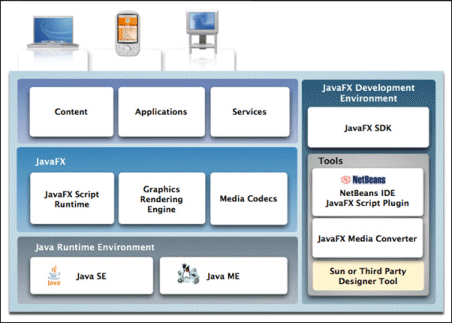
By contrast, Microsoft’s Silverlight does not require the full .NET runtime to be present, making it a much smaller download; and Flash has always been small.

The win for JavaFX is access to all the services of Java:

…JavaFX applications can leverage the power of Java by easily including any Java library within a JavaFX application to add advanced capabilities. This way application developers leverage their investments in Java.

On the other hand, it means a more complex and heavyweight install for users who do not have the right version of Java itself already installed. The Windows JRE is currently around 15MB for the offline version – there’s a 7MB “online” version but my guess is that it downloads more stuff during the install. I suspect that Adobe’s Flash would never have taken off if it had been that large a download.

When I spoke to Sun’s Rich Green earlier this year I recall that he agreed that a small download was important. Maybe I have this wrong, or a smaller runtime is planned for some future date.

It’s interesting that in his official blog post today, Josh Marinacci takes a Java-centric view:

So why am I excited about JavaFX? Because it gives us the freedom to create beautiful and responsive interfaces like never before. This isn’t to say you can’t do it in plain Java. If you’ve been to any of the last 4 JavaOne’s then you’ve seen great interfaces we’ve built. But these demos were a ton of work.

Right; but you could easily build these “beautiful and responsive interfaces” in Flash, both then and now. It’s a question of positioning. Is JavaFX just a new GUI library for Java – which will be welcome, but limited in appeal to the Java crowd? Or a serious alternative to Flash? At the moment, it looks more like the former.
Technorati tags: , , ,

FluorineFx and Weborb bring fast web services to .NET and Flex

Adobe’s Andrew Shorten contacted me following my piece on consuming .NET SOAP with Flex.

He mentioned two free products which integrate Flex with .NET.

Fluorine “provides an implementation of Flex/Flash Remoting, Flex Data Services and real-time messaging functionality for the .NET framework.”

WebORB from Midnight Coders “supports Action Message Format (AMF) version 0 and 3 and can be used to process Flex and Flash Remoting requests. Additionally, WebORB provides an implementation of the RTMP protocol and supports the following real-time messaging and streaming features: Flash Video streaming, video recording, data push, server-to-client invocation and remote shared objects.” There are also implementations of WebORB for Java, PHP and Ruby.

These look useful if you want to take advantage of the faster AMF protocol or use other features like RTMP. The disadvantage: more server-side gunk.

Technorati tags: , , ,

My first Google Knol

On reading this morning that Google has opened Knol to everyone, I thought I should have a go. There seems to be a predominance of medical Knols right now, so my Knol redresses the balance by covering a programming topic. Here it is:

Visual Basic

I deliberately did not look at whatever Wikipedia already has on the subject; knowing how good Wikipedia is on technical topics I am sure it is much longer and better than mine, and probably less opinionated.

Now I’m going to sit back and let the world improve my Knol.

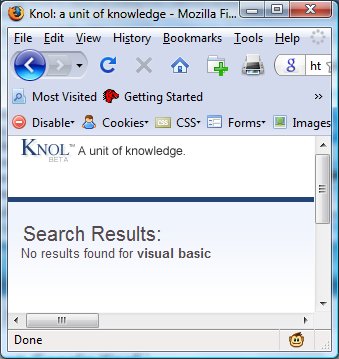
But will anyone find my Knol? Oddly, if I try a search for Visual Basic on the Knol home page, my article doesn’t come up, although I’ve published it:

Oh well, maybe it is still being indexed.

It seems to me that the rating system is key here, and one to which I gave too little attention last time I thought about Knol. The thing is, there’s nothing to stop someone else writing an article about VB, and if it gets rated higher (sniff), my contribution will be lost at the bottom of the Knol dustbin – because I suspect Google will use the ratings heavily when ranking Knols in searches.

Other points of interest: I started creating my Knol in IE7, but gave up because of script errors and continued in FireFox. Second, I tried to verify my identity by telephone, but this only works for USA telephone numbers. It’s a beta.

Update: Danny Sullivan has a good commentary. I agree with him about credit cards. I declined.

Technorati tags: ,

WCF Sessions with Silverlight and Flex

I wanted to adapt my Silverlight CRUD sample (which I also ported to Adobe Flex) to fix a glaring weakness, which is that any user can amend any entry.

I decided to add some logic that allows editing or deleting of only those rows created during the current session. The idea is that a user can amend the entry just made, but not touch any of the others.

WCF has its own session management but this is not supported by the BasicHttpBinding which is required by Silverlight.

Fortunately you can use ASP.NET sessions instead. This means setting your WCF web service for ASP.NET compatibility:

[AspNetCompatibilityRequirements(RequirementsMode = AspNetCompatibilityRequirementsMode.Required)]

Then you can write code using the HttpContext.Current.Session object.

This depends on cookies being enabled on the client. In my simple case it worked fine, in both Silverlight and Flex. In a real app you would probably want to use HTTPS.

I’d post the sample but unfortunately my Windows web space doesn’t support WCF.

Technorati tags: , , ,

Testing a web service with IIS 7 on Vista

Not long ago I created a simple CRUD example using Silverlight 2.0 beta 2. I used Visual Studio 2008 and the ASP.NET Development Server. I wanted to test the same WCF web service with a different client (more on that soon), so I decided to deploy it to the instance of IIS 7.0 which comes with Windows Vista. I created a new web site on a different port than the default.

Nothing worked. Reason: although I have installed .NET 3.5 SP1 beta and Vista SP1 – which should do this automatically – the IIS 7 mime types and  handler mappings were not configured for Silverlight and WCF. How to fix the mime type is here and the handler mappings, here.

The web service still didn’t work. I got:

A first chance exception of type ‘System.ServiceModel.ProtocolException’ occurred in System.ServiceModel.dll.

I changed the debug options to break on all managed exceptions, and got this further detail:

The remote server returned an unexpected response: (404) Not Found.

Problem: Silverlight is looking for a cross-domain policy file.  The reason was that at this point I was still running the Silverlight app from the ASP.NET Development server, and it considered IIS to be on a separate domain. The 404 error does not make this obvious; but a quick Google for Silverlight 404 shows that this is a common problem.

Silverlight is designed to support cross-domain policy files in either Microsoft’s format (clientaccesspolicy.xml) or Adobe’s format (crossdomain.xml). If the service is just for Silverlight, use Microsoft’s format; otherwise I suggest adding both.

Nearly there; but I still had to fix SQL Server authentication. I normally use Windows authentication, and if you are using the ASP.NET Development server this just works. Move to IIS though, and it does not work unless you set up ASP.NET impersonation, or create a SQL Server login for the account under which the application pool is running. Oddly, when I tried the app without fixing the SQL Server login I still got a 404 exception; I’m not sure why.

Incidentally, I noticed that if you configure ASP.NET impersonation for a web site, the username and password gets written to web.config in plain text (bad). If you configure the application pool to run under a different account, the password is encrypted in applicationHost.config (better). In the end I decided to use good old SQL Server authentication.

One last tip: when debugging a web service, put the following attribute on the class which implements your ServiceContract:

[ServiceBehavior(IncludeExceptionDetailInFaults = true)]

Otherwise you get generic fault messages that don’t help much with debugging. Remove it though for release builds.

Once I’d fixed the SQL server login, everything was fine.

Debugging PHP code to fix a WordPress problem

How do you debug a PHP application? Traditionally developers resort to outputting variable values to HTML, or peering through logs, but why not set breakpoints and step through code just as you would in C# or Java? Maybe because it can take some effort to set this up, as I was reminded today.

I was motivated by an annoying WordPress problem which I’ve blogged about before. For historical reasons, I have a lot of subscribers to an old RSS url which delivers the feed in the now deprecated RSS 0.92 format. I prefer to have a full text feed, and this used to work fine with WordPress, which placed the entire blog post in the element of the feed.

At some point this stopped working, and subscribers got a summary only. In fact, the feed broke completely for a while, after I switched to pretty permalinks; but even after fixing that, I still had the problem with summary items. I tried upping the length of the description, but it was delivered without any HTML formatting so that did not work.

Next I tried the WordPress support forums. There are lots of good folk there; but if you review the posts its clear that many queries go unanswered. That’s nobody’s fault; it is a community, and for whatever reason there seem to be more people seeking help than there are experts with the time to give free advice.

So how about debugging the PHP code and working out what was happening? It seemed a good opportunity to try the latest Eclipse Ganymede, released a couple of weeks ago, along with the PHP Development Tools (PDT). I also figured it would be easier to set this up on Linux, to match what I use on the web server. I used the same Ubuntu on VirtualBox setup that worked well for trying out SproutCore. It worked…

Debugging PHP with Eclipse Ganymede

…but I can’t pretend it was wholly straightforward. Here’s how it went. I installed the latest Ubuntu distro versions of Apache, MySql and PHP – easy. Ubuntu’s Eclipse is not the latest, so I downloaded it from the Eclipse site and used some tips to set it up tidily. Note: make sure Sun Java is installed; I set it as the default JVM. Adding the PHP development tools was more fiddly. I’d half expected this to be part of a standard Eclipse download by now, but it is not, and if you try to install it into Ganymede using the standard update site is does not work because of dependency issues (a big problem with Eclipse). You have to download a 2.0.0 build from here instead.

I’d decided to use the Zend debugger – that’s a separate Eclipse update too, as explained here. Note that even after updating Eclipse, you still have to install the separate Zend debugger server from here, if you want to debug real web applications. I had a few problems getting this working, mainly because of the zend_debugger.allow_hosts directive which you have to edit in php.ini, and which is not brilliantly documented.

I replicated my blog on the Ubuntu virtual box – easy. But how do you get your Eclipse PHP project pointing at this existing code? The method I settled on after a couple of experiments was to start a new PHP project, uncheck the Use default option for project contents, and select the blog directory in /var/www. You then get a scary dialog which observes that files already exist. You can either create your project as a subdirectory, in which case you cannot debug with the existing files, or else pass the scary warning:

Create project in /var/www/blog
(Deleting the project will delete the entire /var/www/blog folder)

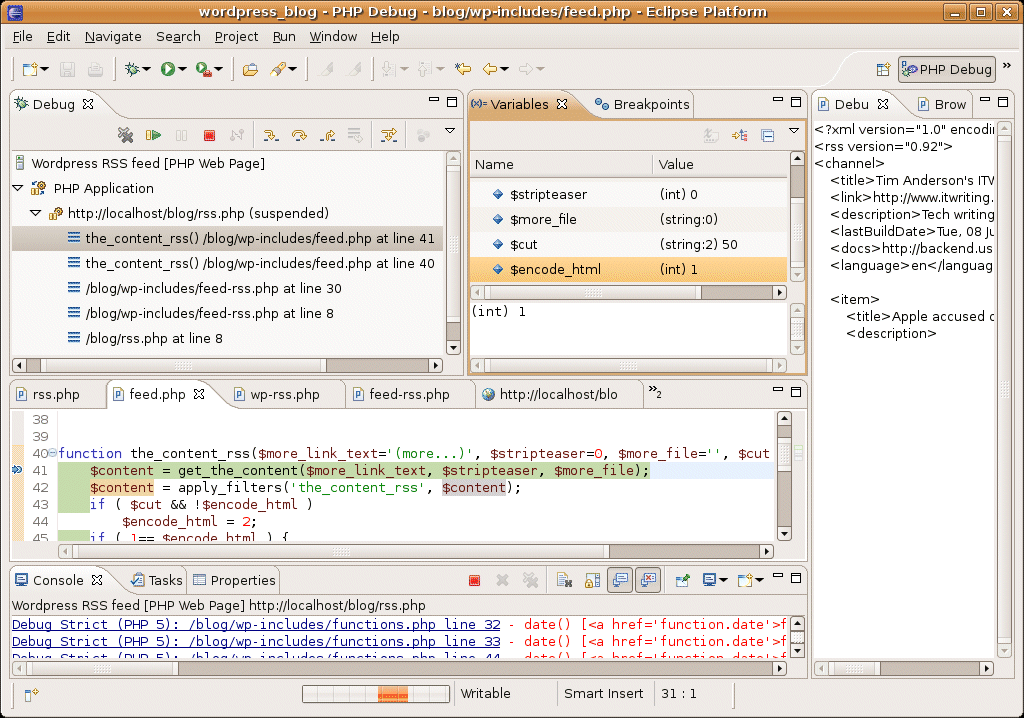
I mis-read this at first, thinking it would delete all the files when creating the project. That’s not what it says. Everything was a backup anyway, so I took the plunge; it worked fine. In fact, if you look closely at the screenshot above (click for a full size image) you can see that it is nicely done. You can see the call stack at top left, current variable values, output as it is being generated, and the usual options to step into or over the code.

That said, I did have some problems with Step Into. Just when it was going to be most useful, it bombed out with a message that said Error. If you looked at the detail, that also just said Error. The only fix I found was to set breakpoints in the actual file I needed to debug.

Still, it worked. I found that by adding a single argument to a line in feed-rss.php I could get my full text feed back. I’ve duly reported this in the WordPress support forums.

A couple of observations.

First, I don’t much like the WordPress code. Sorry, because the product is marvelous, but the code seems like a typical PHP tangle. Using pretty permalinks, which I regret, makes it worse.

Second, are there not plenty of developers who use both Java and PHP and would like it to be a tiny bit easier to set up in Eclipse? I’m being a little unfair, since Ganymede is just out and I guess the PDT will integrate better with it soon. Even so, Eclipse is still not quite the smooth plug-in dream that I once hoped it would become.

Note that if you don’t mind paying, you can have Zend Studio which I should think makes life easier. Or perhaps Delphi for PHP.

Sample code for a very very simple VB database application

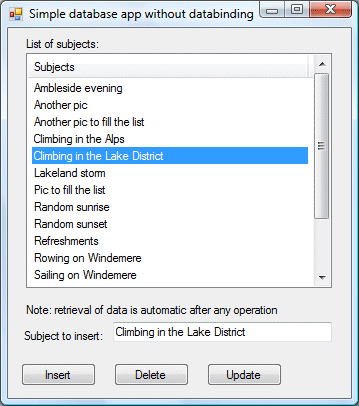
I wrote a short piece for Personal Computer World about making a simple Windows Forms database application. I did this because I get a lot of enquiries about it, and search hits to this site looking for samples.

The piece is actually in two parts. Part one shows how to do CRUD without any databinding or datasets.

You can download the code here – but please don’t bother if you can already do this in your sleep. The app is for Visual Basic Express 2008.

Part two is about using the VB wizards to create an app with a typed dataset, TableAdapters and so on. The database is SQL Server CE, which is well suited to this kind of application. It is the default in Visual Studio 2008 even though it turns out not to be fully compatible with the wizards. Typical Microsoft – simple, but with enough gotchas to frustrate beginners and keep experts in business.

I ran into another little puzzle while doing the sample. I needed to populate the listbox with both a string value and the ID that is the primary key in the database table. The way I would do this normally is to create a custom class to represent the record, implement a ToString() that returns the display value, and add instances of this object to the listbox. I wanted an even simpler way though, so I decided to use a ListView. This lets you add items that have both a key and a value. You can do this with one of the overloaded Add methods for a ListViewItemCollection, documented like this:

Creates an item with the specified key, text, and image and adds an item to the collection.

The strange thing is, the ListViewItem has no key property. So how do you retrieve the value of the key?

The answer is that the ListViewItem.Name property returns the value of the key. So the key is the name. Why not call it the name in both places? Or the key?

I guess that would be too easy.

The messy world of the Web 2.0 user interface

Verity Stob’s Web 2.0 app diagram is worth a look.

So is it back to plain old HTML+forms then? That won’t do either; your app will look a decade old, and offline will never work.

This is why the current RIA wars are fascinating – particularly since Apple seems averse to runtimes like Flash, Java or Silverlight on its iPhone.

Which leaves what? JavaScript, hélas.

Have you found an AIR app you actually use yet?

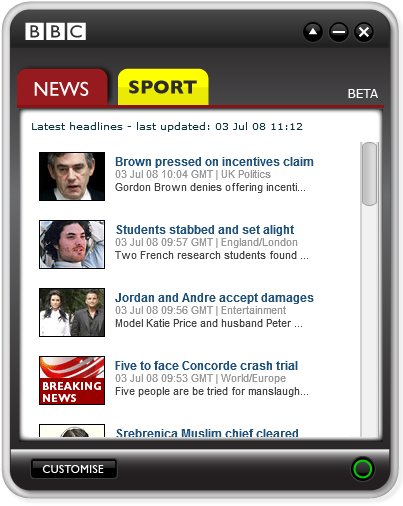
Today I downloaded the BBC’s new Adobe AIR application, BBC Live.

This installs as a system tray app on Windows. It’s a beta. Nice little app; but it’s competing against my existing RSS reader which is subscribed to the BBC news feed. The AIR app is much prettier, has images, and lets you customise the feed easily. However, the RSS reader deals with lots of feeds; and I can’t imagine running a separate application for every one. The advantages of the BBC app are rather small compared to the convenience of using a single application for multiple news sources.

Lifehacker recently published a list of the top ten apps worth installing Adobe AIR for. The list had a contrary affect on me, since there is nothing there that I find really compelling. I tried the eBay Desktop app, for example, but much prefer visiting the web site.

So … personally, I’m still waiting for an AIR app to love. But I’d be interested to know what others are running and finding useful.

Technorati tags: , , ,