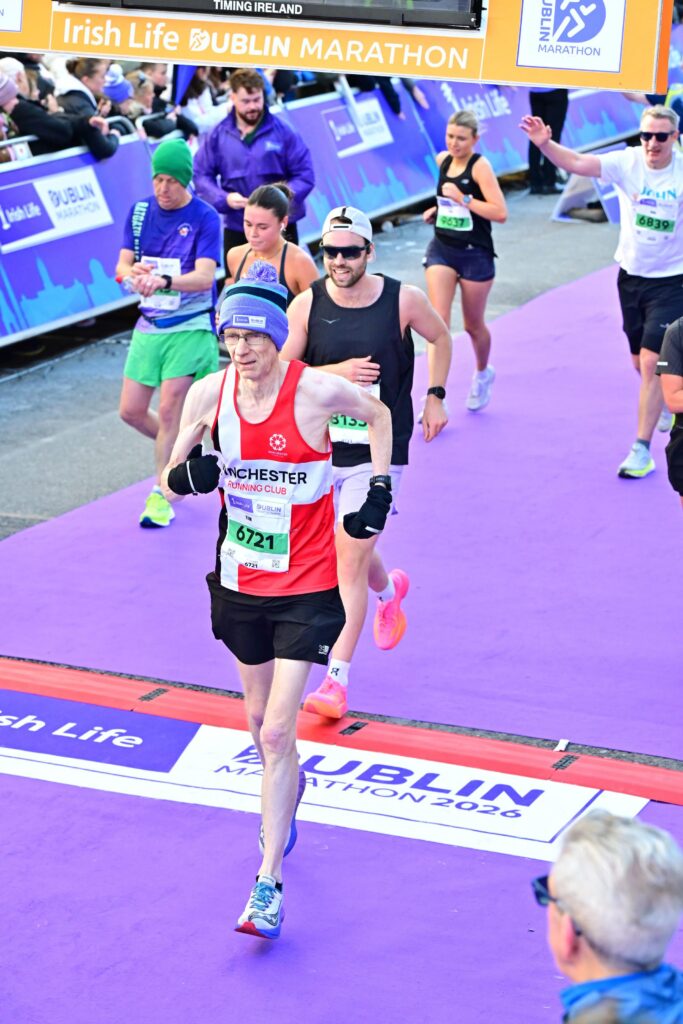
This is my Dublin Marathon story but begins a long time before – as often said, the marathon is the training. 2025 was amazing for me, every run went well including being an England Masters Representative at the Abingdon Marathon (3:26:13) and PBs at every distance from 1 mile up. Running seemed so easy; but from around December my body started to protest. The first thing to go wrong was an unusual injury called Flexor Hallucis Longus tendinopathy, which went months without an accurate diagnosis, messing up my training for the London Marathon in April. I recovered just about in time to get in some decent runs and ran London in 3:40:41. After that I hoped to be back on track; but a chest infection slowed me down, and then when I began to ramp up the miles in preparation for Dublin I pulled a hamstring, a classic case when during a last sprint at Parkrun my right leg collapsed; it did not hurt at the time, but the next day I could not run a step without agonizing pain.
I am not sure why all this happened but consider it to be a combination of much reduced core strength training along with long-term fatigue. It was also a mental thing; during 2025 I was fired up to achieve certain goals, run a marathon sub-3:30, qualify for London good for age, and so on. Once you plateau or start slowing down your goals have to change, perhaps in a good way if you run more for enjoyment and put less pressure on yourself.
Fixing the hamstring meant lots of core strength training, but running at something like full pace and distance did not happen until late September when I ran the Winchester Half. After that I managed one 20-mile training run at a slow pace (between 10 and 11 minutes per mile), another long run of 16 ½ miles at a similar pace, and otherwise just shorter runs to keep my legs moving.
Core strength training on the other hand – I have been obsessive since the hamstring problem with 4 or 5 sessions a week of a workout targeting various muscles.
Onto Dublin then, beginning with the Expo on the Friday before to collect the bib and a fine goody bag with a woolly hat and numerous free samples. I enjoyed the expo though there were many complaints about longs wait times both in an out of the car park – my advice would be to park elsewhere (we walked from the city centre).
Next day was the usual calm-before-the-storm Saturday including a tasty pasts-based carb load at lunchtime followed by only light feed for the rest of the day. The usual taper capers; I had a cricked neck from sleeping in an unfamiliar bed and a sniffle but nothing major. I researched how to treat a crick in the neck and saw the advice, “do not run or jog.” Never mind!
Race morning I headed out too early. Note to self: races before the start are miserable and one should arrive as late as possible, bearing in mind bag drop times and the like. It was a cold October morning; windy, not the lashing rain and storm once feared, but I was shivering despite my throwaway hoody and glad of my decision to wear woolly hat and gloves for the race itself. Despite copious amounts of hanging around, a last minute loo break meant that I was late into the start wave and could not get near the 3:50 pacers I had planned to start with. My idea had been to stay with them or even get a little ahead, but to allow myself to slip a bit if necessary and hope to finish under 4 hours.
The start was congested which at least meant there was no need to make any pace decisions early on, there was little scope even for weaving. The first mile was at a comfortable 9:00 pace, then as the congestion eased I increased my pace a little. I remember thinking that reaching 5K seemed to take an age, but 10K arrived in no time; funny how time plays tricks during a marathon. I got the beginnings of a stich and insisted to myself that stiches always fade away for me, and fortunately this one did. We passed through Phoenix Park then out onto a road with some fine views of Castleknock, then back into Pheonix Park and out again to the halfway point in Crumlin Road, tough going with a strong headwind. The first half had passed in 1:56:26, on target for 4 hours but without much scope for slowing down.
Mentally I divide marathons into three sections: the first half, then 13 to 20 miles (which Pfitzinger and Douglas call the no-mans land of the marathon), then the final 6.2 miles. It was in this second section that I hit some serious fatigue, not surprising given the interrupted training. I felt I was slowing down but hardly checked my Garmin when it beeped each mile, especially since it was now well ahead of the actual mile posts: my recorded distance in the end was 26.45 miles, substantially more than a marathon. I began to think in terms of a 4:10 or 4:15 time and not to worry about it. That said, I wanted to run rather than walk and so pressed on, reminding myself that I was more than half-way to the finish.
This was my sixth marathon but every one has been an intense experience and one that is hard to describe, starting in earnest in the second part of the race. It is enjoyable in some ways, especially a race like Dublin with fantastic crowd support and lots of friendly faces, but also unrelenting as one tries to keep up the pace. My body was holding up pretty well; a few niggles from time to time and a moment which I thought might be the beginning of cramp in my right calf but which soon fixed itself.
The miles ticked by and I was pleased to see mile 20 and to enter that difficult last 10K, just two parkruns to go. Of course they are also the hardest miles, but I had reached the point of not caring too much about my time and just to keep running. I braced myself for the “Irish heartbreak hill,” a 3K climb starting on Roebuck Road between miles 20 and 21. In the event I hardly noticed it, a benefit of training in hilly Winchester. Apparently an earlier hill in Phoenix Park is actually longer and steeper, but one notices it less.
After taking gels every five miles (and a Clif Blok just to vary it a bit) I had a trace of the nausea I had suffered before in New York, probably related to hydration, so I stopped at the last drink station, between mile 24 and 25, and drained a full cup.
At mile 26 I saw my wife, waved for the camera, and looked at my watch. To my surprise it said 3:56 and sub-4 was on after all. Perhaps if I had realised, I would not have dawdled so long at the drink station. Picked up the pace a little and came in at 3:57:56. I had slowed down in the second half, but not as much as I had thought.
After receiving my medal and a nice long-sleeved finisher top I walked for what seemed like a long way to collect my things – the bag drop shuffle, surrounded by fast marathoners suddenly transformed into painful walkers. I was sore but in one piece; no hamstring issues, nothing that would not recover in a few days. It was still cold though, it seemed that the temperature had not risen much since the early morning despite some sunshine, and after emerging into the city we dived into the first available café for a snack and warm-up.
Dublin you were great; the crowd support was lovely, the medal and finisher top look really good, the pint of Guinness later very tasty, and thanks also to Sports Direct for a free medal engraving and photo the following day.