Category Archives: .net

Flash library for Facebook, Silverlight library for MySpace

Adobe and Facebook have announced that ActionScript 3, the language of Flash 9 and higher, is now officially supported by FaceBook along with JavaScript and PHP. Information about coding for Facebook with Flash is here, and the library itself is on Google Code.

MySpace has announced the MySpace Silverlight SDK which will be hosted on Microsoft’s CodePlex open source site. The focus of the Microsoft Silverlight work seems to be on wrapping the Open Social API used by MySpace in a C# library.

Note that there is already documentation on creating Flash applications for MySpace. On the Facebook side, here’s an intriguing fact: there’s also an Fb:silverlight tag, though the documentation remarks: “For now this feature has no functionality.” Fb:swf is better supported. David Justice has been working on a Facebook library for Silverlight. It’s clear though that Flash is more widely accepted and supported on both platforms, reflecting its maturity and broader acceptance.

Smart developers can already devise code to access the public APIs of platforms like Facebook and MySpace from a variety of clients; this is about making that easier. It benefits the social networking sites if a wider group of developers has access to its platform, and with the advantages of multimedia features; equally it benefits the plug-in vendors if their runtime works smoothly with the broadest possible range of services. Therefore we should expect more of this type of announcement.

It is interesting to see technology partnerships bridging political divides. Microsoft has a stake in Facebook, for example, while Google has a partnership with MySpace.

Perhaps the most interesting outcome may be more Facebook applications based on AIR, Adobe’s Flash platform for the desktop. The existence of AIR applications like Twhirl and Tweetdeck has significantly boosted Twitter; maybe it is now Facebook’s turn.
Leaving Las Vegas: Mix09 wrap-up

I’m heading back to London after 3 days at Microsoft’s Mix09 conference in Las Vegas. I took the opportunity to ask a few delegates what they thought. One thing that everyone seemed to love was SketchFlow, a new feature of Expression Blend which enables designers to sketch out design ideas, distribute them for discussion and annotation, collect responses, and export the results to Word to create a report or proposal. It looks like SketchFlow has been influenced by Bill Buxton, who gave a keynote at Mix, since it embodies one of his key ideas, that design ideas should not look too finished as that inhibits the response.

There was also enthusiasm for Silverlight 3.0, with its numerous new features including out-of-browser support. Several Adobe folk were at Mix sizing up the competition; one was Mike Downey who commented:

I’m really impressed by how much Microsoft has gotten done with this whole platform so quickly. They’re catching up really fast. #mix09

It’s true that Silverlight is maturing with remarkable speed, and many of the developers I spoke to were using it or planning to use it.

That said, we are really talking about Microsoft platform people, most from a developer background. I got some insight into what Microsoft is up against chatting to some design students and a lecturer on the bus to the airport. Microsoft sponsored their visit to Mix in an attempt to get them interested. They all use both Macs and Adobe tools; and the lecturer said to me, “we already get the students to install 7 different pieces of software for the courses we run; why should I add two more (meaning, I think, Expression Blend and Visual Studio)? The Mac issue is huge; there is some work being done to support Silverlight design on the Mac, but it is rudimentary in comparison to Blend.

The sessions on ASP.NET MVC were well attended and of the developers I spoke to, those who grasp what it does are delighted with it and intend to use it – several had evolved their own ASP.NET frameworks out of frustration with Web Forms. It appears though that Microsoft didn’t pitch ASP.NET MVC in a way that communicated well with developers not already familiar with it. Some had attended sessions but still didn’t really grok what it does.

Mix day one, with the Buxton/Guthrie keynote, went down better than day two, which had the IE8 launch and Deborah Adler presenting her research and commercial success designing medicine bottles – interesting but over-long in a web conference. IE8, which was a highlight of Mix08, didn’t make much impact here as everyone already knew all about it, and it no longer looks so impressive one year on, even though it is a big advance on IE7.

Windows Azure didn’t appear to make much impression here, though there is relief that SQL Data Services is getting full relational features. I attended a UK round table on Azure with the other UK journalists who made it out here, Jon Honeyball, Simon Bisson and Mary Branscombe. I observed that Azure is widely misunderstood or not understood, that the follow-up since PDC has been poor, and that the web site relies too much on videos and is confusing to navigate; the early access system based on developer tokens is also problematic. I reckon Microsoft needs to do more work on communicating what Azure is about, if it is to win any mindshare from other cloud contenders.

Still, overall this was a good Mix; one delegate said it was the best Microsoft conference he’d ever attended. The wi-fi worked. The conference layout is good for networking and the warm atmosphere was not just a consequence of the desert air.

By the way – Mix10 has been announced, same place, March 15 – 17, 2010.

How to print in Silverlight out of the browser

Trick question, you can’t, or not in any sane way that I’ve discovered. When an app using Microsoft Silverlight is running in the browser you at least have the browser’s print features, but a SLOOB (Silverlight Out of Browser, a new feature in Silverlight 3) does not even have that to fall back on.

This is unfortunate for business applications, though of course many applications are fine without print features.

Workarounds: well, you can press Alt+PrintScreen and paste into Paint…

Another idea is to generate a document in code, then let the user “download” it from your SLOOB to somewhere on the desktop, since finding a document in the app’s isolated storage would be a challenge. The user can then print the document at his or her leisure.

What this illustrates is that even in version 3.0, Silverlight is not altogether mature, especially for this new out-of-browser feature. I’m told that print support is planned in some future version – Silverlight 4.0 I guess. Software is always a waiting game.

Note this post is based on the Silverlight 3.0 beta; it’s just possible something could be added in the final version.

Technorati Tags: ,,

F#, Enterprise JavaScript at QCon London

The best sessions here at QCon London have been the small ones, not the big ones. Yesterday the slot I enjoyed most was from Attila Szegedi on JavaScript in the Enterprise. He uses Mozilla Rhino for server-side development. It’s not a mainstream choice; but he made a case for it, saying that continuations in JavaScript bring huge benefits, that there is a ready supply of developers with JavaScript skills (albeit mostly browser-based), and JavaScript is so flexible that he can work around any limitations.

One example is that JavaScript has no namespaces; but it does support function pointers, so he adds a bunch of function pointers as members of an object, and then that object works like a namespace.

Szegedi says he has little interest in ECMAScript 4.0 – once thought to be the future of JavaScript – because there is no community consensus around it.

Today I’ve just attended a session on Microsoft F# given by Amanda Laucher. F# is a functional language that will be released as part of Visual Studio 2010. I knew little about it until today. Laucher gave a code-heavy presentation looking at how the ease of concurrency in F# can greatly increase speed of execution, using an example from the car insurance industry.

Laucher said that threading in C# is horrible in comparison.

Developers are not going to abandon C# or Visual Basic in favour of F#. Rather, they will encapsulate pieces of functionality in F# where they can get benefit, and call them from their C# or VB application.

Technorati Tags: ,,,,,

QCon London 2009

I’m at QCon London and covering it on Twitter as wi-fi and battery power allows. The focus of the conference is enterprise development, and it spans Java and .NET, SOAP and REST, but with a bias towards Agile methodology.

I was here last year, and my observation is that last year there was considerable angst about the idea that the SOAP stack was failing to deliver and that new stacks based on REST were the thing to do.

This year this same statement feels more widely accepted and people are moving on, based on that assumption.

One delegate stuck his hand up and asked, “is this a fad, or will it last”? Sounds like a cry of pain from someone who invested heavily in something now condemned. History tells that in five or ten years time we may well be equally enthusiastic about some new thing and observing all the weaknesses in the bad stuff we used to do.

Still, these trends don’t form overnight. We have to choose what looks like the best model at the time.

I’m typing this during a session on test-driven development. Personally I think TDD is a more profound improvement in the software development process than REST vs SOAP; the detail of TDD will continue to evolve and be debated; but its basic ideas are hard to challenge.

As an aside, this is one factor in why ASP.NET MVC is so important for developers on Microsoft’s web platform. Reason: it’s testable.

Mono creeping into the mainstream?

For those of you who have not already seen this link on Twitter: I’ve posted a short piece on Mono, the open source implementation of Microsoft .NET. The piece was prompted by my own experience writing a simple .NET application in Visual Studio and deploying it to Linux. Admittedly I anticipated the move by using MySQL rather than SQL Server as the database; but even so, I was impressed by how easy it was – I spent more time recently deploying an application from Visual Studio 2008 to Windows Server 2008, thanks to some issues with SQL Server Express.

Don’t Miguel de Icaza’s comment about scalability and garbage collection, two of the factors that have deterred some from real-world Mono deployments.

Hands on with ASP.Net Membership, SQL Express and Server 2008

Is it worth using the built-in membership framework in your ASP.Net application, or should you roll your own? I’ve been trying it out recently, and I have mixed feelings.

On the plus side, it does get you up and running quickly with user login and role-based permissions, saving time and possibly achieving more reliable results, on the grounds that Microsoft and countless other users should have found and fixed any bugs by now.

One the negative side, there are annoying limitations. The most obvious one is that a user as defined in the framework only has a minimal number of fields, not including information you probably want to store like first and last name. You are meant to fill this gap by using profiles, another ASP.Net feature which lets you store arbitrary name-value pairs in a database as a kind of persistent session. That works, but the way profile properties are stored makes it hard to do things like sorting users by last name. Therefore, you will probably end up managing your own user database and joining it to the membership system with the user ID, at which point you begin to lose some of the benefits.

Some of the supplied controls, like the CreateUserWizard, seem rough-and-ready too.

Still, the real fun began when I tried to deploy my demo app to Server 2008 and SQL Server Express 2008. By the way, make sure you install .NET Framework 3.5 SP1 and Windows Installer 4.5 before installing the latest SQL Server Express, otherwise the setup spends ages unpacking its files and then exits with a brief message. I got there eventually, copied my application across, and optimistically tried to run it.

When you debug a web application in Visual Studio, it defaults to a SQL Express database in the App_Data folder within the web site, attached on demand. In theory, that should make it easy to deploy to another machine with SQL Express installed: just copy it across, right? There must be a way of getting this to  work, but it seems a lot of people have problems. I got the message:

Login failed for user ‘NT AUTHORITY\NETWORK SERVICE’.

This makes sense, insofar as ASP.NET runs as this user. I temporarily attached the database and added the login, to be rewarded with a different and more perplexing error:

Failed to generate a user instance of SQL Server due to a failure in starting the process for the user instance.

A quick Google shows that many users have suffered from these errors, and that a large number of remedies have been proposed. I abandoned the idea of attaching the database on demand and set up a new database, made ready with Aspnet_regsql. I still got one or other of these errors.

Eventually I realised that my application was using more than one connection string. The problem is that the membership framework uses three different "providers", one for membership, one for roles, and one for profiles. By default in IIS 7.0, these all use an attach-on-demand connection string, defined as LocalSqlServer, and inherited from machine.config buried deep within your Microsoft .NET Framework system folder. In order to prevent ASP.Net membership from using this, you have to override all three providers in the web.config for your application. There’s an example in this article from ISP MaximumASP. I wish I’d come across it sooner; but my demo works fine now.

Programming language trends: Flash up, AJAX down?

I’m fascinated by the O’Reilly reports on the state of the computer book market in 2008, particularly the one relating to programming languages.

Notable facts and speculations:

C# is the number one language, overtaking Java (which is down 12%), and was consistently so throughout 2008. Although the .NET platform is no longer new and exciting, I’m guessing this reflects Microsoft’s success in corporate development, plus the fact that the language is changing fast enough to stimulate book purchases. Absolute growth is small though: just 1%.

Objective-C is growing massively (965%). That’s probably stimulated by iPhone app development more than anything else. It’s a perfect topic for a programming book, since the platform is important and popular, and attracting developers who were previously ignorant of Objective-C.

ActionScript is growing (33%). That’s Adobe’s success in establishing Flex and the Flash platform.

PHP is up 3%. I’m not surprised; it’s usually the P in LAMP, everyone’s favourite free and open source web platform. That said, the online documentation and community support for PHP is so good that a book is less necessary than for some other languages.

JavaScript is down 24%. I’m a little surprised, as JavaScript is still a language everyone has to grapple with to some degree. It may be a stretch; but I wonder if this is a symptom of AJAX losing developer mindshare to Flash/Flex (ActionScript) and maybe Silverlight (C#)? Another factor is that JavaScript is not changing much; last year’s JavaScript book is still good enough.

Visual Basic is down 15%. Exactly what I would expect; slow-ish decline but still popular.

Ruby is down 51%. This is a surprise; though it was well up in 2007 so you could be kind and describe this as settling. The problem with Ruby though is lack of a major sponsor; plus the migration from PHP to Ruby that seemed possible a couple of years ago just has not happened. It may be intimidating to casual developers who find PHP more approachable; plus of course, Ruby probably is not installed on your low-cost shared web hosting package.

Python is down 14%. Google sponsors Python, in that it is the language of App Engine, but apparently this has not been enough to stimulate grown in book sales. I guess App Engine is still not mainstream; or maybe there just aren’t enough good Python books out there.*

It will be interesting to see the 2009 report in a year or so. Meanwhile, I’m off to write an Objective C tutorial (joke!).

*Update: I was reading the charts too quickly; it looks as if the percentages above are only for the last quarter; the annual figures are similar except that Python actually grew over the year as a whole.

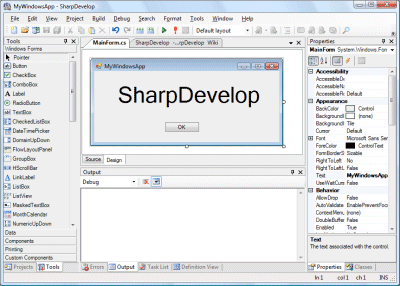
SharpDevelop 3.0: everything .NET from Boo to F#

I’ve been researching open source .NET and noticed that SharpDevelop, the free IDE for .NET on Windows, completed version 3.0 earlier this month. Congratulations to the team. Along with Windows Forms and ASP.NET applications in C# or Visual Basic, you get extras like support for F#, Boo and Python. Another welcome feature is built-in support for Subversion version control. There’s even an ASCII table in the IDE, which brings back memories: 15 years ago every programming manual had one at the back.

SharpDevelop has two major challenges. One is keeping up with Microsoft; right now there are discussions about improving WPF support, for example. The other is that Microsoft offers free Express versions of Visual Studio, which leaves SharpDevelop with those niche users for whom the Express products are unsuitable, but who do not want to pay for a full version, or who are wedded to some exclusive SharpDevelop feature.

In favour of SharpDevelop, it installs more easily and loads more quickly than Microsoft’s effort, and certainly proves the point that native C# applications do not have to be slow.

A more interesting though less complete product is the forked MonoDevelop, which is cross platform and targets Mono, the open source implementation of .NET. Mono now looks good on Linux; but the idea of WORA (Write Once Run Anywhere) has never really caught on in the .NET world. How many significant Mono applications for Windows have you seen? My guess is that if it happens at all, it will be in the form of Silverlight/Moonlight running in the browser.

Technorati tags: , , , ,

First screenshots of Visual Studio 2010 UI

Jason Zander has posted some screenshots and info about the new WPF-based UI for Visual Studio 2010.

An early build of VS 2010 was handed out at PDC last year, but lacked the new UI.

Floating document windows is a great new feature. That said, Visual Studio 2008 works rather well; I hope the new version is equally fast and stable.

Technorati tags: , ,