Category Archives: microsoft

What happens to the browser market when Google plays the OEM card?

Here’s a bit of speculation. My initial thinking about Google Chrome was that it would mainly take market share from Firefox; and that while IE’s share may continue to erode, Chrome is unlikely to accelerate that much.

I’m beginning to change my mind. One factor is OEM installs. We all know what a huge influence default installs have on users, which is why software vendors are happy to pay the likes of Dell and HP for space on the desktop, or to be the default anti-virus engine, for example. This has often been to the detriment of the user’s experience overall, to the extent that it helped to damage Vista’s reputation, but that is an aside.

Now, one thing I’ve noticed is that Google’s toolbar often turns up by default in OEM installs of Windows. When you start up for the first time (or the first time for real, after all those reboots), IE confronts you with Google’s terms of service. However, I have not yet seen Firefox installed as the default web browser. I’ve presumed that Mozilla doesn’t quite have the financial muscle to do it, or maybe there are other reasons.

Google is a more formidable presence than Mozilla. What if Google buys browser share by being the default browser on machines from the leading OEMs? I suspect that would soon impact IE’s share. Microsoft cannot prevent it because of anti-trust constraints.

Since Chrome is in effect the new Google toolbar, this move strikes me as inevitable.

This would mainly impact the consumer and small business space. IE has some special advantages for enterprises, since it hooks in tightly to Microsoft’s software management tools, and there are further improvements to this aspect in IE8. The consumer/business separation is a leaky one so it could still have a big impact.

Technorati tags: , ,

Flash and Silverlight are the Chrome losers, says Zoho boss

Zoho CEO Sridhar Vembu makes an interesting statement in an email he has circulated following the launch of Google Chrome:

The biggest losers in Google’s announcement are not really competing browsers, but competing rich client engines like Flash and Silverlight. As Javascript advances rapidly, it inevitably encroaches on the territory currently held by Flash. Native browser video is likely the last nail in the coffin — and Google needs native browser-based video for its own YouTube; so we can be confident Google Chrome and Firefox will both have native video support, with Javascript-accessible VOM (video object model) APIs for web applications to manipulate video. As for Silverlight, let me just say that if Silverlight is the future of web computing, companies like us might as well find another line of work — and I suspect Google and Yahoo probably see it the same way too.

These last weeks have not been good for Adobe. First there was the Harmony announcement, sidelining the Adobe/Mozilla Tamarin project and making Adobe’s ActionScript 3.0 look more proprietary. Now there is Chrome; and I’m inclined to agree with Vembu, that Google will try to move away from Flash dependency. If that is right, then neither Google, nor Microsoft, nor Apple wants to play the Flash game.

As for Silverlight, I see this more as a Microsoft platform solution, extending its reach beyond the Windows client. I doubt it will be much affected by Chrome, though Vembu is right in saying that the more capable the browser becomes, the less necessity there is for something like Silverlight.

What about Zoho itself? I would take it more seriously if it were not so desperately slow whenever I give it a try, in contrast to Google’s usually responsive servers. It may be better in the USA, or perhaps there is some other reason, but for me the performance just kills it.

Counting primes in Google Chrome

A while back I put together a quick prime counting test for Flash and Silverlight.

As someone noted, this test runs remarkably fast in Chrome, thanks to the V8 JavaScript engine.

Here’s the JavaScript version of the test – note that you cannot easily run this in IE or Firefox for larger values, because the script times out, though you can configure your browser to prevent this.

Here are my figures on Vista (lower is better):

  1. Microsoft Silverlight 2.0 beta 2: 0.464 secs
  2. JavaScript Google Chrome: 1.4 secs
  3. Adobe Flash: 1.667 secs
  4. JavaScript Mozilla Firefox 3: 6.046 secs
  5. JavaScript Microsoft IE7: 11.916 secs

I can’t easily test IE8 as I have it installed in a virtual machine.

10 things you might not have known about XAML

I’ve written a short piece on XAML for the Register. Here’s a few things you might not have known about Microsoft’s Extensible Application Markup Language:

1. It is not just for WPF (Windows Presentation Foundation); it is also used as a language for Workflow Foundation (WF). Microsoft has hinted that we will see more XAML applications announced at the forthcoming PDC.

2. XAML doesn’t have to be XML – see the intro to the XAML Object Mapping Specification 2006, which says that “any physical representation may be used.”

3. XAML is a small core and distinct from XAML vocabularies. The huge WPF is a XAML vocabulary. WF is another vocabulary.

4. Although XAML is usually represented as XML, it is near-impossible to create an XML Schema to validate it usefully. Here’s where Microsoft explains why.

5. In Visual Studio 2005, a huge but imperfect .xsd schema file was used for validation and to drive IntelliSense (things like code completion) in the XAML editor. In Visual Studio 2008 Microsoft abandoned that idea and uses a language service instead.

6. The core idea behind XAML is to be a declarative language for .NET. WPF is merely an early application for XAML.

7. XPS, Microsoft’s fixed-layout language that competes (just about) with Adobe’s PDF, uses XAML that is a subset of WPF. This means that you can actually display XPS documents in Silverlight – there’s no need for a viewer, it is native Silverlight code.

8. When you compile a Silverlight application, the XAML stays as XAML, albeit bundled into a resource.

9. Silverlight allows you to write inline XAML within HTML.

10. XAML rhymes with Camel. Sorry, you knew that already. But did you know that CAML (Compiled Application Markup Language) is XAML compiled to MSIL (Microsoft Intermediate Language)? Microsoft tested this idea in pre-release versions of WPF, but apparently the performance benefits were disappointing and it was less compact than BAML (Binary Application Markup Language), a tokenized representation of XAML. Silverlight doesn’t bother with either: XAML is saved as a resource in a .NET DLL, and then zipped as part of the .XAP package by which a Silverlight application is delivered.


Technorati tags: , , , ,

The new Google Chrome browser: a bad day for Firefox

The Firefox angle is what puzzles me about Google’s announcement that it is is launching a new open source browser. We should get to try it tomorrow; perhaps we’ll see that Google is successfully reinventing the browser. In particular, this is a part of what is sometimes dubbed the Google OS: the client for cloud applications running on Google’s servers:

Under the hood, we were able to build the foundation of a browser that runs today’s complex web applications much better.

Google is using some proven technology in the form of the Webkit rendering component (as used in Apple’s Safari). I imagine it can do a decent job. But why? From Google’s perspective, the browser market was shaping up nicely already. Microsoft’s IE has a still large but declining market share; Mozilla Firefox is growing, has a vibrant community, and relies on Google for the bulk of its income in return for making it  the default search engine – a deal which has just been extended for three years.

Now Google appears to be going head-to-head against Firefox. It won’t necessarily succeed; Firefox has lots of momentum and will be hard to shift. Equally, I doubt that Microsoft’s market share will decline significantly faster against a Google browser than it would anyway against Firefox.

The risk is that this will split the open source community.

As for Firefox, this can only be bad news. It has the embarrassment of relying on a major competitor for its income, and the knowledge that it is driving traffic to a company that will push users to switch to an alternative.

Maybe Google Chrome is so good that it will all make sense when we get to try it. For sure, it is an intriguing development for web applications and I’m looking forward to seeing how well Google can substantiate its claims that it is “much better” for the job of running them.

Internet Explorer 8, FireFox 3 pop-under failure

I attended a UK briefing for Internet Explorer 8 last night. An interesting product which I’ll be writing plenty more about – you can get it here. Installed smoothly on my Virtual Box Vista.

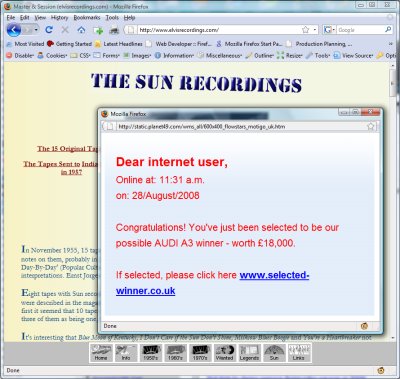
At the event I mentioned to someone from the IE team that it is annoying how pop-ups still somehow get round the pop-up blocker. The guy seemed mildly surprised and asked me to send him any urls I found. I didn’t have to wait long. If you want obsessive detail on the recordings of Elvis Presley, a great site to visit is elvisrecordings.com [warning: pop-ups and pop-unders]. I can’t recommend it though, because there are some annoying scripts there. I thought this would make a good test for IE8 Beta 2. The home page has some stuff that gets blocked, and it has some Java which doesn’t run because I haven’t installed it yet, but if I click the link for the Sun recordings (arguably the best of Elvis) I get this:

The only extra step I took to get this screen was to click the pop-under in the task bar so it came to the front. Lucky me, I’m a “possible Audi A3 winner”.

Just to be fair, I tried it in FireFox 3. Same result:

Maybe it is just too difficult to block this stuff successfully without breaking pages.

The other question: why do otherwise useful sites pollute themselves with this junk? Is the money really that good? For what it’s worth, the culprit seems to be a “free” web stats provider called Motigo. Avoid.

I’ll forward the url to my contact.

Vista shell annoyances

CodeGear’s Barry Kelly has a well-explained list of Vista shell annoyances. I don’t dislike Vista as much as Kelly but these things annoy me too, with the exception of the Start menu which I prefer in its Vista guise. Kelly doesn’t like the way Vista constrains it to a scrolling panel, but I find the search box more than compensates, and I dislike the way the XP Start menu expands all over the screen and gives up when it runs out of room.

He includes a handy tip about how to get a direct shortcut to the Network Connections control panel applet.

There’s an interesting point about menus in Vista applets:

It has become fashionable for applications designed for Vista to hide menu bars. Unfortunately, they usually haven’t been replaced by a viable alternative.

In every case I can think of – for example, Internet Explorer, Explorer, Media Player – I’ve enabled the traditional menus, even though they are hidden by default.

Technorati tags: , ,

Detailed article on Microsoft’s Midori published

The Software Development Times has an in-depth look at Midori by David Worthington, based on “internal Microsoft documents”:

SD Times has viewed internal Microsoft documents that outline Midori’s proposed design, which is Internet centric and predicated on the prevalence of connected systems.

Recommended if you are interested in what Microsoft is contemplating for a future OS. Note that there’s no official word on whether this is more than just another research project.

Technorati tags: , ,

Silverlight 2 threading issues, Quickstarts not working

I’ve been working on a Silverlight tutorial involving reading an RSS feed. Silverlight has a SyndicationFeed class which is meant to make this easy – as Microsoft’s Scott Barnes enthuses here.

It is handy, but I discovered that the Quickstart Barnes refers to does not work in Silverlight 2 Beta 2. The Quickstart section on Silverlight.net needs some work. Even if you get to this Quickstart via the link for Silverlight 2 Beta 2 examples on this page, it is soon apparent that it is actually for Silverlight 2 Beta 1. Click the Run It button and you’ll see that it asks for the older runtime.

The code doesn’t work in Beta 2 either; and as so often with thread-y stuff, it’s not immediately clear what’s going wrong. I got a blank page and the following message in the Debug output window in Visual Studio:

A first chance exception of type ‘System.UnauthorizedAccessException’ occurred in mscorlib.dll

In situations like this I recommend breaking on all CLR exceptions (Debug – Exceptions – check the Thrown box for Common Language Runtime exceptions in Visual Studio). Run again; and this time Visual Studio stops on the line which updates a Silverlight TextBlock:

feedcontent.Text += "* " + item.Title.Text + Environment.NewLine

with the message “Invalid cross-thread access”:

Rooting about a bit, I found this post from Karen Corby on changes in Silverlight 2 Beta 2:

HttpWebRequest’s delegates are called on a new non-UI thread.

  • Delegates were previously always called on the UI thread.
  • You must invoke back on to the UI thread if the data you’re retrieving will be consumed by a UI element.
  • For an example, see the updated networking post series (part one).

What this means is that you have two doses of asynchronous coding to think about if you use HttpWebRequest. First, the request itself; and second, in the code you write for the response handler if it needs to update the UI – which in most cases it will.

The example referenced by Corby shows a neat solution using a SynchronizationContext object, or you can use the Dispatcher class as explained by Wilco Bauwer here – he also draws attention to locking issues. See also Shawn Wildermuth’s post though note that CheckAccess is available despite what is said here.

This adds a significant dose of complexity to Silverlight coding. I’m not sure if any of this will change again in the final release.

I also noticed that VB coders are not well served by the Silverlight examples out there, which are overwhelmingly C#. Looks like this is the language of choice if you want an easy life.

Installing Visual Studio 2008 SP1

First, the patch removal tool, now officially called the “Visual Studio 2008 Service Pack Preparation Tool”.

Wait ages. Useless progress bar stuck at 50%. Wait some more.

Help – it’s asking for the Visual Studio DVD. Hey, at least it proves it is doing something. But where is it? Scrabble round office, eventually find .iso instead and mount it.

Wait ages. We are now over an hour into this install, and haven’t got past the preparation tool yet. Still useless progress bar stuck at 50%.

It’s done at last. Next, mount and run the SP1 iso:

http://www.microsoft.com/downloads/details.aspx?FamilyId=27673C47-B3B5-4C67-BD99-84E525B5CE61&displaylang=en

Wait again. This is when you need multiple computers in order to get on with your work.

Now Windows Update pops up to request a restart. I’m not sure if this is coincidence, or something triggered by the install. It doesn’t seem a good plan to restart when the SP1 installer is still chugging away, so I refuse.

Wait.

Done. Now the installer requests the inevitable Windows restart.

Still need to reinstall Silverlight beta 2:

http://www.microsoft.com/downloads/details.aspx?FamilyId=50A9EC01-267B-4521-B7D7-C0DBA8866434&displaylang=en

That one wasn’t too bad in comparison.

Overall: took longer than I’d like, but it worked.