Category Archives: microsoft

Microsoft promises WPF DataGrid, big performance improvement for .NET clients

Microsoft’s Scott Guthrie posts about coming service updates to client-side .NET (Windows Forms and Windows Presentation Foundation). He says we can expect:

  • A new, quicker and more efficient setup framework
  • 25%-40% faster start-up for applications using .NET 2.0 and higher, and smaller runtime footprint
  • More hardware acceleration in WPF, plus better video performance and data-handling improvements
  • A DataGrid, Ribbon, and Calendar/DatePicker for WPF
  • Improved WPF designer for Visual Studio 2008

These address common real-world complaints. I’m sceptical; when version 1.0 of the .NET Framework came out, Microsoft said it was working to reduce the runtime memory footprint for Windows Forms applications, but it never happened. Let’s hope this time it will be different.

Mono at Mix08

Back in 2003, I blogged about how Miguel de Icaza could not get his proposed Birds of a Feather session approved at Microsoft’s Professional Developers Conference.

There’s always been ambivalence at Microsoft about Mono. Extending the value of .NET – good. Making it possible to ditch Windows – bad. Mono events at Microsoft conferences have tended to be off-site affairs in nearby hotels.

Viewing the sessions for Mix08, it’s clear that Mono has been pretty much welcomed into the fold. The catalyst for change was Moonlight, which solves a problem for Microsoft by enabling Silverlight to run on Linux. Miguel de Icaza is participating in a panel discussion on open technologies (with Andi Gutmans at Zend and Mike Schroepfer from Mozilla), and has his own session on Moonlight, subtitled “Come experience .NET on Linux”.

Don’t expect Microsoft to open source Office any time soon. That said, the company has changed significantly since 2003. Yes, it’s been forced by the market; but it’s a welcome development nonetheless.

If the Yahoo deal goes ahead, open source at Microsoft will get even more interesting.

Vista SP1 report

I’ve installed Vista SP1 on several machines. Takes ages, but otherwise it’s been without incident.

This does not dramatically improve Vista (in my experience); but then again, it wasn’t that bad before. It does seem to speed up Explorer and zip extraction. It tames UAC slightly – some operations that used to require several prompts now only require one. Otherwise, I haven’t noticed much change, though I’m aware that it includes numerous small updates.

What I do find interesting is that Server 2008, which has the same core as Vista SP1, is delightfully smooth in comparison to Vista. Just don’t ever install the Desktop Experience on 2008 – this is a separate feature that is off by default – or whatever it is that makes Vista still somewhat prone to sitting and thinking when you want to get on with your work.

Technorati tags: ,

Doing Web 2.0

What ever Web 2.0 is, I reckon Danny Bradbury is doing it:

In fact, I’m finding online applications replacing Microsoft’s products almost entirely. I write my articles in Zoho Writer and mail those to editors straight from the browser, so that I don’t have to worry about synchronising Word docs between machines. I’m managing my article deadlines and my newsletter schedule using Zoho Sheet. I only use Office, quietly grumbling under my breath, for one client which demands that I fiddle about with Word styles to accomodate its content management system.
Technorati tags: , ,

A Word 2007 annoyance: disappearing vertical scroll bar

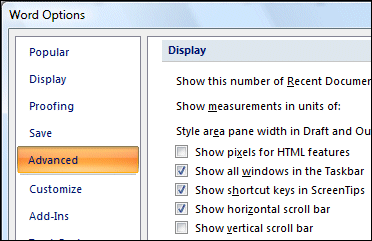
This is odd. A couple of times in the last week Microsoft Word has decided I no longer require a vertical scroll bar. The only way I know to turn it back on is to go into Word options, Advanced, and check the option Show vertical scroll bar.

But how is it getting unchecked? My first assumption was that I must have inadvertently pressed an obscure key combination that toggles the vertical scroll bar, but I can’t find any such shortcut. A bug?

By the way, did you know you can get a complete list of Word commands and shortcuts? Click the Developer ribbon, then Macros, then select Word commands from the Macros in drop-down list. Select the macro ListCommands, then click Run. Word will offer you a document containing either Current Keyboard Settings, or All Commands. The All Commands list is 46 pages long, and contains roughly 2000 commands, none of which hides the vertical scroll bar.

Technorati tags: ,

Hyper-V in Server 2008 RTM doesn’t like non-US locales

Hyper-V is Microsoft’s whizzy new virtual server manager, which uses new virtualization features in recent Intel and AMD processors to support more efficient virtual machines. Intel’s extensions are called Intel Virtualization Technology (Intel-VT), formerly code-named Vanderpool, while AMD’s extensions are called AMD Virtualization (AMD-V), formerly code-named Pacifica. Here’s what Intel says:

How does Intel Virtualization Technology eliminate the gaps in current virtualization solutions?
Three ways. First, the technology provides a new, higher privilege ring for the VMM. This allows guest OSs and applications to run in the rings they were designed for, while ensuring the VMM has privileged control over platform resources. It eliminates many potential conflicts, simplifies VMM requirements, and improves compatibility with unmodified legacy OSs. Second, handoffs between the VMM and guest OSs are supported in hardware. This reduces the need for complex, compute-intensive software transitions. Third, processor state information is retained for the VMM and for each guest OS in dedicated address spaces. This helps to accelerate transitions and ensure the integrity of the process.

Hyper-V is a good reason to use Server 2008 x64 (it is not supported on x86), but it is not done yet. Microsoft has shipped a beta of Hyper-V in the release build of Server 2008, and is promising a full release within 180 days from now. It is not something to use casually – Paul Thurrott quotes Microsoft’s Bryon Surace as saying:

Conceptually, it jacks up the OS and slides in the Hypervisor underneath. So we clearly don’t want that installed by default on servers that won’t be running Virtualization.

So don’t even think about using it for real just yet. When it does get finished, Microsoft recommends using Server Core rather than the full Server 2008 as the host OS. However, Hyper-V is interesting to developers as well as admins, so I wanted to take a look. Unfortunately, after I added the Hyper-V role to the server, the Virtual Machine Management Service failed to start, presenting the gloriously obscure message:

The service changed to an unexpected state.

This problem has been mentioned by others. Apparently the fix is simple but extreme: re-install Server 2008 using the English (United States) locale. Can’t you just change the locale in your existing installation? It didn’t work for me, and Microsoft’s Ben Armstrong says, “It is not sufficient to change the locale after OS installation.”

Once Hyper-V is installed, you can change the locale to what you want and it will still work, though I don’t know if this is supported.

Annoying. Yes, it is mentioned in the release notes – but what if Hyper-V beta had required you to set a non-US locale at install time. Do you think Microsoft would have flagged this problem more prominently?

Technorati tags: ,

Vista SP1 shares same core as Server 2008

I attended a Server 2008 briefing yesterday and it was mentioned that Vista SP1 and Server 2008 share the same core. This is why Server 2008 declares itself as being Service Pack 1 even on its initial release. This isn’t news but I thought it worth a post since I’m not sure that the close relationship between Vista and Server 2008 is all that well known. If Server 2008 wins a decent reputation, which I suspect it will, then it may even help Vista’s tarnished image a little.

When Windows 2003 came out, some enthusiasts ran it as a desktop OS, because it ran better than XP and application compatibility was pretty good. There won’t be any point in doing this with Server 2008. Same code.

Technorati tags: , , ,

Windows Server 2008 is done, embraces PHP

Microsoft says that Windows Server 2008 has been released to manufacturing.

Organizations will be naturally cautious about upgrading their servers. Nevertheless, I suspect that Server 2008 will get an easier ride than Windows Vista. IIS 7.0 is a major upgrade for Microsoft’s web server. Built-in Hyper-V virtualization lets you run multiple operating systems on a single server, Linux included. Server Core is a minimalist install that comes close to answering those critics who have always said, “Why do I need a GUI on a server?”

Here’s the most interesting part of the announcement, especially bearing in mind the Yahoo bid:

With Windows Server 2008, Microsoft is also embracing PHP hosting on Windows via the FastCGI module for IIS 7.0. PHP is a popular open-source scripting language used to build dynamic web applications. This allows IT Professionals to host PHP and ASP.net applications side by side. As a result, the PHP community will be able to take advantage of the increased reliability of PHP on Windows and simplified administration available on the Windows platform.

Quick way to deploy all those PHP applications, eh?

I’m surprised at Microsoft’s choice of language here. Microsoft is not really embracing PHP, as far as I am aware. Its web development platform remains ASP.NET. This is about compatibility and easing migration. Note that Mainsoft can do a fair job of getting your ASP.NET application running on Java, and there is also Mono, so portability between the Microsoft and *nix platforms is improving.

PS I first blogged about IIS 7.0 in July 2005. Nobody can accuse Microsoft of rushing this one.

Finding the preview pane in Vista’s Explorer

I recently came across this (old but interesting) article on creating preview handlers for Vista.

If you have the preview pane showing, you can select a file in Explorer and see a preview of the contents. It is also used for email attachments in Outlook 2007.

This article explains how to use it to create a fast PDF preview based on Foxit, and another for previewing C# source with pretty formatting.

It occurred to me that I rarely see the preview pane in Explorer. It’s not enabled by default. So how do you enable it?

Explorer in Vista has a curious user interface. There are some handy features like favorite links, but adding links to this list is not particularly intuitive. Try drag-and-drop, or right-click the Favorite Links panel and choose Open Favorite Links folder. No, it’s not under Organize, where you would expect.

But I digress. In its default state, Explorer has a toolbar with two menus, Organize and Views. Other menus appear on a semi-random basis according to some broken algorithm which is meant to respond to the context.

If you dislike the capricious toolbar, you can show an old-fashioned menu bar, with top-level entries for File, Edit, View, Tools and Help. That is what I normally use.

Now you might expect that the option to show a preview would be under the Views option on the toolbar, and on the View menu on the menu bar. It’s part of the view, right?

Wrong. To get the preview pane to show, you need to select it under Organize and then the Layout sub-menu. It’s not in the menu bar at all.

Since it is on a sub-menu, it is not surprising that people don’t find it.

Further, I don’t get what concept Organize is meant to represent. It’s helpful to distinguish between things that change the view, like the preview pane or folder options, and things that change the files, like New Folder or Cut. So why is stuff in both categories on this single menu? Who would click Organize to find Delete? Alternatively, if Organize is about modifying files, what is Layout doing there?

Once you have found the preview pane, it’s probably best to turn it off most of the time. The problem is that when you select a Word document, for example, most of Word has to load in the background before it displays…slow. Still, if you have a bunch of Word documents with obscure names, and want to find out quickly what they contain, then the preview pane is really useful.

I hope a faster, more logical and more intuitive Explorer is high on the to-do list for Windows 7.