Category Archives: microsoft

BBC looking at OpenID for iPlayer social network

At Adobe’s MAX conference in Milan last week I spoke to the BBC’s Anthony Rose, who runs iPlayer at the BBC, and wrote this up for today’s Guardian. One of the things we discussed is social networking planned for iPlayer, where you will be able to see comments, ratings and recommendations from your friends. I asked Rose how user identities will be managed:

“We’ll make sure you never have to log in to use our services. But if you want to post comments and create a profile then you’ll need to log in. We’re going to start by using a BBC one, then we’re going to look at OpenID and see if we can synch to others. OpenID is very cool but is a challenging user experience, and some people will get it, and some will go, why have you made it more difficult?”

Right now there are multiple competing “networks of friends”: Facebook, MySpace, Microsoft Live Messenger, Twitter and so on. Facebook is trying to extend its reach with Facebook Connect; Google is evangelising OpenSocial which “defines a common API for social applications across multiple websites”, along with an implementation called Friend Connect. It will be interesting to see to what extent the BBC creates yet another social network, and to what extent it hooks into existing ones.

First steps with offline Silverlight and Live Framework

Yesterday I wrote a simple test application for Silverlight running on Live Mesh. It is an interesting scenario, which enables Silverlight applications to run offline, in the style of Adobe AIR. I wrote a to-do list which stores its data in the cloud; I added some items online, and deleted and added some items offline on another machine, and when it reconnected all the edits synchronized. Cool.

Even so, I’m not finding this particularly easy. Note that this is a limited-access Community Tech Preview, so make big allowance for that. Here are some of the problems I’ve run into to:

Convoluted sign-up and web site navigation.

This is a preview controlled by developer tokens. It’s complicated by the fact that a variety of different types of token control access to different parts of Windows Azure. You get a token, think you are done, then discover you have the wrong kind of token and need to apply for another one.

Even when you have the token, navigation is tricky. I’ve wasted time clicking through from one overview page to another; there are even promising links that seem to go back to the page you are looking at. Tip: when you find a useful page like the Developer Portal, for provisioning Azure and Live Framework apps, bookmark it quick.

Inadequate documentation.

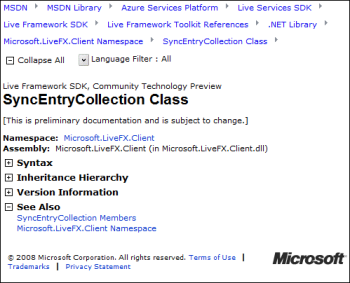
OK, I guess this is to be expected in a preview. But I’m finding an over-abundance of overviews and diagrams, too many videos, and a lack of plain-speaking developer-focused documentation that answers obvious questions. Most of the entries in the .NET reference for the Live Framework client look like this:

That’s right, auto-generated docs with no description of what the class member is for or how to use it. You can expand the plus symbols, but it is not rewarding.

Slow going

Microsoft’s online MSDN documentation and forums work, but I never look forward to visiting them because I know they will be slow to navigate and I’ll be sitting waiting for pages to refresh. I’m not sure that Microsoft understands the importance of this point. It works – so why complain? Well, because the cumulative effect over time is to make me want to go elsewhere. Google and Yahoo, by contrast, usually run much more responsive sites.

Microsoft could improve this quite easily. The key: fast is more important than pretty.

Bugs and outages

I certainly expect bugs and outages in a CTP. Still, they are frustrating. My very simple Mesh app did not work at all on a Mac, even running in the browser. In this scenario, you don’t need the Mesh client; it is just a Silverlight application running in a web page. I asked about this on the forum:

I confirm it from the core team. With quite aggressive timeline for PDC release with the current level of resources and CTP goals, we could only test XP SP3/Vista SP1 and IE7. We will eventually support Mac and Safari but this is not an immediate priority in the near future for CTP QFEs.

Fair enough, thought to me cross-platform is at the heart of why I might want to use this technology.

This morning my Silverlight Mesh application won’t run at all. I get a 404. I guess it’s the bleeding edge.

Online/Offline

I’ve also asked a couple of simple questions on the forum about the online/offline scenario. I’m finding that offline applications don’t run unless you are signed into Windows Live. That is, you can sign in and then go offline, and it works, but if you don’t sign in (for example, because you start up your laptop in an aeroplane), then the app does not start. There must be some way to use cached credentials?

My other question is about synchronization. How do you enforce constraints on a Mesh datafeed, given that it could be edited online and offline simultaneously, bypassing checks in your code? This is not quite the same as a conflict, where the same entry is edited by two different people. My example is how to make sure that duplicate items are not added to a list.

Early days

I expect that this Azure stuff will get much smoother in future updates; and bear in mind that what I’m working with here – Mesh, Silverlight, and the .NET Live Framework client library – is just one small corner of the whole.

I can’t help wondering though if Microsoft is being over-ambitious. Another technology I’ve been looking at recently is Adobe AIR. The scope of this is small relative to Live Mesh. You can describe it in a few words: run a Flash application on the desktop. It has limitations and frustrations, but at least it is easy to understand, and furthermore, it has pretty much worked as advertised from the earliest public previews.

By contrast, Mesh for developers feels like a huge thing that is part of an even huger thing (Azure); it has lots of promise, but it is harder to describe its essence in a few words (that are not marketing fluff).

That said, I like Silverlight itself. This piece at least is easy to grasp and works well, in my experience so far.

Working with Live Framework or Azure? I’d love to know how it is going for you.

Adobe engineer: we gotta beat Silverlight

There was an amusing incident in the Flash Player Internals session this morning at Adobe MAX Milan. An attendee asked engineer Jim Corbett about what he said was a long-standing (10 years) Flash bug. Apparently, sprites sometimes tear as they move across the screen.

Corbett said he wasn’t familiar with the problem; but maybe it was a problem with the browser and that was why the bug had not been fixed.

Silverlight doesn’t have this problem, said the questioner.

Then we gotta fix it, said Corbett.

It reminded me how much I have heard Microsoft mentioned hear at Max. The Adobe execs make constant jibes at Microsoft; and are keen to emphasise wins like the BBC switching away from a Microsoft solution (not Silverlight) to Flash and AIR for its iPlayer.

It really is a war; and the winner for the time being is the user, as competition energises the development of these two Rich Internet Application platforms.

Why it’s hard to compete with Apple in mobile app development and deployment

One OS – one device – one AppStore – easy over-the-air purchase for end users. Apple’s development and deployment model delivers results, despite mutters about lock-in and Apple helping itself to a generous slice of the revenue.

Here at Adobe MAX Europe we’ve been hearing about the future of Flash on mobile devices and even seen a demo of what many would like to be able to do: simple over-the-air download of both the Flash runtime and Flash applications. Flash is a great runtime for a mobile device. A while back I reviewed the LG Viewty phone, which has a Flash UI, and despite some imperfections it convinced me of the potential of Flash for mobile devices.

Even so, it will be difficult for Adobe to create an application platform that works as well as Apple’s AppStore. Here are some of the problems.

  • Device-specific APIs. I spoke to the folk on the Sony Ericsson stand here at MAX. If you want your Flash application to do things like talking to the GPS, or integrating with the PIM (Personal Information Manager) on the phone, then you have to write a device-specific version of your Flash application. This adds to the development effort and creates friction in the deployment process. Will Adobe wrap device functions in Flash APIs? I asked about this at the press briefing today. The answer from Senior Principal Scientist Mark Anders was yes … maybe. He mentioned that API bloat became a negative for Java. It really is a difficult thing to get right.
  • Operator interference. Apple has bullied the operators it works with into doing things its way, and gets away with it because the device is so desirable. The operators though are reluctant to be no more than data carriers. They lock down devices, run their own application stores or music services, and make it difficult to mount a convincing challenge to Apple’s single store.
  • Diversity of devices. Diversity is good, sure. It’s tough for developers though. Maybe there’s a keyboard, maybe there is a touch screen, maybe there is a joypad, maybe the screen is big or small. Your app has to work well in every scenario, or else limit the number of devices it supports. Much easier with Apple, just one device to target. That will change somewhat as Apple bring out new iPhone variants, but there will always be more consistency from a single vendor.

It was similar factors that caused Microsoft to abandon its third-party vendors and create Zune, in an effort to compete with the iPod. Microsoft was too late. I am sure we will see increasing use of Flash and Flash-based applications on mobile devices; but it will be hard to displace Apple’s iPhone as the foremost mobile platform for downloaded applications.

Flash in the mobile browser is another matter, of course. If Apple continues to exclude Adobe’s runtime – which I guess it does to protect its application business – then it makes a nice selling point for competitors which do support Flash.

Amethyst from SapphireSteel: Develop Flex in Visual Studio, an alternative to Tofino

Not long ago I looked at an early preview of Ensemble’s Tofino, an extension to Visual Studio for developing Flex applications that target the Adobe Flash runtime. It was disappointing, though I’ve been assured that an improved build is in preparation. Ensemble had better be quick: I’ve just been informed of an alternative called Amethyst, from SapphireSteel software, creators of the Ruby Visual Studio extension Ruby in Steel. Here’s what I know so far about Amethyst:

  • ActionScript and MXML editing and project management
  • Installs into commercial editions of Visual Studio or the free Visual Studio shell
  • Initial beta of free personal edition available next week
  • Planned for the 2nd quarter of 2009: commercial Professional Edition with drag-and-drop Flex/AIR visual design environment, IntelliSense and graphical debugging tools
  • Can integrate with Ruby In Steel to create a multi-language Visual Studio solution with Flex at the front end and Rails at the back
  • Amethyst Personal will remain completely free

All sounds good; and Ruby in Steel is well-regarded so this is worth watching out for if you have any interest in developing for Flex in Visual Studio.

A high quality Visual Studio design tool for Flex would help Adobe gain adoption for Flex and AIR among Microsoft-platform developers.

From the archives: Mark Anders and Scott Guthrie on ASP+

My editor at The Register asked me if I had any interviews that would be fun to dig out for a retrospective piece. This one is from September 2000, shortly after the announcement of the .NET Framework, where Microsoft’s Mark Anders and Scott Guthrie talk to me about ASP+, the name for ASP.NET when it was in preview.

Listening to the whole interview was a little frustrating, because most of the time I asked questions that were interesting at the time, like the relationship between ASP.NET and COM, but not so much now. I was reminded though that Guthrie gave an impressive demo of what we now call AJAX, where updates to a web page are processed on the client, and described to me how it worked.

The pair also enthused about hosting Windows Forms controls in the browser, one of the .NET ideas that did not really become practical until the release of Silverlight. The full WPF (Windows Presentation Foundation) also works well in the browser, but most web developers rule it out because it is Windows only.

As it turned out, AJAX might never have taken off without the work of Google, while Silverlight now looks like a reaction to Flash. I suspect that Microsoft found it difficult to evolve these ideas into full products because it clung to the idea of a Windows-centric Internet, where Windows rather than the browser is the rich client.

Guthrie is now Corporate VP, .NET Developer Division at Microsoft, while Anders is at Adobe where he has been working on a tool for the Flash platform called Catalyst, previously known as Thermo.

Service triggers: an attempt to reduce bloat in Windows 7

I’ve been reading through the Windows 7 Developer Guide. I like this document; it is tilted more towards information than hype, and is readable even for non-developers. There are things mentioned which I had not spotted before.

One example is triggers in the service control manager. There was actually a PDC session which covered this, among other things, under the unexciting title Designing Efficient Background Processes (PowerPoint). If you check out the slides, you’ll see that this is actually something significant for Windows users. It is an attempt to reduce all that stuff that runs whether or not you need it, increasing boot time and slowing performance. Apparently some people are so upset with the time it takes Windows to boot that they are threatening to sue; so yes, this does matter.

Services are applications that run in the background, usually without any visible interface. They consume system resources, so it makes sense to run them only when needed. Unfortunately, many services run on a “just in case” basis. For example, if I check the services on this machine I see I have one running called Apple Mobile Device, just in case I might connect one. It is using 4MB of RAM. However, I never connect an Apple device to this machine. I’m sure it was installed by iTunes, which I rarely use, though I like to keep up-to-date with what Apple is doing. So every time I start Windows this thing also starts, running uselessly in the background.

According to Vikram Singh, who took the PDC session, adding 10 typical 3rd party services to a clean Vista install has a dramatic effect on performance:

  • Boot time: up by 87% (24.7 to 46.1 seconds)
  • CPU time when idle: up by six times (to 6.04%)
  • Disk Read Count: up by three times (from 10,192 to 31,401 in 15 seconds)

Service triggers are an attempt to address this, by making it possible to install services that start in response to specific events, instead of always running “just in case”. Four trigger types are mentioned:

  • On connection of a certain class of device
  • On connection to a Windows domain
  • On group policy refresh
  • On connection to a network (based on IP address change)

In theory then, Apple can rewrite iTunes for Windows 7, so that the Apple Mobile Device service only starts when an Apple device is connected. A good plan.

Now, I can think of three reasons why this might not happen. First, inertia. Second, compatibility. This means coding specifically for Windows 7, whereas it will be easier just to do it the old, compatible way. Third, I imagine this would mean faster boot, but slower response when connecting the device. Apple (or any third party) might think: the user will just blame Windows for slow boot, but a slow response when connecting the device will impact the perceived performance of our product. So the service will still run at start-up, just in case.

Still, I’m encouraged that Microsoft is at least thinking about the problem and providing a possible solution. We may also benefit if Microsoft tweaks some of its own Windows services to start on-demand.

Microsoft plans free anti-malware

Microsoft will be offering a free anti-malware suite codenamed “Morro”, from the second half of 2009, according to a press release:

This streamlined solution will … provide comprehensive protection from malware including viruses, spyware, rootkits and trojans. This new solution, to be offered at no charge to consumers, will be architected for a smaller footprint that will use fewer computing resources, making it ideal for low-bandwidth scenarios or less powerful PCs.

It’s a good move. Here’s why:

  • The current situation is calamitous. Even users with fully paid-up anti-virus solutions installed get infected, as I recently saw for myself. PC security is ineffective.
  • The practice of shipping PCs with pre-installed anti-virus that has a trial subscription is counter-productive. There will always be a proportion of users who take the free trial and do not renew, ending up with out-of-date security software. A free solution is better – several are available now – if only because it does not expire.
  • Microsoft wants to compete more effectively with Apple. It is addressing an extra cost faced by PC users, as well as (possibly) the poor user experience inherent in pre-installed anti-virus trialware.
  • The performance issue is also important. Anti-malware software is a significant performance drag. Microsoft is the vendor best placed to implement anti-malware that minimizes the drag on the system.

Counter-arguments:

  • Only specialist companies have the necessary expertise. I don’t believe this; Microsoft’s investment in security is genuine.
  • Single-supplier security gives malware a fixed target, easier to bypass. There’s some merit to this argument; but it is weakened by the fact that the current multi-vendor scenario is clearly failing. Further, the Mac is a fixed target that does not appear to be easy to bypass.

All of this is hot air compared to the real challenge, which is securing the operating system. Vista is progress, Windows 7 not much different according to my first impressions.

Why not just use another operating system? There’s a good case for it; ironically the theory that a large factor in Windows insecurity is its dominance can/will only be properly tested when an alternative OS is equally or more popular. If people continue switching to Macs perhaps it will happen some day. Windows is still hampered by its legacy, though my impression is that Vista’s UAC is having its intended effect: fewer applications now write to system areas in Windows, bringing us closer to the day when security can be tightened further.

What about business systems? This is one area that needs clarification. Microsoft says Morro is only for consumers. Why should businesses have to pay for a feature that consumers get for free? On the other hand, some equivalent initiative may be planned for business users.

Develop for Adobe Flex in Microsoft Visual Studio – or maybe not

News from the Adobe MAX conference this week in San Francisco: Ensemble has developed an add-in for Visual Studio for Flex development, code-name Tofino. It’s currently in beta and available for download. Flex is Adobe’s developer-focused SDK for Flash applications.

I installed it this morning, and so far it does not impress. There is zero documentation (just a few links to the standard Flex docs on Adobe’s site), and it lacks even MXML Intellisense, let alone a visual designer. When you go to project properties, there is nothing to configure. The toolbox is also empty. On the plus side, it successfully invoked the Flex compiler to build the project, and managed to open it as a static file in Internet Explorer when I clicked Debug. I’d prefer an option to use Visual Studio’s built-in web server for debugging. There must be more to it than this; then again it is advertised as a beta which is meant to mean well advanced (ha ha). I suggest sticking firmly with Flex Builder for the time being.

Adobe has largely ignored .NET in its Flex and AIR technology, though it does support SOAP. I am not sure whether this is caused by aversion to Microsoft, or an assumption that Microsoft developers will use Microsoft technologies like Silverlight or Windows Forms, or a bit of both. Integration with Visual Studio and server-side .NET could be significant for Flex adoption, though it would be better if Adobe itself were doing the add-in.

You can see the same thing happening on Microsoft’s side, with a half-hearted Silverlight project for Eclipse (which only works on Windows), or the well-regarded Teamprise which integrates Eclipse with Visual Studio Team System. In both cases Microsoft keeps itself at arms length, which does not have the same impact as in-house support.

There are always concerns about the quality of third-party applications. I am sure Adobe itself would not have put such an inadequate preview up for download, as Ensemble has done for Tofino.