Category Archives: microsoft

Hello Windows Azure

Ozzie has made his big announcement here at PDC 2008. Windows Azure is, he says, Windows for the cloud; a “web tier” offering that runs on Microsoft’s own datacenters. The basics: develop a web service in Visual Studio, deploy it to Azure. You can test and debug using a local Azure server. The client for Azure apps can be anything that can call a service – web app, Silverlight app, Windows app. Your Azure apps can call upon a set of other services many of which are already familiar. For example, the database is SQL Services, formerly called SQL Data Services. Workflow can be managed with Workflow Foundation (WF). For identity and access control, there will be an Active Directory connector, or other options (more on this later).

Note that Azure is a platform for hosted applications, written in .NET but eventually with an option for native code, rather than a VM running Windows in the manner of Amazon’s EC2 service. Thus, Azure has more in common with Google App Engine than with what Amazon is offering. Microsoft’s slides also show Sharepoint, Live Services, and Dynamics CRM as part of the Azure platform.

Microsoft will compete on things like the scope and ease of use of its platform. Integration with Visual Studio and Active Directory should make it relatively easy for Microsoft platform developers to start experimenting with enterprise apps hosted on Azure. Business model not spelt out yet, but the assumption is that Azure apps will scale seamlessly and on-demand.

Technorati tags: , ,

PDC 2008: Microsoft attempts to remake its image

There are two big themes at Microsoft’s Professional Developer’s Conference, just getting under way here in Los Angeles.

One is cloud computing. At this morning’s keynote, Ray Ozzie and others will present Microsoft’s cloud computing strategy. If it’s right that IT is moving inexorably into the cloud, this could be make-or-break for the company. Truth is, despite huge number of users for things like Hotmail and Live Messenger, Microsoft is not perceived as a web or on-demand computing company. That space belongs to others, like Google or Salesforce.com. Further, Microsoft has a problem that those companies do not have: how to keep its partners happy while embracing a computing model that may severely reduce their role.

The other is Windows itself. Vista’s image is tarnished: the wow started badly, and although the OS itself now works better than it did at the launch, its negative perception is beyond rescue. Windows 7 is Microsoft’s next opportunity to generate some consumer and user enthusiasm for Windows, and to stem the flow towards Apple. Tomorrow is Windows 7 day.

We’re also going to get insight into the future of key technologies like .NET, the next version of C# and Visual Studio, the Oslo modeling platform, Microsoft’s plans for identity management, and plenty more.

I’ll be blogging and tweeting as I can during PDC. I’m also keen to know what you think, whether or not you happen to be here in LA (the keynotes are being streamed over the Internet).

Technorati tags: , , ,

Tell me what’s wrong with Microsoft’s Team System

At Microsoft’s Remix08 in Brighton last month, a developer asked about Visual Studio Team System during a panel discussion. What interested me was not so much the question itself, but that after the session she was surrounded by other delegates advising her not to use it. These were people who had tried it, or were using it, but found it frustrating. The general proposal was to use open-source tools instead – things like Subversion and CruiseControl.NET.

I was surprised by the strength of feeling. I’ve looked in some detail at Team System and been reasonably impressed by what it does – but that’s not the same as using it in anger, of course. I admit, for my own work I do use Subversion, just because it is lightweight, works well cross-platform, and runs on my Linux web space as well as locally; but I am not part of a team of developers working on Microsoft platform projects, which is where Team System ought to make sense.

For the sake of balance, I’ll add that I met a developer at the airport on the way to Remix Las Vegas earlier this year, who loves Team System and told me that it is Microsoft’s best product.

I’d love to hear in more detail what users think of Team System. Is it broken, or does it depend on how it is set up and maintained? What are the key things that Microsoft needs to fix? Or is it just great, and those complainers in Brighton atypical?

HP laptop go-slow caused by power supply

Wasted some time recently looking at an HP Compaq NX7300 laptop, with Vista, that was running very slow.

No, not just normal Vista sluggishness. Really slow, as in you click the Start menu, wait a bit, and eventually it opens.

Temporarily disabled everything we could think of using msconfig (System Configuration Tool), still slow.

Checked the event log for disk errors, nothing wrong.

All very tedious as any actions took much longer than usual.

Found someone with the same problem on HP’s support forum here – but as so often with the Web, no solution is reported – though the guy does say, “can I assume that the cooling / cpu / power is defective”?

Called HP, and the guy diagnosed a faulty hard drive, though I was sceptical since his argument was that the self-test completed more quickly than expected, though it did not report any errors.

While scratching my head over this, I recalled that this laptop has what HP calls a “Smart AC Adapter”, which has an annoying proprietary connector featuring an additional central pin. According to this thread it actually supplies two separate power lines. The discussion includes this remark:

I tried to substitute the original HP AC adapter, with a general purpose AC adapter, applying a resistor divider between input cylinder- central pin-output cylinder, in order to get the second voltage.  But the laptop did not function normally: it was very slow

and someone adds

The slow function of the system with the alternative power source may be due to the system’s picking up a low voltage on the ‘monitoring’ pin.  This would indicate a low battery or weak charger and the system responded by cutting back on CPU/mainboard frequency to conserve power.

Could this be a clue? We started the laptop on battery power; suddenly it worked fine again. Plugged in the power cable, it slowed down. Removed the power cable, it speeded up again. Bingo.

New power supply is on order. It occurs to me that this could still be a problem with some internal connection, but I’ll be surprised if the new mains adapter does not fix it. Just occasionally the reason for a slow computer is nothing to do with Windows.

Technorati tags: , , , , ,

BBC adopting Adobe AIR for platform-neutral iPlayer downloads

Just noticed that the BBC is adopting Adobe AIR to create a platform-neutral download client for iPlayer. Erik Huggers says:

Today, we are announcing that in partnership with Adobe we are building a platform-neutral download client.

Using Adobe Integrated Runtime (AIR), we intend to make BBC iPlayer download functionality available on Mac, Linux and Windows for the first time later this year. Whatever platform you use, you’ll now be able to download TV programmes from the BBC to watch later.

This follows much criticism of the BBC for its original Windows-only iPlayer.

Looks like Adobe has the BBC in its grip, technology wise, having ousted Microsoft from iPlayer completely – though I believe it is still experimenting with Silverlight’s Deep Zoom.

Technorati tags: , , , ,

Silverlight on Linux: Moonlight or moonshine?

Microsoft’s press release for Silverlight 2.0 says this:

Cross-platform and cross-browser support. This includes support for Mac, Windows and Linux in Firefox, Safari and Windows Internet Explorer.

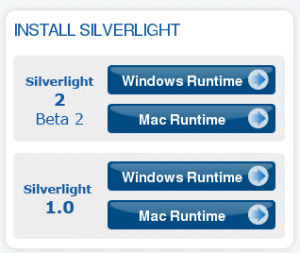
The use of the present tense for Linux support is … misleading, to be generous. I tried visiting the official Silverlight site on Ubuntu. Here’s what I’m offered as downloads:

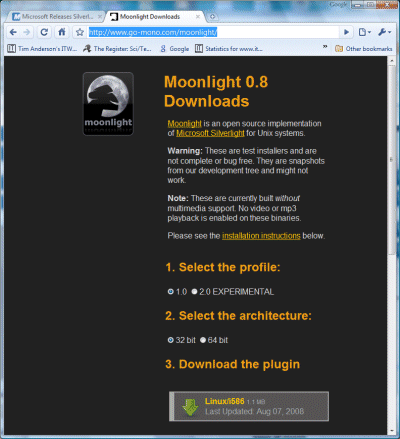
Hmmm. If I go to the official Moonlight site, I see this:

Note that not even Silverlight 1.0 is fully released; further, it says “no video or mp3 playback is enabled”. The installers are said to be incomplete.

I asked about this at the press conference; the answer was “we’re working on it” and “as soon as possible” and “Miguel is speaking at PDC”.

That’s fair enough and I understand that these things take time. But if you read the press release, you might suppose that a Linux user could use it now. Other than for geeky and experimental users, that is not the case.

Vista even thinks Control Panel is photos

One of Vista’s most annoying features is the tendency of Explorer to decide, first, that all your documents are music or photos; and second, that if they are, you care more about metadata like “Rating” than humdrum details such as the date of the file.

I had thought that Vista only did this if it found at least one media file in the folder, but today it happened with Control Panel:

Notice how it highlights another user-hostile feature: the name of each applet is in a column too narrow to read, and several applets are indistinguishable from each other because they begin “Microsoft .NET Frame…” or “Internet Information S…”; another triumph of branding over usability.

What I wanted was the Event Viewer; and while I’m in ranting mode, let me add that I much prefer the old NT Event Viewer to the Vista effort. The new one takes ages to populate a clever multi-pane view, which presents too much information in tiny scrolling panels. In practice I use the tree view on the left to select the log I want, subverting the new design by doing exactly what I would have done in the old Event Viewer. Habit possibly; but there are real design problems with the new Event Viewer. Administrators will always choose practical over pretty.

See here for my earlier complaint about Explorer views and a partial remedy. Why wasn’t this fixed in SP1?

Moving Vista to a new hard drive

I have a Toshiba Portege M400 which is a couple of years old now, but it is not too bad a spec (Core 2 Duo 2.00 Ghz and a Tablet), so when I ran out of disk space I decided to upgrade to a larger drive rather than looking for a new machine. The M400 is slightly unusual, in that you can install a second drive in place of the DVD (which I rarely use), so I was able to fit the new drive in this bay while booting into the old system. The old drive is 80GB, and the new one 250GB. My task was to clone the old Vista installation onto the new drive.

I decided to use Drive Snapshot, which is able to make an exact copy of a running Windows installation. I created two partitions on the new drive, one just a little bigger than the old drive, and one to hold the Drive Snapshot backup files. Then I backed up the old drive to the second partition, and restored it to the first. Next, I removed the old drive (which remains as a backup),  moved the new drive to the permanent internal position, and started the system.

No joy. Windows tried to boot but reported a missing winload.exe. I presumed it was looking in the wrong place. I booted from a Vista DVD and chose the Repair option. There was a slight complication: Vista setup needs to load the Toshiba RAID driver in order to see the drive, but fortunately I have this on another CD. The Vista repair fixed the boot configuration, and I restarted thinking all would be well.

Still no joy. Well, partial joy. Vista booted, and I logged on, but only to a blank light blue screen. Using Task Manager I could start Explorer, but Windows told me it was using a temporary profile. I figured out the problem: drive letters. The system drive was meant to be C, but when I created the partition I had assigned it the letter K. I though that Drive Snapshot’s sector copy would overwrite that assignment, but apparently not. In this state, Vista could boot OK but not much worked. Even RegEdit and the disk management utility failed to open, reporting a “path not found” error.

I found some useful information on the problem here. It looked as if I could fix it by editing the registry, if I could work out how to do so. I have a little experience with this, so I knew roughly what to do. I booted again from the Vista DVD, and opened a command prompt. The minimal system recovery version of Windows does have a registry editor, but if you run RegEdit you get the registry of the setup Windows, not the one in the system you are trying to fix. The solution is to use Load Hive to edit the target registry. I found the key HKEY_LOCAL_MACHINE\SYSTEM\MountedDevices and deleted all the entries except Default. Rebooted, and everything worked perfectly.

One task remained. I ran Disk Management, and deleted the spare partition which contained the Drive Snapshop backup files. Next, I right-clicked the Windows partition, selected Extend Volume, and expanded it to fill the entire drive. Success – now I have 155GB free for new versions of Visual Studio, Adobe CS4, Delphi 2009, VirtualBox disk images, interview recordings, and all the other stuff which occupies my time.

Should I have done a clean install? Now I have a spare drive I might do one as an experiment, but considering the work involved in reinstalling everything, plus the fact that there is nothing really wrong with the current installation, I am not keen.

Overall it did not take long, and while there may be better utilities out there for this particular operation, I’m happy with the results from Drive Snapshot.

Technorati tags: , ,

What’s new in .NET Framework 4.0?

Good question. There are a few things we know about Microsoft’s managed application runtime and class library:

There will be major updates to the Windows Communication Foundation (WCF) and Workflow Foundation (WF). According to this announcement along with this post by Steven Martin we are going to see “better support for Web 2.0 technologies like REST, POX and ATOM” and a 10x performance increase in WF.

The table shown here also mentions a bigger role for XAML:

Seamless integration between WF and WCF and unified XAML model. Build entire application in XAML from presentation to data to services to workflow.

There will be a new application server codenamed Dublin, which hosts WF/WCF applications and manages messages, long-running transactions, state management. Dublin extends Internet Information Services (IIS) and will run on Windows Server – probably Server 2008 only.*

Dublin supports Oslo, which is Microsoft’s latest attempt at model-driven development. I guess Dublin is the host for Oslo applications, as this post implies. XAML is a good fit with modelling, because it is both declarative and well-suited for visual representation. Models do not have to be visual, and Oslo includes a new textual language which could also be based on XAML (?), but nevertheless there is synergy between modelling and visual designers.

Putting this together, we have a new take on Microsoft’s end-to-end stack, developed in Visual Studio with XAML supplemented by procedural code where needed, hosted on Dublin, and using WPF or perhaps Silverlight(?) for the presentation layer. Thanks to the new REST support, or the old SOAP support, you could also use other clients including JavaScript or Java.

It is all a bit perplexing if you currently think of the .NET Framework as the runtime engine and class library for C# and Visual Basic. It sounds as if .NET Framework 4.0 is enterprisey, more JEE than Java. We are seeing increasing fragmentation or more positively, diversification, in Microsoft’s .NET story. There are micro versions, cross-platform versions (Silverlight), desktop versions (client profile), and more and more pieces that only belong on servers.

How much of Oslo and the Dublin application server is likely to be implemented in Mono, I wonder? I suspect not that much, since Mono has focused in the past on the common language runtime and ASP.NET. There was no WPF support in Mono until Moonlight.

All this begs the question: is .NET becoming too complex? I interviewed Scott Guthrie, Corporate VP Developer Division, at the Remix conference in Brighton last month. I asked him about Oslo, thinking that he must be closely involved in what is, according to some at Microsoft, a major step forward in application development. His reply: “That’s not my world”.

Guthrie is a simplifier. He was one of the original developers of ASP.NET, along with Mark Anders, and as I recall, when asked what modelling tool he used he replied, “a whiteboard”. I spoke to Anders about the early days of ASP.NET and he emphasized the value of simplifying what already exists; see also How ASP.NET began in Java.

Microsoft also claims that Oslo/Dublin will make complex things easier for developers, but looking at all these pieces I’m waiting to be convinced. PDC 2008 is where we will find out more.

*According to this post “Dublin” actually refers to the next version of Windows Server itself, though this announcement says “a set of enhanced Windows Server capabilities codenamed ‘Dublin’ that will offer greater scalability and easier manageability.” I guess this comes to the same thing, and that preview versions of Dublin could either be early releases of the entire OS, or preview bits that install into Server 2008.

Microsoft’s cloud platform, multi-touch Windows 7: mining the PDC schedule

I’ve been looking at the PDC Session schedule, as posted so far. Microsoft is serious about its new cloud computing platform. For a start, count the sessions.

Out of 180 posted so far, here are the subjects with 10 or more sessions:

  1. Cloud services [33]
  2. Windows 7 [22]
  3. SQL Server [16]
  4. Visual Studio [16]
  5. Silverlight [13]
  6. Live Platform [11]
  7. ASP.NET [10]
  8. Languages [10]

That’s a huge focus on the cloud. Microsoft’s problem: the company is not perceived as a leader in cloud computing. It has two distinct challenges: first, getting the technology in place, and second, winning developers to its new platform. In mitigation, it is in theory well placed to migrate users from on-premise Windows and Office to cloud equivalents.

Here’s a few snippets about Microsoft’s cloud platform:

A lap around Cloud Services: … Learn about the pillars of the platform, its service lifecycle, and see how they fit with both Microsoft and non-Microsoft technologies. Also, hear about the services roadmap over the next few years.

Cloud Computing: Economics and Service Level Agreements: … Topics include the pricing model for the cloud computing platform, how to monetize a service, and how to reduce the total cost of ownership.

Connecting Active Directory to Microsoft Cloud Services: … Manage and secure end user access to cloud services using your existing investment in Active Directory. Enable end users to access cloud services through existing Active Directory accounts, the same way they access your intranet-hosted software today. Hear how to enable existing software to use new service capabilities without re-writes, and do it all through the use of open and standard protocols.

That last item is a big deal. Managing separate user identities for local and cloud services is horrible.

What else can we glean from the PDC schedule. Here’s a few items that intrigued me:

Windows 7: Web Services in Native Code … Windows 7 introduces a new networking API with support for building SOAP based web services in native code.

Windows 7: Developing Multi-touch Applications … This session highlights the new multi-touch gesture APIs and explains how you can leverage them in your applications.

Oomph: A Microformat Toolkit … a toolkit from the MIX Online Team, that is aimed at web developers and designers to make it easier to create, consume, and style Microformats on the web. See also here.

Concurrent programming: Microsoft Visual Studio: Bringing out the Best in Multicore Systems … demonstrations of the parallel performance analysis and optimization tools in the next release of Microsoft Visual Studio. .

Oslo of course: A Lap around "Oslo" … “Oslo" is the family of new technologies that enable data-driven development and execution of services and applications. Come and learn how to capture all aspects of an application schematized in the "Oslo" repository and use "Oslo" directly to drive the execution of deployed applications.

Generics and constructors in XAML: Microsoft .NET Framework: Declarative Programming Using XAML … Learn about XAML additions like: support for generics, object references, non-default constructors, and more.

Instant cloud apps: Research: BAM, AjaxScope, and Doloto … Hear how BAM can turn a simple specification into a web-based cloud application with the click of a button. Learn how AjaxScope and Doloto automatically instrument and rewrite your web applications’ JavaScript code for end-to-end monitoring and optimization.

Office, a big feature of PDC 2005 when the ribbon was introduced, only has 3 sessions posted so far, though there may be more to come. Normally a new version of Office accompanies each new version of the Windows client.

Another question: what is in .NET Framework 4.0, to merit a full new version number? There is surprisingly little mention of it so far.