Category Archives: microsoft

Microsoft will document the Outlook file format; users would rather it just worked better

Microsoft’s Paul Lorimer, Group Manager for Microsoft Office Interoperability, has announced that the .pst file format will be published:

In order to facilitate interoperability and enable customers and vendors to access the data in .pst files on a variety of platforms, we will be releasing documentation for the .pst file format. This will allow developers to read, create, and interoperate with the data in .pst files in server and client scenarios using the programming language and platform of their choice.

The initials .pst stand, I believe, for “Personal store”. This is the format used by standalone Outlook, for users without Exchange. You can also have Exchange deliver email to a .pst, though more normally Exchange mail is stored in an .ost (“Offline store”) which replicates the mailbox on the server. The .pst format is still used for archiving in this scenario. I’m not sure how different .pst and .ost are internally, or whether Microsoft intends to document both.

Any move towards open formats is welcome, though I’m not sure how important this one is; further, Outlook is frail enough as it is, so I’m nervous about third-party software modifying a .pst and perhaps getting it slightly wrong and causing problems. Programmatic access to Outlook data has long been available, via the ancient MAPI or via Outlook’s COM API.

In just slightly related news, my help post on the error message Cannot open the Outlook window is the most viewed post on this site this month and the fourth most viewed last month; it has 129 comments.

I suspect most users would prefer a faster and more robust Outlook over and above a published file format; unlike Office document formats, a .pst is not generally shared with others.

Visual Studio 2010 and .NET Framework 4.0 – a simply huge release

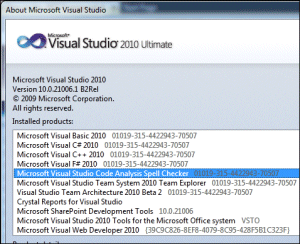
I’ve been exercising the new beta 2 of Visual 2010. It is hard to encapsulate in a few words because this is a simply huge release. OK, so I did download the Ultimate version; but the changes at every level seem greater than in Visual Studio 2008. One of the reasons is that this is the first full update to the .NET Framework since version 2.0 in late 2005. Versions  3.0 and 3.5 extended 2.0 but did not replace it. Another factor is that Visual Studio 2010 has a new editor built with Windows Presentation Foundation, and has a different look and feel than its predecessor. In addition, there is a new language, Visual F#, though I don’t hear much buzz about it; I think elevating IronRuby or IronPython to this status would have attracted more interest – but they are dynamic languages, whereas Visual F# is a functional language. 

When you are assessing Visual Studio you are in part assessing Microsoft’s platform, and as that platform has sprawled, so too has the tool. It is now so large that it is difficult to have in-depth knowledge of the entire thing. I also notice this when speaking to Microsoft folk about the product.

So what is new?

If you need to acclimatise, I suggest you start with What’s new in .NET Framework 4.0. This is a large topic in itself. Some of the things to look out for are What’s new in the Base Class Library, including Complex numbers, Location API, IObservable<T> for observable collections, and other tweaks and enhancements.

Then there are things like in-process side-by-side execution – the ability to run two versions of the Framework at once in the same process, which is remarkable.

Parallel programming with PLINQ and the Task Parallel Library is another major topic.

COM interop is changing; you no longer need to deploy Primary Interop Assemblies, because the compiler can include only the types you need in your application.

Next, take a look at what’s new in specific frameworks, such as WPF version 4 and ASP.NET MVC 2.

After that, you might be ready to look at new stuff in specific languages: including the dynamic keyword in C#, implicit line continuation in VB, lambda expressions in VC++, the concurrency runtime, and the arrival of Visual F#.

With that sorted, check out the new tools in the Visual Studio IDE. I’m thinking of the new code editor, the updated WPF visual designer, the new visual designer for Silverlight, and the Tools for SharePoint development; and not forgetting the updated modelling and application lifecycle management tools.

But isn’t this the era of cloud computing? That’s another part of the problem; the Windows-oriented tools seem less important if you are immersed in the latest cloud news. That said, don’t forget Windows Azure, though I was disappointed to find that the Windows Azure Tools for Visual Studio are a separate download, and not done yet.

I’m impressed that Microsoft seems to be pulling all this together successfully; it is a significant integration task. And as ever I’d be interested in what developers think – was the new code editor really necessary? Is Microsoft addressing the right areas? Has Microsoft done enough to support new Windows 7 features? And is performance OK in this version (it was a problem in beta 1)?

Microsoft quarterly results: server and tools shine, overall decline

Microsoft has reported its results for the quarter ending 30th Sept 2009. I’ve got into the habit of making a small table to help make sense of the figures:

Quarter ending Sept 30th 2009 vs quarter ending Sept 30th 2008, $millions

Segment Revenue % change Profit % change
Client (Windows) 2620 -38.8 1463 -52.17
Server and Tools 3434 0.50 1283 22.89
Online 490 5.80 -480 -49.53
Business (Office) 4404 -11.1 2863 -11.37
Entertainment and devices 1891 -0.11 312 96.22

A quick glance tells you that Windows suffered a sharp decline, though Microsoft says this is because it has deferred $1.47 billion of Windows 7 upgrade revenue, and that adding this back would reduce the decline to 4% year on year.

Note that even with the deferral, Windows is highly profitable.

The star here is server and tools, growing in the downturn and delivering strongly increased profits. I doubt tools counts for much of this; I’m guessing it reflects the positive reception for Server 2008.

Online is as dismal as ever. Clearly the Live properties are still not performing. Presuming Azure is in this category, it’s possible that this will start to turn this round; that is more likely I guess than an improvement in the fortunes of existing products such as Bing.

Office strikes me as pretty good bearing in mind the weak economy and that Microsoft is now talking about Office 2010. Entertainment and devices ticking along but nothing special.

I’m guessing Windows 7 will deliver Microsoft a great next quarter no matter what; but when if ever will it be profitable online?

Disclaimer: I am not a financial analyst, and hold no shares in companies about which I write. Please do not misconstrue this as investment advice; I know nothing about the subject.

Technorati Tags: ,

A year of writing about Windows 7

I’ve written quite a bit about Windows 7 over the last 12 months. Some of it is practical how-to stuff, some review, some comment. I started trying to round it all up then realised there is too much, believe it or not what follows is not complete.

Why so much? The reason is the level of interest. Although Microsoft is the company we love to hate, many of us use its stuff day-in, day-out and want to track what it is up to.

Windows 7 early promise- Passes the Vista test October 28 2008 in The Register

Windows 7 may be less than a year away 29 October 2008 good prophecy on ITJOBLOG

Windows 7 preview, October 30 2008 in The Guardian. “this release promises to be one users will actually enjoy.”

Should you wait for Windows 7 before buying a new PC? 8 Jan 2009 “Yes, you should – even though the suggestion will dismay PC manufacturers and retailers who would prefer that you buy something now to help their sales.”

How good is Windows 7? I argue that, well, it is still Windows. On ITJOBLOG

First Windows 7 beta puts fresh face on Vista The Register 8 Jan 2009

Apple Dock vs Windows 7 taskbar 12 January 2009

Review of Beta 1 in The Guardian, 15 Jan 2009

New in Windows 7 RC- Windows XP Mode, Remote Media Streaming 25 April 2009

Windows 7’s XP Mode — Virtually worth the effort The Register 1 May 2009

Windows 7 XP Mode dialogs confuse virtual with real 4 May 2009

Windows 7- why you should keep User Account Control at the highest level 5 May 2009 still good advice

Review of RC1 in The Guardian 7 May 2009

One thing that is not better in Windows 7- Movie Maker 12 May 2009 Live Movie Maker is now much improved but some still miss the Vista one

EU responds to questions on Microsoft’s plans for Windows 7 25 June 2009 my dialog with the EU on browser bundling

Microsoft’s limited Windows 7 offer a lesson in how to annoy customers- 23 July 2009 bet there are folk wishing they’d snapped up Microsoft’s £49.99 offer back in July

Microsoft’s new EU Windows 7 proposal – will IE now be the default- 24 July 2009. We’ve not yet seen this for real.

Windows 7: the challenge for developers July 27 2009. On ITJOBLOG

No more Windows E – Europe will get full Windows 7 plus upgrade editions 1st August 2009 sighs of relief all round

In-place upgrade adventures with Windows 7 8 August 2009 – the in-place upgrades worked so well I’ve left them alone since

Windows 7 tip- use Group by to merge and manage library views 10 August 2009, could be helpful for those puzzling over this strange UI

It got boring saying nice things all the time so

Hands on Windows 7 multi-touch – will Apple get this right before Microsoft- August 17 2009

Getting picky about the Windows 7 Taskbar – real-world flaws- 21 Aug 2009. Ed Bott disagreed!

Windows 7- Microsoft’s three missed opportunities The Register 25 Aug 2009

Hope for old PCs with Windows 7 26 Aug 2009 about surprisingly good results on old PCs

and the inevitable Windows 7 vs Mac comparison

Windows 7 vs Snow Leopard – The Poison taste test The Register 2nd September – the fun bit about this one is in the comments

Windows 95 to Windows 7- How Microsoft lost its vision The Register 22 October – I argue that Microsoft has gotten conservative with Windows, some of the comments misunderstand but at least it sparked a discussion

A Year with Windows 7 – my launch day piece. Today. Although I’ve cooled towards some ideas, like the hiding of notification icons, my overall feeling about the OS hasn’t changed radically over the year. I’m not sure if that is good or bad, but at least it is consistent.

Technorati Tags: ,

A year with Windows 7

It’s nearly a year since Microsoft unveiled Windows 7 at PDC 2008 – to be precise it was 26th October 2008 when I attended the pre-briefing a tried it out for myself on a loaned laptop. I’ve been using it since on numerous PCs, and used little else – well, aside from the Mac and a little Ubuntu – since it went gold in July. What’s my long-term view?

Well, the pre-brief was impressive, and guided by Steven Sinofsky the team has delivered what it promised. I guess Microsoft should do this sort of thing in its sleep; but the fact that it did not do for Vista, and that other departments such as that for Windows Mobile seem to move with glacial pace, makes the achievement impressive. Even the suggestion that Windows 7 would work fine on older hardware has proven true. I’ve installed it on a seven-year old Pentium 4 and it is perfectly usable; I never dared to put Vista on that machine.

So it works, but do I like it? Generally, yes. The souped-up taskbar is now where I usually launch applications. I don’t bother putting icons on the desktop as they are usually hidden behind applications. I like Aero Peek. I think the Jump List and ability to have controls in thumbnail preview windows will be neat features when more applications come out that properly utilise them. Most important, Windows 7 hasn’t got in my way and most of the time I don’t think about it – which is as it should be.

I’m delighted with Libraries. I find them very useful. They enable me to think less about where a document is stored; it’s something that the user should not have to worry about at all. The UI for grouping and merging is not quite right and will trip up some users; but libraries work, which is what I care about more.

I have a few quibbles. The light shading applied to taskbar icons when the applications is running is too subtle; I’d like some more obvious indication. The taskbar behaves badly when full, as I’ve noted before, and the “small icon” option is terrible.

I think the decision to hide notification icons by default is a bad one. It is detrimental to usability, especially for apps that rely on that icon as the normal point of interaction. I don’t think it will help that much with making Windows “quieter”, as vendors will find other means to intrude if they insist on doing so.

I’ve noticed that the upgrade from Vista to Windows 7 makes Office invisible. I’ve had users complain that they cannot find their email because of this. It is purely a matter of moving icons back onto the taskbar or top-level Start menu, but this could be better.

These are minor gripes. My main further complaint is that by Windows 7 Microsoft really should be further along with creating an advanced client operating system in the Internet era. The main reason I reckon is the technical problems and loss of confidence that ensued after the original plans for Longhorn fell apart, and I’ve written further about this in a piece to be published shortly. Another factor is time wasted on semi-failures like Tablet PC; much was right about it, but it took Apple and the iPhone to show us how a touch (not stylus) UI should work.

I still think Windows 7 deserves to be a huge success, just as I did twelve months ago.

Technorati Tags: ,,

Blast from the past: how Adobe praised XAML at PDC 2003

I’ve been trawling back through material from Microsoft’s Professional Developer’s Conference in 2003 for a piece that will be posted shortly. I believe that the vision that was presented at PDC 2003, and how it fell apart, sheds a lot of light on why Windows is as it is today.

In doing so I came across this snippet about Adobe’s participation in the PDC keynote. It’s still online in Microsoft’s PDC press release:

Adobe Systems, a leading developer of software for consumers, creative professionals and enterprises, demonstrated the possibilities for ISVs created by integrating the new "Avalon" presentation technology and declarative programming techniques for Windows. Using these technologies, a prototype version of Adobe After Effects showed how developers could unify documents, cutting-edge graphics and media. For example, developers would now be able to build animated charts and graphs that are linked to back-end data sources to produce a smart solution that displays stock prices, sales and other information within a high-end professionally designed format.

"Many developers have not taken the visual design of their applications seriously enough, with the most innovative work restricted to creative professional software and games," said Greg Gilley, vice president of Graphics Applications Development at Adobe. "Longhorns new Avalon technology brings the designer and developer closer, so they can truly collaborate on creating software applications that are as beautiful as they are functional."

The odd thing is, this quote could come from the Adobe MAX 2009 conference from which I have just returned. “Animated charts and graphs … linked to back-end data sources” is what we saw in applications build with Mosaic, Adobe’s new framework for LiveCycle ES2 clients.

The difference: Adobe is doing all this with Flex and MXML, not XAML, and the client platform is the Flash runtime, not Avalon running on Windows.

Gilley of course was speaking before Adobe’s acquisition of Macromedia (and Flash and MXML) in 2005. Furthermore, nobody at PDC in 2003 could have guessed how long it would take Microsoft to deliver XAML.

Technorati Tags: ,,

Is Apple iPhone now unstoppable in the mobile platform wars?

I’ve been reflecting on a chat I had with a mobile application developer at Qt Developer Days last week. He thinks that Apple has all-but won in the battle to dominate the SmartPhone platform.

His reasoning is based on a couple of things. The first is that Apple is easily outpacing others in application availability and number of app installations. I guess there are many ways of counting this, but have a look at these figures. Handango, which has been in this game for over a decade, reported in January that it had over 140,000 apps and 100 million all-time downloads across a number of SmartPhone platforms. Apple reported this month that it has 85,000 apps and 2 billion downloads.

His second point is that Apple is one of the few companies to understand that users like consistency better than choice. “If I pick up an iPhone, my fingers know what to do,” he told me. This makes users reluctant to switch, except to another iPhone. By contrast, Nokia has a zillion different devices supposedly tailored for the needs of different customer segments, but as a result there is no sense of a consistent platform and users can easily switch away. Windows Mobile has the same problem but with multiple vendors as well as frequent design changes from each vendor.

These are points well made. If the much-rumoured Apple tablet appears, we can expect the App Store concept to extend its reach to larger devices as well. No wonder Adobe is so determined not to be left out on this platform, announcing a compiler to convert Flash applications to native iPhone code, as well as stepping up its campaign for Flash in the iPhone browser.

That said, I can think of counter-arguments. One is that iPhone isn’t yet, as far as I know, strong for corporate development. Windows Mobile has some advantages here, for Microsoft platform companies, while Java (not available on iPhone so far) is also appealing to corporate developers.

Another is that Google Android will give strong competition and take advantage of Apple’s weakness, its reluctance to abandon premium pricing.

Third, the consistency argument only goes so far. If you look at today’s iPod touch, for example, compared to the first iPods, there are huge differences. Users will in fact switch if there is convincing value in what is new.

Fourth, the more iPhone grows in importance, the more discontent over the closed nature of its platform will grow.

It is still early days for SmartPhones as a development platform; and while it is fun to speculate, things may look very different in a couple of years.

Still, let’s acknowledge that right now it is advantage Apple.

See also: What’s your choice in the mobile battleground?

and this great rant from a frustrated Symbian/Nokia developer:

Calling all Nokia & Symbian geniuses: Am I wrong?

Microsoft says it will recover Sidekick data – but we still need to know more

Hopeful news at last for customers of T-Mobile Sidekick, who were told that their cloud-stored data had been lost. Roz Ho, Coporate Vice President of Premium Mobile Experiences – how hollow that sounds right now – says:

We are pleased to report that we have recovered most, if not all, customer data for those  Sidekick customers whose data was affected by the recent outage.  We plan to begin restoring users’ personal data as soon as possible, starting with personal contacts, after we have validated the data and our restoration plan. We will then continue to work around the clock to restore data to all affected users, including calendar, notes, tasks, photographs and high scores, as quickly as possible.

That’s the best outcome from a bad situation, though even considered as an extended outage it is unacceptable service, but leaves many questions unanswered. Microsoft still has not really told us how the problem occurred. Ho says:

We have determined that the outage was caused by a system failure that created data loss in the core database and the back-up. We rebuilt the system component by component, recovering data along the way.

Sure; I think we all know that there was a “system failure that created data loss.” However, we all also suspect that there was a human failure that caused normally failsafe systems to fall over.

I read in the LA Times:

Microsoft is now emphasizing that the data loss, and the problems that led to it, were limited to a segment of the company’s network that is separate from its core cloud infrastructure. 

“The Danger Service platform, which experienced the outage, is a standalone service operating on non-Microsoft technologies, and is not related to Microsoft’s cloud services platform or Windows Live," Microsoft spokesperson Tonya Klause wrote in an e-mail.

Sorry, that is not good enough. Danger has been part of Microsoft for long enough that customers cannot reasonably be expected to distinguish it from other services run by the company. The technology is uses is an internal matter.

This AppleInsider article about the Microsoft’s mobile strategy and the Danger debacle is devastating, if true. The writer claims to have “engineers familiar with Microsoft’s internal operations who spoke with us,” one of whom said, “no one really grasps how dysfunctional Microsoft has become.” It paints a picture of a mobile device and OS strategy in disarray, a failed acquisition of a company with a promising product and service, and incompetence in handling the Danger service.

All this is rumour and maybe these sources are just disgruntled employees or ex-employees with grudges to settle. In the absence of facts though, rumours will fly. Currently we have just one fact: a catastrophic system failure for Sidekick customers.

Tell us more, or we will assume the worst.

Update

Another version of the story via Mary Jo Foley, who quotes “one of my Microsoft sources”:

(T)he data loss issue was caused by a hardware update on the existing Danger service that had NOT been ported over to a Microsoft platform and the issue was NOT part of a transition to an MS back end. It was an Oracle dB and Sun SAN solution that got a bad firmware update and the backup failed.

though she adds:

I’ve also heard that foul play has not been ruled out because the failure was so catastrophic and seemingly deliberate.

Rentokil Initial adopting Google Apps – largest deployment yet, apparently

Following a successful 100-day trial with 800 users, Rentokil Initial is deploying Google Apps Premier Edition globally to “up to 35,000 colleagues” by the end of 2010, in what the press release says is the:

Largest deployment of Google Apps™ Premier Edition to replace multiple email systems with a standard global email solution … The new platform will provide a single web-based communication and collaboration suite to replace the Group’s existing 180 email domains and 40 mail systems across its six operating divisions.

Note that the focus is on email, though the release also talks about “communication and collaboration”, including Google chat and video and shared calendars.

Rentokil is keen on the translation service which Google offers:

…the frustrations of not having access to a single company-wide email address database will disappear and the translation difficulties faced by those colleagues wanting to collaborate with others around the world will be lessened

says CIO Bryan Kinsella.

There is no mention of word processing, spreadsheets or presentation graphics in the release, suggesting that a wholesale move to Google for documents is not currently envisaged. That said, I suspect that once an organization signs up for email and collaboration services, they will end up using other parts of the platform as well.

Google’s progress in the Enterprise is interesting to watch. If it successful, it will have a profound impact on the IT industry, and there will be less work for all those support organizations that spend their time keeping Microsoft systems up and running.

When the unthinkable happens: Microsoft/Danger loses customer data

Danger is a company acquired by Microsoft in April 2008, which provides synchronization and online data storage for mobile devices, the best-known being the T-Mobile Sidekick.  Here’s the Danger promise:

Data is always synchronized and backed up
Danger-powered devices are always connected to the Danger service. All user data is automatically and securely backed up over-the-air, and emails, photos, and organzier data are automatically synchronized with a Web-based application. All changes that are made on the device are instantly and automatically reflected on the user’s computer, and vice versa.

That dream is in tatters thanks to a currently unspecified server failure. Problems started over a week ago, culminating in this devastating “status update”:

Regrettably, based on Microsoft/Danger’s latest recovery assessment of their systems, we must now inform you that personal information stored on your device – such as contacts, calendar entries, to-do lists or photos – that is no longer on your Sidekick almost certainly has been lost as a result of a server failure at Microsoft/Danger … we recognize the magnitude of this inconvenience.

The word “inconvenience” does not express what some users are experiencing. Here’s an example:

I too have lost business contacts (over 200), family and friends mailing, email address & phone #. Good luck now with holiday cards.  Without my calendar, I now have no clue when all my upcoming appts are.  In addition, I have lost passwords, account codes and my gym workout routine.  I was unable to do my side jobs over the past two weekends without these codes.  To recover the information will take hours of my time worth way more than the month of service credit in addition to the money I have already lost not being able to work.

The entire reason I chose to stay with the sidekick and renew with t-mobile was because of the piece of mind knowing that my data information was backed up to an online system. 

So what next? People are drawing a variety of conclusions, the most obvious being either that the cloud can never be trusted, and/or that Microsoft can never be trusted. Of course there is no such thing as total data (or any other kind of) security, but risks can be minimized, and in the absence of nuclear war, earthquake or volcanic eruption this looks inexcusable – but bad things happen.

The company is promising an update tomorrow (October 12th). Personally I doubt that the data is really irrecoverable, knowing a little about what data forensics can achieve, but it may be economically irrecoverable. Still, the best thing Microsoft could do would be to announce that it can get the data back after all. Failing that, we need to understand as much as possible about what went wrong so that we can make our own judgment about what to conclude.

Presuming that the data does not reappear, this is going to get messy. What happens when the marketing information says one thing, but the small print says another (as is often the case)? One user found this in his contract:

The services and devices are provided on an “as-is” and “with all faults” basis and without warranties of any kind

which may well be typical. Then again, what about T-Mobile’s relationship with Microsoft?

Finally, while I accept that data may be safer in a cloud service provider’s data centre than on my cheap local hard drives, it is also obvious that cloud + local backup is even safer. Apparently this is one thing that Danger made somewhat difficult, and I’ve known this to be true of other cloud-based services.

Update: rumour has it that this was a failed SAN (Storage Area Network) upgrade without a backup. Further rumours of the poor state of Danger (and Windows Mobile) within Microsoft are in this RoughlyDrafted article.