Category Archives: microsoft

In-place upgrade adventures with Windows 7

I have just done Windows 7 RTM in-place upgrades on two systems, one running Vista Ultimate x64, and the other running Vista Business x64. Why do an in-place upgrade? Simply because it is much less time and effort than a clean install. Actually, the “less time” bit needs qualification. The in-place upgrade takes several hours; I left one running overnight. However, most of the time is spent leaving the setup chugging away. It does not take much effort from you.

By contrast, a clean install involves finding all your application setup disks or downloads, serial numbers, and patches, then installing and configuring them. In some cases – Adobe Creative Suite comes to mind – you might need to de-authorize an existing installation first, or be faced with a call to support on reinstallation. Drivers are another issue; you will likely need to visit the vendor web site for your PC and any added devices and download the latest drivers. Overall, not a trivial task.

An in-place upgrade is not optimal. Doing a clean install gives Windows the best chance of running with full performance and stability, without inheriting legacy problems. Still, there is no harm in doing an in-place upgrade now, and a clean install later when you have the time. That way, you get Windows 7 goodness immediately.

Although there has been some fuss about the complexity of Windows 7 upgrades, it is not merited. In a nutshell, you can in-place upgrade from Vista to the equivalent Windows 7 edition or higher. You cannot go backwards, you cannot in-place upgrade XP, and you cannot move between 32-bit and 64-bit editions. Simple.

Here’s how it goes. For an in-place upgrade, you run setup from within the running version of Vista. If you click Check Compatibility Online, you are directed to the beta upgrade advisor. I wouldn’t bother if you’ve got this far; the setup does the same job and does not require a download. So click Install Now.
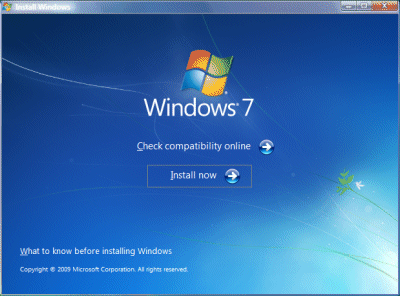
 

Of course, you’ve backed up stuff that matters to you, and appreciate that there is some small chance that Windows will be broken beyond repair and never boot again.

The first thing setup does is to check compatibility (see!).

 

Then it will inform you of any issues. This is what I got:
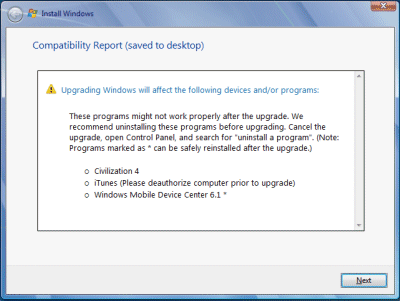
 

Apparently Windows 7 does not like Civilization 4, iTunes or Windows Mobile Device Center 6.1. On my x64 box it also objected to SQL Server 2008, Daemon Tools, and an IDE storage controller. You are advised to cancel setup (which you do by closing the window; there is no Cancel button), remove the problem software, and try again.

You can fix the SQL Server 2008 issue by installing SP1. Daemon Tools is a low-level utility and could easily trip-up a Windows upgrade, and has only recently come out in a Windows 7 compatible version, so I removed it. iTunes was not being used so I removed that too. I also uninstalled Windows Mobile Device Center.

How about the storage controller on the x64 box? This one made me nervous, since if Windows cannot find a compatible storage controller, nothing will work. However, I knew that the storage controller which matters was the one for Intel Sata RAID, not IDE, so I ignored it.

Once I had tidied up the system, I re-ran setup. This time, I hit Next. I got the Big Decision dialog box:
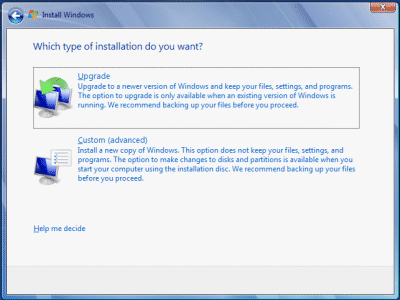
 

I wanted an in-place upgrade, so I chose Upgrade.

The next task is to wait a long time. Go and do something else. While it would be nice if this part went more quickly, it does not bother me that it takes hours; it is a one-off task. In my case, setup transferred nearly 600,000 “files, settings and programs”.

The aftermath

All going well (and it did) the next action is to hit Ctrl-Alt-Del (strange how that ugliness survives the years) and log onto your shiny new Windows 7 OS. There were just a few issues to resolve.

First, the upgrade tinkers with the Start menu, and one of the oddities is that Microsoft Office (version 2007 is installed) in effect disappears from view:
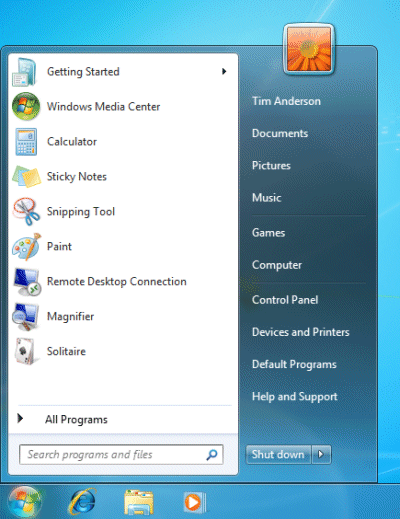
 

I am not saying it is hard to find. Desktop shortcuts remain, if you have them, and you can always type a search or burrow down into All Programs. Still, this could be jarring for some users. Among my first tasks with Windows 7 is to find the applications I use frequently and pin them to the taskbar (right-click, pin to taskbar).

Second, Internet Explorer 8 opened for the first time with odd dimensions. Easily fixed, though it is annoying that you have to go through Welcome to IE8 wizards that you have seen many times before.

 

Third, Lego Digital Designer (don’t ask) failed to run. Apparently the upgrade messed up OpenGL, even though setup correctly detected my NVIDIA graphics card. I downloaded the latest from NVIDIA, bumping up the version from 8.15.11.8593 to 8.15.11.9038. This fixed it. I suspect it was not the driver version as such, more that the NVIDIA install added additional components including OpenGL support.

Fourth, the Movie Maker problem. Your old Movie Maker 6 is removed, and if you try to run Movie Maker, you are invited to download Windows Live Essentials from the Web. The new Live Movie Maker is in beta, and after installation you get a message saying it has expired and offering an update (I imagine this will be fixed by the time of full rollout in October). Eventually it runs, but it is not as good as the old one. Solution: install the Vista one.

Fifth, the upgrade reduces your UAC protection level without asking. My first move is to put it back to the highest level, for reasons explained here.

Sixth, Windows Live Writer is slightly broken under Windows 7. When inserting a picture, the “From Web” option no longer appears; and even if you type in an URL in the file dialog (which used to work), it still tries to upload it. Some incompatibility in the common dialog API, or risky assumptions made by the Live Writer developers?

Overall, these are minor issues – so far, so good. Even Visual Studio 2008 appears to have survived the upgrade.

I need to run Windows 7 for review; but I’d recommend it anyway. It is an excellent upgrade from Vista, even more so from XP.


Apple is like Microsoft

That was my first thought after seeing the news that Google CEO Dr Eric Schmidt is leaving the Apple board. Steve Jobs:

Unfortunately, as Google enters more of Apple’s core businesses, with Android and now Chrome OS, Eric’s effectiveness as an Apple Board member will be significantly diminished, since he will have to recuse himself from even larger portions of our meetings due to potential conflicts of interest. Therefore, we have mutually decided that now is the right time for Eric to resign his position on Apple’s Board.

I realise that we are more used to the idea that Apple is Microsoft’s polar opposite. Apple has design and beautiful hardware, Microsoft has OEM’s with their model-a-minute systems that are never quite right. Apple has iPhone which everyone wants, Microsoft has Windows Mobile which everyone puts up with (if they don’t have an iPhone). Apple has iPod which everyone uses, Microsoft has Zune which nobody uses. And so on.

Nevertheless, Apple and Microsoft are companies from the same era, and they both make most of their money by constantly upgrading the client and persuading us to buy into the latest version. Although Apple has some investment in the cloud, with Mobile Me and more importantly the App Store, these exist primarily to support its client devices.

Google on the other hand is invested in the cloud. Projects like Android and Chrome OS may run on the client, but they are not profit centres in themselves – they exist to promote Google’s web-based services (see Google Chrome OS – the Web’s the thing). It is important for Google to make these investments, as without them the client-centric giants (Apple and Microsoft) have too much power to impair web-based computing in favour of the old model.

Recently Apple has been been making life miserable for App Store developers by denying applications that compete with built-in iPhone features – most visibly in the case of Google Voice. Unfortunately by protecting the iPhone in this way Apple is diminishing its usefulness in the cloud era.

Apple is not quite like Microsoft. Apple can grow by taking market share from Microsoft, whereas it is harder for Microsoft to do the reverse (though Windows 7 is a good attempt). Apple can make more inroads into business computing. It can broaden the market for the iPhone by making a wider range of device and lowering the price of entry, as it did with the iPod. The digital home is another promising market.

On the other hand, Microsoft has more of a cloud platform than Apple. Microsoft has Bing-Yahoo search, Hotmail and Messenger, Windows Azure and Silverlight. It has failed so far, but in theory it could build this into a viable alternative to Google.

Still, now that Apple and Google have started to break their alliance and openly compete, it’s clear that Apple and Microsoft are on the same side of a great divide, with Google on the other.

Technorati Tags: ,,

SQLite C# port raises hopes for a Silverlight local database manager

Yesterday programmer Noah Hart announced a port of SQLite to C#:

I am pleased to announce that the C# port is done to the point where others can look at it.

Unfortunately the code was taken offline almost immediately afterwards, thanks to the intervention of the author of SQLite, D Richard Hipp:

Noah, you are welcomed, even encouraged, to take the source code to SQLite and translate it in any way you want and do whatever you want with it. But you need to make it abundantly clear to everyone on your site and in the comments of your source code that your code is not the original SQLite … SQLite is a registered trade mark. If I don’t defend the trademark, then I could lose it. So, I really do need to insist that you not use the name "SQLite" for your product.

The reason given is that Dr Hipp does not want to receive support requests for the port, though the intervention is a little surprising since there are other 3rd party adaptions out there that do use the SQLite name, though these generally modify or wrap the original code rather than porting it completely.

Still, Hart has taken it in his stride and it looks as if the code may be back soon under the name sqlsharp – a Google code project with that name has been created. I hope this is the name since I suggested it, though it is rather an obvious one and I might not have been the first.

Why the interest? First, it’s always interesting to compare languages. Currently, Hart says his executable compiles to 528kb vs 506kb for the native version, and performs 3-5 times more slowly (results in rows per second):

Test SQLite3 C# SQLite3
Inserts 300K 1300K
Selects 1500K 8450K
Updates 60K 300K
Deletes 250K 700K

Although that may seem disappointing, SQLite is remarkably fast so even 5 times slower is still acceptable in many contexts; and there are no doubt many possibilities for optimisation.

What’s the point? Hart says it was a C# learning exercise, which is fair enough. Others are hopeful for a local database manager for Microsoft Silverlight, writing to isolated storage. Competitor Adobe AIR includes SQLite in the runtime, as does Google Gears.

Silverlight may a stretch for Hart’s port. Silverlight does not allow platform invoke or code marked as unsafe; and while there are apparently only a few p/invoke calls I’m guessing there may be many unsafe sections since the original SQLite makes heavy use of pointers.*

Although Silverlight is an implementation of the .NET Framework, it does not include the System.Data namespace. It does include System.Linq.

There are a few other efforts at creating a local database manager for Silverlight, including McObject’s Perst, db4o (work in progress), and Silverlight Database which works by persisting XML.

*Update: the project has now been published as csharp-sqlite, which is an excellent name; it looks as if Hipp relented to some extent. Now that I’ve seen the code I find I’m wrong about unsafe sections. In fact, I added C#-Sqlite to a Silverlight project and it failed to compile with a mere 53 errors, many of them related to file locking – possibly less necessary in isolated storage? A Silverlight port looks feasible.

No more Windows E – Europe will get full Windows 7 plus upgrade editions

Microsoft’s Dave Heiner has announced that plans for a separate Europe-only release of Windows 7, without Internet Explorer, have been abandoned at the last minute. This follows a new proposal to include a menu of browser choices instead:

In the wake of last week’s developments, as well as continuing feedback on Windows 7 E that we have received from computer manufacturers and other business partners, I’m pleased to report that we will ship the same version of Windows 7 in Europe in October that we will ship in the rest of the world.

Did Microsoft ever intend to ship Windows E, or was the whole thing some sort of bargaining proposition? Heiner even threatens to re-introduce it:

… if the ballot screen proposal is not accepted for some reason, then we will have to consider alternative paths, including the reintroduction of a Windows 7 E version in Europe.

Although Microsoft is making a significant concession by promoting other browsers, its proposal does mean that some users will still get IE by default. These are the users who either install Windows 7 themselves by purchasing Microsoft’s standalone package, or who receive a PC from an OEM that has chosen to leave IE as the default. In this case, here’s what happens:

Shortly after new Windows PCs are set up by the user, Microsoft will update them over the Internet with a consumer ballot software program. If IE is the default browser, the user will be presented with a list of other leading browsers and invited to select one or more for installation. Technically, this consumer ballot screen will be presented as a Web page that can be updated over time as new browsers become available.

There will be a proportion of users who have a “don’t bug me with this” reaction and just close the screen, in which case they will keep IE.

However, if the OEM supplies a PC with a browser other than IE as the default, the ballot screen will not appear, so Microsoft is at a disadvantage in that respect.

I am not sure how this will be handled in corporate environments. IE is arguably more attractive in a Microsoft-centric business environment, because it integrates with network management tools and should work properly with other Microsoft products such as SharePoint or Outlook Web Access. If IE is the corporate standard, I doubt admins will want users to see a ballot screen offering other browsers, and I imagine there will be some way of blocking it.

One final observation. Personally I have never felt locked into using IE or had any problem making choices between different browsers, email clients or other applications on Windows. That’s not the point of course; owning the defaults gives a vendor a substantial advantage because of inertia or lack of technical confidence among a certain proportion of users. It is still worth noting that users have always been able to install alternative browsers, and that the adoption achieved by Firefox, Opera, Google Chrome and others would not have been possible if Windows were truly a closed platform.

After Microsoft deal, what next for Yahoo’s developer platform?

In May I attended a Yahoo Hack Day in London and wrote it up for the Reg. Although I found the business story unconvincing, I was impressed by the technology – things like BOSS, SearchMonkey, and especially YQL (Yahoo Query Language), which lets you treat the entire Internet as a structured database.

One thing all these services have in common is that they are search-related. If the Microsoft-Yahoo deal goes ahead, responsibility for Yahoo’s search engine moves to Microsoft. My high-level understanding is that Bing becomes the search engine, with some Yahoo engineers possibly moving to Microsoft, and others being let go.

There are big implications for Yahoo and the developers which depend on its services. Here’s the official statement quoted by Ashim Chhabra on the BOSS team:

This is the beginning of a process and we’ll be working with Microsoft to determine what makes the best sense for both us and developers. Regardless, we are certainly committed to continuing to innovate on the user experience of search all across Yahoo! and on continuing to engage with the developer community on several fronts, opening up leading audience experiences and data to third-party innovation. In that context, SearchMonkey can add a lot of value to how we help people get the most out of search and out of Yahoo!. Over the next several months we’ll determine what makes sense with our developer offerings and provide information when available.

though Chhabra adds:

Honestly the team is still absorbing the implications and we just don’t know. We can tell you that BOSS will remain live for the time being. There are many aspects still to be considered. Over the next several days we’ll be working hard to get clarity and will update the community as soon as we can.

A reasonable guess is that the APIs will continue to work – it is not usually that hard to map one set of APIs onto another – but that the focus of the development effort will change, and the actual results will be different when based on the new engine.

Bing’s engine is not bad, as one developer observes:

Do not take me wrong, have been using the Bing API since 2.0 and find it very similar to BOSS for integration purposes and results are good, but I guess my point is that Yahoo! Search Technology is pretty much dead from my understanding and hence the "real" BOSS is dead too.

There is another problem though, which is that the Yahoo culture, which draws on open source (Yahoo runs largely on PHP), is different from that of Microsoft. Some developers who use Yahoo APIs will likely feel uncomfortable with moving to Microsoft’s Live platform – prompting comments like this one:

Don’t use Bing please please please please please

Such folk may well find Google more congenial. Google’s search engine is far from open source, but the company supports a large amount of open source code (not least its web browser, Chrome/Chromium) and has been more successful than Microsoft in engaging with the open source community.

Although I suspect Yahoo gets little direct revenue from its developers, they are a dangerous group to disrupt, because of the influence they wield. If the Yahoo platform loses momentum, it is likely to impact its other initiatives as well.

Update:

See also this announcement:

For SearchMonkey and BOSS, we currently do not have anything concrete to tell you. Clearly, we’ll need to work with Microsoft to determine what makes the most sense for you and for us. For more details, please see Ashim Chhabra’s post to developers on the Yahoo! Search BOSS group. We’ve also received questions about the future of Yahoo!’s other developer offerings, such as YUI, YQL , and Pipes. We wanted to let you know that today’s news does not affect these products.

Microsoft – Yahoo search deal: 2+2 makes 5, or 3?

Microsoft’s search deal with Yahoo makes more sense than the attempted full acquisition last year. The 10-year deal provides for Microsoft’s Bing to become the back-end search engine for Yahoo, while Yahoo becomes the exclusive sales force for premium search advertisers on both Bing and Yahoo.

Listening to today’s conference call, the rationale for the deal seems to be like this:

Maintaining a search engine is expensive. Yahoo has no appetite for it. So Yahoo saves some cash (in fact, makes some cash) while no longer having that cost burden.

On Microsoft’s side, it is convinced (probably rightly) that large scale is mandatory in order to compete with Google. As Ballmer put it:

the more searches you serve, the more you learn about what people search for and click on

When I was researching Bing, I was told that some of Bing’s features only work if there is sufficiently high usage. You cannot identify patterns of usage without a certain volume of data, which is easy to get for the most common searches, but not so much for those that are more specialist. The long tail applies – there are lots of niche searches.

The value of the data goes beyond search. Search and browsing patterns must enable some remarkable insights into human behaviour, which can inform product development.

A more humdrum fact is that advertisers like large audiences, and the combined search platform may appeal to some advertisers who would otherwise pass it by.

Microsoft is therefore relying on the combined value of the two companies’ search businesses being more than the sum of their individual values.

There is a risk though, which is that some users who like Yahoo’s current search engine may not like Bing so much. If they perceive Yahoo search as merely Microsoft search rebranded, they might jump ship, most likely to Google.

Still, you have to believe in your product. In theory, both companies could benefit from stronger search results and features.

It is important not to forget the context. Google is utterly dominant in search; this is two smaller players struggling to remain relevant in that market. I hope Yah-Bing succeeds because competition is good but the chances are that Google will sail on unperturbed.

Technorati Tags: ,,,

Morgan Stanley: why we didn’t use Silverlight for Matrix

I attended an online briefing about Morgan Stanley’s Matrix [warning: lots of Flash with sound effects], a tool for financial trading which has been written in Adobe Flex.  Adobe’s Andrew Shorten has more information here, and notes:

Matrix was developed by Morgan Stanley with user experience consultation from Adobe Professional Services and technical delivery by Lab 49 in partnership with Adobe Professional Services and others.

Unfortunately I missed the first part of the briefing thanks to streaming issues (I wasn’t alone), but things settled down after 15 minutes or so. Hishaam Mufti-Bey, Matrix founder and global director at Morgan Stanley, spoke about the application and the technology it uses. He emphasized the value of zero-install:

The technology is out of the way, no-one has a problem with running the application. It’s now about how tight our prices are, how good our content is, which is always what we wanted to have happen … we want to deliver our franchise to the client without taxing their systems, or having to get past firewall issues, or install software and IT security will get in the way and it takes months to deploy.

I couldn’t agree more. The app itself looks great, though details of how it works were sketchy, I guess for commercial reasons. We were also told little about the server side of the application. Performance is said to be good, despite what is apparently 600,000 lines of code (I’m not 100% clear if this is all Flex code running on the client):

We’ve seen up to 40 currency players running on the screen and getting up to about 400 updates a second

claimed Mufti-Bey, though he added later than lack of multi-threading support is an issue. Next, he took a pop at Microsoft’s Silverlight:

Going out to clients and not installing software, that is a major show-stopper for Silverlight. If Silverlight turned around and offered that one day, that I didn’t need to install stuff on the client’s PC, then it would be a head-to-head. Flash is on 97.7% of the world’s browsers. That was a major consideration for us.

It’s an interesting point, though I’d have thought his comments need some qualification. Flash and Silverlight are both browser plug-ins, so the install issue is similar: if the plug-in is already installed, the app will just run in the browser, but if it is not installed in the right version, the user will need to install the plug-in first. According to riastats.com Flash is up to about 74.5% for version 10 and 20.5% for version 9; I’m not sure if Matrix requires version 10, but if it does then Mufti-Bey is exaggerating a little. Matrix currently uses Flash 9 (see comments). Silverlight by contrast is on 30% for version 2 and 1% for the just-released version 3.

Installing a browser plug-in is easy for most of us, but in a locked-down corporate environment may be problematic, and there is always some percentage of installs that will be troublesome. I’ve found installing Silverlight a smooth and quick process; but undoubtedly Flash is a de-facto standard whereas Silverlight is not. Microsoft can only address this by persuading more of us to develop Silverlight apps, and using it more in its own sites and products – like the forthcoming Office 2010 web applications, for example.

Still, the need to install the Silverlight plug-in where necessary is far less burdensome than either a classic Windows setup, or a requirement for the full .Net Framework; and Microsoft has also removed the requirement to run Windows itself by supporting Intel Mac. It sounds as if Microsoft is going in the right direction, even if catching Flash is a tough challenge.

That might not be enough, according to Mufti-Bey. Asked about the importance of designer-developer workflow, he remarked:

You have to look at the people that use that technology. The design community. That’s the biggest problem that Microsoft has. The designers all carry around Apple laptops, they all use the Photosuite [sic] set of software tools. It’s like asking structural engineers to stop using CAD applications. That’s the tool that they use, and if you can’t convince them to switch away from your software suite you are going to get a limited number of designers that will use Microsoft’s toolset … if you can’t get the designers to switch, to learn a new language, then how can you possibly ever get some traction?

Well, it wasn’t the answer to the question posed, but an interesting point nevertheless. Let’s presume that he is right, and nobody will switch from Photoshop. Is it so hard for Mac-wielding designers to work with .NET developers? There must be something in it, bearing in mind the effort Microsoft has made to improve Photoshop import in Expression Blend 3.0.

Overall I would like to have heard more about the process and challenges of developing a large Flex application, and less about why not to use Silverlight, interesting topic though it is.

Microsoft’s new EU Windows 7 proposal – will IE now be the default?

I’m trying to figure out exactly what Microsoft is now proposing to the EU in order to satisfy its concerns about the “tying of Microsoft Internet Explorer web browser with Windows”.

The EU says:

This followed extensive discussions with the Commission which centred on a remedy outlined in the January 2009 Statement of Objections (see MEMO/09/15) whereby consumers would be shown a "ballot screen" from which they could – if they wished – easily install competing web browsers, set one of those browsers as a default, and disable Internet Explorer. Under the proposal, Windows 7 would include Internet Explorer, but the proposal recognises the principle that consumers should be given a free and effective choice of web browser, and sets out a means – the ballot screen – by which Microsoft believes that can be achieved.

Microsoft says:

Under our new proposal, among other things, European consumers who buy a new Windows PC with Internet Explorer set as their default browser would be shown a ‘ballot screen’ from which they could, if they wished, easily install competing browsers from the Web. If this proposal is ultimately accepted, Microsoft will ship Windows in Europe with the full functionality available in the rest of the world. As requested by the Commission, we will be publishing our proposal in full here on our website as soon as possible.

The difference I’ve noticed between these two statements is that Microsoft talks about “a new Windows PC with Internet Explorer set as their default browser.”

Is Microsoft winning the right to continue making IE the default, in exchange for offering the user an easy way to switch browsers?

I guess we will discover when the full details appear.

It is not yet a done deal. The EU is only considering the proposal; and in the meantime customers will still get the browserless Windows E.

Another question: if the change is agreed, will the full Windows 7 be available in time for launch? Microsoft implies it may not:

We currently are providing PC manufacturers in Europe with E versions of Windows 7, which we believe are fully compliant with European law. PCs manufacturers building machines for the European market will continue to be required to ship E versions of Windows 7 until such time that the Commission fully reviews our proposals and determines whether they satisfy our obligations under European law. If the Commission approves this new proposal, Microsoft will begin work at that time to begin implementation of it with PC manufacturers.

My reflection: if the EU had done this twelve years ago, it might have changed the history of the Internet, probably for the better. Today, this manoeuvring is unnecessary.

See also: EU responds to questions on Microsoft’s plans for Windows 7

Technorati Tags: ,,

Microsoft reports weak financials, still failing in the cloud

Microsoft has reported weak results for the quarter ending June 2009.

Here’s a table which breaks down the results vs the same quarter last year, similar to one I made for the March figures. Numbers are in $millions:

Client Revenue % change Profit % change
Client (Windows) 3108 -28.7 2167 -33.32
Server and Tools 3510 -5.67 1349 -1.46
Online 731 12.66 -732 -50.93
Business (Office) 4564 -13.33 2816 -16.17
Entertainment and devices 1189 -25.22 -130 -23.98

I am ignoring the hefty $1483 loss on “corporate-level activity” – though I noticed that despite announcing a projected reduction in headcount of up to 5000 by June 2010, headcount actually increased by 2% (around 1800) in the last 12 months.

Grim figures, though given the recession and that Microsoft still reported profits of $3987 for the quarter, not cataclysmic.

I expect Windows 7 will be a success and that the figures there will improve; further, if the global economy recovers (about which I am sceptical but ignorant) Microsoft’s results will no doubt reflect that. If Windows 7 does succeed, it will have spin-off benefits for other products.

Nevertheless, the company should be worried. Although we are not going to be abandoning our PCs and laptops any time soon, it doesn’t take much insight to predict that increasingly powerful internet-connected devices will tend to reduce the number of traditional computers we need, which will impact Office as well as Windows. On the server side, cloud computing will dampen demand for servers, particularly in the small business sector where Microsoft is particularly successful.

The challenge for Microsoft is to counter those trends by growing its online business, but that is not happening yet. Mobile is another potential growth area, but the figures for entertainment and devices show that Microsoft is not exploiting it successfully.

Further, if online does grow, that will damage the partner ecosystem which thrives on delivering and maintaining on-premise Windows and Office.

Right now it’s hard to disagree with Robin Bloor’s prediction of an Incredible Shrinking Microsoft.

This could change; but only if that awkward third line in the table above undergoes dramatic transformation. Although there are signs of life, with promising technology like Azure and Silverlight, I am not yet convinced that Microsoft is even aware of its predicament, though with results like these it will be soon.

Microsoft’s limited Windows 7 offer a lesson in how to annoy customers?

I’ve returned from a few days away to discover that Microsoft’s special Windows 7 offer, which was meant to run from July 15th 2009 until August 9th 2009, has already in effect expired. This was the deal for UK customers (already less generous that that offered in the USA):

You can pre-order Windows 7 Home Premium E for £49.99** or Windows 7 Professional E for £99.99**.

The double stars are merely a reference to the odd decision to supply Windows without a web browser in Europe – a strategy to counter the EU’s monopoly concerns.

However, if you go along to Amazon.co.uk, for example, you can order Windows 7 Home Premium for £69.98 or Professional for a distinctly un-special £159.99.

I clicked all the links on Microsoft’s offer page and could not find any retailer still offering Windows 7 at the special price.

If the offer was intended to achieve a flurry of pre-orders, I am sure it succeeded. If on the other hand it was a reward to beta testers, as claimed by Brandon LeBlanc:

A special thank you to our beta testers is needed for their time and effort in helping make Windows 7 a solid release. The special pre-order offer we did offering Windows 7 Home Premium and Windows 7 Professional at almost 50% discount was done with our beta testers in mind.

then I am puzzled. First, it was not restricted to beta testers; and second, if you were a beta tester who happened to be away at the wrong moment, then you missed out.

Will customers who are aware that they have missed the offer for arbitrary reasons now be happy to pay 50% more? From a marketing perspective, that is the interesting question. I suppose most users will not allow pique to influence their OS choices; but they will be understandably annoyed.

Technorati Tags: ,