Category Archives: microsoft

Bing’s disappearing search share gain in the US

Web stats site StatCounter caused some excitement last week when it announced that Bing had overtaken Yahoo in search market share, as tracked by its site analysis tools.

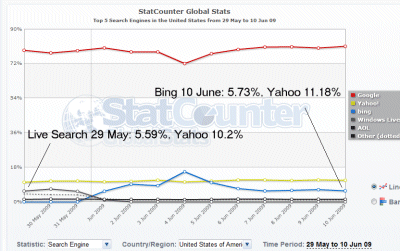
I took a look at the figures today, and they make depressing reading for Microsoft:

I’ve annotated the image to show Live Search share on 29 May, compared to Bing share now. They are nearly the same; within the normal daily variation. Yahoo is actually slightly ahead of where it was. Note that all Live Search hits automatically became Bing hits on the day of transition (1st June). As for Google, it is back a little above where it was before.

One odd thing about the StatCounter figures is that at the beginning of this period there was around 5% share for “other”, which has now almost disappeared. Gone to Google? Who knows; and I don’t particularly trust these figures.

There are two organizations with more reliable numbers, one of them Google, because of the number of sites signed up for its Web Analytics, and the other Microsoft, which can count actual hits, but these numbers are not published.

Well, Ballmer said it was a long haul. I’m actually impressed with Bing; the results seem decent, there are some good UI features, and the re-branding is sensible. If StatCounter accurately reflects the market though, the immediate affect of the launch is vanishingly small.

Update: Things look a little better today – Bing is up to 8.52% (note that the figure changes dynamically during each day). A long haul; I’ll be tracking the figures with interest.

Technorati Tags: ,,,,

Bing, Blind Search and electoral fraud

It’s election fever in the UK: in dramatic results, the incumbent party is being pummelled at the polls. So too for search engines? Microsoft employee Michael Kordahi set up a blind search test. Perform a search, select your favourite from three columns of results. It started well for Bing, but market leader Google soon asserted a lead:

Blind search engine test at http://blindsearch.fejus.com Right now: "Google: 45%, Bing: 33%, Yahoo: 21% | 8,518 votes"

said Mr Google Matt Cutts.

Still, that’s not bad for Bing, considering that its market share is tiny in comparison to Google. 5.5% vs 81.5% according to stats I dug up for this Register piece. The real loser is Yahoo, whose second place in search is now under threat from the Microsoft juggernaut.

But can you trust the results? At some point last night Yahoo started an unlikely surge:

Internet search blind test: Google: 34%, Bing: 26%, Yahoo: 40% Try it out! http://blindsearch.fejus.com/

tweeted Bill Hamilton a few hours after Cutts. Someone was gaming the system:

not surprisingly, #blindsearch has been compromised you can still play, but i’m not currently showing results

said Kordahi, as Yahoo hit 57%.

Will Kordahi be able to insulate his test from fraudsters? Who knows; but it is still an interesting experiment.

I tried the test and found the results generally close, with a small edge to Google in my searches. Still, it would be interesting to measure not only which results are best, but also the margin of difference. In the past I’ve found Live Search almost useless, so Bing has made a substantial improvement from my perspective. The UI changes are important too. I’m a minimalist at heart, which again favours Google, but I like some of Bing’s features, especially the site and video previews.

Google’s Wave is of course more interesting from a technical perspective; but it would be a mistake to downplay the business significance of Microsoft improving its search market share. Search drives advertising income.

It’s also worth noting that in search, quantity drives quality. Program Manager Nathan Buggia explained to me how Bing’s categorisation feature works:

For the categorised results those are driven more off the search behaviour we see on our web site, not actually the semantic information that we infer from their web site. What we’ve done is to take all the queries that come into live search and analysed them to see what user intent those queries have. We take a look at the other search terms that they use to figure out where they go, we aggregate that information and use that to define categories, and we are able to draw on that.

Currently Bing only displays category tabs for around the top 10-20% of searches. The reason it is limited to that, according to Buggia, is insufficient volume of data. Using the Xbox as an example, he told me:

If we have a high enough volume of XBox data and we’ve seen that there are a specific set of intents that people are looking for, then we feel confident enough to show the quick tabs.

In other words, Bing could improve its results simply by more people using it.

What happens next? The easy prediction is that Bing will make at least small gains in market share, and that Yahoo will likely decline, perhaps to third place. For Microsoft, that would be no small achievement, but would do little to dislodge the big G. Further, if it sees significant traffic moving to Bing, Google will be quick to counter it with its own improvements. Personally I would like to see more competition in search, which for many users forms a portal that controls which sites they see and which they do not see, but a good launch for Bing is not enough to effect real change.

It could be the beginning of a change though, and that possibility makes Bing worth watching.

Technorati Tags: ,,,

Cloud Computing survey: more fog than cloud

Yesterday I attended a presentation from NTT Communications, a managed hosting provider, on the plans of 200 CFOs and CIOs from larger UK organizations (500+ employees) with respect to cloud computing. Since NTT would presumably like more companies to stick more stuff on its hosted servers, I presume it was hoping for a strong endorsement of the idea. Unfortunately for NTT, that was not the case. Fewer than 20% of those surveyed think they are using cloud computing now, a bit more than 20% think they will adopt some of it in the next two years, but – and here’s the real killer – cloud computing is way down the list of investment priorities, at around 5%. I’m not clear 5% of what exactly; but the report says it is the lowest priority.

What are companies spending money on instead? Servers and storage, network infrastructure, security, company web sites, backup and disaster recovery, unified communications, desktops and laptops, software, almost anything else in other words.

What’s wrong with the cloud? The three top issues, for those surveyed, are security, immaturity, and reliability.

These are valid concerns, though each one is open to debate; but the entire survey was undermined by the fact that most of those surveyed admitted to not knowing what cloud computing is. The reason is not ignorance, but the many and various ways the term is used. The common strand is that it is something to do with the internet, but even that is undermined if we describe virtual on-premise servers as a “private cloud”.

What are the varieties of cloud? Almost infinite, but here are a few:

  • Multi-tenanted applications such as Salesforce CRM, Google Docs, NetSuite. This is the model that has the biggest inherent economic advantage.
  • Hosted application platforms including Google App Engine, Microsoft Azure, Force.com. These are hosted application servers, where you write the code, taking advantage of integrated hosted services for storage, identity, transactions and so on.
  • Utility services such as Amazon S3. It’s a great example: S3 offers nothing but storage, though you can use it in conjunction with other Amazon web services.
  • On-demand infrastructure such as Amazon EC2. You get virtual servers to do what you like with. NTT’s services are mainly in this broad category. It’s cloud but you are mostly not getting the benefits of multi-tenancy.
  • Anything on the internet. Running a web application? Hey, you’re in the cloud.

If we are going to have a sane discussion about these things, we need to know what we are talking about. Maybe rather than asking companies whether or not they are doing that cool cloud stuff, it would be better to enquire how they see their use of the internet evolving.

Another big question is the extent to which companies are willing to buy in their IT infrastructure as a third-party service. Although it makes obvious financial sense in most cases, it is a big ask given how business-critical it is, hence the concerns about security, immaturity, reliability.

Smaller companies with ad-hoc IT systems are likely to be more amenable to the idea, but this group was not covered by NTTs survey.

Conclusions? The main one is “watch this space”. In the end I reckon sheer economics will drive cloud computing adoption – in all the areas described above – but the one thing NTT’s survey proves is that larger organisations are in no hurry to make that jump.

Technorati Tags: ,,,

Windows 7: July RTM, October 22 launch

News is drifting out that Microsoft intends to launch Windows 7 – that is, have PCs with it pre-loaded on retail sale – on October 22.

Not unexpected news – it is exactly what many of us predicted last year, after seeing it at PDC – but it is good to have it confirmed and will help users considering PC purchase decisions. There should be an announcement very soon about free upgrade offers, where you but a PC with Vista now, and get a free upgrade to 7 when available.

By the way, there’s a further gallery of Windows 7 images up on the Guardian Technology site. This is not just more of the same: I included some of the less publicised corners of the new OS, such as the new-but-not-improved Movie Maker, PowerShell scripting, and the option to remove Internet Explorer.

Update: An official announcement is here:

Microsoft will deliver Release to Manufacturing (RTM) code to partners in the second half of July. Windows 7 will become generally available on Oct. 22, 2009, and Windows Server 2008 R2 will be broadly available at the same time.

I’ve also amended the title of this post to remove the ambiguity between “Windows: 7 July” and “Windows 7: July” 🙂

Technorati Tags: ,

Google Wave: a disruptive approach to collaboration

I watched the Google Wave Developer Preview session at Google IO.

It is tedious to sit through 1 hour 20 mins of conference presentation; but it is worth watching at least a little of it to see some Wave demos. In essence, Google is presenting email++ and hopes it will catch on. A “wave” is loosely analogous to an email conversation or a thread on a discussion board. You participate using a browser-based client. Unlike email, in which messages are copied hither and thither, a wave exists on a server so you always see the latest version. Again unlike email, a wave offers real-time synchronization, so that I see your replies or comments as you type. This means you can use a wave like an instant messaging system or like a wiki (collaborative document editing). You can also embed rich media and extend the system with robots (non-human participants which add functionality) or gadgets, such as polls, games, applications. Waves can be embedded into web pages, just as the above video is embedded into this blog post.

The client-side API for Wave is written in Google Web Toolkit, and according to the keynote:

we couldn’t have built something like this without GWT

The server side, such as robots, has an API in Java or Python. You can check out the APIs here, and sign up for a developer account. The Wave protocol is also published, and is documented here. Google is talking about launch later this year. Mashable has a good overview.

Significance of Wave

This is the bit that interests me most. Why bother with Wave? Well, Google is hoping we will find this to be a compelling alternative and partner to email, Facebook, instant messaging, Twitter, discussion boards, and more. For example, you could develop a new kind of discussion board in which the topics are waves rather than threaded discussions. The impact might include:

  • Driving users to Google Chrome and other browsers optimized for fast JavaScript, and away from Microsoft IE.
  • Promoting use of Google-sponsored APIs like OpenSocial, upon which Wave builds.
  • Shifting attention away from classic email servers such as Microsoft Exchange and Lotus Notes.
  • Offering an alternative to Microsoft Office and Adobe Acrobat for document collaboration.
  • Getting more us to run our content on Google’s servers and use Google’s identity system. This is not required as I understand it – the keynote mentions the ability to run your own Wave servers – but it is inevitable.

The demos are impressive, though it looks like a large Wave with many contributors could become hard to navigate; but it is definitely something I look forward to trying.

Finally, it is notable that Google’s Flash-aversion is continuing here: all the client stuff is done with JavaScript and HTML.

I am not sure how this might work offline; but I imagine Google could do something with Chrome and Gears, while no doubt there is also potential for a neat Adobe AIR client, using the embedded WebKit HTML renderer.

A few good things about Bing – but where is the webmaster’s guide?

So Bing (Bing Is Not Google?) is Microsoft’s new search brand. A few good things about it:

1. Short memorable name, short memorable url

2. Judging by the official video at http://www.decisionengine.com/ Microsoft realises that it has to do something different than Google; doing the same thing almost as well or even just a little better is not enough.

3. Some of the ideas are interesting – morphing the results and the way they are displayed according to the type of search, for example. In the video we see a search for a digital camera that aggregates user reviews from all over the Internet (supposedly); whereas searching for a flight gets you a list of flight offers with fares highlighted.

This kind of thing should work well with microformats, about which Google and Yahoo have also been talking – see my recent post here. But does Bing use them? That’s unknown at the moment, because the Bing Reviewer’s Guide says little about how Bing derives its results. I don’t expect Microsoft to give away its commercial secrets,  but it does have a responsibility to explain how web authors can optimise their sites for Bing – presuming that it has sufficient success to be interesting. Where is the webmaster’s guide?

Some things are troubling. The Bing press material I’ve seen so far is relentlessly commercial, tending to treat users as fodder for ecommerce. While I am sure this is how many businesses perceive them – why else do you want users to come to your site? – it is not a user-centric view. Most searches do not result in a purchase.

There’s a snippet in the reviewer’s guide about why Bing will deliver trustworthy results for medical searches:

Bing Health provides you with access to medical information from nine trusted medical resources, including the Mayo Clinic, the American Cancer Society and MedlinePlus.

No doubt these are trusted names in the USA. Still, reliance on a few trusted brands, while it is good for safety in a sensitive area such as health, is also a route to a dull and sanitized version of the Internet. I am sure there are far more than nine reliable sources of medical information on the Web; and if Bing takes off those others will want to know why they have been excluded.

Back to the introduction in the Reviewer’s Guide:

In a world of excessive choice and too much information, it’s often difficult to make the right decision. What you need is more than just a search engine; you need a decision engine that provides useful tools to help you get what you want fast, rather than simply presenting a list of Web links. Bing is such a decision engine. It provides an easy way to make more informed choices. It organizes popular results by category to help you get the answers you’re looking for without having to guess at the right way to formulate your query. And built right into Bing is a set of intelligent tools to help you accomplish important tasks such as buying a product, planning a trip or finding a local business.

Like many of us, I’ve been searching the web since its earliest days. I found portals and indexes like early Yahoo and dmoz unhelpful: always out of date, never sufficiently thorough. I used DEC’s AltaVista instead, because it seemed to search everywhere. Google came along and did the same thing, but better. Too much categorization and supposed intelligence can work against you, if it hides the result that you really want to see.

Live Search, I’ve come to realise (or theorise), frequently delivers terrible results for me because of faulty localization. It detects that I am in the UK and prioritises what it things are UK results, even though for most of my searches I only care about the quality of the information, not where the web sites are located. It’s another example of the search engine trying to be smart, and ending up with worse results than if it had not bothered.

Still, I’ll undoubtedly try Bing extensively as soon as I can; I do like some of its ideas and will judge it with an open mind.

Technorati Tags: ,,,,,

The battle to be part of the emerging cloud stack: Force.com for Google App Engine

I was interested in today’s announcement of a new Force.com for Google App Engine. App Engine lets you build Python or, since April 7th this year, Java application and run them on Google’s servers. Salesforce.com already offered Python libraries for its Force.com platform, but these have now been joined by Java libraries which are more complete:

The Java toolkit supports the complete Partner WSDL of the Force.com Web Services API. All operations and objects are included in the library and documentation. If you are a Java developer, you can also leverage the Java resources found here.

whereas the Python toolkit only supports “many of the key Force.com Web Services API calls”. I suspect the Java toolkit will have more impact, because it is the language and platform many Enterprises already use for application development.

On the other side, there is also a Google Data API Toolkit for Force.com.

Why is Salesforce.com cosying up to Google? The way I see it, there is an emerging cloud stack and vendors need to be part of that stack or be marginalized.

What’s a cloud stack? You can interpret what the expression means in various ways. Sam Johnston has a go at it here, identifying 6 layers:

  • Infrastructure
  • Storage
  • Platform
  • Application
  • Services
  • Clients

There isn’t a single cloud stack, and all parts of it are available from multiple vendors as well as from open source. It is a major shift in the industry though, and there is no reason to think that the same vendors who currently succeed in the on-premise stack will also succeed in the cloud stack, rather the contrary. You could describe the RIA wars (Adobe Flash vs browser vs Silverlight) as a battle for share of the client stack, for example, and one in which Microsoft is unlikely to win as much share as it has enjoyed with Windows.

By positioning itself as a platform that integrates well with Google App Engine, Salesforce.com is betting that Google will continue to be an important player, and that it will pay to be perceived as complementary to its platform.

A factor which holds back Force.com adoption is that it is expensive. Developers can experiment for free, but rolling out a live application means subscriptions for all your users. Getting started with App Engine, on the other hand, is free, with fees kicking in only after you have succeeded sufficiently that you are generating substantial traffic (and hopefully making or saving some money).

Microsoft having another go at Windows help: Help 3

Online help is a part of Windows full of dead-ends and back-alleys. I’m not going to attempt the story in detail here; but it goes back many years. By online help I mean local help of course; in ancient times the word “online” meant something on your computer as opposed to being in a printed book.

The first help engine I remember was in Windows 3.x, called WinHelp, and used .hlp files. It was well-liked, but authoring the files was an arcane process involving Word, RTF, a help compiler, and a certain amount of black magic.

In 1997 Microsoft replaced .hlp with .chm (compiled HTML); its initial efforts were less good than the old .hlp, but this evolved into a decent help engine despite one or two quirks.

After that it gets messy. In 2001 Microsoft announced Help 2, still HTML based but with all sorts of improvements. It was used by MSDN and in Visual Studio; its viewer is the Microsoft Document Explorer. However, and despite the help authoring tool vendors getting all geared up for Help 2, Microsoft announced in 2003 that it would not be made into a general Windows help engine, but only used for Visual Studio. Since then Help 2 has had a curious status; it is possible to author for Help 2, and those building Visual Studio extensions have needed to do so, but it has never replaced compiled HTML.

There was a similar story with Vista Help. Microsoft built a new help engine for Vista but drew back from making this available to 3rd party applications. In fact, there is a rather wonderful tool called Guided Help which lets you include application automation within Help, complete with “show me” and “do it” functionality. You can get the Guided Help SDK if you know where to look, and it works, but the project was mostly abandoned. You are still meant to use HTML Help 1.4 for your own applications.

Now Microsoft is talking about Help 3. Microsoft’s Terry Clancy mentions it in an informative post about Visual Studio 2010:

Visual Studio 10 will come with a completely re-engineered Help system that introduces a new flexible, standards based Help framework which will ultimately be used in other products beyond Visual Studio. Help3 is a help system replacement for Microsoft Help 2.x . This new help system will be easier to produce content for, and will interfere less with Visual Studio itself. The standards based approach delivers not only a much better local experience but also a seamless transition to an online web browser and with infrastructure and tooling much more consistent other Visual Studio and internet technologies.

Will Help 3 ever replace the seemingly immortal HTML Help 1.x? Place your bets.

In practice, desktop help is less important than it used to be. Online help now means the Internet; or users just use Google.

New Visual Studio 2010 beta has WPF editor, Silverlight designer

I’ve just downloaded and installed the Visual Studio 2010 beta 1 release. I’ve not explored much yet – and it is rather slow in a virtual machine – but it does now seem to have the new editor and other pieces built with Windows Presentation Foundation.

A landmark for both WPF and Visual Studio.

I also noticed that the Silverlight visual designer now works as you would expect, though I had to download the developer runtime and SDK separately:

I’d welcome comments from anyone using the beta.

Exchange 2007 backup to be fixed at last

Microsoft’s Exchange team is including a VSS plug-in in Exchange 2007 SP2, which means you will be able to backup Exchange on Server 2008 without purchasing a third-party product. Details of how this works are here.

Note that this feature, which was first promised in June 2008, will likely be appearing just before Exchange 2010. SP2 is promised in the third quarter this year, and Exchange 2010 in the second half; interpreting this ship-date jargon I guess means Exchange 2010 around the end of the year. In other words, it has taken almost a complete generation of the product to ship the fix.

Technorati Tags: ,,