Category Archives: microsoft

Microsoft disabling USB AutoRun in Windows 7 RC

It’s so easy. Install your virus or worm on a USB memory stick, set it to run automatically via AutoRun. An obvious security risk, and I’m surprised that Microsoft hasn’t already disabled the feature by default in a security update or service pack for XP or Vista.

The company is finally paying attention:

AutoRun entries on non-optical removable storage devices have been disabled to ensure that you are able to make a considered decision before running software from removable media such as USB drives. Worms sometimes attempt to use AutoRun as a vehicle to install malicious software onto your computer. CDs and DVDs, which are not subject to worm injection after manufacturing, will continue to expose the AutoRun choice to enable you to launch the specified software.

says the press release for Windows 7 RC. Personally I think it should apply the same logic at least to writable CDs and DVDs. I’ve disabled AutoRun on my PCs and don’t miss it. I agree though that USB sticks are the biggest risk today – though a little bit of social engineering will probably persuade many users to run a setup file on a USB stick anyway.

Technorati Tags: ,,

New in Windows 7 RC: Windows XP Mode, Remote Media Streaming

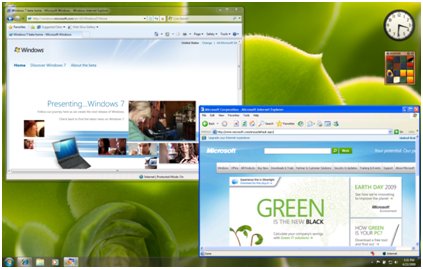
A new feature in Windows 7 has been announced as part of the Release Candidate rollout. Called XP Mode (XPM), it lets users run applications in a virtual instance of Windows XP itself, for excellent compatibility. Although not part of the retail Windows 7, XPM will be a free download or may be installed at no extra cost by PC vendors.

The neat aspect of this is that XP applications don’t have to run within an XP desktop, but can be published to the host system. What this means is that users can start an XP application from the Windows 7 desktop, and only see the application window. This is more user-friendly than having to cope with two operating systems at once.

The main advantage is compatibility. Since this really is XP, pretty much anything that works on XP should run correctly. That said, since the hardware is virtualized there could be issues with some devices, or with applications that require accelerated graphics.

Another aspect is security. For example, if you have some applications that do not work properly with UAC (User Account Control) enabled, you can run them in XP Mode rather than compromising the security of the entire system.

It is a clever move from Microsoft, since it will remove most compatibility concerns that could otherwise impede adoption.

Another interesting new feature is Remote Media Streaming:

Windows 7 offers new functionality called Remote Media Streaming that enables you to access your home-based digital media libraries over the Internet from another Windows 7-based computer outside the home. Simply associate two or more computers running Windows 7 with your online ID provider credentials (such as your Windows Live™ email address and password) and allow Internet access to your media.

says the press release. This feature extends to any PC in your home network, so if you have a fast enough connection you need never be parted from your music. Then again, you could just run Spotify. There’s also support for MOV files in Windows Media Player.

There’s a few more detail changes in the UI; I’ll report further when I’ve had a look.

Windows 7 RC will be released to Technet and MSDN subscribers on April 30th, and made generally available on May 5th.

Microsoft’s quarterly results: will it ever make sense of the cloud?

Most comments on Microsoft’s quarterly results are understandably focused on the overall picture: a quarterly revenue decline for the first time ever.

Revenue decline can be forgiven during a recession, but it’s more interesting to look at the breakdown. I made a simple quarter-on-quarter table to look at the pattern:

Quarter ending Mar 31st 2009 vs quarter ending March 31st 2008, $millions

Client Revenue % change Profit % change
Client (Windows) 3404 -15.6 2514 -19.29
Server and Tools 3467 7.07 1344 24.44
Online 721 14.47 -575 -154.42
Business (Office) 4505 -4.78 2877 -7.99
Entertainment and devices 1567 -1.57 -31 -129.25%

The weak Windows client figures are unsurprising. The poorly-received Windows Vista is out in the market, and the highly-praised Windows 7 is being prepared for release. When anyone asks me, I suggest that they should wait for Windows 7 before buying a new PC or laptop, if they are in a position to delay.

The Business division (Office) remains massively profitable, even though it too has declined a little. Office may be ludicrously expensive, but there’s little evidence of a significant shift to cheaper or free alternatives.

It’s also notable that the server and tools business continues to perform well. Again, I’m not surprised: Server 2008 strikes me as a solid product, and there’s not much wrong with products like SQL Server 2008 and Visual Studio.

Not much to say about entertainment and devices. Xbox is doing so-so; Windows Mobile is rather a mess.

The real shocker here is the online business. Revenue is down and losses have grown. It is no use just blaming the recession: this is a sector that is growing in importance. Should Microsoft back out and leave it to Google? That would be as if Kodak had refused to invest in digital photography. But something is badly wrong here.

That said, I’m guessing that the figures mostly represent the failure of the various Windows Live properties to attract advertising income; the small market share of Live Search must be an important factor. The newer cloud computing business model, where Microsoft sells subscriptions to its online platform and services, is largely still in beta – I’m thinking of things like Windows Azure and Live Mesh. Further, I’m not sure where Microsoft puts revenue from things like hosted Exchange or hosted Dynamics CRM, which straddle server and online. There is still time for the company to get this right.

I’m not convinced though that Microsoft yet has the will or the direction to make sense of its online business. Evidence: the way the company blows hot and cold about Live Mesh; the way SQL Server Data Services was scrapped and replaced by full online SQL Server at short notice; and the ugly and confusing web site devoted to Windows Azure.

When I looked at Virtual Earth recently I was impressed by its high quality and ease of development. It illustrates the point that within Microsoft there are teams which are creating excellent online services. Others are less strong; but what is really lacking is the ability to meld everything together into a compelling online platform.

That could change at any time; but we’ve been waiting a long while already.

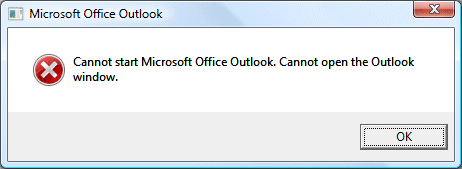
Cannot open the Outlook window – what sort of error message is that?

I’m actually enjoying Outlook 2007 on my desktop, especially since applying the February patch. It opens in a couple of seconds even from cold. I’m running on Vista 64-bit, and not using cached Exchange mode.

Until today, that is. Started Outlook and got this bewildering message:

This Microsoft article suggested I might not have a default gateway. That was nonsense; so I opened Mail setup (I can get to this through the Properties of the Outlook shortcut), clicked Show Profiles, added a new profile and set the new one as default.

Outlook works fine now. I’m not impressed with the error message though.

Update

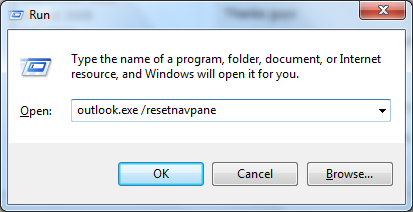
While using a new profile works, there is an easier fix as noted in many of the comments to this post. You can run Outlook with the /resetnavpane argument. Here’s the step by step:

1. Press Windows key and R together to open the Run dialog.

2. In the Open field, type:

outlook.exe /resetnavpane

image

Note: there is a space between outlook.exe and /resetnavpane. There are no other spaces in what you have to type.

3. Click OK. Outlook should open.

Helpful post? Sponsor ITWriting.com for ad-free access to the site

The end of Sun’s bold open source experiment

This is a sad day for Sun. It sought to re-invent its business through open source; and the experiment has failed, culminating not in a re-invigorated company, but instead acquisition by an old-school proprietary software company, Oracle.

It is possible to build a successful business around open source software. Zend is doing it with PHP; Red Hat has done it with Linux. These are smaller companies though, and they have not tried to migrate an older business built on a proprietary model. A further complication is that Sun is a hardware business, and although open source is an important part of its hardware strategy as well as its software strategy, it is a different kind of business.

Maybe the strategy was good, but it was the recession, or the server market, that killed Sun. In the end it does not make any difference, the outcome is what counts.

Reading the official overview of the deal, I see lots of references to “open” and “standard-based”, which means nothing, but no mention of open source.

The point of interest now is what happens to Sun’s most prominent open source projects: OpenOffice.org, MySQL, Java and OpenSolaris. Developers will be interested to see what happens to NetBeans, the open source Java IDE, following the Oracle acquisition, and how it will relate to Oracle’s JDeveloper IDE. These open source projects have a momentum of their own and are protected by their licenses, but a significant factor is what proportion of the committers – those who actually write the software and commit their changes to the repository – are Sun employees. Although it is not possible to take back open source code, it is possible to reduce investment, or to start creating premium editions available only to commercial subscribers, which already appeared to be part of MySQL’s strategy.

I presume that both OpenOffice and Java will feature in Oracle’s stated intention to build an end-to-end integrated solution:

Oracle will be the only company that can engineer an integrated system – applications to disk – where all the pieces fit and work together so customers do not have to do it themselves. Our customers benefit as their systems integration costs go down while system performance, reliability and security go up.

says CEO Larry Ellison, who also says nothing about open source. This will involve invading Microsoft’s turf – something Sun was always willing to do, but not particularly successful at executing.

The best outcome for the open source community will be if Oracle continues to support Sun’s open source projects along the same lines as before. Even if that happens, the industry has lost a giant of the open source world.

Some good comments from Redmonk’s Michael Coté here.

What’s new in Exchange 2010 and Hyper-V R2

Mark Wilson’s blog has the best summary I’ve seen on what’s coming in Exchange 2010 and what’s new in Hyper-V R2.

The big thing in Hyper-V R2 is live migration. The big thing in Exchange 2010 is, well:

For me, it seems that Exchange 2010 is not a major upgrade – just as 2003 was an incremental change built on 2000, 2010 builds on 2007 but, nevertheless, the improvements are significant.

says Wilson. Microsoft’s product releases (irrespective of whether the main version number is incremented) can often be categorized as either a major release, or fine-tuning, and it seems that Exchange 2010 is in the latter category. Not a bad thing, given that there was a lot for admins to learn in Exchange 2007. Still, there is a lot in Exchange 2010 if you are excited about compliance, auditing and rights management, as well as some interesting new storage options:

In what will be a massive shift for many organisations, Microsoft is encouraging Exchange 2010 customers to store mailbox data on inexpensive local disks and to replicate databases between servers rather than using SAN-based replication.

There’s also no sign yet of Exchange moving to SQL Server rather than its own Blue JET Extensible Storage Engine. Confused about Red JET, Blue JET and Exchange? Roger Jennings wrote an extensive discussion of the matter.

And what of the VSS plug-in that enables Exchange-aware backup without purchasing a 3rd party solution? Promised in June 2008, still not delivered. I will be interested to see if it arrives with Exchange 2010, expected towards the end of this year. It’s no longer an issue for me personally; I’m using the old NTBackup copied from 64-bit Windows Server 2003 and it seems to work fine for this purpose. The reason Microsoft does not care about this is that most users are either enterprises, which are meant to use Data Protection Manager, or small businesses with Small Business Server, that has its own backup solution. That does not excuse broken promises.

RIA (Rich Internet Applications): one day, all applications will be like this

I loved this piece by Robin Bloor on The PC, The Cloud, RIA and the future. My favourite line:

Nowadays very few Mac/PC users have any idea where any program is executing.

And why should they? Users want stuff to just work, after all. Bloor says more clearly than I have managed why RIA is the future of client computing. He emphasises the cost savings of multi-tenancy, and the importance of offline capability; he says the PC will become a caching device. He thinks Google Chrome is significant. So do I. He makes an interesting point about piracy:

All apps will gradually move to RIA as a matter of vendor self interest. (They’d be mad not to, it prevents theft entirely.)

Bloor has said some of this before, of course, and been only half-right. In 1997 he made his remark that

Java is the epicenter of a software earthquake, and the shockwaves are already shaking the foundations of the software industry.

predicting that Java browser-hosted or thin clients would dominate computing; he was wrong about Java’s impact, though perhaps he could have been right if Sun had evolved the Java client runtime to be more like Adobe Flash or Microsoft Silverlight, prior to its recent hurried efforts with JavaFX. I also suspect that Microsoft and Windows have prospered more than Bloor expected in the intervening 12 years. These two things may be connected.

I think Bloor is more than half-right this time round, and that the RIA model with offline capability will grow in importance, making Flash vs Silverlight vs AJAX a key battleground.

Flash library for Facebook, Silverlight library for MySpace

Adobe and Facebook have announced that ActionScript 3, the language of Flash 9 and higher, is now officially supported by FaceBook along with JavaScript and PHP. Information about coding for Facebook with Flash is here, and the library itself is on Google Code.

MySpace has announced the MySpace Silverlight SDK which will be hosted on Microsoft’s CodePlex open source site. The focus of the Microsoft Silverlight work seems to be on wrapping the Open Social API used by MySpace in a C# library.

Note that there is already documentation on creating Flash applications for MySpace. On the Facebook side, here’s an intriguing fact: there’s also an Fb:silverlight tag, though the documentation remarks: “For now this feature has no functionality.” Fb:swf is better supported. David Justice has been working on a Facebook library for Silverlight. It’s clear though that Flash is more widely accepted and supported on both platforms, reflecting its maturity and broader acceptance.

Smart developers can already devise code to access the public APIs of platforms like Facebook and MySpace from a variety of clients; this is about making that easier. It benefits the social networking sites if a wider group of developers has access to its platform, and with the advantages of multimedia features; equally it benefits the plug-in vendors if their runtime works smoothly with the broadest possible range of services. Therefore we should expect more of this type of announcement.

It is interesting to see technology partnerships bridging political divides. Microsoft has a stake in Facebook, for example, while Google has a partnership with MySpace.

Perhaps the most interesting outcome may be more Facebook applications based on AIR, Adobe’s Flash platform for the desktop. The existence of AIR applications like Twhirl and Tweetdeck has significantly boosted Twitter; maybe it is now Facebook’s turn.

Open Cloud Manifesto – but from a closed group?

I’ve read the Open Cloud Manifesto with interest. It’s hard to find much to disagree with; I especially like this point on page 5:

Cloud providers must not use their market position to lock customers into their particular platforms and limit their choice of providers.

Companies like IBM won’t do that? I’m sceptical. Still, it is all very vague; and companies not on the list of supporters have been quick to point out the lack of any effort to achieve cross-industry consensus:

Very recently we were privately shown a copy of the document, warned that it was a secret, and told that it must be signed "as is," without modifications or additional input.  It appears to us that one company, or just a few companies, would prefer to control the evolution of cloud computing, as opposed to reaching a consensus across key stakeholders

says Microsoft’s Steve Martin. Amazon, perhaps the most prominent cloud computing pioneer, is another notable absentee.

It is a general truth that successful incumbents rarely strive for openness; whereas competitors who want to grow their market share frequently demand it.

The manifesto FAQ says:

There are many reasons why companies may not be listed. This moved quickly and some companies may not have been reached or simply didn’t have time to make it through their own internal review process.

A poor excuse. If a few more months would have added Microsoft, Amazon, Google and Salesforce.com to the list, it would have been well worth it and added hugely to its impact.

That said, I’ve found Amazon reluctant to talk about interoperability between clouds, while Salesforce.com makes no secret of its lock-in:

… you are making a platform decision, and our job is to make sure you choose our platform and not another platform, because once they have chosen another platform, getting them off it is usually impossible.

said CEO Marc Benioff when I quizzed him on the subject. I guess it could have taken more than a few months.

Sys-con vs Aral Balkan in Web 2.0 war over intellectual property

Aral Balkan is well-known in the Adobe Flash community as an independent speaker and developer; I first came across him a few years back as a champion of open source Flash. On Friday Balkan was surprised to find that he was apparently a key author at Ulitzer.com, a new online publication from Sys-con media which has been launched with the extravagant claim:

Ulitzer is designed to replace Wikipedia with Its three dimensional live content offerings and dynamic topic structure.

Balkan found that he had an entire sub-domain on Ulitzer devoted to his work, with articles he had written. He had not been consulted about this or offered any payment and was indignant, declaring on Twitter (note the sub-domain has been removed):

WTF is Ulitzer and why am I listed as an author on it? Sys-con, remove me now!!! http://aralbalkan.ulitzer.com

He was not alone; and along with a number of other authors contacted sys-con to have his content removed. Balkan expressed his feelings in a series of tweets using the tag @plagiarismtoday and remarking that:

They’ve never had any respect for authors/speakers. I was once announced as speaking at an event I wasn’t approached about!

Fair enough; and the drama could have ended there, except that Sys-con decided to fight back on its blog.

Sys-Con libels me, calls me a "gay son of a bitch" in article titled "Turkish Fags Who Live in London"

tweeted Balkan in response to an intemperate blog post, letting loose a salvo of tweets expressing his emotions towards the company.

Next up, Sys-con blogged under the heading Turkish Web Designer declares Death on Twitter:

Company representatives contacted the Interpol and Scotland Yard to locate the Turkish Web Designer who is suspected to live in London. Aral Balkan seemed to be organizing a Twitter group who may harm the company representatives according to his Twitter logs.

and going on to recall the attempted assassination of the Pope John Paul II.

All very silly; though in saying that I don’t want to underestimate the impact this kind of outburst can have on individuals – it can be profoundly disturbing. Certainly it is not the way a reputable media company should behave. It strikes me that Sys-con has underestimated the influence of a popular individual armed with Twitter, a blog, and the attention of numerous influential folk at companies including Adobe and Microsoft, which are Sys-con’s advertising clients or potential clients – Sys-con’s site is currently plastered with ads for Microsoft’s Visual Studio.

The episode interests me because at heart it is a battle over intellectual property. One way to look at Ulitzer.com is that it gets free content from others and profits from it – something which Experts Exchange also does, but in that case successfully and openly. That’s worrying for those of us who make a business from selling our content. The episode is causing some bloggers to have second thoughts about the Creative Commons license:

Take a scroll down the right-hand side of this blog and you will see that I have removed the Creative Commons License and reverted to specific copyright protection.

Why? Some rather interesting facts have come to light about a certain publishing house over the last few days. It seems that they are doing nothing short of scraping blogs and recycling content under the auspices of a "publishing portal" labelled with their brand, claiming the original blog authors as their own featured authors as if the content was written specifically for them.

says Robert Turrall.

I doubt Sys-con need fear assassins; but it should not under-estimate the power of a community or the importance of reputation.