Category Archives: .net

WS-I closes its doors–the end of WS-* web services?

The Web Services Interoperability Organization has announced [pdf] the “completion” of its work:

After nearly a decade of work and industry cooperation, the Web Services Interoperability Organization (WS-I; http://www.ws-i.org) has successfully concluded its charter to document best practices for Web services interoperability across multiple platforms, operating systems and programming languages.

In the whacky world of software though, completion is not a good thing when it means, as it seems to here, an end to active development. The WS-I is closing its doors and handing maintenance of the WS interoperability profiles to OASIS:

Stewardship over WS-I’s assets, operations and mission will transition to OASIS (Organization for the Advancement of Structured Information Standards), a group of technology vendors and customers that drive development and adoption of open standards.

Simon Phipps blogs about the passing of WS-I and concludes:

Fine work, and many lessons learned, but sadly irrelevant to most of us. Goodbye, WS-I. I know and respect many of your participants, but I won’t mourn your passing.

Phipps worked for Sun when the WS-* activity was at its height and WS-I was set up, and describes its formation thus:

Formed in the name of "preventing lock-in" mainly as a competitive action by IBM and Microsoft in the midst of unseemly political knife-play with Sun, they went on to create massively complex layered specifications for conducting transactions across the Internet. Sadly, that was the last thing the Internet really needed.

However, Phipps links to this post by Mike Champion at Microsoft which represents a more nuanced view:

It might be tempting to believe that the lessons of the WS-I experience apply only to the Web Services standards stack, and not the REST and Cloud technologies that have gained so much mindshare in the last few years. Please think again: First, the WS-* standards have not in any sense gone away, they’ve been built deep into the infrastructure of many enterprise middleware products from both commercial vendors and open source projects. Likewise, the challenges of WS-I had much more to do with the intrinsic complexity of the problems it addressed than with the WS-* technologies that addressed them. William Vambenepe made this point succinctly in his blog recently.

It is also important to distinguish between the work of the WS-I, which was about creating profiles and testing tools for web service standards, and the work of other groups such as the W3C and OASIS which specify the standards themselves. While work on the WS-* specifications seems much reduced, there is still work going on. See for example the W3C’s Web Services Resource Access Working Group.

I partly disagree with Phipps about the work of the WS-I being “sadly irrelevant to most of us”. It depends who he means by “most of us”. Granted, all this stuff is meaningless to the world at large; but there are a significant number of developers who use SOAP and WS-* at least to some extent, and interoperability is key to the usefulness of those standards.

The Salesforce.com API is mainly SOAP based, for example, and although there is a REST API in preview it is not yet supported for production use. I have been told that a large proportion of the transactions on Salesforce.com are made programmatically through the API, so here is one place at least where SOAP is heavily used.

WS-* web services are also built into Microsoft’s Visual Studio and .NET Framework, and are widely used in my experience. Visual Studio does a good job of wrapping them so that developers do not have to edit WSDL or SOAP requests and responses by hand. I’d also suggest that web services in .NET are more robust than DCOM (Distributed COM) ever was, and work successfully over the internet as well as on a local network, so the technology is not a failure.

That said, I am sure it is true that only a small subset of the WS-* specifications are widely used, which implies a large amount of wasted effort.

Is SOAP and WS-* dying, and REST the future? The evidence points that way to me, but I would be interested in other opinions.

The Java crisis and what it means for developers

What is happening with the Java language and runtime? Since Java passed into the hands of Oracle, following its acquisition of Sun, there has been a succession of bad news. To recap:

  • The JavaOne conference in September 2010 was held in the shadow of Oracle OpenWorld making it a less significant event than in previous years.
  • Oracle is suing Google, claiming that Java as used in the Android SDK breaches its copyright.
  • IBM has abandoned the Apache open source Harmony project and is committing to the Oracle-supported Open JDK. Although IBM’s Sutor claims that this move will “help unify open source Java efforts”, it seems to have been done without consultation with Apache and is as much divisive as unifying.
  • Apple is deprecating Java and ceasing to develop a Mac-specific JVM. This should be seen in context. Apple is averse to runtimes of any kind – note its war against Adobe Flash – and seems to look forward to a day when all or most applications delivered to Apple devices come via the Apple-curated and taxed app store. In mitigation, Apple is cooperating with the OpenJDK and OpenJDK for Mac OS X has been announced.
  • Apache has written a strongly-worded blog post claiming that Oracle is “violating their contractual obligation as set forth under the rules of the JCP”, where JCP is the Java Community Process, a multi-vendor group responsible for the Java specification but in which Oracle/Sun has special powers of veto. Apache’s complaint is that Oracle stymies the progress of Harmony by refusing to supply the test kit for Java (TCK) under a free software license. Without the test kit, Harmony’s Java conformance cannot be officially verified.
  • The JCP has been unhappy with Oracle’s handling of Java for some time. Many members disagree with the Google litigation and feel that Oracle has not communicated well with the JCP. JCP member Doug Lea stood down, claiming that “the JCP is no longer a credible specification and standards body”. Another member, Stephen Colebourne, has a series of blog posts in which he discusses the great war of Java and what he calls the “unravelling of the JCP”, and recently  expressed his view that Oracle was trying to manipulate the recent JCP elections.

To set this bad news in context, Java was not really in a good way even before the acquisition. While Sun was more friendly towards open source and collaboration, the JCP has long been perceived as too slow to evolve Java, and unrepresentative of the wider Java community. Further, Java’s pre-eminence as a pervasive cross-platform runtime has been reduced. As a browser plug-in it has fallen behind Adobe Flash, the JavaFX initiative failed to win wide developer support, and on mobile it has also lost ground. Java’s advance as a language has been too slow to keep up with Microsoft’s C#.

There are a couple of ways to look at this.

One is to argue that bad news followed by more bad news means Java will become a kind of COBOL, widely used forever but not at the cutting edge of anything.

The other is to argue that since Java was already falling behind, radical change to the way it is managed may actually improve matters.

Mike Milinkovich at the Eclipse Foundation takes a pragmatic view in a recent post. He concedes that Oracle has no idea how to communicate with the Java community, and that the JCP is not vendor-neutral, but says that Java can nevertheless flourish:

I believe that many people are confusing the JCP’s vendor neutrality with its effectiveness as a specifications organization. The JCP has never and will never be a vendor-neutral organization (a la Apache and Eclipse), and anyone who thought it so was fooling themselves. But it has been effective, and I believe that it will be effective again.

It seems to me Java will be managed differently after it emerges from its crisis, and that on the scale between “open” and “proprietary” it will have moved towards proprietary but not in a way that destroys the basic Java proposition of a free development kit and runtime. It is also possible, even likely, that Java language and technology will advance more rapidly than before.

For developers wondering what will happen to Java at a technical level, the best guide currently is still the JDK Roadmap, published in September. Some of its key points:

  • The open source Open JDK is the basis for the Oracle JDK.
  • The Oracle JDK and Java Runtime Environment (JRE) will continue to be available as free downloads, with no changes to the existing licensing models.
  • New features proposed for JDK 7 include better support for dynamic languages and concurrent programming. JDK 8 will get Lambda expression.

While I cannot predict the outcome of Oracle vs Google or even Apache vs Oracle, my guess is that there will be a settlement and that Android’s momentum will not be disrupted.

That said, there is little evidence that Oracle has the vision that Sun once had, to make Java truly pervasive and a defence against lock-in to proprietary operating systems. Microsoft seems to have lost that vision for .NET and Silverlight as well – though the Mono folk have it. Adobe still has it for Flash, though like Oracle it seems if anything to be retreating from open source.

There is therefore some sense in which the problems facing Java (and Silverlight) are good for .NET, for Mono and for Adobe. Nevertheless, 2010 has been a bad year for write once – run anywhere.

Update: Oracle has posted a statement saying:

The recently released statement by the ASF Board with regard to their participation in the JCP calling for EC members to vote against SE7 is a call for continued delay and stagnation of the past several years. We would encourage Apache to reconsider their position and work together with Oracle and the community at large to collectively move Java forward.  Oracle provides TCK licenses under fair, reasonable, and non-discriminatory terms consistent with its obligations under the JSPA.   Oracle believes that with EC approval to initiate the SE7 and SE8 JSRs, the Java community can get on with the important work of driving forward Java SE and other standards in open, transparent, consensus-driven expert groups.   This is the priority.   Now is the time for positive action.  Now is the time to move Java forward.

to which Apache replies succinctly:

The ball is in your court. Honor the agreement.

Microsoft pledges commitment to Silverlight – but is it enough?

Microsoft’s president of Server and Tools Bob Muglia has posted a response to the widespread perception that the company is backing off its commitment to Silverlight, a cross-browser, cross-platform runtime for rich internet applications. He is the right person to do so, since it was his remark that ”Our strategy with Silverlight has shifted” which seemed to confirm a strategy change that had already been implied by the strong focus in the keynote on HTML 5 as an application platform.

Muglia says Silverlight is in fact “very important and strategic to Microsoft”. He confirms that a new release is in development, notes that Silverlight is the development platform for Windows Phone 7, and affirms Silverlight both as a media client and as “the richest way to build web-delivered client apps.”

So what is the strategy change? It is this:

When we started Silverlight, the number of unique/different Internet-connected devices in the world was relatively small, and our goal was to provide the most consistent, richest experience across those devices.  But the world has changed.  As a result, getting a single runtime implementation installed on every potential device is practically impossible.  We think HTML will provide the broadest, cross-platform reach across all these devices.  At Microsoft, we’re committed to building the world’s best implementation of HTML 5 for devices running Windows, and at the PDC, we showed the great progress we’re making on this with IE 9.

The key problem here is Apple’s iOS, which Muglia mentioned specifically in his earlier interview:

HTML is the only true cross platform solution for everything, including (Apple’s) iOS platform.

Muglia’s words are somewhat reassuring to Silverlight developers; but not, I think, all that much. Silverlight will continue on Windows, Mac and on Windows Phone; but there are many more devices which developers want to target, and it sounds as if Microsoft does not intend to broaden Silverlight’s reach.

Faced with the same issues, Adobe has brought Flash to device platforms including Android, MeeGo, Blackberry and Google TV; and come up with a packager that compiles Flash applications to native iOS code. There is still no Flash or AIR (out of browser Flash) on Apple iOS; but Adobe has done all possible to make Flash a broad cross-platform runtime.

Microsoft by contrast has not really entered the fight. It has been left to Novell’s Mono team to show what can be done with cross-platform .NET, including MonoTouch for iOS and MonoDroid for Google’s Android platform.

Microsoft could have done more to bring Silverlight to further platforms, but has chosen instead to focus on HTML 5 – just as Muglia said in his earlier interview.

Whether Microsoft is right or wrong in this is a matter for debate. From what I have seen, the  comments on Microsoft’s de-emphasis of Silverlight at PDC have been worrying for .NET developers, but mostly cheered elsewhere.

The problem is that HTML 5 is not ready, nor is it capable of everything that can be done in Silverlight or Flash. There is a gap to be filled; and it looks as if Microsoft is leaving that task to Adobe.

It does seem to me inevitable that if Microsoft really gets behind HTML 5, by supporting it with tools and libraries to make it a strong and productive client for Microsoft’s server applications, then Silverlight will slip further behind.

Which mobile platforms will fail?

Gartner’s Nick Jones addressed this question in a blog post yesterday. He refers to the “rule of three” which conjectures that no more than three large vendors can succeed in a mature market. If this applies in mobile, then we will see no more than three survivors, after failures and consolidation, from the following group plus any I’ve missed. I have shown platforms that have common ownership and are already slated to be replaced in strikeout format.

  • Apple iOS
  • Google Android
  • Samsung Bada
  • Maemo MeeGo
  • RIM BlackBerry OS BlackBerry Tablet OS (QNX)
  • HP/Palm WebOS
  • Symbian
  • Windows Mobile Windows Phone 7 and successors

Jones says that success requires differentiation, critical mass, and a large handset manufacturer. I am not sure that the last two are really distinct. It is easy to fall into the tautology trap: to be successful a platform needs to be successful. Quite so; but what we are after is the magic ingredient(s) that make it so.

Drawing up a list like this is hard, since some operating systems are more distinct than others. Android, Bada, MeeGo and WebOS are all Linux-based; iOS is also a Unix-like OS. Windows Mobile and Windows Phone 7 are both based on Windows CE.

While it seems obvious that not all the above will prosper, I am not sure that the rule of three applies. I agree that it is unlikely that mobile app vendors will want to support and build 8 or more versions of each app in order to cover the whole market; but this problem does not apply to web apps, and cross-platform frameworks and runtimes can solve the problem to some extent – things like Adobe AIR for mobile, PhoneGap and Appcelerator. Further, there will probably always be mobile devices on which few if any apps are installed, where the user will not care about the OS or application store.

Still, pick your winners. Gartner is betting on iOS and Android, predicting decline for RIM and Symbian, and projecting a small 3.9% share for Microsoft by 2014.

I am sure there will be surprises. The question of mobile OS market share should not be seen in isolation, but as part of a bigger picture in which cloud+device dominates computing. Microsoft has an opportunity here, because in theory it can offer smooth migration to existing Microsoft-platform businesses, taking advantage of their investment – or lock-in – to Active Directory, Exchange, Office and .NET. In the cloud that makes Microsoft BPOS and Azure attractive, while a mobile device with great support for Exchange and SharePoint, for example, is attractive to businesses that already use these platforms.

The cloud will be a big influence at the consumer end too. There is talk of a Facebook phone which could disrupt the market; but I wonder if we will see the existing Facebook and Microsoft partnership strengthen once people realise that Windows Phone 7 has, from what I have seen, the best Facebook integration out there.

So there are two reasons why Gartner may have under-rated Microsoft’s prospects. Equally, you can argue that Microsoft is too late into this market, with Android perfectly positioned to occupy the same position with respect to Apple that worked so well for Microsoft on the desktop.

It is all too early to call. The best advice is to build in the cloud and plan for change when it comes to devices.

Can Microsoft repeat history and come from behind with Windows Phone 7?

This week is Windows Phone 7 week. Microsoft is announcing details of the launch devices and operators, and I shall be watching and reporting with interest on the joint press conference with CEO Steve Ballmer and AT&T’s Ralph de la Vega.

But how significant is this launch? I think it is of considerable significance. Mobile devices are changing the way we do computing. It is not only that more powerful SmartPhones and tablets are encroaching on territory that used to belong to laptop and desktop computers. We are also seeing new business models based on locked-down devices and over-the-air app stores, and new operating systems, or old ones re-purposed. It is a power shift.

Despite its long years of presence in mobile, it feels like a standing start for Microsoft. A recent, and excellent, free day of training on developing for Windows Phone 7 was only one-third full. Verizon will not be offering the phone, and its president Lowell McAdam suggests that the market belongs RIM, Google and Apple, and that Microsoft’s phones are not innovative or leading edge.

I disagree with McAdam’s assessment. Although I’ve not yet had a chance to try a device for myself, what I have seen so far suggests that it is innovative. While the touch UI does borrow ideas with which we have become familiar thanks to iPhone and Android, the dynamically updating tiles and the hub concept both strike me as distinctive. What McAdam really means is that the phone might not succeed in the market, and such views from someone in his position may be self-fulfilling.

The application development platform is distinctive too, being based on .NET, Silverlight and XNA. I have followed Microsoft’s .NET platform since its earliest days – which as it happens were on Windows Mobile, in the form of the Common Executable Format – and Silverlight seems to me the best incarnation yet of the .NET client. It is lightweight; it performs well; it has a powerful layout language that scales nicely, and it has all sorts of multimedia tricks and effects. Visual Studio and the C# language form a familiar and capable set of tools, supplemented by the admittedly challenging Expression Blend for design.

Still, having a decent product is not always enough. Palm’s webOS devices were widely admired on launch, but that was not enough to rescue the company, or to win more than a tiny market share.

Microsoft has resources that Palm lacked, and a reach that extends from cloud to desktop to device. It may be that Windows Phone 7 has better chances. The problem is that the company’s recent history does not demonstrate the success in coming from behind that characterised its earlier days:

  • Microsoft came from behind with a GUI operating system, even though Windows was inferior to the Mac’s GUI.
  • Microsoft came from behind with Excel versus Lotus 1-2-3.
  • Microsoft came from behind in desktop database managers with Access versus dBase.
  • Microsoft came from behind in networking and then directory services versus Novell and others.
  • Microsoft came from behind with .NET versus Java, which I judge a success even though Java has also prospered.

I am sure there are other examples. Recent efforts though have been less successful. Examples that come to mind include:

  • Internet Explorer – still the most popular web browser, but continues to lose market share, even though Microsoft has been working to regain its momentum since the release of IE7 in 2006.
  • Zune – now a well-liked portable music player, but never came close to catching Apple’s iPod.
  • Silverlight – despite energetic development and strong technology, has done little to disturb the momentum behind Adobe Flash.
  • Tablets – Microsoft was an innovator and evangelist for the slate format, but Apple’s iPad is the first device in this category that has caught on.
  • Numerous examples from Windows Live versus Google and others.

Now here comes Windows Phone 7, with attention to design and usability that is uncharacteristic of Microsoft other than perhaps in Xbox consoles (red light of death aside). In one sense Microsoft can afford for it to fail; it has strong businesses elsewhere. In another sense, if it cannot establish this new product in such a strategic market, it will confirm its declining influence. The upside for the company is that a success with Windows Phone 7 will do a lot to mend its tarnished image.

Windows Phone 7 development hits the big screen

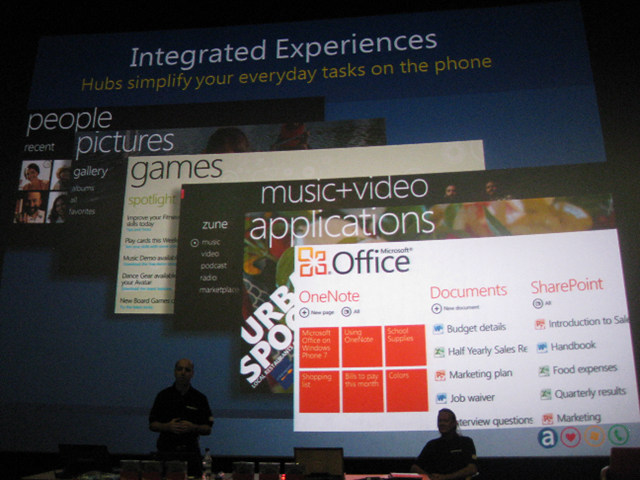
I spent yesterday in the dim light of a Manchester cinema, attending the Windows Phone 7 developer day.

The event was organised by DeveloperDeveloperDeveloper, which is a .NET community group run, as far as I can tell, by a group of Microsoft MVPs. The sponsors were Microsoft, Appa Mundi, and NxtGenUG. Towards the end of the day, Andy Wigley (from Appa Mundi) made a statement that this was a community event and not an official Microsoft event. It was true up to a point, though as far as I can tell Microsoft paid for most of it -“Microsoft UK very kindly provided the venue and logistic support.” says the event description. Microsoft was present showing real Windows Phone 7 devices, and the presenters included Andy Wigley (from Appa Mundi) and Rob Miles, who have also presented the official Jump Start training for Windows Phone 7, and regular TechEd speaker Maarten Struys who is a Windows embedded and Windows Phone evangelist working for Alten PTS in the Netherlands. Community, or Microsoft PR?

Regardless, they were excellent speakers and well informed on all things Windows Phone 7. The community aspect did come to the fore when it came to the catering – there was none – and the venue itself which felt as you would expect a cinema out of hours to feel. I’m guessing Microsoft the community was disappointed with the attendance, around 100 in a venue that seats 330.

image

There is one significant benefit to presenting in a cinema. The screen and projection was first-rate.

image

The sessions themselves were introductory but struck me as useful for anyone getting started with Windows Phone 7 development – which given the devices are not yet available, is probably most of us. Andrej Radinger’s session on creating apps that work offline was particularly interesting to me. I had previously seen the Jump Start course so some of the material was already familiar, though the refresher did no harm.

Much of the challenge of Windows Phone 7 development is coping with the fact that your app will frequently get killed and have to resume later as if nothing happened. We got a lot of input on this topic.

Another challenge is coping with Expression Blend. Designer Tricky Bassett gave a short but insightful view of the design process for a Windows Phone 7 app, with some intriguing asides along the way. He is a design professional, and said that his team had been excited about SketchFlow, the prototyping tool in Blend, but in practice found it little use because they only need sketches, rather then the working controls which SketchFlow gives you. He also commented on Blend, saying that Blend with Windows Phone 7 projects was more stable than it had been before, in his experience with other projects. In previous work with Blend, solutions that did not load have been a recurring problem – I take it that either they loaded in Visual Studio but not in Blend, or vice versa.

Bassett also said that Blend takes some effort to learn, and this was confirmed by the way some of the presenters struggled to do basic operations with the tool. The Blend UI is perplexing and at events like this one I’d suggest that a Blend Basics piece would go down well.

The Silverlight and XNA platforms strike me as pretty good, though I think that lack of native code development will be a problem among the best developers – there are interesting rumours about certain developers getting special privileges.

image

My overriding impression though is that the phone is good, the tools are good, but the demand is lacking. One developer told me that he has been trying to sell an idea for a custom Windows Mobile application to a small business client with 12 employees. They are keen but their employees want either Apple iPhone or Google Android phones. Windows Phone 7 may help by being a better and more attractive device, but getting past the perception that Windows phones are not much good is going to be a problem.

But what can Microsoft do? It is going to take devices that deliver on the promise, a stunning marketing campaign, and aggressive pricing, for this thing to flourish.

NuPack brings package management to Microsoft .NET

Microsoft has announced the beta release of NuPack, which is a package manager for .NET projects, mainly focused on open source libraries. NuPack itself is open source.

I downloaded NuPack and took a look. It installs as a Visual Studio extension, and I used it with Visual Studio 2010. Once installed, you get a new Add Package Reference option for any .NET project, which opens this dialog:

image

There seem to be around 40 projects currently available, including some familiar names:

  • Castle Inversion of Control
  • fbConnectAuth Facebook Connect authentication library
  • JQuery – though this already appears by default in many ASP.NET projects
  • log4net logging library
  • Moq mocking library
  • NHibernate object-relational mapper
  • NUnit unit-testing framework

Once you find the package you want to add, click install and it is automatically added to your project, complete with any necessary configuration changes. There is also a PowerShell-based console. In some cases it is better to use the console, as a package can add new commands which you can call from there.

NuPack strikes me as a great idea; one comment to Scott Hanselman’s post on the subject calls it GEM for .NET, GEM being the Ruby package manager. That said my quick go with NuPack has not been entirely smooth, and I got an error on my first attempt at adding NUnit to a project, fixed after restarting Visual Studio.

My main reservation is whether Microsoft will really get behind this and support it, or whether it will end up as another promising initiative that after a while is abandoned.

ASP.NET Padding Oracle fix released, time to patch for Windows administrators

Scott Guthrie’s blog reports that a fix is now available for the Padding Oracle attack, which enables successful attackers to break the security of ASP.NET applications. There are a few points of interest.

First, there is not one patch but several, and which ones you need depend both on the version of Windows and the version of .NET. Multiple versions of .NET may be installed on a single server.

Second, the exploit is rated “important” in Microsoft security-speak, rather than “critical”. This is apparently because in itself the vulnerability merely discloses information. However, Microsoft is treating it with a high priority because the vulnerability is likely to reveal information that would let the attacker go to to more sever actions such as taking over a server. Confusing, but to my mind it is as critical as they come.

Third, Guthrie’s blog notes:

We’d like to thank Juliano Rizzo and Thai Duong, who discovered that their previous research worked against ASP.NET, for not releasing their POET tool publicly before our update was ready.

The implication is that the POET tool may be publicly available soon – so if you are responsible for an affected machine, get patching! In fact, in the webcast on the subject Microsoft stated that “The potential for exploit is very high during the next 30 days.”

Fourth, the update works by “additionally signing all data that is encrypted by ASP.NET.”

Update: Marc Brooks has investigated and it looks like there is a bit more to it than that.

Finally, the update will be included in Windows Update but not immediately. Your choice is whether to risk a hack in the period before the automatic update appears, or endure the hassle of the manual downloads. Microsoft advises to do it as soon as possible for servers on the public internet.

I am not sure what percentage of systems are likely to be patched soon, but I’d guess that plenty of vulnerable systems will remain online and that we have not heard the last of this bug.

Latest job stats on technology adoption – Flash, Silverlight, iPhone, Android, C#, Java

It is all very well expressing opinions on which technologies are hot and which are struggling, but what is happening in the real world? It is hard to get an accurate picture – surveys tend to have sampling biases of one kind or another, and vendors rarely release sales figures. I’ve never been happy with the TIOBE approach, counting mentions on the Internet; it is a measure of what is discussed, not what is used.

Another approach is to look at job vacancies. This is not ideal either; the number of vacancies might not be proportionate to the numbers in work, keyword searches are arbitrary and can include false positives and omit relevant ads that happen not to mention the keywords. Still, it is a real-world metric and worth inspecting along with the others. The following table shows figures as of today at indeed.com (for the US) and itjobswatch (for the UK), both of which make it easy to get stats.

Update – for the UK I’ve added both permanent and contract jobs from itjobswatch. I’ve also added C, C++, Python and F#, (which hardly registers). For C I searched Indeed.com for “C programming”.

  Indeed.com (US) itjobswatch (UK permanent) itjobswatch (UK contract)
Java 97,890 17,844 6,919
Flash 52,616 2,288 723
C++ 48,816 8,440 2470
C# 46,708 18,345 5.674
Visual Basic 35,412 3,332 1,061
C 27,195 7,225 3,137
ASP.NET 25,613 10,353 2,628
Python 17,256 1,970 520
Ruby 9,757 968 157
iPhone 7,067 783 335
Silverlight 5,026 2,162 524
Android 4,755 585 164
WPF 4,441 3,088 857
Adobe Flex 2,920 1,143 579
Azure 892 76 5
F# 36 66 1

A few quick comments. First, don’t take the figures too seriously – it’s a quick snapshot of a couple of job sites and there could be all sorts of reasons why the figures are skewed.

Second, there are some surprising differences between the two sites in some cases, particularly for Flash – this may be because indeed.com covers design jobs but itjobswatch not really. The difference for Ruby surprises me, but it is a common word and may be over-stated at Indeed.com.

Third, I noticed that of 892 Azure jobs at Indeed.com, 442 of the vacancies are in Redmond.

Fourth, I struggled to search for Flex at Indeed.com. A search for Flex on its own pulls in plenty of jobs that have nothing to do with Adobe, while narrowing with a second word understates the figure.

The language stats probably mean more than the technology stats. There are plenty of ads that mention C# but don’t regard it as necessary to state “ASP.NET” or “WPF” – but that C# code must be running somewhere.

Conclusions? Well, Java is not dead. Silverlight is not unseating Flash, though it is on the map. iPhone and Android have come from nowhere to become significant platforms, especially in the USA. Beyond that I’m not sure, though I’ll aim to repeat the exercise in six months and see how it changes.

If you have better stats, let me know or comment below.

Microsoft’s Scott Guthrie: We have 200+ engineers working on Silverlight and WPF

Microsoft is countering rumours that WPF (Windows Presentation Foundation) or Silverlight, a cross-platform browser plug-in based on the same XAML markup language and .NET programming combination as WPF, are under any sort of threat from HTML 5.0.

We have 200+ engineers right now working on upcoming releases of SL and WPF – which is a heck of a lot.

says Corporate VP .NET Developer Platform Scott Guthrie in a Twitter post. Other comments include this one:

We are investing heavily in Silverlight and WPF

and this one:

We just shipped Silverlight for Windows Phone 7 last week, and WPF Ribbon about 30 days ago: http://bit.ly/aB6e6X

In addition, Microsoft has been showing off IIS Media Services 4.0 at the International Broadcasting Conference, which uses Silverlight as the multimedia client:

Key new features include sub-two-second low-latency streaming, transmuxing between H.264 file formats and integrated transcoding through Microsoft Expression Encoder 4. Microsoft will also show technology demonstrations of Silverlight Enhanced Movies, surround sound in Silverlight and live 3-D 1080p Internet broadcasting using IIS Smooth Streaming and Silverlight technologies.

No problem then? Well, Silverlight is great work from Microsoft, powerful, flexible, and surprisingly small and lightweight for what it can do. Combined with ASP.NET or Windows Azure it forms part of an excellent cloud-to-client .NET platform. Rumours of internal wrangling aside, the biggest issue is that Microsoft seems reluctant to grasp its cross-platform potential, leaving it as a Windows and desktop Mac solution just at the time when iPhone, iPad and Android devices are exploding in popularity. 

I will be interested to see if Microsoft announces Silverlight for Android this autumn, and if it does, how long it will take to deliver. The company could also give more visibility to its work on Silverlight for Symbian – maybe this will come more into the spotlight following the appointment of Stephen Elop, formerly of Microsoft, as Nokia CEO.

Apple is another matter. A neat solution I’ve seen proposed a few times is to create a Silverlight-to-JavaScript compiler along the lines of GWT (Google Web Toolkit) which converts Java to JavaScript. Of course it would also need to convert XAML layout to SVG. Incidentally, this could also be an interesting option for Adobe Flash applications.

As for WPF, I would be surprised if Microsoft is giving it anything like the attention being devoted to Silverlight, unless the Windows team has decided to embrace it within the OS itself. That said, WPF is already a mature framework. WPF will not go away, but I can readily believe that its future progress will be slow.