Category Archives: windows

Microsoft reports weak financials, still failing in the cloud

Microsoft has reported weak results for the quarter ending June 2009.

Here’s a table which breaks down the results vs the same quarter last year, similar to one I made for the March figures. Numbers are in $millions:

Client Revenue % change Profit % change
Client (Windows) 3108 -28.7 2167 -33.32
Server and Tools 3510 -5.67 1349 -1.46
Online 731 12.66 -732 -50.93
Business (Office) 4564 -13.33 2816 -16.17
Entertainment and devices 1189 -25.22 -130 -23.98

I am ignoring the hefty $1483 loss on “corporate-level activity” – though I noticed that despite announcing a projected reduction in headcount of up to 5000 by June 2010, headcount actually increased by 2% (around 1800) in the last 12 months.

Grim figures, though given the recession and that Microsoft still reported profits of $3987 for the quarter, not cataclysmic.

I expect Windows 7 will be a success and that the figures there will improve; further, if the global economy recovers (about which I am sceptical but ignorant) Microsoft’s results will no doubt reflect that. If Windows 7 does succeed, it will have spin-off benefits for other products.

Nevertheless, the company should be worried. Although we are not going to be abandoning our PCs and laptops any time soon, it doesn’t take much insight to predict that increasingly powerful internet-connected devices will tend to reduce the number of traditional computers we need, which will impact Office as well as Windows. On the server side, cloud computing will dampen demand for servers, particularly in the small business sector where Microsoft is particularly successful.

The challenge for Microsoft is to counter those trends by growing its online business, but that is not happening yet. Mobile is another potential growth area, but the figures for entertainment and devices show that Microsoft is not exploiting it successfully.

Further, if online does grow, that will damage the partner ecosystem which thrives on delivering and maintaining on-premise Windows and Office.

Right now it’s hard to disagree with Robin Bloor’s prediction of an Incredible Shrinking Microsoft.

This could change; but only if that awkward third line in the table above undergoes dramatic transformation. Although there are signs of life, with promising technology like Azure and Silverlight, I am not yet convinced that Microsoft is even aware of its predicament, though with results like these it will be soon.

Microsoft’s limited Windows 7 offer a lesson in how to annoy customers?

I’ve returned from a few days away to discover that Microsoft’s special Windows 7 offer, which was meant to run from July 15th 2009 until August 9th 2009, has already in effect expired. This was the deal for UK customers (already less generous that that offered in the USA):

You can pre-order Windows 7 Home Premium E for £49.99** or Windows 7 Professional E for £99.99**.

The double stars are merely a reference to the odd decision to supply Windows without a web browser in Europe – a strategy to counter the EU’s monopoly concerns.

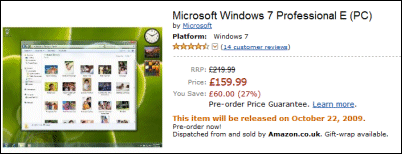
However, if you go along to Amazon.co.uk, for example, you can order Windows 7 Home Premium for £69.98 or Professional for a distinctly un-special £159.99.

I clicked all the links on Microsoft’s offer page and could not find any retailer still offering Windows 7 at the special price.

If the offer was intended to achieve a flurry of pre-orders, I am sure it succeeded. If on the other hand it was a reward to beta testers, as claimed by Brandon LeBlanc:

A special thank you to our beta testers is needed for their time and effort in helping make Windows 7 a solid release. The special pre-order offer we did offering Windows 7 Home Premium and Windows 7 Professional at almost 50% discount was done with our beta testers in mind.

then I am puzzled. First, it was not restricted to beta testers; and second, if you were a beta tester who happened to be away at the wrong moment, then you missed out.

Will customers who are aware that they have missed the offer for arbitrary reasons now be happy to pay 50% more? From a marketing perspective, that is the interesting question. I suppose most users will not allow pique to influence their OS choices; but they will be understandably annoyed.

Technorati Tags: ,

Windows 7 will build the global IT economy, says IDC/Microsoft, or will the Cloud kill it?

Microsoft has sponsored an IDC report on the economic impact of Windows 7 [pdf]. Among the claims:

  • For every dollar of Microsoft revenue from launch in October 2009 to the end of
    2010 from Windows 7, the ecosystem beyond Microsoft will reap $18.52.
  • 19% of the global IT workforce will be working with Windows 7 by the end of 2010
  • IDC expects that employment related to client operating systems will grow by more
    than 300,000 new jobs or more than 30% of total growth in global IT employment in
    2010 solely because of the launch of Windows 7

There is also a forecast that shows Windows 7 taking the majority of Windows client sales in 2010, and which appears to assume that Windows 8 will not be available before 2014.

Realistic figures, or some kind of fantasy? While I expect Windows 7 to take over rapidly from Vista, and to stimulate demand for PCs and laptops somewhat, I don’t believe this steadily rising graph. Cloud computing, software as a service, and growth in mobile devices, will all exert downward pressure on PC sales – even though some of those devices will still run Microsoft’s OS.

I had a conversation with Ian Osborne at Intellect while researching a supplement on software as a service. He made a good point about the unwillingness of the IT industry to embrace change. Although he thinks the cloud is changing everything, he remarked:

You’re dealing with the social phenomena of people working in ITdepartments and data centres who have invested their careers in learning how to make the other stuff work. You tend to want to cling on.

These look like “cling on” charts to me. It is an excellent point though: if the traditional IT industry is being turned on its head by the cloud, that has implications for the shape of IT employment around the world which I’ve not seen spelt out anywhere.

I don’t know if the 20-1 figure quoted by IDC/Microsoft is correct, but it is a useful reminder of how much IT ecosystem revolves around Microsoft’s platform.

Is Mono safe to use?

Microsoft has promised not to sue those who develop implementations of its C# language and Common Language Infrastructure – the heart of .NET.

You might assume that to be good news for Mono, the open source implementation of .NET sponsored by Novell; and I suppose it is, though not in any major way.

The key point here is that Microsoft’s .NET platform goes well beyond what is covered by the promise. ASP.NET, Windows Forms, ADO.NET, Windows Presentation Foundation, Silverlight: all this falls outside. The promise covers only what is standardised by ECMA.

Mono leader Miguel de Icaza is clear about the differences in his post, and says Mono will be split into safe and – presumably – unsafe parts:

In the next few months we will be working towards splitting the jumbo Mono source code that includes ECMA + A lot more into two separate source code distributions. One will be ECMA, the other will contain our implementation of ASP.NET, ADO.NET, Winforms and others.

A good thing? Well, it could help promote the core of Mono in the open source community, which is wary. Open source champion Richard Stallman recently stirred up debate on the subject by proclaiming C# dangerous, in what has become a somewhat perplexing post:

It is dangerous to depend on C#, so we need to discourage its use. … The problem is not unique to Mono; any free implementation of C# would raise the same issue. The danger is that Microsoft is probably planning to force all free C# implementations underground some day using software patents.

he says (and is unlikely to be comforted by Microsoft’s recent moves), though he adds:

This is not to say that implementing C# is a bad thing. Free C# implementations permit users to run their C# programs on free platforms, which is good. (The GNU Project has an implementation of C# also, called Portable.NET.) Ideally we want to provide free implementations for all languages that programmers have used.

Confusing. Still, it’s a valid and important question. Is Mono safe to use?

I have been asking myself this for many years; and have asked Microsoft about it on a number of occasions with no clear answer. However, to me the breakthrough came when Moonlight was announced, an implementation of Silverlight for Linux for which Microsoft has partnered with Mono. The dual significance is first, that Microsoft is working with Mono; and second, that it shows how Microsoft has realised that overall Mono is more a benefit than a threat to its platform.

Action against Mono now seems less likely than ever. That opinion is not based on legal knowledge, but on the business & PR case.

Nevertheless, there could be limits. Stallman’s recent statement was provoked by discussions over whether Mono should be part of the default Debian install. It is not; but it is rising higher on the list of packages that are likely to be installed sooner rather than later by users, because Mono applications are growing in number.

On the server, Mono’s implementation of ASP.NET is now rather good. I’m using it on ITWriting.com for a Silverlight demo. I’ve been impressed by its compatibility with Visual Studio, though I’ve also found it increasing resource usage more than I would like. I’m using what is now an old version though, so I expect this to improve.

The cost savings in using Linux+Mono rather than Windows+ASP.NET are significant, which implies that the potential cost to Microsoft is significant too. It’s only a potential cost, because frankly the official platform is still less risky for a commercial deployment, from a technical rather than legal perspective. Mono is currently more likely to attract free or hobbyist users; but that could change. If Microsoft saw server license sales bleeding away because of Mono, my guess is that there would be rumbles.

What then of de Icaza’s move to separate Mono into safe and unsafe parts? I see the sense of it, but wonder if it could be counter-productive. While Mono is, errm, monolithic, Microsoft cannot take action against the unsafe parts without also blocking the safe parts. After the split, it will be easier for Microsoft to agitate about the pieces of Mono which might (or might not; I’m no lawyer) infringe its rights.

It still strikes me as unlikely that Microsoft would risk full-on legal action against its partner and against what is now a significant part of its platform story. However, I doubt we will get any further comfort from the company, beyond what it has already given.

*updated to acknowledge that Silverlight and WPF are covered by the open spec promise – see links in the comments.

It’s war: Google announces Chrome OS

Google Chrome OS is an open source, lightweight operating system that will initially be targeted at netbooks.

says Google. So the gloves are off – not content with targeting Microsoft Exchange and Office with Google Apps, the company is now going for the whole piece, client operating system included.

It’s not as new as all that, of course:

The software architecture is simple — Google Chrome running within a new windowing system on top of a Linux kernel.

says Google’s Sundar Pichai, VP Product Management. According to the release, it intends that developers will write web applications that will run in any “standards-based” browser – though I’m guessing Google will continue to use its Gears extensions which are not part of any W3C standard.

One of the interesting questions is whether Google Chrome OS will stick with these limited goals, or whether it might end up running local applications such as, say, OpenOffice, or a media and DVD player, or games. What about Adobe AIR, will it run on Chrome OS and provide offline capability? My guess, almost certainly yes.

Linux is an excellent choice for a netbook, and it’s been sad to see Windows almost take over there. The reasons seem to be lack of customer acceptance combined with sloppy releases from some OEMs more familiar with Windows. Google won’t be sloppy; but it faces many of the same challenges in winning users. Expect modest initial success, with more interesting implications for the long-term.

Google Chrome OS will run on both x86 as well as ARM chips and we are working with multiple OEMs to bring a number of netbooks to market next year.

says Pichai.

Clipboard.Clear … oops

Bob Warfield is upset because he lost some work. He copied some text in Live Writer, deleted it, then opened Word and tried to paste. No go .. clipboard empty.

Frustrating, but is he right to call his post Microsoft: Bad User Experience Is Cultural, on the grounds that Word is designed to clear the clipboard every time it opens?

Here’s a bit more information. First, Word does not do that here. Second, if it weren’t that I do equally silly things I’d suggest that it is always risky to entrust the clipboard with your work without a backup.

That said, I can understand why Word might appear to clear the clipboard on start-up. It could be a bug, or it could be an add-in of some kind. The thing is, it is really easy to clear the clipboard in code. Just call EmptyClipboard and you’re done. There are ways to do it in VBA too, via a DataObject, or in .NET via Clipboard.Clear.

As Warfield’s case shows, clearing the clipboard in code can be deeply user-hostile. Should Windows prevent it? Difficult, because if your application or add-in implements clipboard functionality, it is the correct thing to do when the user selects Cut, Copy or Paste.

Lessons? A warning, I guess, not to use the clipboard for any purpose other than a user-initiated clipboard action – though I guess it can be tempting if you are hacking some sort of inter-process data exchange.

Second, when Windows lets you down it is not necessarily Microsoft culture to blame. There is an argument though … applications that don’t conform to Windows guidelines are a big problem and without them things like User Account Control might not need to exist; and that is Microsoft’s fault in a way, because of the history of Windows, its changing guidelines, and the inability of even Microsoft to stick to them in the past. Maybe Microsoft is partly to blame for the wild culture of third-party Windows apps.

This is a blog entry rather than a comment because Warfield’s blog needs registration to comment, and I am allergic.

Eclipse survey shows Windows decline

In May 2009 the open source Eclipse project surveyed its users. Visitors to the Eclipse site were asked to complete a survey, and 1365 did so. That’s out of around 1 million visitors, which shows how much we all hate surveys. Anyway, this report [pdf] was the result. A similar survey [pdf] was carried out in 2007, potentially making a valuable comparison, though the earlier survey has different questions making direct comparisons difficult in most cases, which is a shame. I especially missed the detail on which Eclipse projects are used most which is well covered in the 2007 report.

Here is what I found interesting. First, there’s a shift towards Linux and Apple Mac in the desktops developers use for Eclipse. In 2007 it was 73.8% Windows, 20% Linux and 3.5% Mac. In 2009 it is 64% Windows, 26.9% Linux and 6.9% Mac.

This is echoed in deployment platforms too (client and server). In 2007 it was 46.5% Windows, 36.6% Linux, 1% Mac; today it is 40.5% Windows, 42.7% Linux, 3% Mac.

Those surveyed were asked what other IDEs they used. I noticed that Microsoft Visual Studio and NetBeans feature fairly strongly; I also noticed that Embarcadero’s JBuilder is hardly a blip on the chart – intriguing, given how popular this used to be in the pre-Eclipse era.

The most popular code management tool is Subversion (57.5%) followed by CVS (20%). For build tools, Ant (33.4%) and Maven (18%).

Here’s an intriguing one: I often hear that Java is only successful on the server. That presumption is not supported by this survey. 23.4% said that desktop client apps are the primary type of software they are developing, compared to 30.2% server, and 24.7% web or RIA apps.

The preferred app server is Apache Tomcat (34.8%) followed by JBoss (12.7%) and Websphere (6.9%).

The most popular database manager is MySQL (27.7%) followed by Oracle (27.3%). That’s 55% for Sun+Oracle, of course, though bear in mind that many of the MySQL users are likely attracted by its free licence.

Before drawing too many conclusions, bear in mind that it is a small sample self-selected by people willing to take the survey; apparently it was also featured by a German technology site which resulted in a larger response from German visitors.

Although it suggests a declining use of Windows – which is especially plausible given the trend towards web applications – it does not prove it beyond the Eclipse community.

And next time – how about using the same questions, which would make it possible to identify trends?

I’ve also written about Eclipse here: The Eclipse Conundrum: can it grow without hurting its contributors?

Upgrade to Windows 7 in Europe: confusing as expected

PC manufacturers are now publicising their upgrade deals for Windows 7. Buy a machine with Vista today, get a free upgrade to Windows 7 later.

Except the software is not an upgrade as such – it’s a replacement. Here are the details from Asus, for example, which note:

The Windows® 7 Upgrade Option Program requires a clean installation of the Windows 7 upgrade media.  All personal data and settings, including documents, pictures, files, programs, music and video, should be backed-up prior to performing the clean installation of Windows 7.  After installation of Windows 7, the end user should then re-install all personal data and restore settings. Visit http://windows.microsoft.com/upgrade-windows-E for important information.

I think (and hope) that the referenced Microsoft site is only a placeholder, since its instructions are far from detailed:

… before installing E editions of Windows 7, make sure to back up your files and settings to an external hard disk, USB Flash Drive, or other media. After the installation, move your files and settings back to your PC and reinstall the programs you want to keep using.

Important: E editions of Windows 7 do not include Internet Explorer. We recommend that you get an Internet browser from Microsoft or another software manufacturer and have it available on a CD/DVD or other media so you can install it after you install Windows 7.

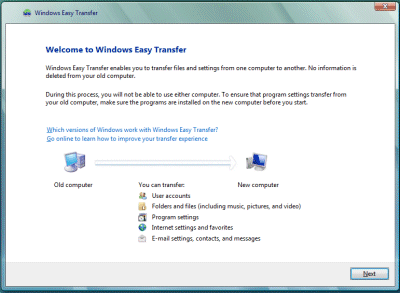
It is not a trivial exercise. There is a Windows Easy Transfer wizard for XP and Vista, and I presume this will be used:

Although this does a reasonable job, there are plenty of gotchas. The most obvious is that it generally cannot transfer applications, only data. It gives the user options concerning which folders to copy, but knowing which are needed may not be easy. It does not cope well if you partition the new computer in a different way. It presumes you have sufficient intermediate storage, which could be a problem if you have many gigabytes of media files to copy and no suitable external drive. You could get into difficulties with badly-behaved applications that store data in Program Files.

There is also a chicken-and-egg problem with reinstalling applications. You are meant to reinstall applications, and then run Easy Transfer, as otherwise installing an application might overwrite the settings you have transferred. On the other hand, if the reinstalled application has a different version than the source application (which is not unlikely if it is downloaded) then transferring settings over the top could mess it up.

Personally I’m wary of the tool. If I have to do this sort of reinstallation, I take a minimalist approach and only transfer documents, plus a few select settings that I understand. Without Easy Transfer though, it is easy to lose things like emails and address books, or browser bookmarks, the lack of which can cause aggravation.

Then there’s the matter of the web browser. Asus doesn’t say whether it is supplying one on its “driver” DVD.

Overall, I’m expecting this to be good business for armies of home PC support people.

Discussion of the reasons for this is here and here.

EU responds to questions on Microsoft’s plans for Windows 7

Events in the EU’s case against browser bundling in Windows have taken an odd twist. The case was brought originally by Opera, which complained that it couldn’t sell its browser because IE came free with Windows. Other interested parties such as Google and Mozilla joined in. In January the EU issued a statement of objection:

The evidence gathered during the investigation leads the Commission to believe that the tying of Internet Explorer with Windows, which makes Internet Explorer available on 90% of the world’s PCs, distorts competition on the merits between competing web browsers insofar as it provides Internet Explorer with an artificial distribution advantage which other web browsers are unable to match. The Commission is concerned that through the tying, Microsoft shields Internet Explorer from head to head competition with other browsers which is detrimental to the pace of product innovation and to the quality of products which consumers ultimately obtain. In addition, the Commission is concerned that the ubiquity of Internet Explorer creates artificial incentives for content providers and software developers to design websites or software primarily for Internet Explorer which ultimately risks undermining competition and innovation in the provision of services to consumers.

Microsoft’s problem: whatever the merits of the EU’s case, it is desperate to have a single global launch for Windows 7, to put Vista behind it, to persuade XP users to upgrade, and to compete with Apple. The EU had in mind some sort of install menu where users could choose a browser; but Microsoft unilaterally decided to unbundle Internet Explorer from Windows 7 completely, in a special Windows E edition. Today Microsoft also confirmed that because of the EU’s case, it will not offer upgrade editions of Windows 7 in Europe.

The odd thing is, Microsoft has no guarantee that its actions will necessarily appease the EU, as confirmed when I asked about this. The EU’s immediate response was not comforting:

At the level of both computer manufacturers and retail sales, the Commission’s Statement of Objections (SO) suggested that consumers should be provided with a genuine choice of browsers. Given that over 95% of consumers acquire Windows pre-installed on a PC, it is particularly important to ensure consumer choice through the computer manufacturer channel.

As for retail sales, which amount to less than 5% of total sales, the Commission had suggested to Microsoft that consumers be provided with a choice of web browsers. Instead Microsoft has apparently decided to supply retail consumers with a version of Windows without a web browser at all. Rather than more choice, Microsoft seems to have chosen to provide less.

I spoke to Jonathan Todd, European Commission spokesman on competition:


What could happen if Windows 7E doesn’t satisfy EU requirements?

We haven’t reached any conclusions yet as to whether or not their intention would in any way be relevant to the concerns that we’ve expressed in our statement of objections. Until such time as we’ve reached our conclusions it’s difficult to comment. If we were to find that there had been a breach of the anti-trust rules we could fine them and we could require them to change their business practices.

What is the likely timescale of the EU determining whether or not the planned release of Windows 7 conforms to the requirements?

Clearly we’re doing that as quickly as possible.

How long?

That depends to a certain extent on Microsoft.

What does Microsoft need to do to expedite the process?

As we indicated in our statement, one of our concerns was that we would have to verify whether the technical separation of Internet Explorer from Windows was not negated by other actions by Microsoft, for example as regards the terms and conditions under which Internet Explorer would be made available to computer manufacturers.

There’s some tension between the usability issues that people will face when they try and acquire Windows 7, for example that acquiring an operating system without a browser could be inconvenient, and the …

[interrupts] Let me make it clear, the commission has never ever suggested to Microsoft that they should supply Windows 7 without a browser.

This has never been one of the suggestions that we’ve made to them.

It is not necessarily relevant to resolving the concerns that we have about Microsoft’s conduct.

The considerations are that consumers have to have genuine choice about which browser they use.

Why do the same conditions not apply to Apple and other operating system vendors?

For the extremely simple reason that Apple doesn’t enjoy a dominant position of the operating system market. It’s not a problem to have a dominant position, but when you are in a dominant position in the market, and they have over 90% of the operating system market, when you are in a dominant position that places constraints on what you can and cannot do.

I suppose the counter argument is that if you are in the operating system market you need to be allowed to offer similar features to others in that same space?

Listen. You can do what you like in terms of bundling if you are not in a dominant position. If you are in a dominant position your actions have a direct affect on competition throughout that market. That’s the difference.

How low would Microsoft’s share of the market need to dip before they would no longer be required to hobble their product for the sake of competition law?

I don’t agree with your analogy about hobbling their product. What we’re talking about is making sure that consumers are not hobbled by what is imposed on them by Microsoft.

There are advantages to having a browser integrated with the operating system. For example, it means that a single vendor is managing security, that updates are coming down in a streamlined fashion, and that within enterprises the functions of the browser can be managed with the same tools that are used to manage the rest of the operating system.

If you bundle in your browser and you make it difficult for other browsers to get a market share, then you’re denying consumers choice and you’re taking away the incentive for innovation. Internet Explorer wasn’t updated for, how many years?

For five years, which was disgraceful by any measure.

Because they didn’t have an incentive to do so.

They did have an incentive to do so, but they didn’t realise that they did, and in fact Microsoft is losing market share quite rapidly in browsers which throws into doubt whether legislation is actually necessary.

You’ve read our statement. We’ve never ever suggested that Windows should be supplied without a browser. The heart of our case is genuine consumer choice. Therefore, certainly as regards retail sales of Windows 7, they appear to be taking away choice from consumers rather than giving them more.

I don’t think many users are going to be operating Windows without a browser so they are going to make that choice at some point.

Yes, but as we all know, if you are buying an operating system that doesn’t have a browser included it’s that much more difficult to actually get a browser.

If you require a software manufacturer to bundle another company’s software product with their own, it raises questions about security, about support, about updates, which are difficult ones, I understand why Microsoft might not be willing to do so.

We both know also that Microsoft claimed for many years it was technically impossible to separate Internet Explorer from the operating system.

Microsoft does not intend to remove the parts of IE that could reasonably be described as part of the operating system. All it intends to remove is the web browser as the user sees it.

For many years Microsoft said it is impossible to sell the operating system without a browser, that it’s not possible to separate out Internet Explorer from the operating system.


Todd said more than I had expected. There are a few things I find it hard to make sense of. The EU’s complaint seems to be not only about lack of competition, but about its consequences, spelt out as lack of innovation in browsers, and Microsoft’s unfairly-gained market share for IE. This made perfect sense a couple of years ago, but not so much now. Browser innovation is rapid – look at Google Chrome, WebKit and Safari, Mozilla FireFox, Opera (which never went away) – and Microsoft is already losing market share in browsers, a point which Todd did not answer.

On the other hand, I do not want to downplay Microsoft’s discreditable action in first energetically developing IE to squash the competition, and then leaving it frozen to promote Windows rather than the Web as the platform of choice. A disgrace; but one which the market is solving without EU legislation.

As for current developments, could Microsoft be trying to stimulate antipathy towards the EU by deliberately inconveniencing them with Windows E? Or is this really the company’s best effort to satisfy the EU while still releasing Windows 7 on time? I guess the latter; but it is an odd state of affairs.

Technorati Tags: ,

Windows 7: cheap prices but painful upgrade for EU

Microsoft is offering Windows 7 at bargain prices for customers who pre-order. General availability is set for October 22nd.

In the USA, Windows 7 will be on offer at $49.99 for Home Premium or $99.99 for Windows 7 Professional, if you order between 26th June and July 11th. Pre-order details are here, and upgrade deals here.

UK customers get Home Premium for £49.99 or Professional for £99.99 if they pre-order between July 15th and August 14th. That’s more expensive than in the USA but still reasonable.UK pre-order details are here, and UK upgrade deals are here.

Why so cheap? My guess is that Microsoft wants to get users off the unpopular Vista as rapidly as possible, and to persuade Windows XP diehards that now is the time to migrate. It pays to pre-order, since after the deadline prices rise to roughly match those for Windows Vista today.

The snag for customers in the EU is that there are no upgrade editions. To be clear, there is upgrade pricing, at least until December 31st 2009. Home Premium will be £79.99, Professional £189.99 and Ultimate £199.99. However, these will be discounted “Fully packaged product”, which is Microsoft-speak for an unencumbered edition you can clean install and transfer between PCs.

There will be no in-place upgrade allowed, neither for XP nor Vista. The same restriction applies to Vista PCs purchased with a “technology guarantee” that gives a free or nearly free upgrade to Windows 7 when available, a scheme which starts on June 26th for participating manufacturers.

Why not? It is all to do with the EU’s action against Microsoft concerning browser bundling. According to Microsoft’s Laurence Painell, Windows OEM & WGA Product Manager in the UK:

The reason we won’t be offering an upgrade product is because the customer with whatever previous version of Windows they had, didn’t make the decision to have IE installed. So we cannot carry Internet Explorer across into the latest version of Windows. However we’re working through the ramifications of this with the EU, but that’s pretty much what the expectations are. So currently we can’t offer an upgrade process from Windows Vista to Windows 7 that will be seamless. It will need to be a wipe and replace and the customer will then need to make a choice as to which browser they want to install after that point.

After telling me this, Painell gave a making-the-best-of-a-bad-job sigh, and I can understand why. Many users have no clue how to handle a “wipe and replace” replacement of Windows, which is not something to be undertaken lightly. In this type of installation, the hard drive is typically reformatted to be completely blank, and Windows installed as if it were a new machine. There are three substantial risks in this operation:

1. Parts of the hardware may not work if drivers are missing. You need to get these from the manufacturer’s web site.

2. All applications must be reinstalled. For this you need the setup disks or files plus serial numbers, keys and so on, which are not always available.

3. Most significant of all: any documents, pictures or other data on the hard drive is zapped. You need to copy this elsewhere first – if you know how to find it.

All this means that while technically a wipe-and-replace install is the best option (a point which Painell made to me), it is also a dangerous option for non-experts.

In mitigation, most users stick with whatever version of Windows is pre-installed, and Microsoft doesn’t support in-place upgrade from XP to Windows 7 anyway.

On the other hand, there are a couple of reasons why the in-place upgrade from Vista to 7 is unusually attractive. Unlike most Windows upgrades, 7 generally runs better than Vista on the same hardware. Vista also shares the same underlying architecture as 7, so the in-place upgrade has a good chance of working well.

Further complicating matters, EU Windows users have to cope with a version of Windows without a browser pre-installed. Painell was vague about how this will work exactly, for users who buy the retail product. Those who buy PCs with 7 pre-installed should have this sorted by the manufacturer. He did emphasise that IE will not be included at all:

Will we be putting IE disks in with the fully packaged product? No. It will be separate, and it will be down to the customer to decide whether or not they want to take it. We need to make sure that there is a clear split between IE and Windows.

How then will they get a browser? It could be “through disks in retail, through download options, or any other technology options that we can provide,” says Painell, explaining that Microsoft has between now and October to work out the details with its partners.

Could users buy an upgrade copy while on holiday in the USA, and use that?

Technically, yes, however we’re still working through what that means and whether we have to do anything in that space.

No doubt this and other workarounds will receive plenty of attention and publicity once Windows 7 is released.

It is all very inconvenient. The bizarre twist though is that Microsoft has no idea whether or not its actions in Windows E will satisfy EU requirements. I asked Painell if the EU might still object:

The conversation is still ongoing. We’re working through it with the EU, there is still the possibility, yes, but we don’t know at this stage. We’re doing what we can early on to pre-empt it and show that we’re trying to do the right thing by their decisions, but ultimately this is not final and we’re working through the process.

It all sounds like an elaborate game. Naturally I picked up the phone and spoke to the EU about Microsoft’s plans. Is it likely to disrupt them, and what are the implications? I’ve reported in a separate post.

Update: URLs added to give pre-order as well as upgrade details.

Technorati Tags: ,,