Category Archives: microsoft

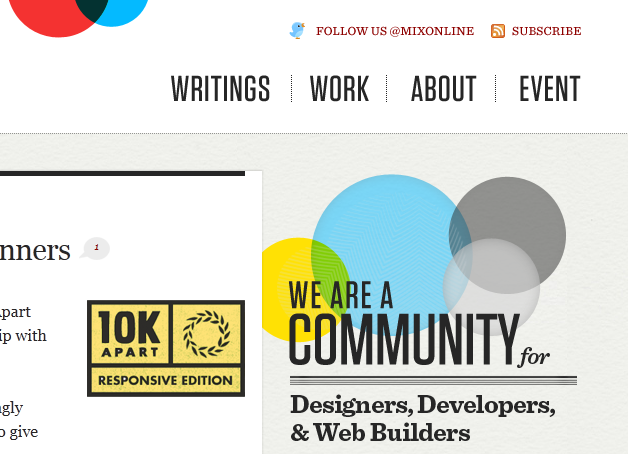
Why Microsoft is scrapping the MIX conference

Microsoft is scrapping its MIX conference, according to General Manager Tim O’Brien:

we have decided to merge MIX, our spring web conference for developers and designers, into our next major developer conference, which we will host sometime in the coming year. I know a number of folks were wondering about MIX, given the time of year, so we wanted to make sure there’s no ambiguity, and be very clear… there will be no MIX 2012.

O’Brien says that MIX started in the aftermath of the 2005 PDC because:

there was a lot of discussion around our engagement with the web community, and how we needed a more focused effort around our upcoming plans for Internet Explorer, the roadmap for our web platform, the work we were starting on web standards (we were shipping IE6 at the time), and so on.

That is not quite how I recall it. PDC 2005 was the pre-Vista PDC, no, not the “three pillars of Longhorn” in PDC 2003, but the diluted version of Longhorn that was actually delivered as Windows Vista. One thing Microsoft really did get around this time was that design mattered. Apple had cool design, Adobe had cool design (and a strong grip on the designer community), but Microsoft did not.

Windows Presentation Foundation (WPF) was intended to win designers to the Windows platform, with its graphically-rich and multimedia-friendly API. In order to do this, the company needed to win designers over to the idea of using Expression Blend rather than Adobe Flash and Photoshop.

This was doubly true when Microsoft decided to bring WPF to the browser in the form of Silverlight, a decision that was announced at PDC 2005 and expanded on at the first MIX in 2006.

One of the things I recall at the first and second MIX events were groups of bemused Flash designers who had been bussed in by Microsoft to enjoy the lights of Vegas and learn about Blend.

General web authoring was a factor as well, as Microsoft sought to bring Internet Explorer back on track and to persuade web designers of the virtues of Microsoft’s web platform.

I enjoyed the MIX events. They were small enough that you could easily get to speak both to attendees and to the Microsoft folk there, and once you allow for the fact that Vegas is Vegas, the atmosphere was good.

As an attempt to appeal to designers though, MIX was a failure. It was all too forced; many of the people attending were developers anyway; and Microsoft itself included more and more developer content in ensuing MIX events.

The 2010 MIX was hijacked by Windows Phone 7, an interesting topic but drifting far from the original intentions.

It comes as no surprise to hear than MIX is no more. It is associated with WPF and Silverlight, neither of which are now strategic for Microsoft in these days of Windows 8 and the Windows Runtime (WinRT).

That said, Microsoft still has difficulty appealing to designers.

What next then? O’Brien says:

we look ahead to 2012 and beyond, the goal is to ensure that global Microsoft developer events are of the caliber that many of you experienced at BUILD last September, in addition to the thousands of online and local developer events we host around the world to support communities and connect directly with developers. We will share more details of our next developer event later this year.

image

Microsoft LocalDB: another option for local databases

Microsoft is launching SQL Server 2012 on  March 7th 2012. In Microsoft’s world “launches” do not always coincide with the availability of release code, which may come before or after, but they are usually not far apart.

The big news in SQL Server 2012 is in new BI (Business Intelligence) features and the ability to import and export from the open source Hadoop framework. Microsoft is also supporting Hadoop on Windows Server and Windows Azure. Robert Sheldon has an excellent article on TechTarget which describes the Hadoop integration.

At the other end of the scale though there is a new approach to local databases, which interests me as this is the kind of thing an application developer might use for local applications. SQL Express LocalDB uses the full SQL Server Express engine but does not require a SQL Server service to be running or even installed. In summary:

  • The LocalDB binaries can be installed with a separate installer or as part of the SQL Server Express.
  • LocalDB instances are isolated to the user.
  • The LocalDB system databases are buried deep in AppData in the user profile. The default location for user databases is the root of the user profile.
  • The old SQL Server User Instances are now deprecated

A driver for LocalDB has to know how to fire up the SQL Server binaries if they are not running, which means that old drivers will not work. Microsoft has patched System.Data.SqlClient in .NET 4 to work with LocalDB.

LocalDB Pros and cons

The advantage of LocalDB over the cut-down Compact Edition is that you get full access to SQL Server features including transactions, stored procedures, geographical data types and so on. It is meant to improve on the old user instances by simplifying matters for the user: no need to run a service, and management of SQL Server completely hidden.

The disadvantage is that your app still has the overhead of SQL Server running in a separate process. A SQL Server LocalDB install also takes around 140MB, which bumps up the download size if your app is distributed on the web.

If you need a local database, it seems to me that Microsoft still has nothing that quite matches SQLite, which runs in-process, is lightning fast, and which does not require any hidden system databases.

On the other hand, it might make sense to use SQL Server if you want to integrate with a server database, or if you are familiar with coding for SQL Server.

I would like to see Windows ship with a local database engine documented as something developers can rely on being there, as with Core Data on the Mac. It would also help if the SQL Server team got together with the Office team and worked out how to get Access and SQL Server Express to use the same database engine – yes, I know Access can use SQL Server data, but it still defaults to its own .ACCDB format and JET database engine.

Microsoft financials: Windows under stress, Server and Office making up

If we are really in the post-PC era, then one of two things will happen. Either Microsoft will make a big success of non-PC products, or it will start delivering shocking financial results. Neither is yet true. Here are the results just announced, broken down into a simple table.

Quarter ending December 31st 2011 vs quarter ending December 31st 2010, $millions

Segment Revenue Change Profit Change
Client (Windows + Live) 4736 -320 2850 -64
Server and Tools 4772 +484 1996 +285
Online 784 +71 -458 +101
Business (Office) 6279 +169 4152 +65
Entertainment and devices 4237 +539 528 -138

A few observations. Server revenue (though not profit) exceeded client revenue; I am not sure if this is the first time it has done so, but it is unusual. The Office division enjoyed a remarkable quarter, and the press release mentions 10% growth in Exchange and SharePoint, and 30% growth (from a smaller base) in Lync and Dynamics CRM. Azure? Not mentioned so I presume revenue is small.

Where is Office 365? Somewhere in the Office figures I would guess; and once again, since it is not mentioned, I think we can assume it is not delivering a large amount of revenue yet. I would like to know more though.

What Microsoft calls Online is formed of Bing search and services and advertising income. Another hefty loss, but revenue is up, loss somewhat reduced, and Microsoft claims that  “Bing-powered US market share, including Yahoo! properties, was approximately 27%”. Not bad.

This is the big quarter for gaming and Xbox delivered accordingly. The faltering Windows Mobile and Windows Phone 7 are somewhere lost in those Xbox numbers, and again its revenue is not mentioned in the press release.

Meet Resilient File System (ReFS), a new file system for Windows

Microsoft has announced the Resilient File System (ReFS), a replacement for the NTFS file system which has been used since the first release of Windows NT in 1993.

The new file system increases limits in NTFS as follows:

  NTFS ReFS
Max file size 2^64 -1 2^64-1 bytes
Max volume size 2^40 bytes 2^78 bytes
Max files in a directory 2^32 –1 (per volume) 2^64
Max file name length 32K unicode (255 unicode) 32K unicode
Max path length 32K 32K

I have done my best to set out the NTFS limits but it is complicated, and there are limitations in the Windows API as well as in NTFS. See this article for more on NTFS limits; and this article for an explanation of file name and path length limits in the Windows API.

Microsoft’s announcement focuses on two things. One is resilience, with claims that ReFS is better at preserving data in the event of power failure or other calamity. Another is how ReFS is designed to work alongside Storage Spaces, about which I posted earlier this month.

Of the two, Storage Spaces will be more visible to users. In addition, it sounds as if ReFS will not be the default in Windows 8 client:

…we will implement ReFS in a staged evolution of the feature: first as a storage system for Windows Server, then as storage for clients, and then ultimately as a boot volume. This is the same approach we have used with new file systems in the past.

Note that there are losses as well as gains in ReFS. Short file names are gone, so are quotas, so is compression:

The NTFS features we have chosen to not support in ReFS are: named streams, object IDs, short names, compression, file level encryption (EFS), user data transactions, sparse, hard-links, extended attributes, and quotas.

Overall ReFS strikes me as a conservative rather than radical upgrade. This is not the return of WinFS, an abandoned project which was to bring relational file storage to Windows. It will not help, in itself, with the biggest problem client users have with their file system: finding their stuff. Nor does it have built-in deduplication, which can make storage substantially more efficient. Microsoft says the file system is pluggable (as is NTFS) so that features like deduplication can added by other providers or by Microsoft with other products.

OEMs are still breaking Windows: can Microsoft fix this with Windows 8?

Mark Russinovich works for Microsoft and has deep knowledge of Windows internals; he created the original Sysinternals tools which are invaluable for troubleshooting.

His account of troubleshooting a new PC purchased by a member of his family is both amusing and depressing, though I admire his honesty:

My mom recently purchased a new PC, so as a result, I spent a frustrating hour removing the piles of crapware the OEM had loaded onto it (now I would recommend getting a Microsoft Signature PC, which are crapware-free). I say frustrating because of the time it took and because even otherwise simple applications were implemented as monstrosities with complex and lengthy uninstall procedures. Even the OEM’s warranty and help files were full-blown installations. Making matters worse, several of the craplets failed to uninstall successfully, either throwing error messages or leaving behind stray fragments that forced me to hunt them down and execute precision strikes.

I admire his honesty. What he is describing, remember, is his company’s core product, following its mutilation by one of the companies Microsoft calls “partners”.

Russinovich adds:

As my cleaning was drawing to a close, I noticed that the antimalware the OEM had put on the PC had a 1-year license, after which she’d have to pay to continue service. With excellent free antimalware solutions on the market, there’s no reason for any consumer to pay for antimalware, so I promptly uninstalled it (which of course was a multistep process that took over 20 minutes and yielded several errors). I then headed to the Internet to download what I – not surprisingly given my affiliation – consider the best free antimalware solution, Microsoft Security Essentials (MSE).

Right. I do the same. However, the MSE install failed, probably thanks to a broken transfer application used to migrate files and settings from an old PC, and it took him hours of work to identify the problem and complete the install.

What interests me here is not so much the specific problems, but Microsoft’s big problem: that buying a new Windows PC is so often a terrible user experience. Not always: business PCs tend to be cleaner, and some OEMs are better than others. Nevertheless, although I have had Microsoft folk tell me a number of times that its partners were getting the message, that to compete with Apple they need to deliver a better experience, the problem has not been cracked.

There is something about the ecosystem which ensures that users get a bad product. It goes like this I guess: customers are price-sensitive, and to get the price required OEM vendors have to take the money from malware companies and others desperate to drive users towards their products. Yet in doing so they perpetuate the situation where you you have to buy Apple, or be a computer professional, in order to get a clean install. That describes a broken ecosystem.

Microsoft’s Signature PCs are another option, but they are only available from Microsoft stores.

The next interesting question is whether Microsoft can fix this with Windows 8. It may want to follow the example of Windows Phone 7, which is carefully locked down so that OEMs and operators can add their own apps, but their ability to customise the operating system is limited, protecting the user experience. It is hard to see how Microsoft can achieve the same with the x86 version of Windows 8, since this remains an open platform, though it may be possible to insulate the Metro side from too much tinkering. Windows 8 on ARM, on the other hand, may well follow the Windows Phone pattern.

PHP Developer survey shows dominance of mobile, social media and cloud

Zend, a company which specialises in PHP frameworks and tools, has released the results of a developer survey from November 2011.

The survey attracted 3,335 respondents drawn, it says, from “enterprise, SMB and independent developers worldwide.” I have a quibble with this, since I believe the survey should state that these were PHP developers. Why? Because I have an email from November which asked me to participate and said:

Zend is taking the pulse of PHP developers. What’s hot and what matters most in your view of PHP?

There is a difference between “developers” and “PHP developers”, and much though I love PHP the survey should make this clear. Nevertheless, If you participated, but mainly use Java or some other language, your input is still included. Later the survey states that “more than 50% of enterprise developers and more than 65% of SMB developers surveyed report spending more than half of their time working in PHP.” But if they are already identified as PHP developers, that is not a valuable statistic.

Caveat aside, the results make good reading. Some highlights:

  • 66% of those surveyed are working on mobile development.
  • 45% are integrating with social media
  • 41% are doing cloud-based development

Those are huge figures, and demonstrate how far in the past was the era when mobile was some little niche compared to mainstream development. It is the mainstream now – though you would get a less mobile-oriented picture if you surveyed enterprise developers alone. Similar thoughts apply to social media and cloud deployment.

The next figures that caught my eye relate to cloud deployment specifically.

  • 30% plan to use Amazon
  • 28% will use cloud but are undecided which to use
  • 10% plan to use Rackspace
  • 6% plan to use Microsoft Azure
  • 5% have another public cloud in mind (Google? Heroku?)
  • 3% plan to use IBM Smart Cloud

The main message here is: look how much business Amazon is getting, and how little is going to giants like Microsoft, IBM and Google. Then again, these are PHP developers, in which light 6% for Microsoft Azure is not bad – or are these PHP developer who also work in .NET?

I was also interested in the “other languages used” section. 82% use JavaScript, which is no surprise given that PHP is a web technology, but more striking is that 24% also use Java, well ahead of C/C++ at 17%, C# at 15% and Python at 11%.

Finally, the really important stuff. 86% of developers listen to music while coding, and the most popular artists are:

  1. Metallica
  2. = Pink Floyd and Linkin Park

Wow.

Windows Phone, Windows 8, and Metro Metro Metro feature in Microsoft’s last keynote at CES

I watched Microsoft CEO Steve Ballmer give the last in a long series of Microsoft keynotes at the Consumer Electronics Show in Las Vegas.

image

There were three themes: Windows Phone, Windows 8, and Xbox with Kinect. It was a disappointing keynote though, mainly because of the lack of new news. Most of the Windows Phone presentation could have been from last year, except that we now have Nokia involvement which has resulted in stronger devices and marketing. What we have is in effect a re-launch necessitated by the failure of the initial launch; but the presentation lacked the pizzazz that it needed to convince sceptics to take another look. That said, I have enjoyed using Nokia’s Lumia 800 and still believe the platform has potential; but Microsoft could have made more of this opportunity. A failed voice demo did nothing other than remind us that voice control in Windows Phone is no Apple Siri.

image

What about Windows 8? Windows Chief Marketing Officer Tami Reller gave a presentation, and I was hoping to catch a glimpse of new stuff since the preview at last year’s BUILD conference. There was not much though, and Reller was using the same Samsung tablet as given to BUILD delegates. We did get a view of the forthcoming Windows Store that I had not seen before:

image

Reller mainly showed the Metro interface, in line with a general focus on Metro also emphasised by Ballmer. She talked about ARM and said that Metro apps will run on both Intel and ARM editions of Windows 8; notably she did not say the same thing about desktop apps, which implies once again that Microsoft intends to downplay the desktop side in the ARM release.

Reller also emphasised that Windows 8 Metro works well on small screens, as if to remind us that it will inevitably come to Windows Phone in time.

Windows 8 looks like a decent tablet OS, but the obvious questions are why users will want this when they already have iOS and Android, and why Microsoft is changing direction so dramatically in this release of Windows? The CES keynote was a great opportunity to convince the world of the merits of its new strategy, but instead it felt more as if Microsoft was ducking these issues.

Xbox and Kinect followed, and proved firmer ground for the company, partly because these products are already successful. There was a voice control demo for Xbox which worked perfectly, in contrast to the Windows Phone effort. We also heard about Microsoft’s new alliance with News Corporation, which will bring media including Fox News and the Wall Street Journal to the console. We also saw the best demo of the day, a Sesame Street interactive Kinect game played with genuine enthusiasm by an actual child.

Microsoft unveiled Kinect for Windows, to be released on 1st February, except that there was not much to say about it. Amazon.com has the product available for pre-order, and there was more to be learned there.

image

The new product  retails at $249.99, compared to $149 for the Xbox version, but seems little different. Here is what the description says:

This Kinect Sensor for Windows has a shortened USB cable to ensure reliability across a broad range of computers and includes a small dongle to improve coexistence with other USB peripherals. The new firmware enables the depth camera to see objects as close as 50 centimeters in front of the device without losing accuracy or precision, with graceful degradation down to 40 centimeters. “Near Mode” will enable a whole new class of “close up” applications, beyond the living room scenarios for Kinect for Xbox 360.

I imagine hackers are already wondering if they can get the new firmware onto the Xbox edition and use that instead. Kinect for Windows does not come with any software.

What is the use of it? That is an open question. Potentially it could be an interesting alternative to a mouse or touch screen, face recognition could be used for personalisation, and maybe there will be some compelling applications. If so, none were shown at CES.

I am not sure of the extent of Microsoft’s ambitions for this first Windows release of Kinect, but at $249 with no software (the Xbox version includes a game) I would think it will be a hard sell, other than to developers. If wonderful apps appear, of course, I will change my mind.

Storage Spaces coming to Windows 8 client as well as server

Steven Sinofsky has posted on the Building Windows 8 blog, making it clear that this feature is coming to the Windows 8 client as well as to Windows Server 8.

I took a hands-on look at Storage Spaces back in October.

The feature lets you add and remove physical drives from a pool of storage, create virtual disks in that pool with RAID-like resiliency if you have more than one physical drive available. There is also “thin provisioning”, which lets you create a virtual disk bigger than the available space. It sounds daft at first, but makes sense if you think of it as a resource to which you add media as needed rather than paying for it all up-front. It

The server version includes data deduplication so that similar or identical files occupy less physical space. Another feature which is long overdue is the ability to allocate space to a virtual folder rather than to a drive letter.

I do not know if all these features will come to the Windows 8 client version, but as data deduplication is not mentioned in Sinofsky’s post, and the dialog he shows does not include a folder option, it may well be that these are server-only. This is the new Windows 8 dialog:

image

Storage Spaces occupies a kind of middle ground in that enterprises will typically have more grown-up storage systems such as a Fibre Channel or iSCSI SAN (Storage Area Network). At the other end of the scale, individual business users do not want to bother with multiple drives at all. Nevertheless, for individuals with projects like storing large amounts of video, or small businesses looking for good value but reliable storage based on cheap SATA drives, Storage Spaces look like a great feature.

Most computer professionals will recall seeing users struggling with space issues on their laptop, not realising that the vendor (Toshiba was one example) had partitioned the drive and that they had a capacious D drive that was completely empty. It really is time that Microsoft figured out how to make storage management seamless and transparent for the user, and this seems to me a big step in that direction.

Users petition Asus over locked bootloader in Asus Transformer Prime

The new Asus Transformer Prime TF201 Android tablet is winning praise for its performance and flexibility. It is driven by NVIDIA’s quad-core Tegra 3 processor and can be equipped with a keyboard and dock that extends battery life and makes the device more like a laptop.

All good; but techie users are upset that the bootloader is encrypted, which means the kernel cannot be modified other than through official Asus updates.

A petition on the subject has achieved over 2000 signatures. Detailed discussion of the implications are here.

image

Why do vendors lock the bootloader? One reason is for support, since it increases the user’s ability to mess up their machines. On the other hand, most users who hack to this extent understand what they are doing. This comment from the petition stood out for me:

We understand that custom firmware cannot be supported by ASUS, but we consider that it is our right to customise our devices in any way we wish: once bought, the Prime is our property alone to modify if we choose.

This is something we have taken for granted in the PC era, but the tablet era is looking different, with locked-down devices that give vendors more control. The success of the Apple iPad suggests that most users do not mind if the result is a good experience. It is a profound change though, and one that makes users vulnerable to vendors who are slow or reluctant to provide updates.

ITWriting.com awards 2011: ten key happenings, from Nokia’s burning platform to HP’s nightmare year

2011 felt like a pivotal year in technology. What was pivoting? Well, users are pivoting away from networks and PCs and towards cloud and devices. The obvious loser is Microsoft, which owns PCs and networks but is a distant follower in devices and has mixed prospects in the cloud. Winners include Apple, Google, Amazon, and Android vendors. These trends have been obvious for some time, but in 2011 we saw dramatic evidence of their outcome. As 2011 draws to a close, here is my take on ten happenings, presented as the first ever ITWriting.com annual awards.

1. Most dramatic moment award: Nokia’s burning platform and alliance with Microsoft

In February Nokia’s Stephen Elop announced an alliance with Microsoft and commitment to Windows Phone 7. In October we saw the first results in terms of product: the launch of the Lumia smartphone. It is a lovely phone though with some launch imperfections like too short battery life. We also saw greatly improved marketing, following the dismal original Windows Phone 7 launch a year earlier. Enough? Early indications are not too good. Simply put, most users want iOS or Android, and the app ecosystem, which Elop stated as a primary reason for adoption Windows Phone, is not there yet. Both companies will need to make some smart moves in 2012 to fix these issues, if it is possible. But how much time does Nokia have?

2. Riskiest technology bet: Microsoft unveils Windows 8

In September 2011 Microsoft showed a preview of Windows 8 to developers at its BUILD conference in California. It represents a change of direction for the company, driven by competition from Apple and Android. On the plus side, the new runtime in Windows 8 is superb and this may prove to be the best mobile platform from a developer and technical perspective, though whether it can succeed in the market as a late entrant alongside iOS and Android is an open question. On the minus side, Windows 8 will not drive upgrades in the same way as Windows 7, since the company has chosen to invest mainly in creating a new platform. I expect much debate about the wisdom of this in 2012.

Incidentally, amidst all the debate about Windows 8 and Microsoft generally, it is worth noting that the other Windows 8, the server product, looks like being Microsoft’s best release for years.

3. Best cloud launch: Office 365

June 2011 saw the launch of Office 365, Microsoft’s hosted collaboration platform based on Exchange and SharePoint. It was not altogether new, since it is essentially an upgrade of the older BPOS suite. Microsoft is more obviously committed to this approach now though, and has built a product that has both the features and the price to appeal to a wide range of businesses, who want to move to the cloud but prefer the familiarity of Office and Exchange to the browser-based world of Google Apps. Bad news though for Microsoft partners who make lots of money nursing Small Business Server and the like.

4. Most interesting new cross-platform tool: Embarcadero Delphi for Windows, Mac and iOS

Developers, at least those who have still heard of Embarcadero’s rapid application development tool, were amazed by the new Delphi XE2 which lets you develop for Mac and Apple iOS as well as for Windows. This good news was tempered by the discovery that the tool was seemingly patched together in a bit of a hurry, and that most existing application would need extensive rewriting. Nevertheless, an interesting new entrant in the world of cross-platform mobile tools.

5. Biggest tech surprise: Adobe shifts away from its Flash Platform

image

This one caught me by surprise. In November Adobe announced a shift in its business model away from Flash and away from enterprise development, in favour of HTML5, digital media and digital marketing. It also stated that Flash for mobile would no longer be developed once existing commitments were completed. The shift is not driven by poor financial results, but rather reflects the company’s belief that this will prove a better direction in the new world of cloud and device. Too soon and too sudden? Maybe 2012 will show the impact.

6. Intriguing new battle award: NVIDIA versus Intel as GPU computing catches on

In 2011 NVIDIA announced a number of wins in the supercomputing world as many of these huge machines adopted GPU Computing, and I picked up something of a war of words with Intel over the merits of what NVIDIA calls heterogeneous computing. Intel is right to be worried, in that NVIDIA is seeing a future based on its GPUs combined with ARM CPUs. NVIDIA should worry too though, not only as Intel readies its “Knight’s Corner” MIC (Many Integrated Core) chips, but also as ARM advances its own Mali GPU; there is also strong competition in mobile GPUs from Imagination, used by Apple and others. The GPU wars will be interesting to watch in 2012.

7. Things that got worse award: Spotify. Runners up: Twitter, Google search

Sometimes internet services come along that are so good within their niche that they can only get worse. Spotify is an example, a music player that for a while let you play almost anything almost instantly with its simple, intuitive player. It is still pretty good, but Spotify got worse in 2011, with limited plays on free account, more intrusive ads, and sign-up now requires a Facebook login. Twitter is another example, with URLS now transformed to t.co shortcuts whether you like it not and annoying promoted posts and recommended follows. Both services are desperately trying to build a viable business model on their popularity, so I have some sympathy. I have less sympathy for Google. I am not sure when it started making all its search results into Google links that record your click before redirecting you, but it is both annoying and slow, and I am having another go with Bing as a result.

8. Biggest threat to innovation: Crazy litigation from Lodsys, Microsoft, Apple

There has always been plenty of litigation in the IT world. Apple vs Microsoft regarding graphical user interfaces 1994; Sun vs Microsoft regarding Java in 1997; SCO vs IBM regarding UNIX in 2003; and countless others. However many of us thought that the biggest companies exercised restraint on the grounds that all have significant patent banks and trench warfare over patent breaches helps nobody but lawyers. But what if patent litigation is your business model? The name Lodsys sends a chill though any developer’s spine, since if you have an app that supports in-app purchases you may receive a letter from them, and your best option may be to settle though others disagree. Along with Lodsys and the like, 2011 also brought Microsoft vs several OEMs over Android, Apple vs Samsung over Android, and much more.

9. Most horrible year award: HP

If any company had an Annus Horribilis it was HP. It invested big in WebOS, acquired with Palm; launched the TouchPad in July 2011; announced in August that it was ceasing WebOS development and considering selling off its Personal Systems Group; and fired its CEO Leo Apotheker in September 2011.

10. Product that deserves better award: Microsoft LightSwitch

On reflection maybe this award should go to Silverlight; but it is all part of the same story. Visual Studio LightSwitch, released in July 2011, is a model-driven development tool that generates Silverlight applications. It is nearly brilliant, and does a great job of making it relatively easy to construct business database applications, locally or on Windows Azure, complete with cross-platform Mac and Windows clients, and without having to write much code. Several things are unfortunate though. First, usual version 1.0 problems like poor documentation and odd limitations. Second, it is Silverlight, when Microsoft has made it clear that its future focus is HTML 5. Third, it is Windows and (with limitations) Mac, at a time when something which addresses the growing interest in mobile devices would be a great deal more interesting. Typical Microsoft own-goal: Windows Phone 7 runs Silverlight, LightSwitch generates Silverlight, but no, your app will not run on Windows Phone 7.  Last year I observed that Microsoft’s track-record on modelling in Visual Studio is to embrace in one release and extinguish in the next. History repeats?