Category Archives: software development

Intel’s compiler is best for AMD too says software director

I attended Intel’s software conference in Barcelona earlier this week, and took the opportunity to talk to Director of Software Products James Reinders. I asked him about the complaint from the FTC, which I reported on here, that Intel deliberately underperforms on non-Intel CPUs, specifically those made by AMD. Was it a valid complaint?

He was surprisingly (to me) forthright.

It’s not valid. It’s misguided. Intel’s compilers are very high performance. If you use our compiler, you’ll get better performance on Intel or AMD processors than if you used anyone else’s compiler. That’s always been our goal. We believe – I’ll use the words “in general” and that’s a legal disclaimer – in general we’re better. Why don’t I say always? Always is an absolute. Nobody is “always” anything. We are as close to always as we can figure out to be. We have many customers that use our compiler, ship code, because they believe it gets the best performance on Intel and AMD. We will back that. If you find that our compiler is getting less performance on AMD than someone else’s compiler, we consider it a bug. That includes AMD processors.

We settled the suit with AMD, we agreed that we wouldn’t do things we were accused of in future – well, we didn’t do them before. There’s a lot of proof points. AMD used our compiler for benchmarking for a long time. They didn’t do that because we were lower performance.

There are a lot of technical nuances, details of what we do in our compiler that are confusing. One of the challenges is how do we produce a binary that runs best on Nehalem, and on an older Intel processor, or on a processor that supports SSE 2.0 but not 3.0? We have technology in our compiler to try to adapt to that. We mix into that blend AMD, because AMD processors have different capabilities, in the same way that our processors have different capabilities from each other. Yes, people will say, “hey, your compiler’s checking for an AMD processor”. Yes, absolutely, we also check to see if we’re on a Intel processor that only supports SSE 2.0. We have to. AMD processors don’t support the same instructions we do. Our processors have a lot of variety too.

The short answer is that we didn’t do what we’re accused of, we’re very serious about being an excellent compiler for AMD as well as Intel, and this extends to our libraries too.

So that’s telling them. Is he correct and it was a misguided complaint? Well, as I mentioned previously, there are issues of disclosure as well as performance if you are publishing benchmarks; and it is hard to believe that Intel devotes equal effort to optimisation on AMD processors as for its own. Nevertheless I respect Reinders and don’t dismiss his statement. Perhaps Intel’s compiler is OK for AMD after all.

Apple locks down its platform just a little bit more

How much money is enough? “Just a little bit more”, said J D Rockefeller; and Apple is taking a similar line with respect to control of its mobile platform. It is no longer enough that all apps are approved by Apple, sold by Apple, and that a slice of any sales goes to Apple. It now wants to control how you make that app as well, stipulating the tools you use and prohibiting use of others:

Applications must be originally written in Objective-C, C, C++, or JavaScript as executed by the iPhone OS WebKit engine.

On the face of it, bad news for third-party companies like Adobe, whose Flash to iPhone compiler is released tomorrow, Novell’s Monotouch, or Unity3D:

JavaScript and C# scripts are compiled to native ARM assembler code during the build process. This gives an average performance increase of 20-40 times over interpreted languages.

What is interesting is not only the issue itself, but the way debate is being conducted. I don’t know how Novell is getting on in “reaching out to Apple” concerning Monotouch, but as far as I can tell Apple introduced the restriction by revising a clause in a contract shown only to paid-up iPhone developers and possibly under NDA, then seeing if anyone would notice. Now that sparks are flying, CEO Steve Jobs is participating by one-line emails to a blogger referencing a post by another blogger, John Gruber.

Further, his responses do not altogether make sense. Gruber’s post is long – does Jobs agree with all of it? Gruber says that Apple wants the lock-in:

So what Apple does not want is for some other company to establish a de facto standard software platform on top of Cocoa Touch. Not Adobe’s Flash. Not .NET (through MonoTouch). If that were to happen, there’s no lock-in advantage.

Probably true, but not the usual PR message, as lock-in is bad for customers. How much are inkjet cartridges? I suspect Jobs was thinking more of this part:

Cross-platform software toolkits have never — ever — produced top-notch native apps for Apple platforms. Not for the classic Mac OS, not for Mac OS X, and not for iPhone OS. Such apps generally have been downright crummy.

As it happens, I think Gruber, and by extension Jobs, is wrong about this; though it all depends what you mean by the output of a cross-platform toolkit. Firefox? NeoOffice? WebKit, as found in Safari? Jobs says:

We’ve been there before, and intermediate layers between the platform and the developer ultimately produces sub-standard apps and hinders the progress of the platform.

Well, we know he does not like Java – “this big heavyweight ball and chain” – but there are many approaches to cross-platform. In fact, I’m not even sure whether Jobs means technical layers or political layers. As Gruber says:

Consider a world where some other company’s cross-platform toolkit proved wildly popular. Then Apple releases major new features to iPhone OS, and that other company’s toolkit is slow to adopt them. At that point, it’s the other company that controls when third-party apps can make use of these features.

The point is: we don’t know what Jobs means. We might not know until apps hit the app store and are approved or not approved. It is a poor way to treat third parties who are investing in your platform; and that was one part of the reason for my initial reaction: it stinks.

The other reason is that I enjoy the freedom a personal computer gives you, to install what you want, from whomever you want, and the creativity that this inspires. At the same time, I can see the problems this has caused, for security, for technical stability, and for user experience. Personal computing seems to be transitioning to a model that gives us less control over the devices we use, and which makes a few privileged intermediaries more powerful and wealthy than anything we have seen before.

In the end, it is Apple’s platform. Apple does not yet monopolise the market – though my local supermarket has iPods in all sorts of colours but no other portable music player on sale – and the short answer is that if you don’t like the terms, don’t buy (or develop for) the product.

As Apple’s market share grows, the acceptability of its terms will lessen, and protests will grow louder, just as they did for Microsoft – though I hesitate to make that comparison because of the many differences between the two companies and their business models. Having said which, looking at Zune and Windows Phone 7, Microsoft seems to like Apple’s business model enough to imitate it.

Book Reviews: Programming F# and Beginning F#

I’ve been working with Microsoft’s new language F# recently and enjoying it. If it catches your interest, you might turn to a book in order to familiarise yourself with the basics. Here are two which I’ve looked at. They are both aimed at experienced developers who are new to F#.

Programming F# by Chris Smith

Programming F# comes from O’Reilly. It kicks off with Hello World and an introduction to the interactive console in Visual Studio 2010 – a great way to try out F#. Next we get a summary of types, and a brief explanation of how to write an F# program – stuff you have to know.

Chapter 3 is an introduction to functional programming, and also mentions type inference, an important F# feature. The following chapter explains mutable programming in F# – yes, you can do it; it is just not the default behaviour – and also covers exceptions. Chapter 5 turns to object-oriented programming in F#, another distinctive feature, while chapter 6 covers aspects specific to .NET such as garbage collection. That’s about half the book, and gets you up and running with the language.

The second half of the book is more interesting, looking at ways of using F#. Smith looks at applied functional programming, including pattern matching, recursion, continuations and closures. Next, there’s a look at applied object orientation. Chapter 9 covers scripting with F# – an interesting use case – and includes welcome examples for things like copying files and automating Microsoft Office. Chapter 10 is a key one, explaining computation expressions that let you create workflows and all-but extend the language. It’s “a very advanced concept that even expert developers can have a hard time grasping,” admits the author, though he presents it clearly.

Next we get a section on a likely reason for picking up F#: asynchronous and parallel programming. There’s a wide-ranging chapter explaining both .NET and F# asynchronous techniques, including the .NET Parallel Extensions. It’s a little confusing, especially since Smith observes that F# asynchronous workflows are sub-optimal for CPU parallelism; he recommends the .NET Parallel Extensions because of the better thread management it offers.

The last chapters cover .NET Reflection, code analysis and generation with Quotations – “deep wizardry”, says the author. An appendix summarises .NET Libraries and F# interop with COM and native code.

While this is an excellent language introduction, and thorough within the topics it covers, some aspects disappointed me. I cannot find any mention of F# agents, based on the MailboxProcessor class (nothing to do with email), which is a surprising omission; F# designer Don Syme sees it as a critical feature for scalable web development. Nor is there anything on graphics processing, another common usage, or any hint about how you might use F# for financial analysis. I also found it rather dry overall – hard to avoid with so much plumbing to cover, but I feel the author could have conveyed a little more excitement about what F# enables. Don’t make this the only F# book you read.

Beginning F# by Robert Pickering

This Apress title covers similar ground as the O’Reilly book, but with a slightly more hands-on and informal style, which on the whole I enjoyed. It starts with an introduction including a quote from Ralf Herbrich at Microsoft Research describing how he converted 1000 lines of C# into 100 lines of F# which performed just as well – this is the kind of real-world touch that makes you want to read on. The second chapter explains how to install F#, including different versions of Visual Studio, the open source SharpDevelop, and Mono on Linux – excellent diversity. Chapter 3 introduces functional programming, in effect a brisk overview of the core of F#. Read it slowly!

The author goes on to look at imperative programming and mutability in F#, and then object orientation, just as Smith did in his book. Chapter 6 is useful overview of how code is organised into modules and namespaces, and also covers comment annotations. Next, Pickering looks at F# libraries, including a brief look at math programming. Chapter 8 covers user interface coding – completely lacking in Smith’s book – complete with a quick look at GTK#, which works on Linux. There’s also a quick look at ASP.NET, Microsoft’s web server platform. Although this little introductions are too brief to be really useful, they do spark ideas about how you might use F#.

Data Access is next, another important real-world topic, covering XML, LINQ (Language Integrated Query) and ADO.NET.

Chapter 10 is when we get to parallel programming and reactive programming – code that waits for an external event before running. Pickering introduces F# agents and the MailboxProcessor class. Next comes a look at distributed applications using sockets, HTTP requests, web services, and Windows Communication Foundation.

Chapter 12 has the intriguing title Language-Oriented Programming, and should be taken together with the next chapter on parsing text. This is where we look at using data structures as little languages, parsing and interpreting text, and extending F# syntax. Finally, chapter 14 is the interop chapter, covering interop with C# as well as platform invocation for COM and native code.

Of the two books, this is the more lively and wide-ranging read, and more likely to enthuse you about the possibilities F# offers, though it skims the surface in places; many topics receive only shallow coverage.

View on Amazon.com


View on Amazon.co.uk


Anders Hejlsberg on functional programming, programming futures

At TechDays in Belgium Micrososft’s C# designer and Technical Fellow Anders Hejlsberg spoke on trends in programming languages; you can watch the video here.

I recommend it highly, not so much because of any new or surprising content, but because in his low-key way Hejlsberg is a great communicator. The talk is mostly not about the far future, and much of what he covers relates directly to C# 4.0 and F# as found in Visual Studio 2010. Despite his personal investment in C#, Hejlsberg talks cheerfully about the benefits of F# and gives perhaps the best overview of functional programming I have heard, explaining what it is and why it is well suited to concurrency.

image

I will not try and summarise the whole talk here; but will bring out its unifying thought, which is that programming is moving towards a style that emphasises the “what” rather than the “how” of the tasks it encodes. This fits with a number of other ideas: greater abstraction, more declarative, more use of DSLs (domain-specific languages).

The example he gives early on describes how to get a count of groups in a set of data. You can do this using a somewhat manual approach, iterating through the data, identifying the groups, storing them somewhere, and incrementing the count as items belonging to each group are discovered.

Alternatively you can code it in one shot using the count keyword in LINQ or SQL (though Hejlsberg talked about LINQ). This is an example of using a DSL (Domain Specific Language), and also demonstrates a “what” rather than “how” approach to code. It is easier for another programmer to see your intention, as there is no need to analyse a set of loops and variables to discover what they do.

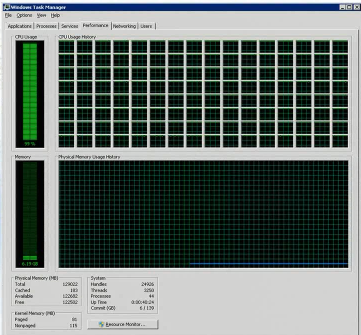
There is another reason to prefer this approach. Since the implementation is not specified, the compiler can more easily optimise your code; you do not care provided the result is correct. This becomes hugely important when it comes to concurrency, where we want the compiler or runtime to utilise many CPU cores if they are available. He has a screenshot of Task Manager running on a 128-core machine which apparently exists in Redmond (I can’t quite read the figure for total RAM but think it may be 128GB):

image

Hejlsberg says there was a language doldrums between 1995 and 2005, when many assumed that Java was the be-all and end-all. I wonder if this is a tacit admission that C#, which he was working on during that period, is not that different in philosophy from Java? The doldrums are over and we now have an explosion of new and revived languages: Ruby, Groovy, Python, Clojure, Boo, Erlang, F#, PowerShell and more. However, Hejlsberg says it makes sense for these to run on an existing framework – in practice either the Java or .NET runtime – since the benefits are so great.

Hejsberg also predicts that distinctions such as dynamic versus static languages will disappear as each language absorbs the best features from other languages. “Traditional taxonomies of languages are breaking down as languages pick paradigms from each other,” he says. The new language paradigm is multi-paradigm.

Just as C# has now acquired dynamic features, we can expect it to get better support for immutability in future (borrowed from functional languages).

Embarcadero All-access: a better way to deploy developer tools?

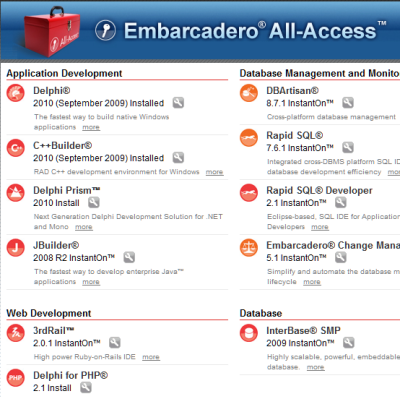
I have a call lined up with Embarcadero today, and wanted to catch up with their latest tools. It reminded me of something I’d intended to post about for some time, the Embarcadero All-Access system which allows no-touch install of many of its tools. Here is how it works. First, you run the All-Access client:

image

I’m not showing all the available tools here: I count 17 currently. You’ll notice many of them are marked InstantOn. Let’s say I want to take a look at DBArtisan. I click the link and get a dialog:

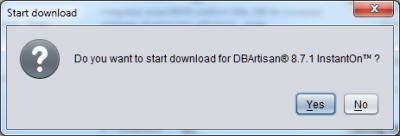
image

This invites me to start a download. Click Yes and I get a download thermometer:

image

Once downloaded, I have to pass a license screen and enter a serial number. Presuming you have a current subscription, you can get a serial number by logging on to you Embarcadero account and requesting it there, where it is supplied instantly. This part of the process is similar to that used by Microsoft for MSDN subscriptions. It is a shame it is not built into the All Access desktop client, but a minor inconvenience.

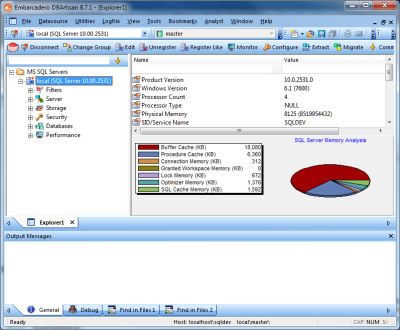
Then the application runs.

image

No further setup, no install options, or any of the other complications that often accompany installing developer tools.

To be fair, I can think of other development tools that are pretty much download and run. Eclipse is usually good in this respect, at least until you try to get updates. Further, even with All Access there can be additional steps. Instant-on 3rd Rail, for example, does not install a Ruby runtime, so it is not really click and run: the Eclipse-based IDE runs, but you cannot start a project without getting a Ruby interpreter from somewhere.

Nevertheless, this is the closest I’ve seen to on-demand developer tools, short of the interesting browser-hosted tools that are emerging. Embarcadero now also calls it the ToolCloud. It is not just an easy install; this is application virtualisation:

Aimed at simplifying deployment, enabling side-by-side versioning of products, and breaking down the barriers to use, InstantOn is also great in locked-down desktop environments, since the product does not affect any system files or system registry settings.

says the faq.

Alongside the technical aspects, All-Access simplifies license management for a development team. You can install the server piece on your own network for full control.

This comes at a price of course. There are four subscription levels, from Bronze to Platinum, though even the Bronze gives you use of a wide range of tools including Delphi, C++ Builder, JBuilder, Rapid SQL, some parts of ER/Studio, 3rdRail and Delphi for PHP. Example price from Grey Matter in the UK starts at £3188.57 for a 1-year Bronze concurrent license.

The interesting question: when can this be made into a generic tool that developers can use for deploying their own applications?

Building for multiple mobile platforms with one codebase

Individuals may have strong opinions about the merits of Apple iPhone versus Google Android versus the struggling Palm WebOS versus the not-yet Windows Phone 7; but sit them round a table to discuss app strategy and those diverse platforms change from a debating point to a problem. Presuming a web app won’t cut it, how do you target all those devices without the unreasonable expense and complication of managing multiple projects? The native languages are all different; Objective-C for iPhone and iPad, Java for Android and RIM BlackBerry, JavaScript for WebOS, C# for Windows Phone 7.

There are three possibilities that come to mind. One is that all the platforms will eventually allow you to write in C or C++, making this the unifying language, though you still have some fancy footwork to do overcoming library differences. Android now allows this via the NDK, and Palm via the PDK. There is currently no alternative to Java for Blackberry, and Microsoft says native code won’t be possible on Windows Phone 7, but well, you never know.

The second is Adobe Flash. This is an interesting one, because Apple prohibits Flash on the iPhone, but Adobe has a Packager for iPhone that builds native iPhone apps from Flash projects. Another issue is that although Flash is available or promised for all the main non-Apple devices – Apple’s gift of a selling point to its rivals – it is not Flash alone that does what it needed, but AIR, the “desktop” or out-of-browser runtime. This has been previewed for Android and promised for other devices including Blackberry. AIR for Windows Phone 7? Maybe, though I’ve not seen it mentioned.

A third idea is a clever framework that does the necessary cross-compilation under the covers. This cannot depend on deploying a runtime, nor compiling to native code, because these approaches are blocked by some mobile platforms. Rhomobile has the Rhodes framework, where you code your app in HTML and Ruby and compile for devices including iPhone, Windows Mobile, RIM Blackberry, Symbian, and Android. Rhodes includes an MVC (Model View Controller) framework and an ORM (Object Relational Mapper) to wrap database access. There is also a RhoSync server component to enable offline data with synchronisation back to the server when reconnected; and the RhoHub hosted IDE for buildings apps with a web browser.

Rhomobile tells me that Palm WebOS support is in the works. They also promise Windows Phone 7 support, which intrigued me because Rhodes says it compiles to “true native device applications”. Has Rhomobile gotten round Microsoft’s opposition to native code? Apparently not; VP Rob McMillen eventually told me that this will mean a .NET IL (intermediate language) implementation.

The Rhomobile approach reminds me of AppForge, a company which produced the well-regarded Crossfire add-on for Visual Studio and compiled Visual Basic to a wide variety of mobile platforms. Unfortunately AppForge was acquired by Oracle, and its new owners showed callous disregard for existing customers. Not only did development cease; it also became impossible to renew existing licenses. Thanks to an activation component, that also blocked new deployment of existing applications – every developer’s nightmare.

That said, there is no activation requirement for Rhodes that I know of, and the framework is open source, so I don’t mean to suggest it will suffer a similar fate.

What about Java? On the face of it, Java should be ideal, since multi-device support is what it was designed for. It is a measure of how far Java has fallen that we hear far more about the lack of Flash on the iPhone, than the lack of Java. Microsoft says yes to Flash on Windows Phone 7, though not on first release, but nothing about Java.

Java as a mobile runtime needs a strong dose of lobbying and evangelism from its new stewards Oracle if it is not to fall by the wayside in this context. Hmm, AppForge.

Bill Buxton, Windows Phone 7 hits at Mix10, say attendees

I recall seeing conversations on Twitter about whether it is worth going to conferences, especially vendor-led ones such as Microsoft’s Mix10 which took place earlier this month. It’s expensive, it’s marketing, and many of the sessions are available for free online soon after they take place.

In that context it’s interesting to see some off-the-cuff comments from attendees about what they liked at Mix. Networking comes high on the list, something you cannot get from a distance. There is general boredom with slide-driven presentations, and enthusiasm for interactive panels. One attendee says:

I always find the panels more exciting, and I like the open dialogs where people can ask questions and get real world opinion and advice

As for the content, the name that comes up most often is Bill Buxton, the design expert who joined Microsoft specifically to introduce greater design-consciousness into a company whose track record in this respect is poor. It was a fascinating appointment, and I believe you can see traces of his work in Windows 7 and much more in Windows Phone 7. I talked to Buxton briefly about this and wrote it up here. When I say “his work”, I don’t mean hands-on screen designs, rather a different approach to product development.

Buxton apparently made a considerable impression at Mix10. His session An hour with Bill Buxton (the link has the video) is also one that is interactive, and worth watching if you have an interest in where design fits into the development process. The fact that Microsoft-platform developers are engaging with his ideas is encouraging, given the usability issues that spoil so many Windows applications and machines.

Overall it also seems that Windows Phone 7 went down well – remarkable when you consider that Windows Mobile was all-but dismissed as irrelevant a few months ago – though I did smile at the Microsoft employee (I think) who shows an iPhone with a Mix scheduling app installed. Its special feature: shake the iPhone and it displays a Windows Phone 7 screen, handy if Ballmer appears in the corridor:

image

One final point: an attendee says IronRuby was shown running on Windows Phone 7 in one of the sessions, something I was told elsewhere was not possible.

Adobe news: Flash Builder 4, Creative Suite 5, quarterly results

Lots of Adobe news this week.

First, the release of Flash Builder 4. It seems a long time ago that I was looking at the first preview of code-name Gumbo; it’s good to see this finally released. Since it is Eclipse-based, it looks similar to to Flex Builder 3.0; but under the covers there is the new Flex 4 SDK with the Spark component architecture. The design tools have been revamped, and a time-saving feature is that you can now generate an event handler with one click. Flash Builder 4 also has built-in unit testing with FlexUnit, which is a big deal for those enlightened folk who do test-driven development.

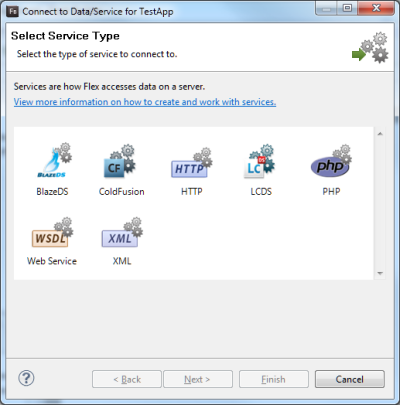
Adobe has also worked hard on database connectivity. Flash Builder 4 will generate wrapper code for a variety of data sources, including HTTP and REST, PHP, SOAP, and Adobe’s LiveCycle Data Services middleware.

image

There is a new data/services panel that shows all the available sources, with drag-and-drop data binding, batch updates, and other handy features.

There are a few downsides to Flash Builder 4. ActionScript feels dated if you have been playing with something like C# 4.0, soon to be released as part of Microsoft’s Visual Studio 2010. I’ve also heard complaints that equivalent projects built with Flex are larger than equivalents built with the Flash IDE. The naming is puzzling; we now have to distinguish between the Flash IDE and the Flash Builder IDE, which are completely different products, but the SDK for code-centric development is still called Flex. There is no support yet for AIR 2.0, the latest version of the desktop runtime; nor for the much-hyped iPhone app development. Patience is called for, I guess.

More information on Flex and Flash Builder here.

The next big product launch from Adobe will be Creative Suite 5, for which a launch date of Monday, 12th April has been announced. You can sign up for an online launch event and see some sneak peek videos here.

Finally, Adobe released quarterly financial figures today. The company says they are strong results; revenue is 9.1% higher than last year and GAAP earnings are positive (unlike the last quarter). However, looking at the investor datasheet [PDF] I noticed that new analytics acquisition Omniture now accounts for 10% of revenue; if you deduct that from the increase it does not look so good. Still, a profit is a profit, and the quarter before a major update to CS 5.0 may be under par as users wait for the new release,  so overall it does not look too bad.  The Q1 Earnings Call is worth looking at if only for its nice indexing; I wish all online videos worked like this.

One questioner asked about HTML 5 – “how quickly can you provide support when it comes”? An intriguing question. I suspect it reflects more on the publicity around Flash vs HTML than on the progress of the HTML 5 standard itself, which is coming in fits and starts. “The reality is that it’s a fragmented standard, but we will continue to support it”, was the answer from CEO Shantanu Narayen, though he added a plug for the “benefits of our runtime, which is Flash”.

Visual Studio software factories to emerge from Microsoft deep freeze

Last night at the Microsoft Mix party in Las Vegas I happened across Michael Lehman, a senior architect, who told me he had been working for the last six years on a Visual Studio add-on called Feature Builder. This turns out to be the evolution of the very same project which Microsoft’s Jack Greenfield told me about back in March 2007, at an architecture conference in the UK, though back then it had a more exalted status (in Greenfield’s eyes at least) – he described it as a platform rather than merely an add-on. Now Feature Builder is to appear as an extension in the Visual Studio 2010 Gallery, only discoverable by those who seek it out. If enough developers find it and like it, it may end up as part of a future Visual Studio release.

It’s all part of Microsoft’s desperately confused architecture and modelling story. Note that Greenfield in 2007 denigrated the UML:

The UML is a collection of useful abstractions. Unfortunately it’s been peddled as a universal modelling language, but the U never stood for Universal. We subscribe to Michael Jackson, author of Problem Frames, who says that there is no such thing as a universal solution. It’s a childish approach. This is where the Universal Modelling Language marketing pitch fails. UML was never properly extensible. It also has the problem that it was designed by a committee.

So what do we have actually shipping with Visual Studio 2010? Standard UML modelling, the best Microsoft has yet come up with.

Reading between the lines, this likely means that the UML faction within Microsoft outvoted the non-UML faction. However, each release of Visual Studio seems to have its own unique approach to modelling and architecture tools, so it would be no great surprise if Visual Studio 2012, say, replaced them with something different.

As for Feature Builder, it does sound interesting – read the Greenfield interview referenced above for why it has potential. Lehman says it is a simpler approach than previous software factory tools from Microsoft, and named Feature Builder to avoid association with past efforts.

Update: Lehman has blogged about the project here, and you can download the preview here.

Microsoft playing HTML 5 standards game alongside Silverlight game

I’m at Mix10 in Las Vegas where Microsoft has been showing off the latest preview of IE9 – you can try it here, provided you have Vista SP2, Windows 2008 or Windows 7.

The two themes are performance, with GPU-accelerated HTML and graphics and a new Javascript engine that compiles code in the background, and standards support. This latter was not a surprise to me, as I’d heard the well-informed Molly Holzschlag praise Microsoft’s commitment to HTML5 at a workshop here on Sunday – see this earlier post.

During the keynote, we saw IE9 playing a video using the HTML 5 video tag – no Flash or Silverlight needed. Microsoft also showed that in this instance IE9 performed better than Chrome thanks to better hardware acceleration. Although one should always mistrust one vendor’s demonstration of another vendor’s product, it should not be surprising that Microsoft is able to deliver a browser that is better optimised for Windows.

Video, hardware accelerated graphics, audio element support, fast JavaScript: there is considerable overlap with the features of the Microsoft Silverlight (and Adobe Flash) plug-ins.

The plug-in approach has advantages. It offers consistency across browsers, and enables rapid evolution without the hassles of standards committees. The multimedia features in Silverlight and Flash are well ahead of those in HTML 5 – Holzschlag nailed this when she described today’s HTML 5 demos as reminiscent of Flash demos a decade ago.

Still, if you can do without the plug-in you end up with cleaner code, removing the awkward transition between what is in HTML and JavaScript, and what is in the plug-in. There is also a better chance that your code will run on Apple’s iPhone and iPad, for example.

The question though: can Microsoft do an equally good job of supporting HTML 5 throughout its platform, as it will do with Silverlight? This is where I’m doubtful. The Visual Studio and Expression tools will continue to drive developers towards Silverlight rather than HTML 5.

It’s notable that shortly after Microsoft’s IE9 demos at Mix, we saw demos of fun technology like code-name Houston, develop databases in the cloud using just your browser and … Silverlight.