Category Archives: software development

QCon London 2010 report: fix your code, adopt simplicity, cool .NET things

I’m just back from QCon London, a software development conference with an agile flavour that I enjoy because it is not vendor-specific. Conferences like this are energising; they make you re-examine what you are doing and may kick you into a better place. Here’s what I noticed this year.

Robert C Martin from Object Mentor gave the opening keynote, on software craftsmanship. His point is that code should not just work; it should be good. He is delightfully opinionated. Certification, he says, provides value only to certification bodies. If you want to know whether someone has the skills you want, talk to them.

Martin also came up with a bunch of tips for how to write good code, things like not having more than two arguments to a function and never a boolean. I’ve written these up elsewhere.

image

Next I looked into the non-relational database track and heard Geir Magnusson explain why he needed Project Voldemort, a distributed key-value storage system, to get his ecommerce site to scale. Non-relational or NOSQL is a big theme these days; database managers like CouchDB and MongoDB are getting a lot of attention. I would like to have spent more time on this track; but there was too much else on; a problem with QCon.

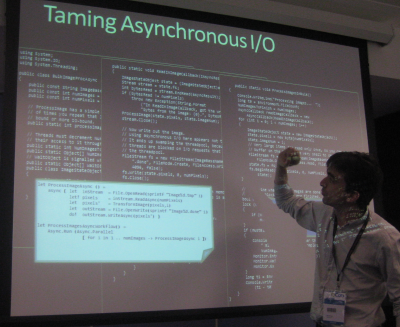
I therefore headed for the functional programming track, where Don Syme from Microsoft Research gave an inspiring talk on F#, Microsoft’s new functional language. He has a series of hilarious slides showing F# code alongside its equivalent in C#. Here is an example:
image

The white panel is the F# code; the rest of the slide is C#.

Seeing a slide that this makes you wonder why we use C# at all, though of course Syme has chosen tasks like asychronous IO and concurrent programming for which F# is well suited. Syme also observed that F# is ideal for working with immutable data, which is common in internet programming. I grabbed a copy of Programming F# for further reading.

Over on the Architecture track, Andres Kütt spoke on Five Years as a Skype Architect. His main theme: most of a software architect’s job is communication, not poring over diagrams and devising code structures. This is a consistent theme at QCon and in the Agile movement; get the communication right and all else follows. I was also interested in the technical side though. Skype started with SOAP but switched to a REST model for web services. Kütt also told us about the languages Skype uses: PHP for the web site, C or C++ for heavy lifting and peer-to-peer networking; Delphi for the Windows interface; PostgreSQL for the database.

Day two of QCon was even better. I’ve written up Martin Fowler’s talk on the ethics of software development in a separate post. Following that, I heard Canonical’s Simon Wardley speak about cloud computing. Canonical is making a big push for Ubuntu’s cloud package, available both for private use or hosted on Amazon’s servers; and attendees at the QCon CloudCamp later on were given a lavish, pointless cardboard box with promotional details. To be fair to Wardley though, he did not talk much about Ubuntu’s cloud solution, though he did make the point that open source makes transitions between providers much cheaper.

Wardley’s most striking point, repeated perhaps too many times, is that we have no choice about whether to adopt cloud computing, since we will be too much disadvantaged if we reject it. He says it is now more a management issue than a technical one.

Dan North from ThoughtWorks gave a funny and excellent session on simplicity in architecture. He used pseudo-biblical language to describe the progress of software architecture for distributed systems, finishing with

On the seventh day God created REST

Very good; but his serious point is that the shortest, simplest route to solving a problem is often the best one, and that we constantly make the mistake of using over-generalised solutions which add a counter-productive burden of complexity.

North talked about techniques for lateral thinking, finding solutions from which we are mentally blocked, by chunking up, which means merging details into bigger ideas, ending up with “what is this thing for anyway”; and chunking down, the reverse process, which breaks a problem down into blocks small enough to comprehend. Another idea is to articulate a problem to a colleague, which exercises different parts of the brain and often stimulates a solution – one of the reasons pair programming can be effective.

A common mistake, he said, is to keep using the same old products or systems or architectures because we always do, or because the organisation is already heavily invested in it, meaning that better alternatives do not get considered. He also talked about simple tools: a whiteboard rather than a CASE tool, for example.

Much of North’s talk was a variant of YAGNI – you ain’t gonna need it – an agile principle of not implementing something until/unless you actually need it.

I’d like to put this together with something from later in the day, a talk on cool things in the .NET platform. One of these was Guerrilla SOA, though it is not really specific to .NET. To get the idea, read this blog post by Jim Webber, another from the ThoughtWorks team (yes, there are a lot of them at QCon). Here’s a couple of quotes:

Prior to our first project starting, that client had already undertaken some analysis of their future architecture (which needs scalability of 1 billion transactions per month) using a blue-chip consultancy. The conclusion from that consultancy was to deploy a bus to patch together the existing systems, and everything else would then come together. The upfront cost of the middleware was around £10 million. Not big money in the grand scheme of things, but this £10 million didn’t provide a working solution, it was just the first step in the process that would some day, perhaps, deliver value back to the business, with little empirical data to back up that assertion.

My (small) team … took the time to understand how to incrementally alter the enterprise architecture to release value early, and we proposed doing this using commodity HTTP servers at £0 cost for middleware. Importantly we backed up our architectural approach with numbers: we measured the throughput and latency characteristics of a representative spike (a piece of code used to answer a question) through our high level design, and showed that both HTTP and our chosen Web server were suitable for the volumes of traffic that the system would have to support … We performance tested the solution every single day to ensure that we would always be able to meet the SLAs imposed on us by the business. We were able to do that because we were not tightly coupled to some overarching middleware, and as a consequence we delivered our first service quickly and had great confidence in its ability to handle large loads. With middleware in the mix, we wouldn’t have been so successful at rapidly validating our service’s performance. Our performance testing would have been hampered by intricate installations, licensing, ops and admin, difficulties in starting from a clean state, to name but a few issues … The last I heard a few weeks back, the system as a whole was dealing with several hundred percent more transactions per second than before we started. But what’s particularly interesting, coming back to the cost of people versus cost of middleware argument, is this: we spent nothing on middleware. Instead we spent around £1 million on people, which compares favourably to the £10 million up front gamble originally proposed.

This strikes me as an example of the kind of approach North advocates.

You may be wondering what other cool .NET things were presented. This session was called the State of the Art .NET, given by Amanda Laucher and Josh Graham. They offer a dozen items which they considered .NET folk should be using or learning about:

  1. F# (again)
  2. M – modelling/DSL language
  3. Boo – static Python for .NET
  4. NUnit – unit testing. Little regard for Microsoft’s test framework in Team System, which is seen as a wasted and inferior effort.
  5. RhinoMocks – mocking library
  6. Moq – another mocking library
  7. NHibernate – object-relational mapping
  8. Windsor – dependency injection, part of Castle project. Controversial; some attendees thought it too complex.
  9. NVelocity – .NET template engine
  10. Guerrilla SOA – see above
  11. Azure – Microsoft’s cloud platform – surprisingly good thanks to David Cutler’s involvement, we were told
  12. MEF – Managed Extensibility Framework as found in Visual Studio 2010, won high praise from those who have tried it

That was my last session (I missed Friday) though I did attend the first part of CloudCamp, an unconference for cloud early adopters. I am not sure there is much point in these now. The cloud is no longer subversive and the next new thing; all the big enterprise vendors are onto it. Look at the CloudCamp sponsor list if you doubt me. There are of course still plenty of issues to talk about, but maybe not like this; I stayed for the first hour but it was dull.

For more on QCon you might also want to read back through my Twitter feed or search the entire #qcon tag for what everyone else thought.
Martin Fowler on the ethics of software development – QCon report

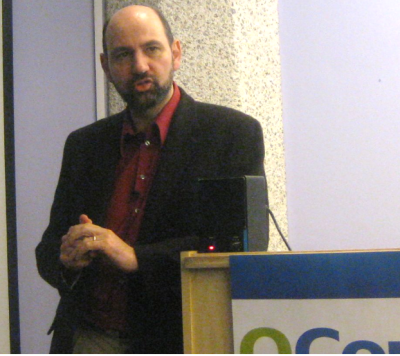
Martin Fowler of ThoughtWorks gave what seemed an important session at QCon London, exploring the ethical dimension of software development with a talk called What are we programming for?. The room was small, since the organisers figured that a track on IT with a a conscience would be a minority interest; but Fowler always attracts a large audience and the result was a predictable crush.

The topic itself has many facets, perhaps awkwardly commingled. Should you walk away if your customer or employer asks you to code the wrong thing – maybe enforcing poor practice, or creating algorithms to fleece your customer’s customers? What about coding for proprietary platforms owned by vendors with questionable business practices? Fowler mentioned that around 50% of ThoughtWorks solutions are built on Microsoft .NET; and that the efforts of Bill Gates to combat malaria was something that helped him make sense of that relationship.

image

Fowler also echoed some of Robert Martin’s theme from the day before: if you build poor software, you are in effect stealing from the future revenue of your customer.

Finally, he talked about the male/female imbalance in software development, rejecting the idea that it is the consequence of natural differences in aptitude or inclination. Rather, he said, we can’t pretend to have the best people for the job while the imbalance continues. I’d add that since communication is a major theme of Agile methodology, and that females seem to have communication skills that males lack, fixing the imbalance could improve the development process in other ways.

Big questions; and Fowler had few answers. When asked for the takeaway, he said the main one is to discuss these issues more.

Functional programming, NOSQL themes at QCon London

One reason I enjoy the QCon London software development conference is that it reflects programming trends. Organiser Floyd Marinescu described it as by practitioners for practitioners. In previous years I’ve seen themes like disillusionment with enterprise Java, the rise of Agile methodologies, the trend towards dynamic languages, and the benefits of REST.

So what’s hot this year? A couple of trends are striking. One is functional programming. Don Syme, Principal Researcher at Microsoft Research and co-inventor of F#, gave a lively presentation on functional approaches to parallelism and concurrency. He shows screen after screen of equivalent F# and C# code, illustrating how F# is more concise and expressive, as well as being better suited to concurrent development.

F# is one of the languages included by default in Visual Studio 2010, which should be released shortly.

I asked Syme what sort of problems are not well suited to F#. In his reply he described the state of play in Visual Studio 2010, where you can easily create F# libraries but there is no designer support for user interface code, such as Windows Forms or Windows Presentation Foundation. That is merely a tooling issue though.

Syme’s point is that functional programming, and F# in particular, is ideal for today’s programming challenges, including concurrency and asynchronous code.

If nothing else, he convinced me that every .NET programmer should at least be looking at F# and learning what it can do.

The functional programming track at QCon is not just about F#, of course, though in some ways it seems to be the functional language of the moment.

The other theme that has made a big impression is NoSQL, or what the QCon track calls “Non-relational database managers and web-oriented data”.Geir Magnusson from Gilt Groupe talked about the challenge of running a web site which has extreme peaks in traffic, and where every user needs dynamic data and transaction support so simple caching does not work. They were unable to get their relational database store to scale to handle thousands of transactions a second. They solved the problem with an in-memory non-relational database.

In another talk, the BBC discussed their use of CouchDB for highly scalable web sites.

Why programmers should study Microsoft’s random failure and not trust Google search

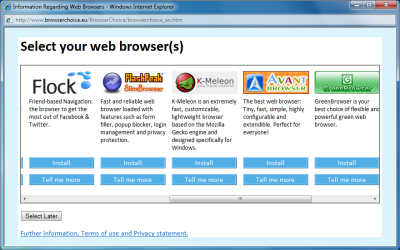
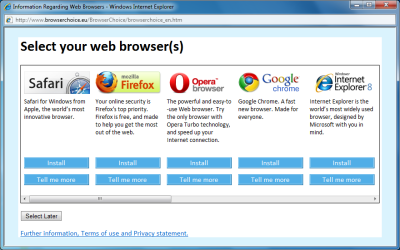
The bizarre story of the EU-mandated Windows browser choice screen took an unexpected twist recently when it was noticed that the order of the browsers was not truly random.

image

IBM’s Rob Weir was not the first to spot the problem, but did a great job in writing it up, both when initially observed and after it was fixed by Microsoft.

It was an algorithm error, a piece of code that did not return the results the programmer intended.

Unless Microsoft chooses to tell us, there is no way to tell how the error happened. However, as Weir and others observe, it may be significant that a Google search for something like Javascript random sort immediately gets you sample code that has the same error. Further, the error is not immediately obvious, making it particularly dangerous.

I am sure I am not the only person to turn to Google when confronted with some programming task that requires some research. In general, it is a great resource; and Google’s own algorithms help a little with filtering the results so that sites with better reputation or more inbound links come higher in the results.

Still, what this case illustrates – though accepting again that we do not know how the error occurred in this instance – is that pasting code from a Google search into your project without fully understanding and testing it does not always work. Subtle bugs like this one, which may go unnoticed for a long time, can have severe consequences. Randomisation is used in security code, for example.

As an aside, there also seems to be some randomness in the appearance of the browser choice screen. It turned up on my laptop, but not on my desktop, although both have IE as the default.

And who would have guessed that the EU would arrange for so many of us to get an ad for something like the GreenBrowser popping up on our desktop? Apparently it is the “best choice of flexible and powerful green web browser”, though since it is based on IE it is less radical a choice than it first seems.

image

Microsoft maybe gets the cloud – maybe too late

Microsoft CEO Steve Ballmer gave a talk on the company’s cloud strategy at the University of Washington yesterday. Although a small event, the webcast was widely publicised and coincides with a leaked internal memo on “how cloud computing will change the way people and businesses use technology”, a new Cloud website, and a Cloud Computing press portal, so it is fair to assume that this represents a significant strategy shift.

According to Ballmer:

about 70 percent of our folks are doing things that are entirely cloud-based, or cloud inspired. And by a year from now that will be 90 percent

I watched the webcast, and it struck me as significant that Ballmer kicked off with a vox pop video where various passers by were asked what they thought about cloud computing. Naturally they had no idea, the implication being, I suppose, that the cloud is some new thing that most people are not yet aware of. Ballmer did not spell out why Microsoft made the video, but I suspect he was trying to reassure himself and others that his company is not too late.

I thought the vox pop was mis-conceived. Cloud computing is a technical concept. What if you did a vox pop on the graphical user interface? or concurrency? or Unix? or SQL? You would get equally baffled responses.

It was an interesting contrast with Google’s Eric Schmidt who gave a talk at last month’s Mobile World Congress that was also a big strategy talk; I posted about it here. Schmidt takes the cloud for granted. He does not treat it as the next big thing, but as something that is already here. His talk was both inspiring and chilling. It was inspiring in the sense of what is now possible – for example, that you can go into a restaurant, point your mobile at a foreign-language menu, and get back an instant translation, thanks to Google’s ability to mine its database of human activity. It was chilling with its implications for privacy and Schmidt’s seeming disregard for them.

Ballmer on the other hand is focused on how to transition a company whose business is primarily desktop operating systems and software to one that can prosper in the cloud era:

If you think about where we grew up, other than Windows, we grew up with this product called Microsoft Office. And it’s all about expressing yourself. It’s e-mail, it’s Word, it’s PowerPoint. It’s expression, and interaction, and collaboration. And so really taking Microsoft Office to the cloud, letting it run in the cloud, letting it run from the cloud, helping it let people connect and communicate, and express themselves. That’s one of the core kind of technical ambitions behind the next release of our Office product, which you’ll see coming to market this June.

Really? That’s not my impression of Office 2010. It’s the same old desktop suite, with a dollop of new features and a heavily cut-down online version called Office Web Apps. The problem is not only that Office Web Apps is designed to keep you dependent on offline Office. The problem is that the whole model is wrong. The business model is still based on the three-year upgrade cycle. The real transition comes when the Web Apps are the main version, to which we subscribe, which get constant incremental updates and have an API that lets them participate in mash-ups across the internet.

That said, there are parallels between Ballmer’s talk and that of Schmidt. Ballmer spoke of 5 dimensions:

  • The cloud creates opportunities and responsibilities
  • The cloud learns and helps you learn, decide and take action
  • The cloud enhances your social and professional interactions
  • The cloud wants smarter devices
  • The cloud drives server advances

In the most general sense, those are similar themes. I can even believe that Ballmer, and by implication Microsoft, now realises the necessity of a deep transition, not just adding a few features to Office and Windows. I am not sure though that it is possible for Microsoft as we know it, which is based on Windows, Office and Partners.

Someone asks if Microsoft is just reacting to others. Ballmer says:

You know, if I take a look and say, hey, look, where am I proud of where we are relative to other guys, I’d point to Azure. I think Azure is very different than anything else on the market. I don’t think anybody else is trying to redefine the programming model. I think Amazon has done a nice job of helping you take the server-based programming model, the programming model of yesterday that is not scale agnostic, and then bringing it into the cloud. They’ve done a great job; I give them credit for that. On the other hand, what we’re trying to do with Azure is let you write a different kind of application, and I think we’re more forward-looking in our design point than on a lot of things that we’re doing, and at least right now I don’t see the other guy out there who’s doing the equivalent.

Sorry, I don’t buy this either. Azure does have distinct advantages, mainly to do with porting your existing ASP.NET application and integrating with existing Windows infrastructure. I don’t believe it is “scale agnostic”; something like Google App Engine is better in that respect. With Azure you have to think about how many virtual machines you want to purchase. Nor do I think Azure lets you write “a different kind of application.” There is too little multi-tenancy, too much of the old Windows server model remains in Azure.

Finally, I am surprised how poor Microsoft has become at articulating its message. Azure was badly presented at last year’s PDC, which Ballmer did not attend. It is not an attractive platform for small-scale developers, which makes it hard to get started.

Windows Phone 7 incompatibility may drive developers elsewhere

Microsoft’s Charlie Kindel has blogged about the Windows Phone 7 development platform.

As widely leaked, the new mobile device supports Silverlight and XNA; Kindel also mentions .NET, but since both Silverlight and XNA are .NET platforms, that might not mean anything additional.

The big story is about compatibility:

To deliver what developers expect in the developer platform we’ve had to change how phone apps were written. One result of this is previous Windows mobile applications will not run on Windows Phone 7 Series.

This puts Microsoft in an awkward position. Support for custom business apps has been one of the better aspects of Windows Mobile. What Microsoft should do is to have some way of continuing to run those old apps on the new devices. Instead, Kindel adds:

To be clear, we will continue to work with our partners to deliver new devices based on Windows Mobile 6.5 and will support those products for many years to come, so it’s not as though one line ends as soon as the other begins.

I would not take much account of this. No doubt there will some devices, but demand for Windows Mobile will dive through the floor (if it has not already) once Phone 7 is available, making it an unattractive proposition for hardware partners.

The danger for Microsoft is that after this let-down, those with existing Windows Mobile apps that are now forced to choose a new development platform might choose one from a competitor.

The mitigation is that apps which use the Compact Framework will likely be easier to port to Windows Phone 7, because the language is the same. Native code apps are a different matter. Of course it will be technically possible to write native code apps for Windows Phone 7, but probably locked down and restricted to special cases, such as perhaps the Adobe Flash runtime (I am speculating here).

PS – I see that developer Thomas Amberg has articulated exactly these concerns in a comment to Kindel’s post:

Platform continuity was the single most important feature of Windows Mobile. Being able to run code from 2003 on a current phone is more important to our customers than a fancy UI (which Microsoft seems not able to get right anyway). Further, the ability to access hardware specific APIs through P/Invoke has been vital in many of our projects (e.g. to use Bluetooth in the early days). Those advantages have now gone. You just rendered useless years of development work and many thousands of lines of code.

"we will continue to work with our partners to deliver new devices based on Windows Mobile 6.5 and will support those products for many years to come"

You will, I bet. But which device manufacturer will produce such "dead-end" devices?

Time to switch to another mobile OS.

Microsoft .NET gotchas revealed by Visual Studio team

The Visual Studio Blog makes great reading for .NET developers, and not only because of the product it describes. Visual Studio 2010 is one of the few Microsoft products that has made a transition from native C++ code to .NET managed code – the transition is partial, in that parts of Visual Studio remain in native code, but this is true of the shell and the editor, two of the core components. Visual Studio is also a complex application, and one that is extensible by third parties. Overall the development team stressed the .NET platform, which is good for the rest of us because the developers are in a strong position both to understand problems, and to get them fixed even if it means changes to the .NET Framework.

Two recent posts interested me. One is Marshal.ReleaseComObject Considered Dangerous. I have some familiarity with this obscure-sounding topic, thanks to work on embedding Internet Explorer components. It relates to a fundamental feature of .NET: the ability to interact with the older COM component model, which is still widely used. In fact, Microsoft still uses COM for new Windows 7 APIs; but I digress. A strong feature of .NET from its first release is that it can easily consume COM objects, and also expose .NET objects to COM.

The .NET platform manages memory using garbage collection, where the runtime detects objects that are no longer referenced by active code and deletes them. COM on the other hand uses reference counting, maintaining a count of the number of references to an object and deleting the object when it reaches zero.

Visual Studio 2008 and earlier has lots of COM APIs. Some of these were called from .NET code, and for the same of efficiency called the method mentioned above, Marshal.ReleaseComObject, to reduce the reference count immediately so that the COM object would be deleted.

Now here comes Visual Studio 2010, and some of those COM APIs are re-implemented as .NET code. For compatibility with existing code, the new .NET code is also exposed as a COM API. Some of that existing code is actually .NET code which wraps the COM API as .NET code. Yes, we have .NET to COM to .NET, a double wrapper. Everything still works though, until you call Marshal.ReleaseComObject on the doubly-wrapped object. At this point the .NET runtime throws up its hands and says it cannot decrement the reference count, because it isn’t really a COM object. Oops.

The post goes on to observe that Marshal.ReleaseComObject is dangerous in any cause, because it leaves you with an invalid .NET wrapper. This means you should only call it when the .NET instance is definitely not going to be used again. Obvious, really.

Once you’ve digested that, try this illuminating post on WPF in Visual Studio 2010 – Part 2 : Performance tuning. WPF, or Windows Presentation Foundation, is the .NET API for rich graphical user interfaces on desktop Windows applications. Here is an example of why you should read the post, if you work with WPF. Many of us frequently use Remote Desktop to run applications on remote PCs or PCs that do not have a screen and keyboard attached. This is really a bad scenario for WPF, which is designed to take advantage of local accelerated graphics. Here’s the key statement:

Over a remote desktop connection, all WPF content is rendered as a bitmap. This is in contrast to GDI rendering, where primitives such as rectangles and text are sent over the wire for reconstruction on the client.

It’s a bad scenario, but mitigated if you use graphics that are amenable to compression, like solid colours. There are also some tweaks introduced in WPF 4.0, like the ability to scroll an area on the remote client, which saves having to re-send the entire bitmap if it has moved.

Nokia Maemo, Intel Moblin gives way to MeeGo

Nokia’s Maemo operating system, a Linux distribution for mobile devices, is being merged with the Intel-sponsored Moblin distribution to form MeeGo, under the direction of the Linux Foundation:

MeeGo combines Intel’s Moblin and Nokia’s Maemo projects at the Linux Foundation to create one open source uber-platform for the next generation of computing devices: tablets, pocketable computers, netbooks, automotive IVI and more.

says the Foundation’s Jim Zemlin.

Watching the joint Intel and Nokia interview it seemed to me that this is more Maemo than Moblin, especially since Nokia’s Qt framework and Qt Creator IDE is mentioned as the primary application development platform for MeeGo.

The most significant factor is that Intel and Nokia will now be backing the same mobile OS. You would expect this to have an impact, though I guess the move is an attempt to win back mindshare that has gone to Android, the up and coming mobile OS from Google.

Although both Android and MeeGo are based on Linux, the Android OS has a completely different development model based on Java rather than C/C++.

XML literals come to PHP via Facebook: XHP

Facebook engineer Marcel Laverdet has written up the XHP project on which he has been working at Facebook, and which he says is “quickly becoming a cornerstone of front-end PHP development at Facebook”. XHP enables XML fragments to be valid PHP expressions. In addition, most HTML elements have been pre-defined as variables. The project is hosted on github and you can read a quick summary here. PHP inventor Rasmus Lerdorf has had a quick look and says:

The main interest, at least to me, is that because PHP now understands the XML it is outputting, filtering can be done in a context-sensitive manner. The input filtering built into PHP can not know which context a string is going to be used in. If you use a string inside an on-handler or a style attribute, for example, you need radically different filtering from it being used as regular XML PCDATA in the html body. Some will say this form is more readable as well, but that isn’t something that concerns me very much.

Lerdorf goes on to express concern about performance, but says that in combination with APC caching it is much better, and with HipHop compilation to native code becomes “a viable approach”.

One of the benefits here is that getting XML markup out of quoted strings means that it can be checked as it is parsed, so that errors are caught earlier. There are parallels with Microsoft’s work on Linq (Language Integrated Query) which pulls database queries into the language, and XML literals in Visual Basic 9.0. Ideally, developers should not have to hide code such as SQL, XML or Javascript within strings that are not checked for valid syntax until runtime.

This might also re-ignite the debate about whether XML literals should be in C#, now also gaining more attention because of the popularity of ASP.NET MVC.

Visual Studio 2010 RC arrives with go-live license

Microsoft has made the Release Candidate of Visual Studio 2010 available for download to MSDN subscribers. From tomorrow (10th February) the same release will be available to everyone. There is a go-live license so you can use this in production if you wish, though if the full release comes in April as planned, it hardly seems worth it in most scenarios.

What’s new since the beta? Jason Zander says mainly performance. Note that the Chief Architect of Visual Studio is Rico Mariani, formerly Microsoft’s .NET performance guru, which is encouraging in this respect.

The blow-by-blow account of issues with the RC is here.

Whatever your views on the direction and future of Microsoft’s platform, there’s no doubting the huge scope of this release, though in my view the company has not communicated this particularly well, saying too much about things like SharePoint development, top of its list of walkthroughs but still an ugly business, and not enough about features such as IntelliTrace debugging, or the new ability to float windows out of the IDE and onto a second display, which will have a more immediate impact on developers. Note that the Visual Studio IDE has been re-built using WPF (Windows Presentation Foundation), and that it comes with a the first completely new version of the .NET Framework since 2005.

Silverlight 4.0 is another area of interest, though I understand that it will not be complete in time for this release. Visual Studio 2010 will have Silverlight 3.0 out of the box, with the ability to install the 4.0 preview release and eventually the final release as an add-on. I’ve also heard that Silverlight 4.0 is not yet supported at all in the RC, so be cautious if this is your area of work – you may need to stick with the last beta for the moment.

New is not always better, of course. I’m interested in hearing from developers working with Visual Studio 2010 – whether performance and stability issues have been overcome, and what you think of it overall.