Category Archives: microsoft

Store any type of file in Google Apps – in effect, GDrive

Google has announced a new feature – the ability to upload any type of file to its online storage.

Over the next couple of weeks, we are rolling out the ability for Google Apps users to easily upload and securely share any type of file internally and externally using Google Docs. You get 1 GB of storage per user, and you can upload files up to 250 MB in size…Combined with shared folders in Google Docs, the upload feature is a great way to collaborate on files with coworkers and external parties.

Additional storage is available at $0.25/GB/yr according to this post.

Is this “GDrive” – the long-rumoured generic online storage from Google? Pretty much. Note however that Microsoft’s excellent SkyDrive already offers 25 GB of unrestricted online storage for free.

Enterprise customers who use the Premier Edition of Google Apps are also getting this service, but at a higher price: additional storage is $3.50/gb (or €3.00/gb in the EU). This storage is accessible via the Google Documents List Data API, enabling developers to create applications that backup or synchronise files between Google and client devices, and is therefore more comparable to Amazon’s Simple Storage Service (S3). Amazon has no free offering but S3 is modestly priced at $0.15 per GB per month, between Google’s consumer and business pricing, though note that Amazon also charges for data transfer.

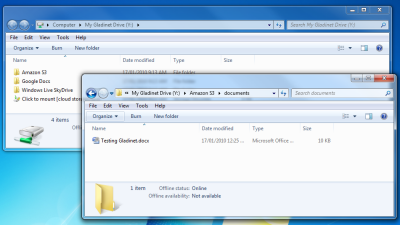
Once third-parties do their stuff to make this look like any other network folder, this looks like a handy new feature. One advantage is that you can store Microsoft Office files in their native format, rather than having to convert them to Google documents with loss of fidelity.

It may also mean less usage for a popular workaround – emailing attachments to yourself in GMail.

Update: post revised to include information on Premier Edition.

Going Mobile

In the back of my mind I knew that this blog looked terrible on a mobile, but I did nothing about it until @monkchips complained that it was unreadable on his HTC Magic, which runs Google Android 1.6.

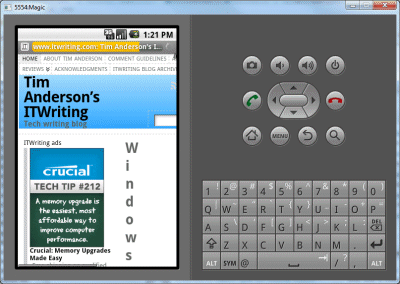
I don’t have an Android device, but I grabbed the SDK, ran up the emulator, and had a look. The page took ages to load, and did not work properly even when fully loaded.

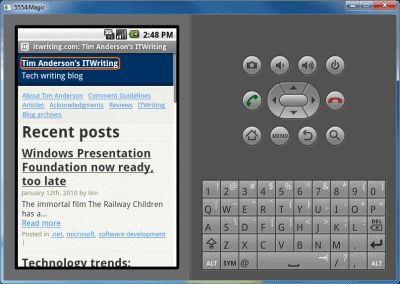
I figured “there’s a plugin for that”, and there is – several in fact. I settled on the WordPress Mobile Pack. Installed, configured, and a short time later was up and running.

I had a few hassles, mainly because most of my wordpress installation is not writeable by the web server, and this plugin needs to write themes on installation and temporary images after that, so I had to loosen permissions slightly. I then set the themes directory back to read-only, and configured the cache so that Apache will only serve images.

I still only get a score of Fair (2 fails) from the MobiReady report. Still, progress. I am ahead of bbc.co.uk which gets Bad (10 fails); but behind microsoft.com which rates Good (0 fails).

The plugin also tells me that 5% of the traffic to this site is from mobile users. More than I had expected.

Beep beep.

Windows Presentation Foundation now ready, too late

The immortal film The Railway Children has a scene in which a band plays during an award presentation. Unfortunately a series of false starts delay the performance, until finally it all comes together and the music begins. The camera pans – the audience has already departed.

Is it like that for WPF (Windows Presentation Foundation), Microsoft’s user interface framework which is built on .NET and DirectX and was intended to replace the ancient GDI (Graphics Device Interface) and GDI+?

In this new post I make the case that with WPF 4.0 is the framework is now truly ready to use, not least because Microsoft itself is using it in Visual Studio and the interaction between these two teams has solved a number of problems in WPF.

But who now wants to develop just for Windows? Well, it makes sense in some contexts, though I note that in the Thoughtworks paper on emerging technology and trends about which I wrote yesterday, neither Windows nor WPF gets a mention. Nor for that matter does the Mac, Linux, or OS X, though iPhone and Android feature strongly. The only emerging desktop technology that interests Thoughtworks is the browser.

What’s wrong with Microsoft Hotmail?

Joe Wilcox has a good post about Microsoft’s decade of shattered dreams. These are all things in which the company invested, but did not get right: eBooks, HailStorm web services, digital music, Origami small computing devices.

The list is longer than that of course. Tablet PC is a big one; we’ll see what happens to Apple’s efforts. And when I researched a retrospective on .NET recently I was struck by how well Microsoft got the mash-up idea: building block services pulled together by .NET web sites or client applications.  And let’s not forget that Microsoft demonstrated Ajax partial page refresh in September 2000. These ideas have not been total failures at Microsoft, but their potential has been realised mainly by others.

That brings me to Hotmail (also known as Live Mail), the web-based email service that launched in 1996 and was acquired by Microsoft in late 1997. Microsoft was long teased for keeping it running on Unix while promoting Windows Server; that is emphatically no longer the case, as explained in two recent blogs by Arthur de Haan and Dick Craddock. It was moved off Unix in 2004, and rewritten in C# and ASP.NET in 2005. According to de Haan, it is the largest SQL Server 2008 deployment in the world. Impressive.

It would be absurd to call Hotmail a failure, when it has 1.3 billion inboxes and 350 million active users. Nevertheless, when I read or hear people recommending a web-based email service, it is almost always Google Gmail, not Hotmail (nor Yahoo for that matter). There are several people with whom I communicate professionally at Gmail addresses, none that I can think of on Hotmail.

Last year, Information Week reported that in the USA Gmail was set to overtake Hotmail in 2009; I do not know if it did so, but it would not surprise me, though internationally Hotmail is likely still ahead. Yahoo was well ahead of both, but will not be immune to the Google effect.

How has Google managed to steal mindshare away from Microsoft’s long-established service?

One reason is that Google got it right pretty much from the first public beta, whereas Hotmail has made pretty much every mistake in the book, though it has gradually corrected most of them. For a long time my Hotmail account was nearly unusable because of spam, whereas Gmail has great spam filters. Hotmail had inadequate storage, until Gmail turned up with 1GB of storage and its competitors quickly followed suit.

Another factor is the user experience. When I go to Gmail, I get a full page dedicated to email, and it is responsive and generally pleasant to use. The Hotmail UI is busier, the ads are more intrusive, and it takes longer to load.

Still, Hotmail is usable and much better than it once was. What else is wrong?

There is a clue in comments to de Haan’s blog. Hotmail has traditionally been awkward if you want to use offline mail clients, which is odd considering Microsoft’s “software plus services” approach. The Outlook Live Connector has always been troublesome. POP3 support eventually arrived, but users want IMAP as offered by Google.

Another problem is that Hotmail has never seemed core to Microsoft’s strategy. We all know how Microsoft does email, and it is not Hotmail, it is Exchange. Hotmail is a consumer service. Both marketing and product integration efforts are mainly focused on Exchange.

Despite its 350 million users, I reckon Hotmail needs a Bing-style makeover.

Joining the Smartphone dots

Google has made a big splash with its launch of Nexus One, even though technically it is not all that exciting. A neat phone; 1 Ghz Qualcomm processor; runs Android 2.1; good for web video with its inclusion of Adobe Flash 10.1, along with the ability to capture your own videos at 20 frames per second in 720×480 pixels. No keyboard though; and the q&a at the press briefing revealed a few limitations, such as lack of tethering support (using the phone to connect a laptop to the Internet), and that downloaded applications all end up in the 512MB on-board RAM rather than on an SD card, making it more likely that you will run out of space. Tethering is being worked on, apparently, and the application restriction is for copy protection, supposedly making it more difficult to pirate paid-for downloads.

My biggest disappointment is the price. It is a fraction cheaper than an Apple iPhone, but still far from a mass market product; though it won’t feel that way in the tech influencer community.

All this is rather unimportant; even prices will fall eventually. What matters is that attention is shifting from web+desktop (or laptop) to web+smartphone as the computing platform of the moment. That shift is far from complete; most of us still need the large screen and comfortable keyboard of a laptop to do our work. It is real though, and it is obvious that the need to carry around a bulky laptop with a short battery life is diminishing. Netbooks and Apple’s rumoured tablet are part of the same movement towards smaller, lighter and web-connected.

Although these gadgets are getting more capable, there is no sign of them following the desktop model with feature-rich local applications and heavy use of local storage. The applications being downloaded in huge numbers from Apple’s app store – a breathtaking three billion to date according to today’s announcement – are small, single-purpose apps where speed and usability is valued over richness of features, and where data comes from the Internet. This is the new model of application development.

Google’s announcement is also an important move in the identity wars. Most computer users have multiple identities: maybe an Active Directory account on a Microsoft network, a Facebook account, an Apple ID for iTunes and MobileMe, a Google account for Gmail and Google Docs. All these competing players gain hugely if they can increase the importance of your identity on their platform versus the others. If Microsoft can keep your Active Directory account at the centre of your world, then you will be a customer for Exchange, Office, SharePoint and so on. On the other hand, if your Google sign-in becomes more important, then Google’s products are correspondingly more attractive and it can sell you more services and advertising. Buy a Google phone and you hook directly into Google’s world. In ChromeOS the link is even more obvious, since you sign onto the computer with your online Google credentials.

The power shift is obvious. And as Tim O’Reilly implies in his excellent post, Google’s lack of legacy desktop baggage is helping it to compete against Apple as well as Microsoft.

A year of blogging: another crazy year in tech

At this time of year I allow myself a little introspection. Why do I write this blog? In part because I enjoy it; in part because it lets me write what I want to write, rather than what someone will commission; in part because I need to be visible on the Internet as an individual, not just as an author writing for various publications; in part because I highly value the feedback I get here.

Running a blog has its frustrations. Adding content here has to take a back seat to paying work at times. I also realise that the site is desperately in need of redesign; I’ve played around with some tweaks in an offline version but I’m cautious about making changes because the current format just about works and I don’t want to make it worse. I am a writer and developer, but not a designer.

One company actually offered to redesign the blog for me, but I held back for fear that a sense of obligation would prevent me from writing objectively. That said, I have considered doing something like Adobe’s Serge Jespers and offering a prize for a redesign; if you would like to supply such a prize, in return for a little publicity, let me know. One of my goals is to make use of WordPress widgets to add more interactivity and a degree of future-proofing. I hope 2010 will be the year of a new-look ITWriitng.com.

So what are you reading? Looking at the stats for the year proves something I was already aware of: that the most-read posts are not news stories but how-to articles that solve common problems. The readers are not subscribers, but individuals searching for a solution to their problem. For the record, the top five in order:

Annoying Word 2007 problem- can’t select text – when Office breaks

Cannot open the Outlook window – what sort of error message is that? – when Office breaks again

Visual Studio 6 on Vista – VB 6 just won’t die

Why Outlook 2007 is slow- Microsoft’s official answer – when Office frustrates

Outlook 2007 is slow, RSS broken – when Office still frustrates

The most popular news posts on ITWriting.com:

London Stock Exchange migrating from .NET to Oracle/UNIX platform -  case study becomes PR disaster

Parallel Programming: five reasons for caution. Reflections from Intel’s Parallel Studio briefing – a contrarian view

Apple Snow Leopard and Exchange- the real story – hyped new feature disappoints

Software development trends in emerging markets – are they what you expect?

QCon London 2009 – the best developer conference in the UK

and a few others that I’d like to highlight:

The end of Sun’s bold open source experiment – Sun is taken over by Oracle, though the deal has been subject to long delays thanks to EU scrutiny

Is Silverlight the problem with ITV Player- Microsoft, you have a problem – prophetic insofar as ITV later switched to Adobe Flash; it’s not as good as BBC iPlayer but it is better than before

Google Chrome OS – astonishing – a real first reaction written during the press briefing; my views have not changed much though many commentators don’t get its significance for some reason

Farewell to Personal Computer World- 30 years of personal computing – worth reading the comments if you have any affection for this gone-but-not-forgotten publication

Is high-resolution audio (like SACD) audibly better than than CD – still a question that fascinates me

When the unthinkable happens: Microsoft/Danger loses customer data – as a company Microsoft is not entirely dysfunctional but for some parts there is no better word

Adobe’s chameleon Flash shows its enterprise colours – some interesting comments on this Flash for the Enterprise story

Silverlight 4 ticks all the boxes, questions remain – in 2010 we should get some idea of Silverlight’s significance, now that Microsoft has fixed the most pressing technical issues

and finally HAPPY NEW YEAR

Browser wars: IE loses 12% market share in 2009, Germany hates it

I’ve been looking at the browser stats for 2009. According to StatCounter, Microsoft began the year with a 67.19% share for IE (versions 6-8 combined) and ends it with 55.23%. That’s a 12% loss or an 18% decline, depending how you figure it.

The biggest part of that share has gone to Firefox, which started with 25.08% and closes with 31.92 – a gain of 7% or a rise of  27%.

The big story is that Firefox 3.5 is now the world’s most popular browser. Although true on these figures, it is also true that IE 7 on the way down is crossing IE 8 on the way up; it’s possible that IE 8 will overtake Firefox sometime next year, though by no means certain.

However, there are huge regional variations. The UK loves IE: currently IE 8 is on 31.48% vs Firefox 3.5 on 19.2%, and IE overall is 56.02%. Germany on the other hand hates it:

According to these stats, Firefox 3.5 has a 44.19% share in Germany and IE 8 just 15.32%. The USA is somewhere in between, though closer to the UK in that IE 8 is in the lead with 26.64%.

Overall, clearly a good year for Mozilla and a bad one for Microsoft.

What about the future? Well, it’s notable that not all IE migrants are going to Firefox. The Other section is showing steady increase, and I’d bet that a large chunk of Other is based on WebKit, either in mobile browsers or in Google Chrome. Apple’s Safari is also WebKit-based, and has increased its share significantly during 2009. Mozilla should worry that developers are largely choosing WebKit rather than Gecko.

A bigger concern for Mozilla is the big G, source of most of its income. Google pays Mozilla for search traffic sent its way. It cannot be good when your main customer has a product that competes directly with your own. I’m guessing that a Google browser will overtake Firefox during the next decade.

More patent nonsense: Microsoft loses in Office custom XML appeal

Microsoft has lost its appeal in a case where a small company called i4i claims that Office 2003 and 2007 infringes its patent on embedding custom XML within a Word document. This is not the XML that defines the content and layout of the document. It is XML contained within the document that Word itself does not understand, because it conforms to a custom schema, and which will not be displayed unless you write code to parse it and output some sort of result to the document.

Microsoft now says:

With respect to Microsoft Word 2007 and Microsoft Office 2007, we have been preparing for this possibility since the District Court issued its injunction in August 2009 and have put the wheels in motion to remove this little-used feature from these products. Therefore, we expect to have copies of Microsoft Word 2007 and Office 2007, with this feature removed, available for U.S. sale and distribution by the injunction date.  In addition, the beta versions of Microsoft Word 2010 and Microsoft Office 2010, which are available now for downloading, do not contain the technology covered by the injunction.

The key phrase here is “little used feature”. It is true, in that the vast majority of Word documents do not use it; the only users who will be affected will be those who have built custom solutions which use it in some kind of workflow or for data analysis.

Why did Microsoft lose? Here I have to admit my lack of legal knowledge; though I’m aware that Microsoft’s track record in court is not good. One interesting aspect of the case reported here is that Microsoft was proven, by an email from January 22 2003, to have been aware of the patent and products from i4i:

we saw [i4i’s products] some time ago and met its creators. Word 11 will make it obsolete

says the internal email; Word 11 is another name for Word 2003.

That said, intuitively both the patent and the decision seem odd to me, in that XML is specifically designed to allow data with a custom schema to be embedded within a document defined by another schema. But does the i4i patent cover every XML document out there that does this – such as, for example, XHTML documents that include microformats? The answer, as I understand it, is no, because the patent is about how the custom XML is stored, not that it exists. Here’s a quote from the patent itself:

The present invention is based on the practice of separating encoding conventions from the content of a document. The invention does not use embedded metacoding to differentiate the content of the document, but rather the metacodes of the document are separated from the content and held in distinct storage in a structure called a metacode map, whereas document content is held in a mapped content area … delivering a complete document would entail delivering both the content and a metacode map which describes it.

In other words, the custom XML is not stored directly within the containing document, but in a separate file, together with an instruction that says “please insert me at location x”.

Is that really any different? Intuitively, I doubt it. What we think of as single files are often in reality a number of sections bundled together, such as a header part and a content part. Further, what we think of as a single file may be stored in several locations, with metadata that defines how to get from one part to the next.

An Office 2007 document such as .docx is in reality a ZIP archive which contains several separate files, organised according to the Open Packaging Convention; if the i4i patent has wider implications, it strikes me that they would be for the OPC rather than for XML itself.

I don’t claim any expertise in whether or not i4i has a valid claim against Microsoft or others. I do have an opinion though, which is that this kind of patent litigation does not benefit either the industry or the general public. This particular case concerns me, because the patent strikes me as generic, and one that could be applied elsewhere, which means more effort expended to workaround legal issues rather than in improving the software we use; and because even if the feature in Word is “little used”, the concept is an important one that still has great potential – though now probably not in Microsoft Office.

Technorati Tags: ,,,

Splashtop: the pragmatic alternative to ChromeOS

Today I received news of the a new Eee PC range from Asus which will be based on the Intel Atom N450. Two things caught my eye. One was the promise of “up to 14 hours of battery life”. The other was the inclusion of dual-boot. The new range offers both Windows 7 and what Asus calls Express Gate, a lightweight Linux which boots, it is claimed, in 8 seconds.

Express Gate is a version of Splashtop, and is a web-oriented OS that offers a web browser based on Firefox, a music player, and instant messaging. There is also support for:

View and edit Microsoft Office compatible documents as well as the latest Adobe PDF formats

though whether that means OpenOffice or something else I’m not yet sure. The Adobe Flash runtime and Java are included, and you can develop custom applications. Citrix Receiver and VMware View offer the potential of using Splashtop as a remote desktop client.

The idea is that you do most of your work in Windows, but use Splashtop when you need access right now to some document or web site. I can see the value of this. Have you ever got half way to a meeting, and wanted to look at your email to review the agenda or location? I have. That said, a Smartphone with email and web access meets much of this need; but I can still imagine times when a larger screen along with access to your laptop’s hard drive could come in handy.

The concept behind Splashtop has some parallels with Google’s ChromeOS, which also aims to “get you onto the web in a few seconds”. The Asus package includes up to 500GB of free web storage, and of course you could use Google’s email and applications from Splashtop. Another similarity is that Splashtop claims to be:

a locked-down environment that is both tamper proof and malware/virus resistant.

That said, ChromeOS is revolution, Splashtop is evolution. The Google OS will be a pure web client, according to current information, and will not run Windows or even Linux desktop applications. Knowing Google, it will likely be well executed and easy to use, and more polished than versions of Splashtop hurriedly customised by OEM vendors.

Splashtop on the other hand arrives almost by stealth. Users are getting a Windows netbook or laptop, and can ignore Splashtop if they wish. Still, that fast boot will make it attractive for those occasions when Splashtop has all you need; and frankly, it sounds as if successfully captures 80% of what many users do most of the time. Splashtop could foster a web-oriented approach for its users, supplemented with a few local applications and local storage; and some may find that it is the need for Windows that becomes a rarity.

It is telling that after years of hearing Microsoft promise faster boot times for Windows – and in fairness, Windows 7 is somewhat quicker than Vista – vendors are turning to Linux to provide something close to instant-on.

Moonlight 2 released; no Microsoft codecs unless you get it from Novell

The Mono Project has released Moonlight 2, its implementation of Silverlight for Linux. I tried my own database application and was pleased to find that it works fine; better than it did with the earlier release.

Note the right-click menu which offers some handy debugging features as well as the invitation to “Install Microsoft Media Pack”. If you choose this, you get a dialog offering the Microsoft codecs which are downloaded from Microsoft, not from Mono servers. You have to agree a EULA that restricts use to Moonlight running in a web browser.

That last bit is intriguing; it seems Microsoft is trying to prevent desktop or out-of-browser Moonlight (or Mono) from taking advantage of its codecs.

So what is in Moonlight 2? Miguel de Icaza explains:

Moonlight 2 is a superset of Silverlight 2. It contains everything that is part of Silverlight 2 but already ships with various features from Silverlight 3.

Those additional features include the pluggable pipeline, easing animation support, writeable bitmaps, and partial out-of-browser support. Further, de Icaza says:

We are moving quickly to complete our 3 support. Microsoft is not only providing us with test suites for Moonlight but also assisting us in making sure that flagship Silverlight applications work with Moonlight.

There is also a new patent covenant that:

ensures that other third party distributions can distribute Moonlight without their users fearing of getting sued over patent infringement by Microsoft

That said, the media pack is a source of friction. Only the Novell Moonlight distribution will raise the above dialog to install the Microsoft codecs; others will have to make their own arrangements; at least that is how I understand de Icaza’s post.

It seems an odd restriction, and means that most users should download from Novell.