Category Archives: microsoft

Microsoft Dynamics CRM 2011 hassles: asynchronous processing service stopped

I installed Microsoft Dynamics CRM 2011 a few days ago – rarely a straightforward task, thanks to Active Directory dependencies and the complexities of Windows security. There also seem to be unfixed bugs in the setup. For example, I always find that the trace directory is incorrectly configured and has to be fixed via PowerShell, even with a new install on a new installation of Windows Server 2008 R2.

Never mind. This time I came across a new problem. After a successful install, users reported errors in scheduled jobs and imports. An attempted import resulted in the message Waiting for Resources.

The problem was that the two CRM Asynchronous Processing Services were not running. Start them manually, and everything works.

The event log reported Event ID 7000 after the last reboot – “the service did not respond to the start or control request in a timely fashion”.

The solution in my case was to set the start action on these services to Automatic (Delayed Start). They now start OK after a reboot.

I suspect this problem may be related to update rollup 12, since the very same problem appeared on another Dynamics CRM 2011 install after applying this.

I also wonder if the fact that SQL Server is on the same VM is related. If CRM starts before SQL Server is fully running, you get this kind of problem.

Microsoft’s Visual Studio and Team Foundation Server get Git integration

Microsoft has announced Git integration in both the Visual Studio IDE and the Team Foundation Service hosted source code management system. According to Technical Fellow Brian Harry:

1. Team Foundation Server will host Git repositories – and more concretely, Team Foundation Service has support for hosting Git repositories starting today.

2. Visual Studio will have Git support – and concretely, we released a CTP of a VSIX plugin for the Visual Studio 2012 Update 2 CTP today.

Git is an open source version control system originally designed by Linus Torvalds to support the development of the Linux operating system. It is a distributed version control system, which means every working directory is itself a full repository, enabling easy forking and offline work.

Team Foundation Service is a version of Team Foundation Server hosted by Microsoft.

Git integration was also recently added to Perforce, another version control system, in the form of the Perforce Git Fusion add-in, emphasising the fact that Git is now a mainstream, enterprise revision control system.

Microsoft financials: record revenue, signs of Windows 8 concern

Yesterday Microsoft released its financial figures for the last three months of 2012.

Quarter ending December 31st 2012 vs quarter ending December 31st 2011, $millions

Segment Revenue Change Profit Change
Client (Windows + Live) 5881 +1140 3296 +416
Server and Tools 5186 +171 2121 +409
Online 869 +85 -283 +176
Business (Office) 5691 -619 3565 -623
Entertainment and devices 3772 -466 596 +79

Although Microsoft reported record revenue, I do not consider these figures all that revealing. The transcript of the earnings call is more to the point. A few notable remarks from CFO Peter Klein and General Manager Investor Relations Chris Suh

  • 60 million Windows 8 licenses sold and 100 million apps downloaded. At 1.66 apps per license that shows lack of interest in the new Windows Store and raises suspicions that some of those sales may actually be downgraded to Windows 7. The remarks from Klein confirm that the new platform is off to a slow start:

It’s early days and an ambitious endeavor like this takes time. Together with our partners, we remain focused on fully delivering the promise of Windows 8.

While the number of apps in the Windows Store has quadrupled since launch, we clearly have more work to do. We need more rich, immersive apps that give users’ access to content that informs, entertains and inspires.

  • Suh states that Windows is selling better to businesses than consumers. Declining interest from consumers is obvious if you walk around a few retailers selling Windows PCs:

Within the x86 PC market, we saw similar trends to prior quarters, with emerging markets outperforming developed markets, and business outperforming consumer. The consumer segment was most impacted by the ecosystem transition, as demand exceeded the limited assortment of touch devices available.

  • System Center 18% revenue growth
  • SQL Server revenue 16% growth
  • Online revenue (this is Bing not Azure) up 11%
  • Windows Phone sales 4 times higher than last year
  • Skype calls up 59%

The company says little about Office 365 and Azure, but my perception is that both are growing fast though how significant they are versus traditional software license sales is less clear.

Trouble ahead? With Windows 8 struggling for acceptance, Office under threat from online and device alternatives, the games console business (overall not just Microsoft) probably in permanent decline, and Windows Phone not yet quite mainstream, you would think so. On the other hand, this is a company with a broad and deep product range and looking at the solid performance of the server products and continuing strength of Windows and Office in business, we may continue to be surprised at its resilience.

Why is Windows 8 not selling better?

The Register reports a rumoured blame game playing out between Microsoft and its OEM partners concerning why Windows 8 sales have not taken off in the hoped-for manner.

A separate source at a major Windows 8 PC maker confirmed frustration is simmering inside Microsoft, and the blame is settling on PC makers. He said [Microsoft] "is pinning the blame on the manufacturers for not having enough touch-based product".

PC makers on the other hand:

PC makers, though, are hitting back after Redmond’s finger-pointing – countering that if they’d followed Microsoft’s advice they’d have ended up building very expensive tablets and would have been saddled with the costs of a huge piles of unsold units. Those who did buy Windows 8 PCs ultimately bought the cheap laptops not high-end Ultrabooks or hybrids.

This is a silly discussion. I agree that not enough tablets were available at launch. On the other hand, the OEMs are correct: the market for high-end expensive hybrids is limited, and rightly so as they are not good value for most users.

What both sides seem to be ignoring is that Windows 8 was always going to be a hard sell. Microsoft made a conscious and deliberate decision to create a new tablet platform and bolt it on to desktop Windows in order to establish it. The added value for users who just want to run Office and other desktop apps is small, while the cost in terms of learning to find your way around a new Start screen is significant.

This could yet work out well for Microsoft. As the platform matures and better new-style apps appear, Windows 8 will become more attractive. Further, as users discover that Windows 8 is not really hard to use, the reasons not to upgrade will diminish. In theory, users will gradually be able to spend more time in the touch-friendly user interface rather than in the desktop, making pure tablet use of Windows 8 (no keyboard or mouse) more attractive.

The counter-argument is that Windows may never shake off its desktop inheritance and that the Metro-style platform will never be important.

Maybe Microsoft should have communicated "let’s have a low-key launch and build this slowly" rather than spending big on marketing in the hope that nobody would notice these issues.

It is true that there are big and long-standing problems with the way Windows machines are designed, built and marketed, problems that have caused Microsoft to create its own Surface devices (I am typing this on Surface RT) and to copy Apple by opening its own stores, selling "signature" PCs with third-party rubbish removed.

In addition, Microsoft made inexplicable mistakes with the launch of Windows 8 and Windows RT, such as building a mail app that is barely competent – one app that almost everyone will try and which could have been used to show off the potential of the new platform. Check the reviews; there is even something odd about the few five-star ratings.

That does not mean that the subdued launch of Windows 8 is mainly Microsoft’s fault, or mainly the fault of its partners. The reasons are more obvious and more fundamental.

Making sense of Microsoft’s Cloud OS

People have been talking about “the internet operating system” for years. The phrase may have been muttered in Netscape days in the nineties, when the browser was going to be the operating system; then in the 2000s it was the Google OS that people discussed. Most notably though, Tim O’Reilly reflected on the subject, for example here in 2010 (though as he notes, he had been using the phrase way earlier than that):

Ask yourself for a moment, what is the operating system of a Google or Bing search? What is the operating system of a mobile phone call? What is the operating system of maps and directions on your phone? What is the operating system of a tweet?

On a standalone computer, operating systems like Windows, Mac OS X, and Linux manage the machine’s resources, making it possible for applications to focus on the job they do for the user. But many of the activities that are most important to us today take place in a mysterious space between individual machines.

It is still worth reading, as he teases out what OS components look like in the context of an internet operating system, and notes that there are now several (but only a few) competing internet operating systems, platforms which our smart mobile phones or tablets tap into and to some extent lock us in.

But what on earth (or in the heavens) is Microsoft’s “Cloud OS”? I first heard the term in the context of Server 2012, when it was in preview at the end of 2011. Microsoft seems to like how it sounds, because it is getting another push in the context of System Center 2012 Service Pack 1, just announced. In particular, Michael Park from Server and Tools has posted on the subject:

At the highest level, the Cloud OS does what a traditional operating system does – manage applications and hardware – but at the scope and scale of cloud computing. The foundations of the Cloud OS are Windows Server and Windows Azure, complemented by the full breadth of our technology solutions, such as SQL Server, System Center and Visual Studio. Together, these technologies provide one consistent platform for infrastructure, apps and data that can span your datacenter, service provider datacenters, and the Microsoft public cloud.

In one sense, the concept is similar to that discussed by O’Reilly, though in the context of enterprise computing, whereas O’Reilly looks at a bigger picture embracing our personal as well as business lives. Never forget though that this is marketing speak, and Microsoft consciously works to blur together the idealised principles behind cloud computing with its specific set of products: Windows Azure, Window Server, and especially System Center, its server and device management piece.

A nagging voice tells me there is something wrong with this picture. It is this: the cloud is meant to ease the administrative burden by making compute power an abstracted resource, managed by a third party far away in a datacenter in ways that we do not need to know. System Center on the other hand is a complex and not altogether consistent suite of products which imposes a substantial administrative burden on those who install and maintain it. If you have to manage your own cloud, do you get any cloud computing benefit?

The benefit is diluted; but there is plentiful evidence that many businesses are not yet ready or willing to hand over their computer infrastructure to a third-party. While System Center is in one sense the opposite of cloud computing, in another sense it counts because it has the potential to deliver cloud benefits to the rest of the business.

Further confusing matters, there are elements of public cloud in Microsoft’s offering, specifically Windows Azure and Windows Intune. Other bits of Microsoft’s cloud, like Office 365 and Outlook.com, do not count here because that is another department, see. Park does refer to them obliquely:

Running more than 200 cloud services for over 1 billion customers and 20+ million businesses around the world has taught us – and teaches us in real time – what it takes to architect, build and run applications and services at cloud scale.

We take all the learning from those services into the engines of the Cloud OS – our enterprise products and services – which customers and partners can then use to deliver cloud infrastructure and services of their own.

There you have it. The Cloud OS is “our enterprise products and services” which businesses can use to deliver their own cloud services.

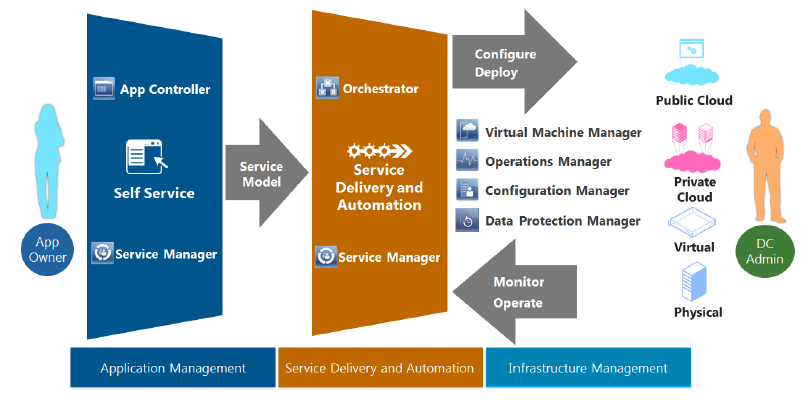
What if you want to know in more detail what the Cloud OS is all about? Well, then you have to understand System Center, which is not something that can be explained in a few words. I did have a go at this, in a feature called Inside Microsoft’s private cloud – a glossary of terms, for which the link is currently giving a PHP error, but maybe it will work for you.

image

It will all soon be a little out of date, since System Center 2012 SP1 has significant new features. If you want a summary of what is actually new, I recommend this post by Mike Schutz on System Center 2012 SP1; and this post also by Schutz on Windows Intune and System Center Configuration Manager SP1.

My even shorter summary:

  • All System Center products now updated to run on, and manage, Server 2012
  • Upgraded Virtual Machine Manager supports up to 8000 VMs on clusters of up to 64 hosts
  • Management support for Hyper-V features introduced in Server 2012 including the virtual network switch
  • App Controller integrates with VMs offered by hosting service providers as well as those on Azure and in your own datacenter
  • App Controller can migrate VMs to Windows Azure (and maybe back); a nice feature
  • New Azure service called Global Service Monitor for monitoring web applications
  • Back up servers to Azure with Data Protection Manager

and on the device and client management side, new Intune and Configuration Manager features. It is confusing; Intune is a kind-of cloud based Configuration Manager but has features that are not included in the on-premise Configuration Manager and vice versa. So:

  • Intune can now manage devices running Windows RT, Windows Phone 8, Android and iOS
  • Intune has a self-service portal for installing business apps
  • Configuration Manager integrates with Intune to get supposedly seamless support for additional devices
  • Configuration Manager adds support for Windows 8 and Server 2012
  • PowerShell control of Configuration Manager
  • Ability to manage Mac OS X, Linux and Unix servers in Configuration Manager

What do I think of System Center? On the plus side, all the pieces are in place to manage not only Microsoft servers but a diverse range of servers and a similarly diverse range of clients and devices, presuming the features work as advertised. That is a considerable achievement.

On the negative side, my impression is that Microsoft still has work to do. What would help would be more consistency between the Azure public cloud and the System Center private cloud; a reduction of the number of products in the System Center suite; a consistent user interface across the entire suite; and simplification along the lines of what has been done in the new Azure portal so that these products are easier and more enjoyable to use.

I would add that any business deploying System Center should be thinking carefully about what they still feel they need to manage on-premise, and what can be handed over to public cloud infrastructure, whether Azure or elsewhere. The ability to migrate VMs to Azure could be a key enabler in that respect.

Microsoft updates .NET Framework 4.5 for Windows 8, Server 2012 to fix performance, bugs

Microsoft has released an update for .NET Framework 4.5 which you may have noticed flying past if you keep an eye on Windows Update in Windows 8. The update is described here, and it is a big one. For example, in the Network Class Library:

Assume that you run a .NET Framework 4.5-based application that uses asynchronous APIs to read chunked responses. In this situation, the chunked responses may be read synchronously.

The HttpWebRequest class lets callers read an HTTP response either synchronously or asynchronously. However, if the response is a chunked HTTP response, then parts of the response are read by using synchronous I/O (Winsock calls) even when the caller uses the asynchronous code path. In this situation, the calling thread is blocked until data is received on the network.

Given this and other issues, the update is highly recommended. Maybe we will see fewer pauses in Windows App Store apps, some of which have not delivered on the “fast and fluid” promise.

Hacking Windows RT and Surface RT to run desktop apps

A developer on the XDA Developers forum, known as clrokr, has figured out how to run unsigned applications on Windows RT (Windows on ARM), including Microsoft’s own-brand Surface RT device.

The technique is described here and involves patching the Windows kernel. Currently it is not possible to jailbreak Windows RT completely, because Secure Boot prevents tampering with the system files, but it can be done after booting by using the remote debugger:

The minimum signing level determines how good an executable’s signature is on a scale like this: Unsigned(0), Authenticode(4), Microsoft(8), Windows(12). The default value on x86 machines is of course 0 because you can run anything you like on your computer. On ARM machines, it defaults to 8.
That means that even if you sign your apps using your Authenticode certificate, the Surface or any other Windows RT device (at this moment) will not run them. This is not a user setting, but a hardcoded global value in the kernel itself. It cannot be changed permanently on devices with UEFI’s Secure Boot enabled. It can, however, be changed in memory.

There is further discussion on the forum here. The technique is not practical for most users yet.

According to clrokr:

The decision to ban traditional desktop applications was not a technical one, but a bad marketing decision. Windows RT needs the Win32 ecosystem to strengthen its position as a productivity tool. There are enough “consumption” tablets already.

Personally I have mixed feelings about this. If I understand the concept correctly, Windows RT is meant to have iPad-like ease of use as well as excellent security. Configuring the operating system so that only code signed by Microsoft or Windows Store apps will run is a key part of the implementation. Surface RT is not as good as it should be, in part because there is too much old-style Windows, not too little.

On the other hand, the usefulness of Windows RT is limited by the absence of key apps. There are certain things missing, like the ability to play FLAC files, and until recently, an SSH terminal client (there is one now). Looking at the thread on XDA Developers, note that among the first things users are keen to port are putty (open source SSH client) and VLC (open source multimedia player).

image

That said, personally I would rather see suitable apps come to the Windows Store, rather than introduce all the problems and complexities of desktop Windows to Windows RT.

Google the new Microsoft, goes to war on Windows Phone users (updated)

Google has fired a one – two – three salvo at Microsoft and Windows Phone users. Consider the following.

First, we learn that Google, under the guise of Winter cleaning, is removing Google Sync from its Mail, Calendar and Contacts online products, for consumers only. This is the Exchange ActiveSync protocol used by Windows Phone and other mobile devices:

Starting January 30, 2013, consumers won’t be able to set up new devices using Google Sync; however, existing Google Sync connections will continue to function

Next, Microsoft reveals that Google is blocking the creation of a YouTube app for Windows Phone:

Microsoft is ready to release a high quality YouTube app for Windows Phone. We just need permission to access YouTube in the way that other phones already do, permission Google has refused to provide.

Now Google is blocking Windows Phone users from accessing Google Maps in the mobile browser. Google says:

The mobile web version of Google Maps is optimized for WebKit browsers such as Chrome and Safari. However, since Internet Explorer is not a WebKit browser, Windows Phone devices are not able to access Google Maps for the mobile web.

but Microsoft observes that Google Maps works fine in IE on Windows and:

Internet Explorer in Windows Phone 8 and Windows 8 use the same rendering engine.

This last is of most concern. It is one thing to “optimize” for WebKit, another specifically to block non-WebKit browsers. If WebKit is in Google’s eyes the de facto standard for mobile devices – which are more significant than desktop browsers – then what is the function of the W3C, and what is to prevent a repetition of the IE6 effect where one company (Microsoft) in controlled what was implemented for most users?

We can conclude that Google has decided its interests are better served by inconveniencing Windows Phone users in the hope of stifling the platform, rather than trying to persuade Windows Phone users to use its services as it does on Apple’s iOS platform (with considerable success).

Sympathy for Microsoft will be limited because of its history. The company has never been a friend of cross-platform support, preferring to keep its customers on Windows. That said, it is difficult to find exact analogies for what is happening now. Nor is it clear what is and is not reasonable. Google Mail, YouTube and Maps are all Google properties. Is it reasonable to expect Google to make the extra effort required to support additional platforms? It is a matter for debate with no easy and clear cut answer.

This does not mean you have to like it. If it is Windows Phone today, what platform might it be tomorrow? Google’s willingness to lock out users of other platforms is a warning, and one that should give pause for thought to any individual, business or government entity who depends or is considering depending on the Google platform. If history tells us anything, it is that monopoly and lock-in always works out badly for users. Check the price of inkjet cartridges for a simple example, or the price of Microsoft Office for business users for another.

What will be the effect on Windows Phone of Google’s campaign? That again is hard to judge. Microsoft is better off than RIM, for example, because it does have something like a complete stack of what it takes to be a mobile platform, especially in conjunction with Nokia: search, maps, email, web-based documents, cloud storage, music streaming and so on. That said, “doesn’t work properly with YouTube, Gmail, Google Maps” is hardly a selling point.

Update: Google now says:

We periodically test Google Maps compatibility with mobile browsers to make sure we deliver the best experience for those users.

In our last test, IE mobile still did not offer a good maps experience with no ability to pan or zoom and perform basic map functionality. As a result, we chose to continue to redirect IE mobile users to Google.com where they could at least make local searches. The Firefox mobile browser did offer a somewhat better user experience and that’s why there is no redirect for those users.

Recent improvements to IE mobile and Google Maps now deliver a better experience and we are currently working to remove the redirect. We will continue to test Google Maps compatibility with other mobile browsers to ensure the best possible experience for users.

Is Google being straight with us? Why has the statement changed overnight?

One user discovered that certain URLs work for Google maps on Windows Phone and posted a video to prove it.

The video shows Google Maps working on a Lumia 800 (not the latest version of Windows Phone). I tried this URL:

ms-gl=au&ie=UTF8&t=m&source=embed&oe=UTF8&msa=0&msid=202255975001106586432.0004bb17c01b36a71a644

on my own Lumia 800 and it does indeed work. You can search for places, they show up on the map, and you can zoom with the + and – controls. However, it is not perfect. The search box is slightly corrupted and I am unable to pinch to zoom or swipe to pan. Better than nothing? Certainly.

Still, the experience is sufficiently degraded to lend some credence to Google’s statements; and there is undoubtedly extra work in supporting additional browsers as any web developer will confirm. 

Is Google at war with Windows Phone, or just not going out of its way to support a rival platform? Watch this space.

Android up, Apple down, Microsoft so near, so far: 2012 in review

What happened in 2012?

Windows 8

Whether you regard it as the beginning of the end for Windows, or a moment of rebirth, for me it was the year of Windows 8. Microsoft’s new Windows is fascinating on several levels: as a bold strategic move to make a desktop operating system into a tablet operating system, or as an experiment in how much change you can make in an established product without alienating too many of your customers, or as the first mainstream attempt to create an “immersive” user interface where users engage solely with the content and have to make an effort to summon menus and tools.

The context is also gripping. Microsoft’s desktop monopoly is under attack from all sides. Apple iPad and Google Android tablets, cloud apps that make the desktop operating system irrelevant, Mac OSX computers and laptops that have captured the hearts of designers and power users. Windows still dominates in business computing, but the signs of encroachment are there as well, with reports of iPad deployments and a shift in focus away from desktop apps.

Windows 8 is intended as the fix, making Windows into a first-class tablet operating system and establishing a new app ecosystem based on the Windows Runtime and the Windows Store.

How is it going so far? Not too well. App developers have not flocked to the platform. Users who were happy with Windows 7 have been bewildered. Most seriously, the Windows ecosystem of OEM vendors and general retailers has failed to adjust to the concept of Windows as a tablet operating system, treating it more as a somewhat awkward upgrade to Windows 7.

The work of Windows President Steven Sinofksy in overseeing the engineering and design of Windows 8 and delivering it on schedule has been amazing. He kept his team focused and shipped a release of Windows that is faster and with nice improvements on the desktop side, as well as offering a tablet personality designed for touch-first, in which apps are securely sandboxed and easily installed from an online store.

At the same time, it is easy to see ways in which Microsoft bungled Windows 8.

  • Why was Microsoft so unrelenting with its “immersive” UI that it would not tolerate an option to show things like time and battery status on screen all the time, or three dots for “more” so that users will more easily discover the app bar, as suggested by Paul Thurrott?
  • Why did Microsoft spend mind-stretching amounts on advertising for Windows 8 and for Surface RT tablets, but not allocate enough budget to create a decent Windows 8 Mail app, for example? The current effort is a constant annoyance, especially on the Surface where there is no alternative.
  • Why did Microsoft expend so much effort pumping up the number of apps in its Store, but so little effort nurturing quality? Very few outstanding apps were available at launch, and even now they are hard to find.

I say this as as someone who likes Windows 8 overall. The strategy makes sense to me, but the execution in some critical areas has been disappointing. So near but so far.


image

The sudden departure of Sinofsky immediately after the Windows 8 launch was unfortunate; a significant loss of a person with both vision and the ability to implement it.

That said, despite all the difficulties Microsoft has now launched this radically different version of Windows; it is over the first hump and provided that the company keeps its nerve, it can focus on refining the platform and creating compelling new apps that will persuade users to explore it. Further, users who have the patience to learn a few new ways to navigate Windows will discover that it is a decent upgrade, with strong features like Hyper-V, improved file operations, Windows to Go and more.

It is tablets that matter though. Tablet usage will continue to grow, and if Microsoft cannot establish Windows as a tablet platform, its further decline is inevitable.

Does CEO Steve Ballmer have a grip on this huge, dysfunctional, brilliant, frustrating company? Maybe 2013 will answer that question definitively.

image 

Surface RT

2012 also saw the launch of Microsoft’s first own-brand tablet. It is high quality, exceptionally strong, with long battery life thanks to its ARM processor and supported by keyboard covers that let you flip it between touch and keyboard/trackpad without making the device too bulky or complex.

image

Three things, no make that four things, have prevented Surface RT from taking off as Microsoft hoped:

1. Performance is barely adequate. It is usable, but Office is sluggish with large documents and apps are noticeably less responsive than on x86 Windows 8. That said, the NVIDIA Tegra 3 chipset is capable of fast graphics, and some games run surprisingly well, so it is not all bad.

2. The lack of strong apps affects Windows RT devices like Surface more than x86 Windows 8, since you cannot install desktop apps. Yes, it is a new platform, but Microsoft could have done better.

3. There is too much desktop in Windows RT and therefore in Surface RT, making the device more complex than it should be.

4. Microsoft has not yet established Windows 8 as a tablet platform in public perception, nor yet provided the apps that make it work fully as a tablet platform. One consequence is that when someone goes out to buy a tablet, they do not think of Surface RT as a candidate; it is iPad or Android. Another consequence is that reviewers tend to evaluate Surface RT as Windows rather than as a tablet. Considered as Windows, it is weak compared to x86 builds.

Despite all the above, I often slip Surface RT into my bag when travelling. The combination of small size, keyboard cover, long battery life, and Word and Excel is a winner for me. Surface RT 2, with faster performance and a more mature app platform could be great, if the product makes it to a second edition.

Apple: a bad year

2012 was a bad year for Apple. On one level everything is fine, with iPads and iPhones selling like fury, and the successful launch of iPad Mini. What changed though is that the concern of the late Steve Jobs, that Android is close enough to iOS to capture a lot of its market, became a reality. Android is the bestselling smartphone platform and Android tablets, led by Google Nexus and Samsung Galaxy, will likely overtake iPad for the same reasons: better value, more vendors, faster innovation. There was plenty of litigation in 2012 as Apple sought to protect its inventions, but despite some legal successes, Android has continued to grow and it looks unlikely that court action will do much to impede it. Another problem for Apple is that price pressure makes it difficult to sustain the high hardware margins which have made the company so profitable.

The other Microsoft

The Windows 8 drama caught our attention, but Microsoft has been busy elsewhere, generally with better success. The most significant development was the transformation of the cloud platform, Windows Azure from an also-ran to a compelling contender (though still small relative to Amazon), thanks to the addition of IaaS (infrastructure as a service), or plain old Windows VMs, along with a new management portal that makes the service easier to use.

Microsoft also released Server 2012, a substantial upgrade to Windows Server particularly in Hyper-V, but also in storage, remote access, server management, and general modularisation.

Windows Phone had a mixed year, with a sage in sales when Microsoft announced that Windows Phone 7 devices will not be upgradeable to Windows Phone 8, but ending more positively with relatively strong (in the context of a market dominated by iOS and Android) sales for new Windows Phone 8 devices.

image

It was a good year for Office 365, on-demand Exchange and SharePoint, which is now an obvious choice for small businesses migrating from Small Business Server and a plausible choice for medium and larger businesses too.

2012 also saw the launch of Office 2013. I am not so sure about this one. It is meant to be the version of Office that is touch-friendly and cloud-centric. It is not too bad, but with its washed-out appearance and various annoyances it hardly seems a compelling upgrade. Office needs a “Windows 7” release, one where Microsoft focuses on what Office users find slow and/or irritating and sets out to fix the issues.

Adobe’s cloud and HTML transformation

Microsoft took too much of my attention in 2012, something I hope will change in 2013, but one company which caught my attention was Adobe. Without great fanfare, it has successfully switched the business model for the Creative Suite (PhotoShop, Premiere, Dreamweaver and so on) which forms the largest part of its business to a subscription-based model with cloud delivery and additional cloud services. It has also moved its technical platform away from Flash and towards HTML with less pain that I had expected, and is coming up with interesting new tools in its Edge range. Most impressive.

RIM and Blackberry: all to prove in 2013

2012 was painful for RIM, which saw interest in its Blackberry platform decline to the point where many now consider it of little relevance in mobile, but mitigated by intense effort to engage its developer community in preparation for the launch of Blackberry 10 devices at the end of January 2013. It may be too late; but the new OS does have attractions, especially in business where there is innovation in the way it separates business and personal use of a single device. Is Windows Phone or Blackberry 10 the third mobile platform after iOS and Android, or will these two stragglers simply weaken each other while Apple and Google dominate?

Amazon web services: fast pace of innovation

Amazon dominates the IaaS market and with good reason: relatively low prices, high quality of service, and fast pace of innovation. It was this last that most impressed me when I attended an update last November. Amazon prefers to talk to developers and businesses rather than the press, and its services are perhaps under-reported relative to its competitors. An impressive operation, with an inspiring CEO.

Google the winner in 2012

It may not have vanquished Facebook, but of all the tech giants Google has had the best year, with sustained success in search and advertising, huge Android sales and the establishment of the operating system on tablets as well as smartphones, thanks to Samsung and Google’s own efforts with the Nexus range. Google also won some kudos versus Apple following the iOS 5 maps debacle, with Apple’s own mapping efforts found wanting.

Not everything has worked for Google, yet. The web-centric Chromebooks are out there, but whether there is much appetite for netbooks that run everything in the browser is an open question; there are security advantages to this computing model, but users would rather have Android with its rich app ecosystem and greater freedom.

How will Google monetize Android, in the face of further fragmentation and a competitor like Amazon helping itself to what is free but building its own commercial platform on top? Another open question, though my guess is that Google will find a way.

Google rationalised its services in 2012 and pushed hard on its social platform, Google+, but failed to make much dent on Facebook’s popularity.

At the end of 2012 we were reminded of the downside of reliance on cloud providers when Google pulled Exchange ActiveSync support from its free email service. Existing users are not affected, but new users will find it harder to set up Gmail accounts on devices such as Windows Phones. Free users can hardly complain, but if they have become reliant on a gmail address there is an element of lock-in which Google is now using to discourage users from using a competitor’s mobile device.

2013?

A few predictions. More Microsoft fireworks as the PC and laptop market continues to decline; Apple vs Android wars; a strong play from Google for the Office/Exchange/SharePoint market. What else? If the past is anything to go by, expect some surprises.

Fresh Paint Windows Store app: in equal parts great and frustrating

Now that the initial shock of “where is the Start menu” is wearing off, some of the real issues and points of interest in Windows 8 are coming to the surface (ha!), one of which is what a good Windows Store (also known as Metro) app is meant to look like. Microsoft has not been helped by the fact that most apps in the Store are either simplistic, or poor quality, or both.

In this respect Fresh Paint is worth a look, since it comes from Microsoft and is the outcome of considerable work and research. There is a post about the history of the app on Steve Clayton’s blog which is good reading.

The title cleverly combines the sense of a new approach to Paint, the Windows app from way back, with the fact that this is a simulation of paint (the liquid stuff). I have not found much in the way of documentation, though there is a FAQ here, but even a few moments playing shows that this is a sophisticated painting tool, especially on a tablet where you can paint with a finger or stylus. It works on both x86 and ARM devices such as Surface RT though performance is laggy compared to that on a modern x86 PC, and the pencil and pastel tools are missing.

This is an example of immersive UI. While painting, few tools are visible. As a concession, there are five faint tools at the bottom of the screen for undo, redo, show template, centre artwork, and dry. Right-click or swipe in, and you get tools for selecting the painting tool (pencil, brush or pastel), a colour palette that really is like a palette, with the ability to mix your own colours, an eraser, a dropper tool which I have not fully figured out, and a dry paint tool that picks up wet paint from the canvas.

image

Click or tap surface and you can select the canvas type and background colour. The camera button lets you use an image as the background.

image

Paintings are saved automatically every five minutes or when you return to the home page. You can also export paintings as .PNG files.

You can zoom in and out using the mouse wheel or pinch gestures.

The app is free, but Microsoft offers paid-for add-in packs which provide templates. You can paint over the template, then use the template tool mentioned above to remove it from the canvas. There is a free Fun Pack to get you started.

image

This is not a replacement for the desktop Windows Paint. Features missing in Fresh Paint include selection, fill, cropping, resizing, rotation, clipboard support and printing, to name a few.

Concerning Fresh Paint, three things are obvious.

One is that this is innovative, bold, and excellent in the way it lets you paint in a manner that is much closer to the real thing than most computer graphics software.

Second, users are having real difficulty figuring it out. Some users have not worked out how to get the menus and tools showing at all, hence this is explained in the FAQ mentioned above. Others are like Terry Odell who says:

The problem I have is there’s no "help" or "right click to figure out what things do" in the app. It’s total trial and error, and perhaps if I were 5 like my grandson, I’d be able to figure it out. There are choices on the top of the screen, and more choices/icons on the bottom. The camera on the bottom opens up the ‘real’ camera on my computer, but there’s no ‘click here to take a picture’ (not to mention I have no idea what to do with one.  I’d rather see a tutorial of some sort than have to keep wading through forums to get a question answered. As for ‘dropdown’ I have no idea where that is? The top menu? The bottom menu. Windows 8 is hardly intuitive, and the apps, while great in theory, don’t have enough information provided for how to use them.

It is as if not having documentation is a point of pride, because the app should be so easy to use that documentation is not needed, and if the user does not get it, it is the user’s fault. It puzzles me, since it in a few hours the team could provide some simple documentation that would help users get the best from this app.

Third, it is not stable. I got several crashes in the course of playing around briefly to write this post.

image

Why is it crashing? There are hints that it may be to do with graphics drivers. I have the latest NVIDIA drivers and other apps and games are solid. It would be interesting to know the reason why it falls over so much, and whether this is caused by buggy app code or problems in the Windows Runtime itself. It is not just my system; take a look at the reviews in the Windows Store for more reports.

I do not mean to be snarky; in many ways this is a brilliant app both for children and for anyone with some artistic talent. It just needs a little more work, and seems to say a lot about the state of Windows 8 apps right now.