Category Archives: professional

As Microsoft releases new tools for Windows Phone, developers ask: how is it selling?

Microsoft has released Visual Basic for Windows Phone Developer Tools – not a lot to report, I guess, except that what you could already do in C# you can now also do in Visual Basic.

Still, when someone at Microsoft asked me what I thought of the Windows Phone 7 developer platform I replied that the tools look good for the most part – though I would like to see a native code option and it seems unfortunate that mobile operators can install native code apps but the rest of us officially cannot – but the bigger question is around the size of the market.

We all know that a strong and large community of developers is critical to the success of a platform – but as I’ve argued before, developers will go where their customers are, rather than selecting a platform based on the available tools and libraries. It is a bit of both of course: the platform has to be capable of running the application, and ease of development is also a factor, but in the end nothing attracts developers more than a healthy market.

Therefore the critical question for developers is how well Windows Phone 7 is selling.

Nobody quite knows, though Tom Warren makes the case for not much more than 126,000, that being the number of users of the Windows Phone Facebook application.

I’m not quite convinced when Warren says:

It’s likely that most users will connect their Facebook account so the statistics could indicate nearly accurate sales figures.

Not everyone loves Facebook; and when I was trying out Windows Phone 7 I found myself reluctant to have it permanently logged in. Even so, I’d agree that well over 50% of users will enable Facebook integration so it is a useful statistic.

Although that suggests a relatively small number in the context of overall Smartphone sales, my perception is that lack of availability is part of the reason, so it is too early to judge the platform’s success. I do not see many Windows Phone 7 in the mobile phone shops that I pass in the UK; in fact it is unusual to see it at all. I am not sure if this is mainly because of supply shortages, or because Microsoft and its partners found it difficult to build expectations in the trade that this would be a sought-after device, or both.

Some bits of anecdotal evidence are encouraging for Microsoft. Early adopters seem to like it well enough. Nevertheless, it is a minority player at the moment and that will not change soon.

Developers are therefore faced with a small niche market. Microsoft has done a fair job with the tools; now it needs to get more devices out there, to convince developers that once they have built their applications, there are enough customers to make it worth while.

HTML 5 Canvas: the only plugin you need?

The answer is no, of course. And Canvas is not a plugin. That said, here is an interesting proof of concept blog and video from Alexander Larsson: a GTK3 application running in Firefox without any plugin.

image

GTK is an open source cross-platform GUI framework written in C but with bindings to other languages including Python and C#.

So how does C native code run the browser without a plugin? The answer is that the HTML 5 Canvas element, already widely implemented and coming to Internet Explorer in version 9, has a rich drawing API that goes right down to pixel manipulation if you need it. In Larsson’s example, the native code is actually running on a remote server. His code receives the latest image of the application from the server and transmits mouse and keyboard operations back, creating the illusion that the application is running in the browser. The client only needs to know what is different in the image as it changes, so although sending screen images sounds heavyweight, it is amenable to optimisation and compression.

It is the same concept as Windows remote desktop and terminal services, or remote access using vnc, but translated to a browser application that requires no additional client or setup.

There are downsides to this approach. First, it puts a heavy burden on the server, which is executing the application code as well as supplying the images, especially when there are many simultaneous users. Second, there are tricky issues when the user expects the application to interact with the local machine, such as playing sounds, copying to the clipboard or printing. Everything is an image, and not character-by-character text, for example. Third, it is not well suited to graphics that change rapidly, as in a game with fast-paced action.

On the other hand, it solves an immense problem: getting your application running on platforms which do not support the runtime you are using. Native applications, Flash and Silverlight on Apple’s iPad and iPhone, for example. I recall seeing a proof of concept for Flash at an Adobe MAX conference (not the most recent one) as part of the company’s research on how to break into Apple’s walled garden.

It is not as good as a true local application in most cases, but it is better than nothing.

Now, if Microsoft were to do something like this for Silverlight, enabling users to run Silverlight apps on their Apple and Linux devices, I suspect attitudes to the viability of Silverlight in the browser would change considerably.

The Microsoft Azure VM role and why you might not want to use it

I’ve spent the morning talking to Microsoft’s Steve Plank – whose blog you should follow if you have an interest in Azure – about Azure roles and virtual machines, among other things.

Windows Azure applications are deployed to one of three roles, where each role is in fact a Windows Server virtual machine instance. The three roles are the web role for IIS (Internet Information Server) applications, the worker role for general applications, and newly announced at the recent PDC, the VM role, which you can configure any way you like. The normal route to deploying a VM role is to build a VM on your local system and upload it, though in future you will be able to configure and deploy a VM role entirely online.

It’s obvious that the VM role is the most flexible. You will even be able to use 64-bit Windows Server 2003 if necessary. However, there is a critical distinction between the VM role and the other two. With the web and worker roles, Microsoft will patch and update the operating system for you, but with the VM role it is up to you.

That does not sound too bad, but it gets worse. To understand why, you need to think in terms of a golden image for each role, that is stored somewhere safe in Azure and gets deployed to your instance as required.

In the case of the web and worker roles, that golden image is constantly updated as the system gets patched. In addition, Microsoft takes responsibility for backing up the system state of your instance and restoring it if necessary.

In the case of the VM role, the golden image is formed by your upload and only changes if you update it.

The reason this is important is that Azure might at any time replace your running VM (whichever role it is running) with the golden image. For example, if the VM crashes, or the machine hosting it suffers a power failure, then it will be restarted from the golden image.

Now imagine that Windows server needs an emergency patch because of a newly-discovered security issue. If you use the web or worker role, Microsoft takes responsibility for applying it. If you use the VM role, you have to make sure it is applied not only to the running VM, but also to the golden image. Otherwise, you might apply the patch, and then Azure might replace the VM with the unpatched golden image.

Therefore, to maintain a VM role properly you need to keep a local copy patched and refresh the uploaded golden image with your local copy, as well as updating the running instance. Apparently there is a differential upload, to reduce the upload time.

The same logic applies to any other changes you make to the VM. It is actually more complex than managing VMs in other scenarios, such as the Linux VM on which this blog is hosted.

Another feature which all Azure developers must understand is that you cannot safely store data on your Azure instance, whichever role it is running. Microsoft does not guarantee the safety of this data, and it might get zapped if, for example, the VM crashes and gets reverted to the golden image. You must store data in Azure database or blob storage instead.

This also impacts the extent to which you can customize the web and worker VMs. Microsoft will be allowing full administrative access to the VMs if you require it, but it is no good making extensive changes to an individual instance since they could get reverted back to the golden image. The guidance is that if manual changes take more than 5 minutes to do, you are better off using the VM role.

A further implication is that you cannot realistically use an Azure VM role to run Active Directory, since Active Directory does not take kindly to be being reverted to an earlier state. Plank says that third-parties may come up with solutions that involve persisting Active Directory data to Azure storage.

Although I’ve talked about golden images above, I’m not sure exactly how Azure implements them. However, if I have understood Plank correctly, it is conceptually accurate.

The bottom line is that the best scenario is to live with a standard Azure web or worker role, as configured by you and by Azure when you created it. The VM role is a compromise that carries a significant additional administrative burden.

What you are saying about the Java crisis

A week or so ago I posted about the Java crisis and what it means for developers. The post attracted attention both here and later on The Guardian web site where it appeared as a technology blog. It was also picked up by Reddit prompting a discussion with over 500 posts.

So what are you saying? User LepoldVonRanke takes a pragmatic view:

I’d much rather have Java given a purpose and streamlined from a central authoritative body with a vision, than a community-run egg-laying, wool-growing, milk-giving super cow pig-sheep, that runs into ten directions at the same time, and therefore does not go anywhere. The Java ship needs a captain. Sun never got a good shot at it. There was always someone trying to wrestle control over Java away. With the Oracle bully as Uberfather, maybe Java has a place to go.

which echoes my suggestion that Java might technically be better of under more dictatorial control, unpalatable though that may be. User 9ren is sceptical:

Theoretically, the article is quite right that Java could advance faster under Oracle. It would be more proprietary, and of course more focussed on the kinds of business applications that bring in revenue for Oracle. It would be in Oracle’s interest; and the profit motive might even be a better spur than Sun had.

But – in practice – can they actual execute the engineering challenges?

Although Oracle has acquired many great software engineers (eg. from Sun, BEA Systems, many others), do they retain them? Does their organizational structure support them? And is Oracle known for attracting top engineering talent in general?

In its formation, Oracle had great software engineers (theirs was the very first commercial relational database, a feat many thought impossible). But that was 40 years ago, and now it’s a (very successful) sales-driven company.

There’s an important point from djhworld:

Java is hugely popular in the enterprise world, companies have invested millions and millions of pounds in the Java ecosystem and I don’t see that changing. Many companies still run Java 1.4.2 as their platform because it’s stable enough for them and would cost too much to upgrade.

The real business world goes at its own pace, whereas tech commentators tend to focus on the latest news and try to guess the future. It is a dangerous disconnect. Take no notice of us. Carry on coding.

On Reddit, some users focused on my assertion that the C# language was more advanced than Java. Is it? jeffcox111 comments:

I write in C# and Java professionally and I have to say I prefer C# hands down. Generics are very old news now in .Net. Take a look at type inference, lambdas, anonymous types, and most of all take a look at LINQ. These are all concepts that have been around for 3 years now in .Net and I hate living without them in Java. With .Net 5 on the horizon we are looking forward to better asynchronous calling/waiting and a bunch of other coolness. Java was good, but .Net is better these days.

and I liked this remark on LINQ:

I remember my first experience with LINQ after using C# for my final-year project (a visual web search engine). I asked a C# developer for some help on building a certain data structure and the guy sent me a pseudocode-looking stuff. I thanked him for the help and said that I’d look to find a way to code it and he said "WTF, I just gave you the code".

From there on I’ve never looked back.

Another discussion point is write once – run anywhere. Has it ever been real? Does it matter?

The company I work for has a large Java "shrinkwrap" app. It runs ok on Windows. It runs like shit on Mac, and it doesn’t run at all on Linux.

write once, run anywhere has always been a utopian pipe dream. And the consequence of this is that we now have yet another layer of crap that separates applications from the hardware.

says tonymt, though annannsi counters:

I’ve worked on a bunch of Java projects running on multiple unix based systems, windows and mac. GUI issues can be a pain to get correct, but its been fine in general. Non-GUI apps are basically there (its rare but I’ve hit bugs in the JVM specific to a particular platform)

Follow the links if you fancy more – I’ll leave the last word to A_Monkey:

I have a Java crisis every time I open eclipse.

WS-I closes its doors–the end of WS-* web services?

The Web Services Interoperability Organization has announced [pdf] the “completion” of its work:

After nearly a decade of work and industry cooperation, the Web Services Interoperability Organization (WS-I; http://www.ws-i.org) has successfully concluded its charter to document best practices for Web services interoperability across multiple platforms, operating systems and programming languages.

In the whacky world of software though, completion is not a good thing when it means, as it seems to here, an end to active development. The WS-I is closing its doors and handing maintenance of the WS interoperability profiles to OASIS:

Stewardship over WS-I’s assets, operations and mission will transition to OASIS (Organization for the Advancement of Structured Information Standards), a group of technology vendors and customers that drive development and adoption of open standards.

Simon Phipps blogs about the passing of WS-I and concludes:

Fine work, and many lessons learned, but sadly irrelevant to most of us. Goodbye, WS-I. I know and respect many of your participants, but I won’t mourn your passing.

Phipps worked for Sun when the WS-* activity was at its height and WS-I was set up, and describes its formation thus:

Formed in the name of "preventing lock-in" mainly as a competitive action by IBM and Microsoft in the midst of unseemly political knife-play with Sun, they went on to create massively complex layered specifications for conducting transactions across the Internet. Sadly, that was the last thing the Internet really needed.

However, Phipps links to this post by Mike Champion at Microsoft which represents a more nuanced view:

It might be tempting to believe that the lessons of the WS-I experience apply only to the Web Services standards stack, and not the REST and Cloud technologies that have gained so much mindshare in the last few years. Please think again: First, the WS-* standards have not in any sense gone away, they’ve been built deep into the infrastructure of many enterprise middleware products from both commercial vendors and open source projects. Likewise, the challenges of WS-I had much more to do with the intrinsic complexity of the problems it addressed than with the WS-* technologies that addressed them. William Vambenepe made this point succinctly in his blog recently.

It is also important to distinguish between the work of the WS-I, which was about creating profiles and testing tools for web service standards, and the work of other groups such as the W3C and OASIS which specify the standards themselves. While work on the WS-* specifications seems much reduced, there is still work going on. See for example the W3C’s Web Services Resource Access Working Group.

I partly disagree with Phipps about the work of the WS-I being “sadly irrelevant to most of us”. It depends who he means by “most of us”. Granted, all this stuff is meaningless to the world at large; but there are a significant number of developers who use SOAP and WS-* at least to some extent, and interoperability is key to the usefulness of those standards.

The Salesforce.com API is mainly SOAP based, for example, and although there is a REST API in preview it is not yet supported for production use. I have been told that a large proportion of the transactions on Salesforce.com are made programmatically through the API, so here is one place at least where SOAP is heavily used.

WS-* web services are also built into Microsoft’s Visual Studio and .NET Framework, and are widely used in my experience. Visual Studio does a good job of wrapping them so that developers do not have to edit WSDL or SOAP requests and responses by hand. I’d also suggest that web services in .NET are more robust than DCOM (Distributed COM) ever was, and work successfully over the internet as well as on a local network, so the technology is not a failure.

That said, I am sure it is true that only a small subset of the WS-* specifications are widely used, which implies a large amount of wasted effort.

Is SOAP and WS-* dying, and REST the future? The evidence points that way to me, but I would be interested in other opinions.

The Java crisis and what it means for developers

What is happening with the Java language and runtime? Since Java passed into the hands of Oracle, following its acquisition of Sun, there has been a succession of bad news. To recap:

  • The JavaOne conference in September 2010 was held in the shadow of Oracle OpenWorld making it a less significant event than in previous years.
  • Oracle is suing Google, claiming that Java as used in the Android SDK breaches its copyright.
  • IBM has abandoned the Apache open source Harmony project and is committing to the Oracle-supported Open JDK. Although IBM’s Sutor claims that this move will “help unify open source Java efforts”, it seems to have been done without consultation with Apache and is as much divisive as unifying.
  • Apple is deprecating Java and ceasing to develop a Mac-specific JVM. This should be seen in context. Apple is averse to runtimes of any kind – note its war against Adobe Flash – and seems to look forward to a day when all or most applications delivered to Apple devices come via the Apple-curated and taxed app store. In mitigation, Apple is cooperating with the OpenJDK and OpenJDK for Mac OS X has been announced.
  • Apache has written a strongly-worded blog post claiming that Oracle is “violating their contractual obligation as set forth under the rules of the JCP”, where JCP is the Java Community Process, a multi-vendor group responsible for the Java specification but in which Oracle/Sun has special powers of veto. Apache’s complaint is that Oracle stymies the progress of Harmony by refusing to supply the test kit for Java (TCK) under a free software license. Without the test kit, Harmony’s Java conformance cannot be officially verified.
  • The JCP has been unhappy with Oracle’s handling of Java for some time. Many members disagree with the Google litigation and feel that Oracle has not communicated well with the JCP. JCP member Doug Lea stood down, claiming that “the JCP is no longer a credible specification and standards body”. Another member, Stephen Colebourne, has a series of blog posts in which he discusses the great war of Java and what he calls the “unravelling of the JCP”, and recently  expressed his view that Oracle was trying to manipulate the recent JCP elections.

To set this bad news in context, Java was not really in a good way even before the acquisition. While Sun was more friendly towards open source and collaboration, the JCP has long been perceived as too slow to evolve Java, and unrepresentative of the wider Java community. Further, Java’s pre-eminence as a pervasive cross-platform runtime has been reduced. As a browser plug-in it has fallen behind Adobe Flash, the JavaFX initiative failed to win wide developer support, and on mobile it has also lost ground. Java’s advance as a language has been too slow to keep up with Microsoft’s C#.

There are a couple of ways to look at this.

One is to argue that bad news followed by more bad news means Java will become a kind of COBOL, widely used forever but not at the cutting edge of anything.

The other is to argue that since Java was already falling behind, radical change to the way it is managed may actually improve matters.

Mike Milinkovich at the Eclipse Foundation takes a pragmatic view in a recent post. He concedes that Oracle has no idea how to communicate with the Java community, and that the JCP is not vendor-neutral, but says that Java can nevertheless flourish:

I believe that many people are confusing the JCP’s vendor neutrality with its effectiveness as a specifications organization. The JCP has never and will never be a vendor-neutral organization (a la Apache and Eclipse), and anyone who thought it so was fooling themselves. But it has been effective, and I believe that it will be effective again.

It seems to me Java will be managed differently after it emerges from its crisis, and that on the scale between “open” and “proprietary” it will have moved towards proprietary but not in a way that destroys the basic Java proposition of a free development kit and runtime. It is also possible, even likely, that Java language and technology will advance more rapidly than before.

For developers wondering what will happen to Java at a technical level, the best guide currently is still the JDK Roadmap, published in September. Some of its key points:

  • The open source Open JDK is the basis for the Oracle JDK.
  • The Oracle JDK and Java Runtime Environment (JRE) will continue to be available as free downloads, with no changes to the existing licensing models.
  • New features proposed for JDK 7 include better support for dynamic languages and concurrent programming. JDK 8 will get Lambda expression.

While I cannot predict the outcome of Oracle vs Google or even Apache vs Oracle, my guess is that there will be a settlement and that Android’s momentum will not be disrupted.

That said, there is little evidence that Oracle has the vision that Sun once had, to make Java truly pervasive and a defence against lock-in to proprietary operating systems. Microsoft seems to have lost that vision for .NET and Silverlight as well – though the Mono folk have it. Adobe still has it for Flash, though like Oracle it seems if anything to be retreating from open source.

There is therefore some sense in which the problems facing Java (and Silverlight) are good for .NET, for Mono and for Adobe. Nevertheless, 2010 has been a bad year for write once – run anywhere.

Update: Oracle has posted a statement saying:

The recently released statement by the ASF Board with regard to their participation in the JCP calling for EC members to vote against SE7 is a call for continued delay and stagnation of the past several years. We would encourage Apache to reconsider their position and work together with Oracle and the community at large to collectively move Java forward.  Oracle provides TCK licenses under fair, reasonable, and non-discriminatory terms consistent with its obligations under the JSPA.   Oracle believes that with EC approval to initiate the SE7 and SE8 JSRs, the Java community can get on with the important work of driving forward Java SE and other standards in open, transparent, consensus-driven expert groups.   This is the priority.   Now is the time for positive action.  Now is the time to move Java forward.

to which Apache replies succinctly:

The ball is in your court. Honor the agreement.

Apple gives up on Xserve dedicated server hardware – looking towards the cloud?

Apple is scrapping is Xserve products, according to the latest information on its web site:

Xserve will no longer be available after January 31, but we’ll continue to fully support it. To learn more, view the PDF.

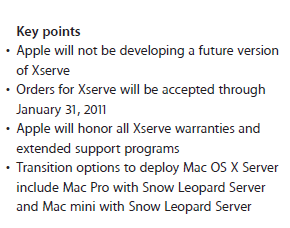
If you do indeed view the PDF, it confirms that:

Apple will not be developing a future version of Xserve

However, the Snow Leopard Server, a version of OS X tuned for server use, remains; and Apple suggests that you install it either on a Mac Pro or on a Mac Mini.

image

That’s all very well; but while a Mini might well make sense for a very small business, larger organisations will not be impressed by the lack of features like dual redundant power supplies, lights out management, and rack mounting, which the Xserve provides.

There are a couple of ways to look at this. One is that Apple is giving up on the server market. Largely true, I think; but my guess is that Apple realises that this type of on-premise server is under threat from the cloud. I do not see this as Apple giving up on corporate computing; that would be unexpected considering the gains it is making with Mac, iPhone and iPad. I do see this as a move towards a client and cloud, or device and cloud, strategy. In that context it is not so surprising.

That said, I imagine there are a few businesses out there focused on supplying Xserve-based systems who will be disappointed by the news. I’ve not used one myself; but from what I’ve heard it is rather good.

Adobe MAX 2010 – it’s all about the partners

Last week was all conferences – Adobe MAX 2010 followed by Microsoft PDC – which left me with plenty of input but too little time to write it up. It is not too late though; and one advantage of attending these two events back-to-back was to highlight the tale of two runtimes, Adobe Flash and Microsoft Silverlight. MAX was a good event for Flash, and PDC a bad one for Silverlight, though the tale has a long way yet to run.

The key difference at this point is not technical, but all about partners. At MAX we saw how the Flash runtime is integral to the Blackberry PlayBook, with RIM founder Mike Lazaridis coming on stage to tell us so. Flash is also built into Google TV, and Andres Ferrate and Daniels Lee from Google Developer Relations presented a session on creating web apps for the platform – worth watching as it brings out the difference between developing for a TV “lean back” environment and traditional mouse or touch user interfaces -  and we also heard from Samsung about its Flash-enabled TVs coming in 2011. In each case, it is not just Flash but AIR, for applications that run outside the browser, which is supported. Google TV runs Android; and AIR for Android in general drew attention at MAX, encouraged by free Motorola Droid 2 smartphones handed out to attendees.

If the task was to convince Flash developers – and those on the fence – that the platform has a future, MAX delivered in spades; and Adobe can only benefit from the uncertainty surrounding the most obvious runtime rivals to Flash, Java and Silverlight.

But what about that other platform, HTML? Well, Adobe made a bit of noise about projects like EDGE, which exports animations and transitions to SVG and JavaScript using an extended JQuery library, as well as showing a “sneak peek” of a tool to export a Flash animation (but not application) to  HTML. Outside the Adobe fan club there is still considerable aversion to Flash, stoked by Apple; in one of the sessions at MAX we were told that Steve Jobs’ open memo Thoughts on Flash has done real damage.

My impression though is that Adobe still has a Flash-first philosophy. The Solution Accelerators announced for LiveCycle 2.5, for example, all seem to be based on Flash clients, which could prove difficult if Apple’s iPad continues to take off in the enterprise. Adobe could do more to provide JavaScript libraries for LiveCycle clients, and tools for creating HTML applications. If you came to MAX looking for evidence that Adobe is moving towards web standard HTML clients, you would have been largely disappointed; though seeing JQuery guy John Resig in the day two keynote would give you some comfort.

Some other MAX highlights:

  • Round-tripping between Catalyst and Flash Builder at last. This makes Catalyst more useful, though I still find myself thinking that the Catalyst features could be rolled into one of the other products, either as a designer personality for Flash Builder, or maybe in Flash Professional. The former would be easier as both Catalyst and Flash Builder are built on Eclipse.
  • Enhancements in the Flash Player – I am writing a separate piece on this, but it is great to see the 3D extensions codenamed Molehill, which together with game controller support lay the foundations for Flash games that compete more closely with console games.
  • Analytics – Adobe’s acquisition of Omniture a year ago was a far-sighted move, and the company talked about analytics in the context of applications as well as web sites. Despite unsettling privacy implications, the ability for developers to drill down into exactly how an application is used, and which parts are hardly used, has great potential for improving usability.
  • Digital publishing – it was fascinating to hear from publisher Condé Nast about its plans for digital publishing, using Adobe’s Digital Publishing Suite to create files targeting Adobe’s content viewer on iOS and eventually AIR. As a web enthusiast I have mixed feelings, and there was some foot-shuffling when I asked about SEO (Search Engine Optimisation); but as someone with a professional interest in a flourishing media industry I also hope this becomes a solid and profitable platform.

Disappointments? I was sorry to hear that Adobe is closing down contributions and reducing transparency in the open source Flex SDK, though it is said to be temporary. It also seems that plans to enhance ActionScript are not well advanced; Silverlight remains well ahead in this respect with its C# and .NET support.

What about Adobe’s enterprise ambitions? Klint Finley’s post on the Adobe Stack and what it means for Enterprise Development is a good read. The pieces are almost in place, but the focus on document processing at the back end, and Flash and Acrobat on the front end, makes this a specialist rather than a generic application platform.

Overall though it was a strong MAX. I appreciate Adobe for not being Google or Apple or Microsoft or IBM, and hope that takeover rumours remain as rumours.

See also my earlier post Adobe aims to fill mobile vacuum with AIR.

Microsoft pledges commitment to Silverlight – but is it enough?

Microsoft’s president of Server and Tools Bob Muglia has posted a response to the widespread perception that the company is backing off its commitment to Silverlight, a cross-browser, cross-platform runtime for rich internet applications. He is the right person to do so, since it was his remark that ”Our strategy with Silverlight has shifted” which seemed to confirm a strategy change that had already been implied by the strong focus in the keynote on HTML 5 as an application platform.

Muglia says Silverlight is in fact “very important and strategic to Microsoft”. He confirms that a new release is in development, notes that Silverlight is the development platform for Windows Phone 7, and affirms Silverlight both as a media client and as “the richest way to build web-delivered client apps.”

So what is the strategy change? It is this:

When we started Silverlight, the number of unique/different Internet-connected devices in the world was relatively small, and our goal was to provide the most consistent, richest experience across those devices.  But the world has changed.  As a result, getting a single runtime implementation installed on every potential device is practically impossible.  We think HTML will provide the broadest, cross-platform reach across all these devices.  At Microsoft, we’re committed to building the world’s best implementation of HTML 5 for devices running Windows, and at the PDC, we showed the great progress we’re making on this with IE 9.

The key problem here is Apple’s iOS, which Muglia mentioned specifically in his earlier interview:

HTML is the only true cross platform solution for everything, including (Apple’s) iOS platform.

Muglia’s words are somewhat reassuring to Silverlight developers; but not, I think, all that much. Silverlight will continue on Windows, Mac and on Windows Phone; but there are many more devices which developers want to target, and it sounds as if Microsoft does not intend to broaden Silverlight’s reach.

Faced with the same issues, Adobe has brought Flash to device platforms including Android, MeeGo, Blackberry and Google TV; and come up with a packager that compiles Flash applications to native iOS code. There is still no Flash or AIR (out of browser Flash) on Apple iOS; but Adobe has done all possible to make Flash a broad cross-platform runtime.

Microsoft by contrast has not really entered the fight. It has been left to Novell’s Mono team to show what can be done with cross-platform .NET, including MonoTouch for iOS and MonoDroid for Google’s Android platform.

Microsoft could have done more to bring Silverlight to further platforms, but has chosen instead to focus on HTML 5 – just as Muglia said in his earlier interview.

Whether Microsoft is right or wrong in this is a matter for debate. From what I have seen, the  comments on Microsoft’s de-emphasis of Silverlight at PDC have been worrying for .NET developers, but mostly cheered elsewhere.

The problem is that HTML 5 is not ready, nor is it capable of everything that can be done in Silverlight or Flash. There is a gap to be filled; and it looks as if Microsoft is leaving that task to Adobe.

It does seem to me inevitable that if Microsoft really gets behind HTML 5, by supporting it with tools and libraries to make it a strong and productive client for Microsoft’s server applications, then Silverlight will slip further behind.

Reflections on Microsoft PDC 2010

I’m in Seattle airport waiting to head home – so here are some quick reflections on Microsoft’s Professional Developers Conference 2010.

Let’s start with the content. There was a clear focus on two things: Windows Azure, and Windows Phone 7.

On the Azure front, the cloud platform, Microsoft impressed. Features are being added rapidly, and it looks solid and interesting. The announcements at PDC mean that Azure provides pretty much the complete Windows Server platform, should you want it. You will get elevated privileges for complete control over a server instance; and full IIS functionality including support for multiple web sites and the ability to install modules. You will also be able to remote desktop into your Azure servers, which is going to make Windows admins feel more comfortable with Azure.

The new virtual machine role is also a big deal, even though in some ways it goes against the multi-tenanted philosophy by leaving the customer responsible for patches and updates. Businesses with existing virtual servers can simply move them to Azure if they no longer wish to run their own hardware. There are also existing tools for migrating physical servers to virtual.

I asked Bob Muglia, president of server and tools at Microsoft, whether having all these VMs maintained by customers and potentially compromised with malware posed a security threat to the platform. He assured me that they are fully isolated, and that the main danger is to the customer who might consume unexpected amounts of bandwidth.

Simply running on an Azure VM does not take full advantage of the platform though. It makes more sense to hook into Azure services such as SQL Azure, or the non-relational storage services, and deploy to Azure web or worker roles where Microsoft take care of maintenance. There is also a range of middleware services called AppFabric; see here for a few notes on these.

If there was one gap in the Azure story at PDC, it was a lack of partner announcements. Microsoft says there are more than 20,000 applications running on Azure, but we did not hear much about them, or about notable large customers embracing Azure. There is still a lot of resistance to the cloud among customers. I asked some attendees at lunch whether they expect to use Azure; the answer was “no, we have our own datacenter”.

I think the partner announcements will come. Microsoft is firmly behind Azure now, and it makes sense for its customers. I expect Azure to succeed; but whether it will do well enough to counter-balance the cost to Microsoft of migration away from on-premise servers is an open question.

Alongside Azure, though hardly mentioned at PDC, is the hosted application business originally called BPOS and now called Office 365. This is not currently hosted on Azure, though Muglia told me that most of it will in time move there. There are some potential synergies here, for example in Azure workflow applications that handle SharePoint forms or documents.

Microsoft’s business is primarily based on partners selling Windows hardware and licenses for on-premise or client software. Another open question is how easily the company can re-orient itself to be a cloud platform and services company. It is a massive shift.

What about Windows Phone? Microsoft has some problems here, and they are not primarily to do with the phone itself, which is decent. There are a few issues over the design of the launch devices, and features that are lacking initially. Further, while the Silverlight and XNA SDK forms a strong development platform, there is a need for a native code SDK and I expect this will follow at some point.

The key issue though is that outside the Microsoft bubble there is not much interest in the phone. Google Android meets the needs of the OEM hardware and operator partners, being open and easily customised. Apple owns the market for high-end devices with the design quality and ease of use that comes from single-vendor control of the whole stack. The momentum behind these platforms is such that it will not be easy for Microsoft to grab much market share, or attention from third-party app developers. It deserves to do well; but I will not be surprised if it under-performs relative to its quality.

There was also some good material to be found on the PDC sidelines, as it were. Andes Hejlsberg presented on new asynchronous features coming in C# 5.0, which look like a breakthrough in making concurrent programming safer and easier. He also showed a bit of Microsoft’s work on compiler as a service, which has huge potential. Patrick Smaccia has an enthusiastic report on the C# presentation. Herb Sutter gave a brilliant talk on lambdas.

The PDC site lets you stream pretty much all the sessions and seems to work very well. The player application is written in Silverlight. Note that there are twice as many sessions as appear in the schedule, since many were pre-recorded and only show in the full session list.

Why did Microsoft run such a small event, with only around 1000 attendees? I asked a couple of people about this; the answer seems to be partly as a cost-saving measure – it is much cheaper to run an event on the Microsoft campus than to hire an external venue and pay transport and expenses for all the speakers and staff – and partly to emphasise the virtual aspect of PDC, with a global audience tuning in.

This does not altogether make sense to me. Microsoft is still generating a ton of cash, as we heard in the earnings call at the event, and PDC is a key opportunity to market its platform to developers and influencers, so it should not worry too much about the cost. Second, you can do virtual as well as physical; they are not alternatives. You get more engagement from people who are actually present.

One of the features of the player is that you see how many are currently streaming the content. I tuned into Mark Russinovich’s excellent session on Azure – he says he has “drunk the cloud kool-aid” – while it was being streamed live, and was surprised to see only around 300 virtual attendees. If that figure is accurate, it is disappointing, though I am sure there will be thousands of further views after the event.

Finally, what about all the IE9/HTML 5 vs Silverlight discussion generated at PDC? Clearly Microsoft’s messaging went badly awry here, and frankly the company has only itself to blame. It cannot be surprised if after making a huge noise about how IE9 forms a great client for web applications, standards-based and integrated with Windows, that people question what sort of role is envisaged for Silverlight. It did not help that a planned session on Silverlight futures was apparently cancelled, probably for innocent reasons such as not being quite ready to show, but increasing speculation that Silverlight is now getting downplayed.

Microsoft chose to say nothing on the subject, other than some remarks by Bob Muglia to freelance journalist Mary-Jo Foley which seem to confirm that yes, Silverlight is no longer Microsoft’s key technology for cross-platform web applications.

If that was not quite the message Microsoft intended, then why not clarify the matter to press, myself included, as we sat in the press room on Microsoft’s campus?

My take is that while Silverlight is by no means dead, it seems destined for a lesser role than was once envisaged – a shame, as it is an excellent cross-platform .NET client.