Tag Archives: iphone

Review: Lenco iPD-4500 portable iPod dock–zip up your sounds

Today’s gadget is an iPod travel dock with a few distinctive features. The Lenco iPD-4500 zips up to look like a sturdy travel bag; though at 250 x 180 x 80mm it is on the bulky side.

image

It is not really a bag, but unzips to form an iPod dock in the base with speakers in the top.

image

Although  it looks as if there are four speaker drivers it seems only the lower pair are active. The top panel is ported for better bass extension.

The unit has a built-in rechargeable NiMH battery which claims up to 8 hours of playback from a full charge. A mains adaptor is supplied. If mains power is on, then when seated in the dock, the iPod or iPhone charges, but not when on battery.

Along with the iPod dock there is a standard mini-jack input for non-Apple devices or smaller iPods. Controls on the device itself are limited to on-off and volume, but a compartment on the base unit opens to reveal a tiny remote, secured in a clip, with on-off, play-pause, track forward and back, and volume.

image

Lenco also supplies a short mini-jack cable. I would have preferred a longer cable, since the short one will be awkward if you want to connect, say, a laptop for playing a movie; but of course you can use your own cable.

Sound quality

So how does it sound? Contrary to what I had expected from the advertised “bass boost”, this is not a particularly bass-heavy or boomy unit but has a pleasantly balanced sound. It is important to set your expectations. No, the iPD-4500 does not sound as good as docks geared more for home use, that are heavier, larger and more expensive. Compare it to the tiny speaker in an iPhone though, and it is a massive improvement. I rate it one of the better-sounding travel docks I have tried. It is worth experimenting with position too; you can get a weightier sound by positioning the dock near a wall or in a corner. As with any audio device, I recommend hearing it before purchase if possible.

According to the rather uninformative specifications there are 2 x 3W speakers, though without qualification 3W does not mean much. What you really want to know is how loud it goes; and the answer is loud enough for enjoying music in a hotel room or a small tent; but not loud enough if you really want to rock out or drown out significant background noise.

Design and appearance

It has to be said, this is not a beautiful device. A colleague said it looks like a toasted sandwich maker; and I see her point. It does not bother me because I care more about the convenience and the sound, but it is a factor.

I also noticed that the hinged panel which gives access to the front compartment tends to catch when you try to close it so needs to be operated with care.

On the plus side, when zipped up the iPD-4500 does feel securely protected from knocks and bumps, and I would be more confident about subjecting this to the rough and tumble of travel luggage than with most portable speakers.

A flaw is that the mains adaptor does not fit in the pouch, but has to be carried separately. Further, if you were camping rather than in a hotel, it might not be easy to recharge. A car adaptor would be worth considering.

Value for money

The iPD-4500 is on offer for around £75.00 which is at the upper end of the price range for a portable iPod dock. Then again, it sounds good, includes a rechargeable battery and a remote, and has a particularly robust integrated case.

It still strikes me as a premium price; and bear in mind that the Logitech Rechargeable Speaker S315i, for example, claims up to 20 hours playback, though with no remote, and plays somewhat louder. The S315i is nominally more expensive, but seems widely discounted to below the price of the iPD-4500.

What might swing it is if you particularly like the sound quality, or if the strong packaging suits your travelling lifestyle.


More germs on an iPhone than on a toilet seat? Proporta’s screen protectors kill the other kind of bugs.

Today’s inbox brings the disturbing news that:

In independent laboratory tests, the E. coli population on an untreated screen protector soared from 200,000 to 13 million in 24 hours.

Note the inclusion of the word “untreated” in this sentence, preparing us for the good news that:

The unique SteriTouch® coating on Proporta Antimicrobial Screen Protectors not only prevent this unbridled growth, but eradicates the E. coli completely.

The idea is that touch screens get, well, touched a lot; possibly even by more than one person. Touching spreads germs, so if you want to be safe maybe Proporta’s new “anti-bacterial germ resistant advanced screen protector with steritouch for iPad2” is just the thing for you. Bug-zapping screen protectors are also available for iPhone4, iPod touch, HTC Desire HD, Blackberry Torch, and Samsung Galaxy S2.

If this sounds like your thing, head over to Proporta’s site where you can also learn that

the average mobile has 25,127 germs per square inch, whilst the average toilet seat has just 49.

While quoting this sounds like a great way of annoying an Apple fanperson, the scientist in me would like a bit more information please. What about other things in our life that are touched frequently, door handles for example? How does the risk from using an “untreated” mobile device compare with that from, say, shaking hands with someone? Or travelling on the London Underground in the rush hour?

I am all in favour of a cleaner, healthier world; though I also recall theories that too much hygiene can be counter-productive since the body’s built-in defences need some enemies to munch on in order to operate at full efficiency. It makes some kind of intuitive sense.

Still, if you would like your shiny new Apple iPad2 to be more germ-free than a toilet seat, it looks like an Antimicrobial Screen Protector is the answer.

Amazon Kindle goes social with Public Notes, Twitter and Facebook integration

A free firmware update for Amazon’s Kindle ebook reader adds several new features, including an element of social networking.

The features are as follows:

  • Page numbers for easier referencing, for example in essays, reviews and discussions. Page numbers must be included in the digital book for this to work. It is not clear how many titles include them; Amazon just says “Many titles in the Kindle Store now include real page numbers”.
  • New newspaper and magazine layout with a “Sections & Articles” view. Each section has its own article list for easier browsing.

image

  • Public notes with Facebook and Twitter integration. This is the feature that makes Kindle reading social. You can attach notes to a passage and make them publicly viewable by other readers who choose to follow you, either on a note-by-note basis, or by making an entire book public through the Amazon website. You can also register a Facebook and Twitter account and have specific notes and ratings posted to those who follow you on those networks.

image

The advantage for Amazon is that these features should promote books through viral marketing.

It comes at an interesting time, since Apple’s new subscription rules may make it difficult for Amazon to continue supporting iPhone and iPad with free readers. Apple is insisting on a 30% cut of the revenue for all titles purchased through apps, forming a financial barrier for competitors to its own iBooks service.

If Amazon can cement loyalty to Kindle though social network integration, that could help it maintain market share.


Trying out MonoTouch – C# for Apple’s iPhone and iPad

I’ve posted an article on trying out MonoTouch, which builds on the open source Mono project to provide a means of developing apps for Apple’s iOS using C# and the .NET Framework.

It is easy to assume that since the .NET Framework is Microsoft’s technology, using a non-Microsoft implementation is risky. Then again, Mono is open source; and the more usage it gets, the better it becomes. MonoTouch is an important development for the project, since it is a commercial project which might actually be making some money for Novell/Attachmate. While it would be nice to get it for free, it is important that Mono makes business sense as well. MonoTouch has given the Mono project a significant boost.

Dear BBC: please give us mobile apps for offline viewing

The BBC has announced apps for Android and iPad, sparking a bad-tempered discussion (see the comments) in which users complain about two things:

1. The requirement for Flash 10.1 or higher on Android, which limits it to Android 2.2

2. The fact that catch-up viewing is only available on-demand, as on the Web, and not for offline viewing.

image

Both are interesting points, but to my mind the first is the biggest deal. As one of the commenters observes:

As people have pointed out you can use the web interface to watch so using up valuable memory on a phone for an app that does the same thing essentially is not very useful!

By contrast, the ability to download two or three programmes for viewing on the train or plane would be a huge feature. Downloaded video is also more robust even when you are online, thanks to the variability of typical wifi or 3G connections.

Storage is an issue, but not such a bad one now that cards with 16GB or more are commonplace. My HTC Desire currently has 14GB free on the storage card – plenty for a few videos in quality suitable for a tiny screen.

Apple’s devices do not support add-on storage cards, but even the cheapest iPhone 4 has 16GB of storage, as does the iPad.

Failing that, I would rather see the BBC invest in optimising its web site for mobile, rather than creating apps that add little value. See my earlier post, Why I don’t want to view bbc.co.uk through an app.

Too much to ask? The BBC’s Nick Reynolds promises a follow-up post next week, so perhaps we will discover then.

Using HTML 5 to mitigate locked-down platforms like Apple iOS

Apple has created a beautiful mobile platform; but it has some drawbacks. One was highlighted yesterday, when Apple rejected an app from Sony for reading and purchasing digital books on the device.

According to Apple’s Trudy Miller, as quoted in the New York Times:

We are now requiring that if an app offers customers the ability to purchase books outside of the app, that the same option is also available to customers from within the app.

What Miller does not spell out is the further implication, which is that the purchase must go though the Apple App Store, and is therefore subject both to approval and to a 30% fee to Apple.

There is a suggestion that Apple is only applying the rule to books at the moment, but that could change. Other readers such as Amazon’s Kindle app will be affected though, after a grace period ending June 30 2011 for existing applications.

Currently these apps have a link which opens the browser, so that users can purchase on the web, and then download to the device, and this is what is annoying Apple. It is not clear to me whether Apple will be satisfied if that link is removed, but with users still to bypass the App Store by purchasing on the web.

It matters little. It is Apple’s platform, and tight control is one of its facets that makes it what it is. Apple can argue that it is enforcing the quality of the user experience. It seems to me that there are competition concerns if Apple comes to dominate a particular market; but don’t hold your breath for change driven by regulators.

What interests me about the issue is the extent to which HTML 5 apps provide a solution. Safari/WebKit on iPhone is a capable platform, and apps can even work offline and have local shortcuts installed. You can use local storage up to at least 5MB, with the user prompted to increase the limit if it is a SQL database – SQLite is built in to the platform.

Local storage is a problem for eReaders, though you can cache a fair amount of text even in 5MB. For many apps though, it is more than enough.

The more Apple locks down and taxes its platform, the more attractive the HTML5 alternative becomes.

Gadget Writing – iPhone docks, 5.1 headphones, mobile, gaming and more

I have started a new blog over at gadgets.itwriting.com which is for reporting on mobile, audio, gaming and other such enthusiasms. The main reason is to have somewhere to cover these subjects without diluting the focus of itwriting.com itself.

Currently on Gadget Writing:

AVI preparing a successor to the ADM 9.1 – the floorstanding ADM 40

Surround sound 5.1 headphones–why and why not. Roccat Kave reviewed

How to get better sound: higher resolution, or something else?

Review: Audyssey iPhone Audio Dock South of Market Edition

and a few more bits and pieces.

Back to BASIC with NS App Studio for mobile

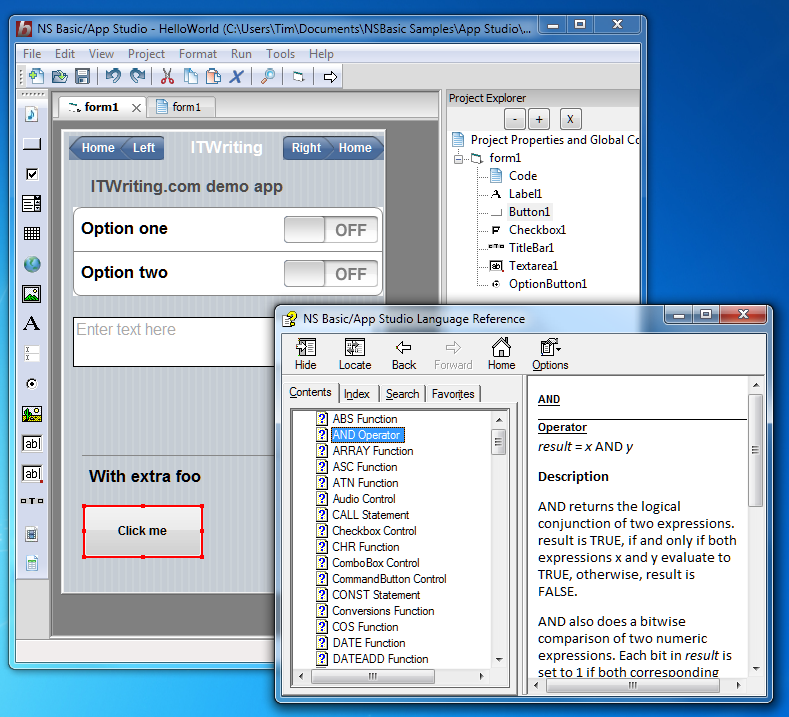
I was intrigued to discover NS Basic/App Studio, which offers a simple Windows IDE targeting iPhone and Android mobile devices.

image

It is all a bit retro, especially when you discover that the company (NS Basic Corporation) has the leading Basic on the … Apple Newton.

Still, something like Visual Basic for iPhone and Android sounds interesting. Does this thing deliver?

I tried the demo. What NS App Studio actually does is to translate Basic code to JavaScript, so the end result is a web application targeting mobile browsers, rather than a mobile app. There is a bit more to it though. Apps have access to local storage including SQLite databases, since this is available to the WebKit-based browsers on iPhone and Android. You can create a shortcut to a web app and even run it offline, making it behave somewhat like a locally installed app. Further, the FAQ notes that you can wrap your web app with PhoneGap to create an app that you can distribute through the App Store or Android Market; and this or similar capability may eventually be included in the IDE.

The question though: why would you choose to use Basic rather than just learning JavaScript? I can make sense of the Google Web Toolkit, which compiles Java to JavaScript, but Google’s effort is more sophisticated. You are not expected to puzzle out the generated JavaScript, but just work in Java. By contrast, with NS App Studio you code in Basic but debug in JavaScript, with all sorts of potential for confusion.

I got the impression that the product is not yet mature. I changed the name of the form in my Hello World project, for example, but found generated code that still referred to the old name, causing a JavaScript error. I found it confusing that the property listed as “text” in the visual grid was “textContent” in code. The IDE is very simple, but also very lacking in features. Most developers would find a modern JavaScript IDE more productive.

Nevertheless it is interesting as a proof of concept, and shows the capability of these mobile browsers as a pre-installed application runtime.

Hardware vendors chase Apple’s iPad at CES with Android, not Windows

There is a chorus of disapproval on the web today as Asus announced a full-fat Windows tablet  (Eee Slate EP121)  at CES in Las Vegas, along with three other devices running Google Android – the Eee Pad MeMo, the Eee Pad Transformer, and the Eee Pad Slider.

The most detailed “review” I’ve seen for the EP121 is on the Windows Experience Blog. Core i5, 4GB RAM, 64GB SSD, capacitive screen with touch and stylus input.

Nice in its way; but no kind of game-changer since this is an echo of early Windows slates which never achieved more than niche success. Four big disadvantages:

  • Short battery life
  • High price
  • The stylus
  • and another thing: in the rush to embrace touch computing, vendors appear to have forgotten one of the best features of those early tablets: you could rest your hand on the screen while writing with the pen. If you have a combined touch/stylus device that will not work.

Microsoft fans will be hoping CEO Steve Ballmer does not make too much of the EP121 and devices like this in tonight’s keynote. If he does, it will seem the company has learned little from failures of the past.

Asus deserves respect for introducing the netbook to the world in 2007, with the original Eee PC. It ran Linux, had an SSD in place of a hard drive, battery life was good, and above all it was light and cheap. Back then the story was how Microsoft missed the mark with its 2006 Origami project – small portable PCs running Windows – only to be shown how to do it by OEMs with simple netbooks at the right price.

Asus itself is not betting on Windows for tablet success; after all, three of the four products unveiled yesterday run Android. Despite what was apparently a poor CES press conference these may work out OK, though the prices look on the high side.

There will be many more tablets announced at CES, most of them running Android. Android “Honeycomb”, which is also Android 3.0 if Asus CEO Johnny Shih had his terminology right, is the first version created with tablet support in mind.

But why the tablet rush? The answer is obvious: it is because Apple has re-invented the category with the iPad. Since the iPad has succeeded where the Tablet PC failed, as a mass-market device, intuitively you would expect vendors to study what is right about it and to copy that, rather than repeating past mistakes. I think that includes long battery life and a touch-centric user interface; keyboard or stylus is OK as an optional extra but no more than that.

Equalling Apple’s design excellence and closed-but-seamless ecosystem is not possible for most manufacturers, but thanks to Android they can come up with devices that are better in other aspects: cheaper, more powerful, or with added features such as USB ports and Adobe Flash support.

It is reasonable to expect that at least a few of the CES tablets will succeed as not-quite iPads that hit the mark, just as Smartphones like the HTC Desire and Motorola Droid series have done with respect to the iPhone.

Microsoft? Ballmer’s main advantage is that expectations are low. Even if he exceeds those expectations, the abundance of Android tablets at CES shows how badly the company misjudged and mishandled the mobile market.

The implication for developers is that if you want app ubiquity, you have to develop for Android and iOS.

Microsoft could help itself and its developers by delivering a cross-platform runtime for the .NET Framework that would run on Android. I doubt Silverlight for Android would be technically difficult for Microsoft; but sadly after PDC it looks unlikely.

Ten big tech trends from 2010

This was an amazing year for tech. Here are some of the things that struck me as significant.

Sun Java became Oracle Java

Oracle acquired Sun and set about imposing its authority on Java. Java is still Java, but Oracle lacks Sun’s commitment to open source and community – though even in Sun days there was tension in this area. That was nothing to the fireworks we saw in 2010, with Java Community Process members resigning, IBM switching from its commitment to the Apache Harmony project to the official OpenJDK, and the Apache foundation waging a war of words against Oracle that was impassioned but, it seems, futile.

Microsoft got cloud religion

Only up to a point, of course. This is the Windows and Office company, after all. However – and this is a little subjective – this was the year when Microsoft convinced me it is serious about Windows Azure for hosting our applications and data. In addition, it seems to me that the company is willing to upset its partners if necessary for the sake of its hosted Exchange and SharePoint – BPOS (Business Productivity Online Suite), soon to become Office 365.

This is a profound change for Microsoft, bearing in mind its business model. I spoke to a few partners when researching this article for the Register and was interested by the level of unease that was expressed.

Microsoft also announced some impressive customer wins for BPOS, especially in government, though the price the customers pay for these is never mentioned in the press releases.

Microsoft Silverlight shrank towards Windows-only

Silverlight is Microsoft’s browser plug-in which delivers multimedia and the .NET Framework to Windows and Mac; it is also the development platform for Windows Phone 7. It still works on a Mac, but in 2010 Microsoft made it clear that cross-platform Silverlight is no longer its strategy (if it ever was), and undermined the Mac version by adding Windows-specific features that interoperate with the local operating system. Silverlight is still an excellent runtime, powerful, relatively lightweight, easy to deploy, and supported by strong tools in Visual Studio 2010. If you have users who do not run Windows though, it now looks a brave choice.

The Apple iPad was a hit

I still have to pinch myself when thinking about how Microsoft now needs to catch up with Apple in tablet computing. I got my first tablet in 2003, yes seven years ago, and it ran Windows. Now despite seven years of product refinement it is obvious that Windows tablets miss the mark that Apple has hit with its first attempt – though drawing heavily on what it learnt with the equally successful iPhone. I see iPads all over the place, in business as well as elsewhere, and it seems to me that the success of a touch interface on this larger screen signifies a transition in personal computing that will have a big impact.

Google Android was a hit

Just when Apple seemed to have the future of mobile computing in its hands, Google’s Android alternative took off, benefiting from mass adoption by everyone-but-Apple among hardware manufacturers. Android is not as elegantly designed or as usable as Apple’s iOS, but it is close enough; and it is a relatively open platform that runs Adobe Flash and other apps that do not meet Apple’s approval. There are other contenders: Microsoft Windows Phone 7; RIM’s QNX-based OS in the PlayBook; HP’s Palm WebOS; Nokia Symbian and Intel/Nokia MeeGo – but how many mobile operating systems can succeed? Right now, all we can safely say is that Apple has real competition from Android.

HP fell out with Microsoft

Here is an interesting one. The year kicked off with a press release announcing that HP and Microsoft love each other to the extent of $250 million over three years – but if you looked closely, that turned out to be less than a similar deal in 2006. After that, the signs were even less friendly. HP acquired Palm in April, signalling its intent to compete with Windows Mobile rather than adopting it; and later this year HP announced that it was discontinuing its Windows Home Server range. Of course HP remains a strong partner for Windows servers, desktops and laptops; but these are obvious signs of strain.

The truth though is that these two companies need one another. I think they should kiss and make up.

eBook readers were a hit

I guess this is less developer-oriented; but 2010 was the year when electronic book publishing seemed to hit the mainstream. Like any book lover I have mixed feelings about this and its implications for bookshops. I doubt we will see books disappear to the same extent as records and CDs; but I do think that book downloads will grow rapidly over the next few years and that paper-and-ink sales will diminish. It is a fascinating tech battle too: Amazon Kindle vs Apple iPad vs the rest (Sony Reader, Barnes and Noble Nook, and others which share their EPUB format). I have a suspicion that converged devices like the iPad may win this one, but displays that are readable in sunlight have special requirements so I am not sure.

HTML 5 got real

2010 was a huge year for HTML 5 – partly because Microsoft announced its support in Internet Explorer 9, currently in beta; and partly because the continued growth of browsers such as Mozilla Firefox, and the WebKit-based Google Chrome, Apple Safari and numerous mobile browsers showed that HTML 5 would be an important platform with or without Microsoft. Yes, it is fragmented and unfinished; but more and more of HTML 5 is usable now or in the near future.

Adobe Flash survived Apple and HTML 5

2010 was the year of Steve Jobs’ notorious Thoughts on Flash as well as a big year for HTML 5, which encroaches on territory that used to require the services of a browser plug-in. Many people declared Adobe Flash dead, but the reality was different and the company had a great year. Apple’s focus on design and usability helps Adobe’s design-centric approach even while Apple’s refusal to allow Flash on its mobile computers opposes it.

Windows 7 was a hit

Huge relief in Redmond as Windows 7 sold and sold. The future belongs to mobile and cloud; but Windows is not going away soon, and version 7 is driving lots of upgrades as even XP diehards move over. I’m guessing that we will get first sight of Windows 8 in 2011. Another triumph, or another Vista?