Category Archives: microsoft

Microsoft CEO Satya Nadella introduces Microsoft Office for iPad, talks up Azure Active Directory and Office 365 development

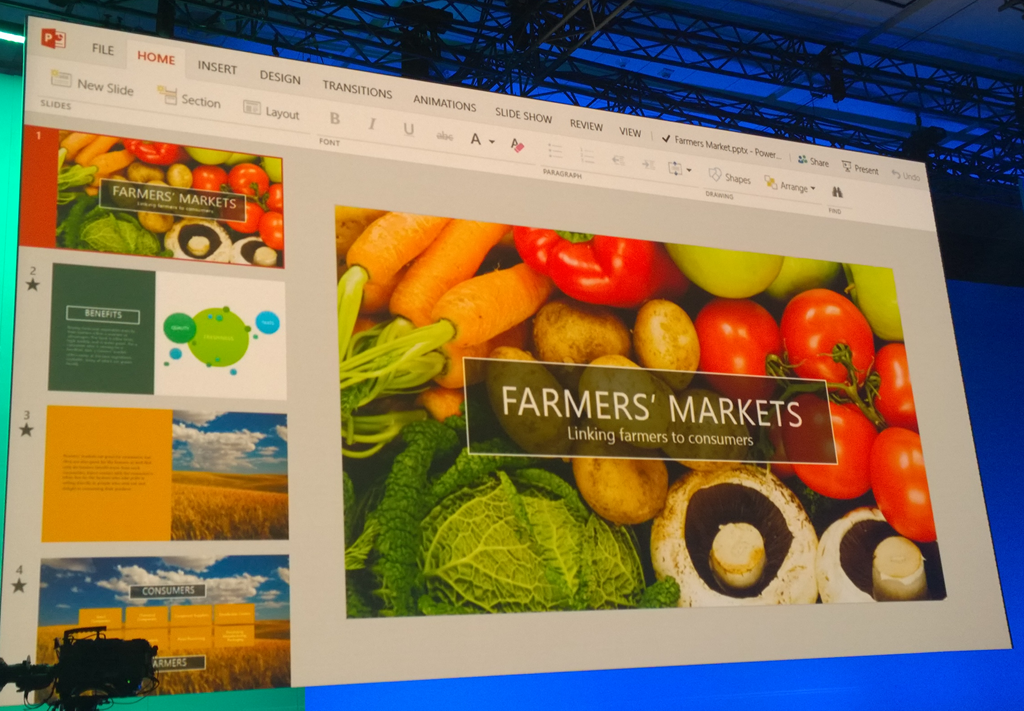
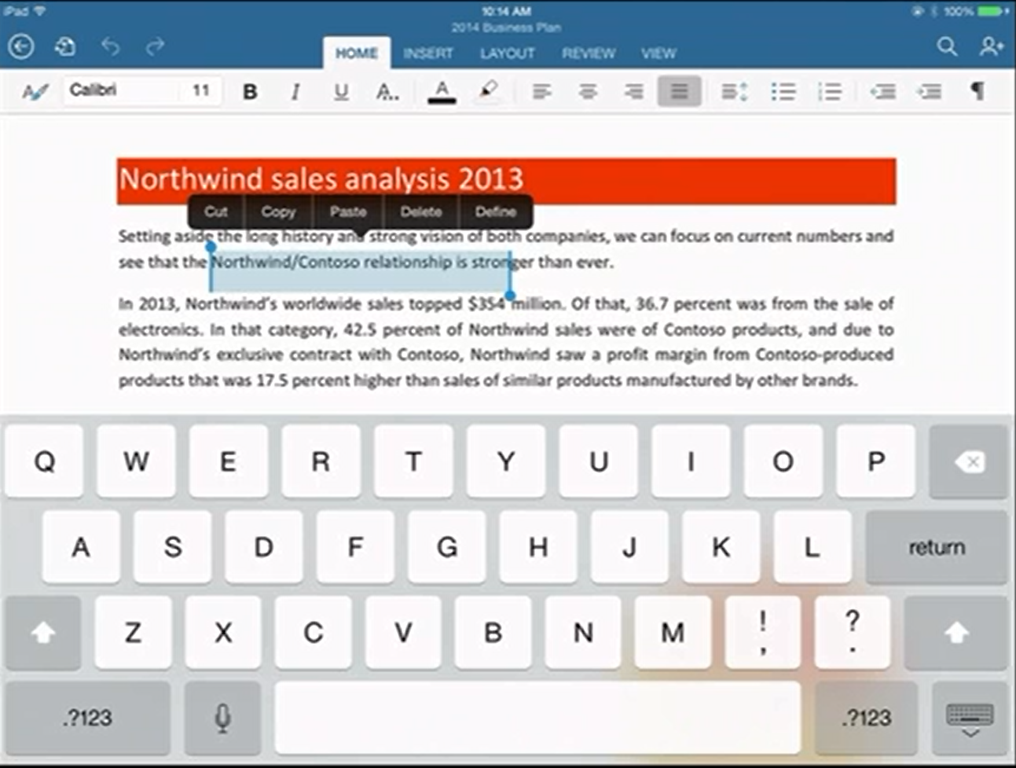
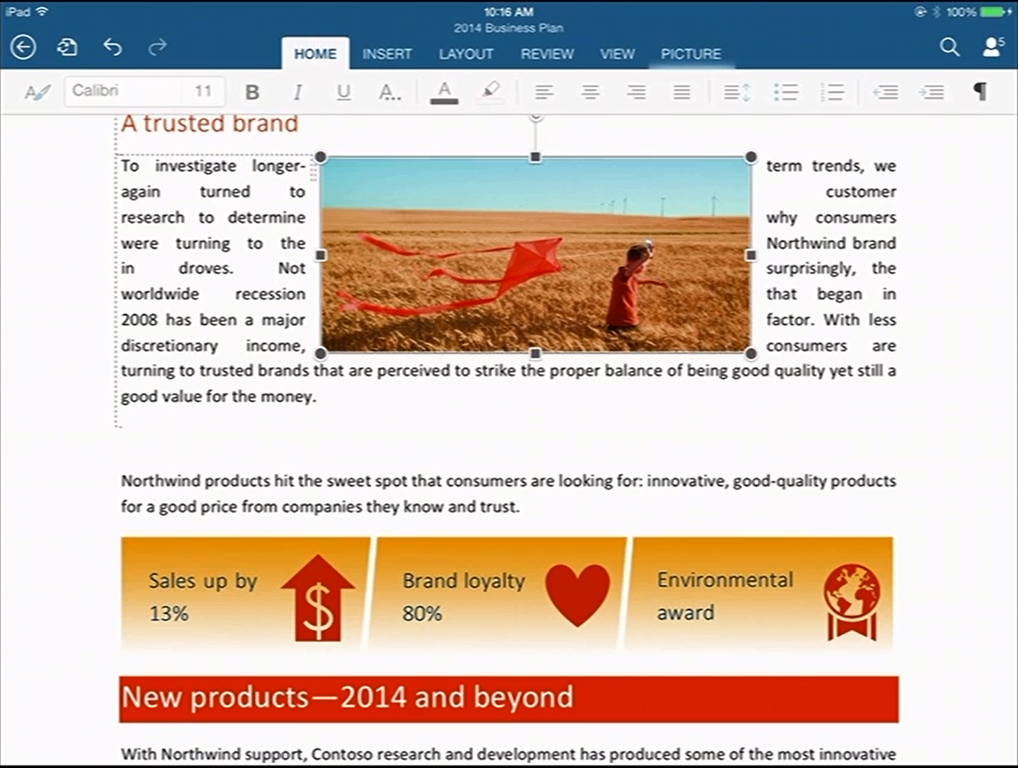
New Microsoft CEO Satya Nadella has announced Office for iPad at an event in San Francisco. Office General Manager Julie White gave a demo of Word, Excel and Powerpoint on Apple’s tablet.

image

White made a point of the fidelity of Office documents in Microsoft’s app, as opposed to third party viewers.

image

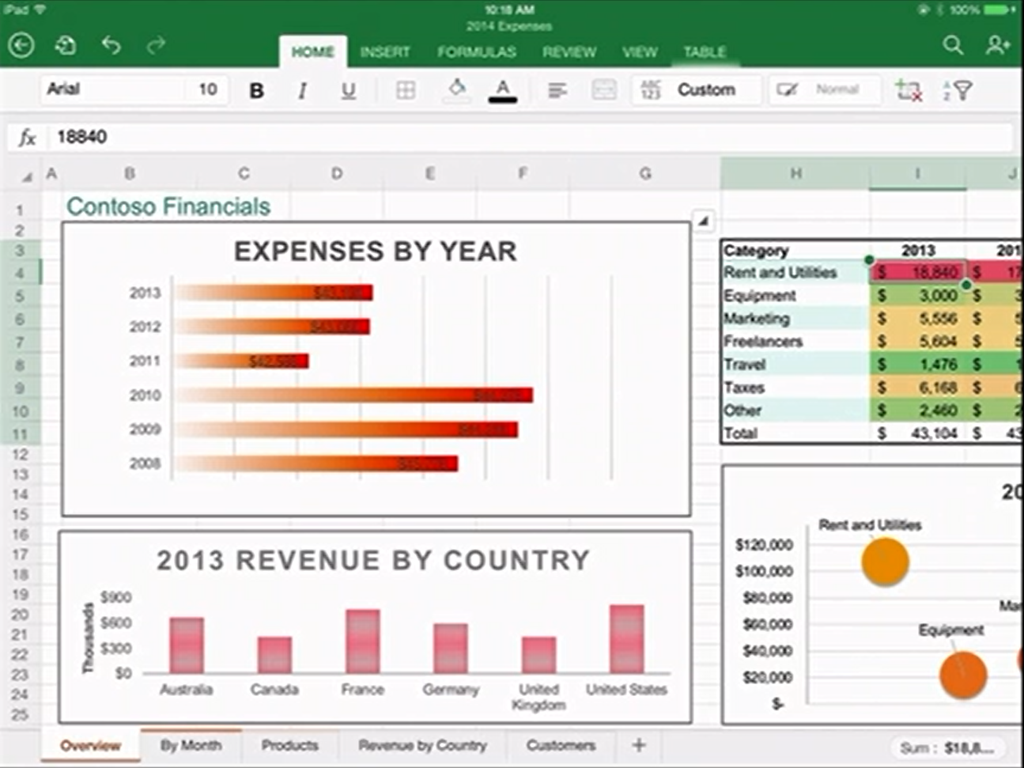
Excel looks good with a special numeric input tool.

image

Office will be available immediately – well, from 11.00 Pacific Time today – and will be free for viewing, but require an Office 365 subscription for editing. I am not clear yet how that works out for someone who wants full Office for iPad, but does not want to use Office 365; perhaps they will have to create an account just for that purpose.

There was also a focus on Office 365 single sign-on from any device. This is Azure Active Directory, which has several key characteristics:

1. It is used by every Office 365 account.

2. It can be synchronised and/or federated with Active Directory on-premise. Active Directory handles identity and authentication for a large proportion of businesses, small and large, so this is a big deal.

3. Developers can write apps that use Azure Active Directory for authentication. These can be integrated with SharePoint in Office 365, or hosted on Azure as a separate web destination.

While this is not new, it seems to me significant since new cloud applications can integrate seamlessly with the directory already used by the business.

Microsoft already has some support for this in Visual Studio and elsewhere – check out Cloud Business Apps, for example – but it could do more to surface this and make it easy for developers. Nadella talked about SDK support for iOS and other devices.

Microsoft hardly mentioned Android at the event, even though it has a larger market share than iOS. That may be because of the iPad’s popularity in the enterprise, or does it show reluctance to support the platform of a bitter competitor?

Microsoft is late with Office for iPad; it should perhaps have done this two years ago, but was held back by wanting to keep Office as an exclusive for Windows tablets like Surface, as well as arguments with Apple over whether it should share subscription income (I do not know how that has been resolved).

There was also a brief introduction to the Enterprise Mobility Suite, which builds on existing products including Azure Active Directory, InTune (for device management) and Azure Rights Management to form a complete mobility management suite.

Nadella made a confident performance, Office for iPad looks good.

What is coming up at Build, Microsoft’s developer conference next week? Nadella said that we will hear about innovations in Windows, among other things. Following the difficulties Microsoft has had in marketing Windows 8, this will be watched with interest.

Entering Microsoft’s XAML labyrinth: is it worth it?

I spent some time at the weekend working on a Bridge game for the Windows Store. I am writing it in XAML and C#. The UI is hardly demanding, given that Bridge is a card game, but it has made me take a fresh look at XAML, the markup language for a Windows Store App user interface (unless you use HTML and JavaScript). XAML is also used in Windows Presentation Foundation and in Silverlight/Windows Phone.

As part of the game, the user selects a “bid” which consists of a number from 1 to 7 and a suit of cards (or double, redouble or pass). Most bridge games show this as a grid though functionally it is like a combo-box (choosing from a pre-defined range of options).

Naturally I looked for the easiest way to accomplish this. The solution I came up with was to nest TextBlock controls in Border controls in Grid cells. Then I wrote C# code that detects which cell the user taps and updates the background of the selected Border accordingly.

image

I have in mind to replace the text with graphics and make the numbers a bit smarter at some future date. My solution works fine; here it is at runtime:

image

At the weekend I happened to be chatting with a developer more expert in XAML than myself, who told me I had done it wrong. In XAML everything should be in Style definitions. I should use a ListView and design it in Blend.

Well, I knew that I had somewhat subverted how XAML is meant to work, so I sat down to investigate this different approach. A ListView looks nothing like what I want out of the box.

image

However, with the magic of XAML it can be transformed. I made the ListView horizontal by defining an ItemsPanelTemplate in Application.Resources:

<ItemsPanelTemplate x:Key="ItemsPanelTemplate1">
  <StackPanel Orientation="Horizontal"/>
</ItemsPanelTemplate>

and adding 

ItemsPanel="{StaticResource ItemsPanelTemplate1}

as an attribute of the ListView.

Then I added an ItemTemplate to draw the kind of block that I wanted:

<ListView.ItemTemplate>
    <DataTemplate>
        <Border BorderThickness="1" Height="130" Width="130" BorderBrush="Black">
            <TextBlock FontSize="24" FontWeight="Bold" HorizontalAlignment="Center" VerticalAlignment="Center"
                       Text="{Binding Name}" Foreground="Black" />
        </Border>
    </DataTemplate>
</ListView.ItemTemplate>

Note that I am using a DataTemplate because the ListView is bound to an ObservableCollection in the proper XAML way.

At this point I am close to what I want – never mind that the numbers are missing, they can easily be added with a second ListView:

image

However I do not want that little tick mark appearing, the selected background colour is not to my taste, and the spacing of the items is wrong. How do I fix that?

My search led me to this post which explains a far-from-obvious series of steps you can take in Blend. The steps did not quite work for me but got me on track to create a new Style resource which I called ListViewItemStyleNoGlyph and which lets me adjust the margin and also a previously hidden property called SelectionCheckMarkVisualEnabled. Blend generated a substantial block of code for this:

image

This has helped and now my ListView looks like this:

image

Well, it is nearly there and I can see that with a bit more effort I can get what I want. Even so, I am beginning to wonder whether my initial approach, in which I understood all the code, had advantages over this exploration into the labyrinth.

Is XAML well loved out there? I came across this post by Paul Stovell from a couple of years back which seems relevant. “I’ve lived and breathed the technology for the last six years”, he says, but writes:

What’s disappointing is that WPF started out quite positively during its time. Concepts like dependency properties, styles, templates, and the focus on data binding felt quite revolutionary when Avalon was announced.

Sadly, these good ideas, when put into practice, didn’t have great implementations. Dependency properties are terribly verbose, and could have done with some decent language support. Styles and templates were also verbose, and far more limited than CSS (when WPF shipped I imagined there would be a thousand websites offering high quality WPF themes, just like there are for HTML themes; but there aren’t, because it is hard).

Data binding in WPF generally Just Works, except when it doesn’t. Implementing INotifyPropertyChanged still takes way too much code. Data context is a great concept, except it totally breaks when dealing with items like ContextMenus. ICommand was built to serve two masters; the WPF team who favored routed commands, and the Blend team who favored the command pattern, and ended up being a bad implementation for both.

Stovell mentions the verbosity of XAML, and that it is hard, both of which sound right to me. He contrasts the way ASP.NET has evolved, with ASP.NET MVC a great improvement on web forms. Read the full post for more detail.

It seems to me that XAML does offer much that is wonderful: flexibility, capability, and the ability to separate presentation from data. At the same time, neither XAML nor Blend are intuitive tools for developers; they may make more sense to designers, but it seems to me that removing a tick mark from a ListViewItem should be more straightforward. Perhaps it is, in which case there is a failure of documentation or tooling rather than functionality, but it makes little difference to the developer.

How to crash your Windows Store XAML app

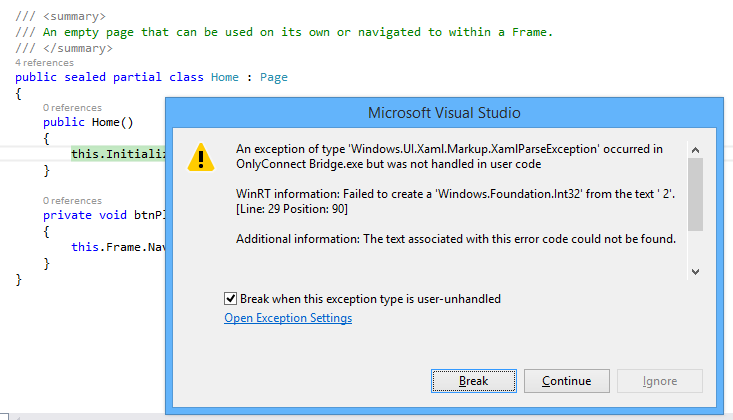
I am working on a Windows Store app, of which more soon. I am writing the app in XAML and C#. I was tweaking the page design when I hit a problem. Everything was fine in the designer in Visual Studio, but running the app raised an exception:

image

WinRT information: Failed to create a ‘Windows.Foundation.Int32’ from the text ‘ 2’.

along with the ever-helpful:

Additional information: The text associated with this error code could not be found.

The annoying this about this error is that debugging is not that easy. The exception is in Framework code, not your own code, and Microsoft does not supply the source. Once again, everything is fine in the designer and there are no compiler errors.

Puzzling. I resorted to undoing bits of my changes until I found what triggered the problem.

This was it. In the XAML, I had somehow typed a leading space before a number:

Grid.Row=" 2"

The designer parses this OK (it would be better if it did not) but the runtime does not like it.

Actually, I know why this happens. If you are typing in the XAML code editor (which I find myself doing a lot), then auto completion inserts the blank space for you:

image

I wish all bugs were this easy to solve, though I regard it as a bug in the Visual Studio editor. Posted here mainly in case others hit this problem; but I also observe that Windows Store development still seems less solid in Visual Studio than the tools for desktop or web apps.

Other problems I have hit include the visual designer changing to read-only of its own accord; and a highly irritating issue where the editor for a XAML code-behind class sometimes forgets the existence of all the controls you have declared in XAML, covering your valid code with red squiggly lines and reporting numerous errors, which disappear as soon as you compile. Once this starts happening, the problem persists for the rest of the editing session.

It is not all bad. I am pleased with the way I have been able to put together a touch-friendly game UI relatively easily. Now comes the fun part: writing the logic for the AI (Artificial Intelligence).

SQL Server 2014 is done: Hekaton, Azure integration

Microsoft has released SQL Server 2014 to manufacturing (an odd phrase in these diskless days) but which signifies that it is code complete for the initial release. General availability is April 1st.

What do you do if hardware trends enable you to stuff vast amounts of RAM into your server, along with many CPU cores? The answer is that you optimize applications to work mostly in RAM, with disk important as a persistence layer. This contrasts to the approach when you have large amounts of disk space and little RAM, when you focus on loading only as much data into memory as you absolutely need.

The implications for a database server are profound. Instead of a logic that goes something like “read from disk, do something, write to disk” you can address the data directly; it is just a memory pointer.

Now combine that with stored procedures compiled to native code. Performance leaps up, and by much more than you get simply by caching data in RAM, or using fast SSD storage, but still using the old disk-based approach in the database engine.

This is the reasoning behind “Hekaton”, properly known as In-Memory OLTP (online transaction processing), which is a new in-memory database engine that comes with SQL Server 2014.

It is fully integrated. You just have to add a filegroup to a a SQL Server database with the keyword CONTAINS MEMORY_OPTIMIZED_DATA and then create a table with the keyword WITH (MEMORY_OPTIMIZED=ON). And for the stored procedures, use WITH NATIVE_COMPILATION.

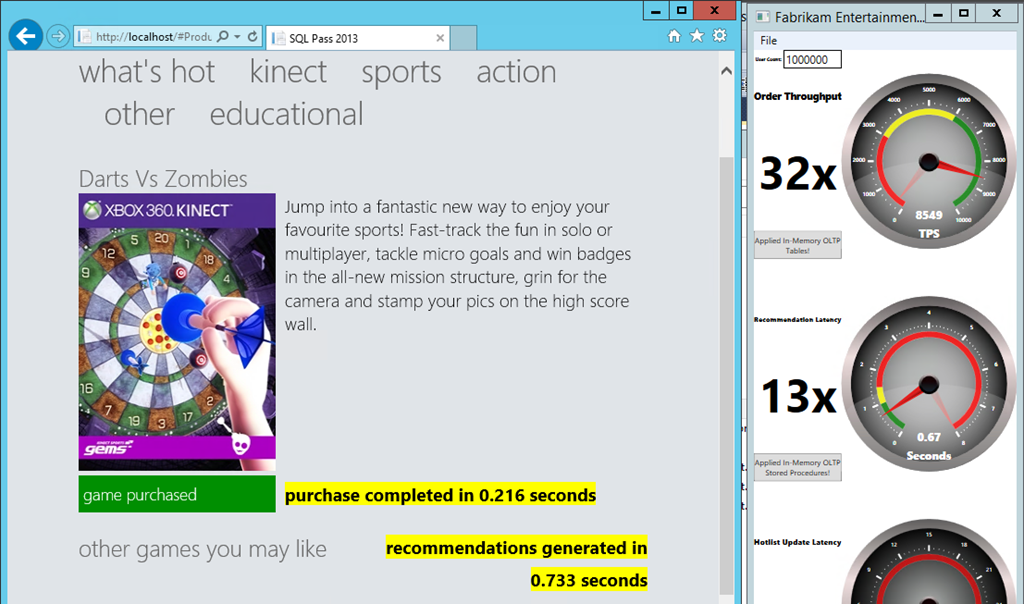
The speed-up is as great as you would expect. I have seen demonstrations of 30x or more performance increases, like this one in a demo based on one from the SQL Pass conference, but which I did for myself in one of Microsoft’s “Hands On Labs”:

image

In another demo, on an Azure VM, I got a speed up of 7x. Only seven times faster! Still, hard to complain about those sorts of numbers.

Unfortunately, in-memory OLTP is spoilt by some rather severe limitations in this release. The first problem is that a combination of the need to support native compilation of stored procedures, and other limitations, means that only a subset of T-SQL (the query and management language of SQL Server) is supported. You can see the list of what is not supported here; and it is depressing reading, with lots of keywords that you likely do use at the moment; even IDENTITY is on the list of what does not work.

Another issue is that the ability of In-Memory OLTP to take advantage of hardware is not as extensive as you might hope. Lead program manager Kevin Liu told me at a recent press workshop that the team recommends restricting total data size to 256GB, and that the recommended number of CPU sockets is two. You can get servers today with much more memory and more sockets. It gets complicated though: in a multi-socket server memory has processor affinity and there is a thing called NUMA (Non-Uniform Nemory Access) that describes the way memory is shared between processors.

According to Liu, Microsoft expects to lift these limitations in future releases, as well as improving T-SQL support, but things like this remind you that it is a version one release.

What else is in SQL Server 2014? There is some neat Azure integration, including a managed backup tool that is almost one click to have your data backed up to Azure storage; a brilliant facility for small businesses. You can also use Azure for high availability, creating always-on replicas in Azure VMs.

Data warehouse users will like the new clustered columnstore indexes, which allow you do use a column-oriented table structure for much faster processing of typical report and analysis queries. Columnstore indexes first appeared in SQL Server 2012 but were not updateable. Now they are.

SQL Server is well liked, licensing hassles aside; and even on licensing, Microsoft can always point at Oracle and claim, rightly, to be cheaper and less complex. It has earned a reputation for solid performance. SQL Server 2014 looks as good as ever, even if the management tools now look rather dated – the shell for SQL Server Management Studio uses an old version of Visual Studio, which is one of the reasons. I also suspect the SQL Server team lacks a dialog designer, but doubt that the average database admin cares one jot.

That said, it is difficult to describe this as a must-have upgrade, unless you can make good use of “Hekaton” in-memory OLTP. The porting effort will be worth it presuming you can get it to work. One of the good fits for the technology is managing web app session data, or, as in the example above, rapid processing to display recommendations or customisations on a web site.

I can imaging though that many users will look at Hekaton and decide that it is too much work or too immature for immediate use. What is left for them, apart from some nice Azure integration?

Not a huge amount, it seems to me, making this to my mind a transitional release.

Are you planning to upgrade? I would be interested to know your reasons why or why not.

Running WordPress on Windows Azure

I am investigating hosting this site on Windows Azure, partly as a learning exercise, and possibly to enable easier scaling.

I discovered that any web site short of Standard is worthless other than for experimentation and prototyping. I set up a Small Standard Web Site (£48 per month). But what database? I recalled that you can run WordPress with SQL Server and tried using a 1GB SQL Server Web Edition hosted on Azure (£6.35 per month).

In order to use this, I used the Brandoo WordPress configuration which is set up for SQL Server. I later discovered that it uses the WP Db Abstraction plug-in which according to its home page has not been updated for two years. The installation worked, but some plug-ins reported database errors. I imported some posts and found that search was not working; all searches failed with nothing found.

My conclusion is that running WordPress with SQL Server is unwise unless you have no choice. I looked for another solution.

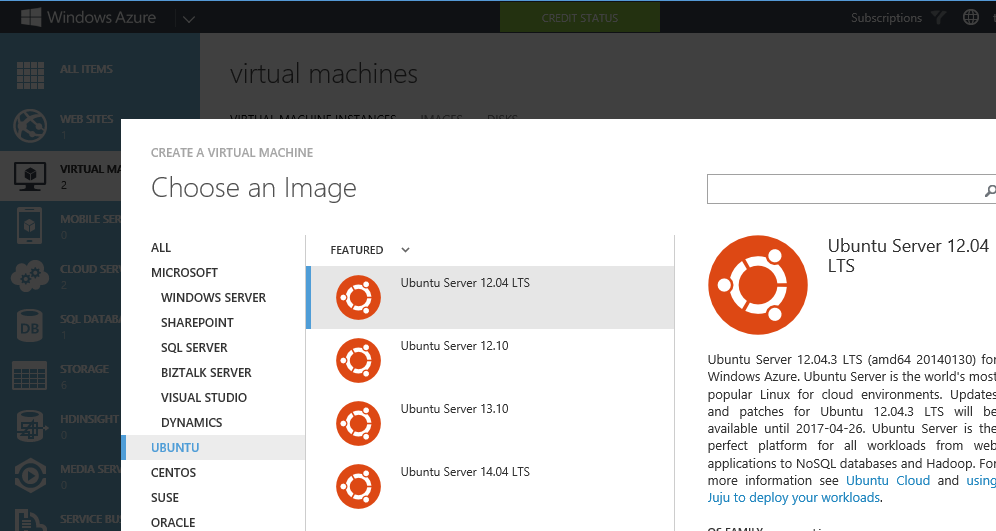
Azure has a Web Site template which uses WordPress and a MySQL database hosted by ClearDB. I would rather not involve another hosting company, so considered other options. One is to run a VM on Azure and to install MySQL on it. If you are doing that, you might as well put WordPress on the same VM at least until the traffic justifies scaling out. So I have created a new Medium Linux VM – two virtual cores, 3.5GB RAM – at £57 per month, with Ubuntu, and installed the LAMP stack and WordPress on that. The cost is similar to the Windows/SQL Server setup, but the VM is a higher specification, since a Small Web Site is 1 virtual core and 1.75GB RAM. You also get full access to the VM, as opposed to the limited access that a Web Site offers. The installation is a bit more effort but performance is better and it looks like this might work.

image

The problem with backpedalling on Windows 8: it is the wrong direction

Lukas Mathis has a detailed post on Windows 8, including its advantages over the Apple iPad as a productivity tablet. Mathis switched from the iPad to a Surface Pro:

In general, I really love the Surface, and I use it much more, and for many more things, than I ever used any iPad I ever owned. But it’s not perfect.

Mathis likes the Metro (Windows Runtime) UI:

Almost everything that happens inside the Metro environment is fantastic. It’s clean, fast, and powerful. The apps are easy to use, but still offer a lot. The gesture-based user interface requires you to learn a few new things, but takes very little time to get used to.

This makes interesting reading for Windows users (and there seem to be many) who have convinced themselves that Metro is difficult, pointless or obstructive, though of course it may be those things to them. It is also true that you cannot easily get your work done in Metro alone. Office, Visual Studio, Windows Live Writer are three quick examples of applications which do not have any good substitute, not to mention countless custom line of business applications, so you still need the desktop whether you like it or not.

Mathis is also scathing about various aspects of Windows:

The problems with Windows 8 don’t end with the integration between desktop and Metro. There’s also the problem that good old Windows seems to be a pretty terrible operating system.

He relates encounters with DLL errors, inconsistent visual design, old stuff left in for legacy reasons, and a culture of adware, spyware and malware.

Personally I have learned how to navigate the Windows software world and have fewer problems than Mathis but that said, his complaints are justified.

These problems are hard to fix which is why Microsoft made such radical changes in Windows 8, making a new, secure and touch-friendly personality the centre and (conceptually at least) isolating the old desktop into a legacy area for running your existing apps. Although there are many flaws in the way this change has been executed, it seems to me a reasonable approach if Windows is to have a future beyond business desktops.

What was and is wrong with Windows 8? My own list of flaws includes:

  • Poor selection and quality of apps, even the built-in ones that had no reason not to be great
  • A design that lacks visual appeal
  • An immature development platform, too difficult, buggy and incomplete
  • Lack of a status bar in Metro so you cannot see at a glance essentials like time, date and battery life
  • Widescreen design that does not work well in portrait
  • Confusions like two versions of Internet Explorer, Metro PC settings vs Control panel and so on

I could go on; but there are also plenty of things to like, and I disagree with commonly expressed views like “it is no good without touch” (I use it constantly with only keyboard and mouse and it is fine) or “bring back the Start menu” (I like the new Start menu which improves in several ways over its predecessor).

It does not matter what I think though; the truth is that the business world in particular has largely rejected Windows 8, and the consumer world is hardly in love with it either. I look at lists of PCs and laptops for sale to businesses and the majority state something like “Windows 8 downgraded to Windows 7” or “Windows 7 with option to upgrade to Windows 8”. This tells the whole story.

It seems to me that the Windows 8 team has been largely disbanded, following Stephen Sinofsky’s resignation and Julie Larson-Green’s sideways moves; she is now “Chief Experience Officer in the Applications and Services Group”; and whatever that means, she is no longer driving the Windows team. Microsoft has to come to terms with the failure of Windows 8 to meet its initial objectives and to make peace with the user base that has rejected it. There are signs of this happening, with coming updates that improve integration between Metro and Desktop and ease the learning path for keyboard and mouse users:

Most of the changes in the update are designed to appease keyboard and mouse users, with options to show Windows 8 apps on the desktop taskbar, the ability to see show the desktop taskbar above Windows 8-style apps, and a new title bar at the top of Windows 8 apps with options to minimize, close, or snap apps.

The big question though is what happens to Metro in the next major release of Windows, bearing in mind that its chief advocates are no longer running the show. Should and will Microsoft stop trying to push the unwanted Metro environment on users and go back to improving the desktop, as it did when moving from Windows Vista to Windows 7?

My guess is that we will see some renewed focus on the desktop; but Microsoft will also be aware that the problems that gave rise to Metro still exist. The Windows desktop is useless on tablets, the Windows culture foists numerous applications with evil intent on users, and the whole design of traditional Windows is out of step with modern moves towards simpler, safer and easier to manage computing devices.

Therefore the correct direction for Microsoft is to improve Metro, rather than to abandon it. If we see a renewed focus on the desktop to the extent that energetic Metro development ceases, Microsoft will be marching backwards (and perhaps it will).

The only plausible “Plan B” is to do what some thought Microsoft should have done in the first place, which is to evolve Windows Phone to work on tablets and to replace Metro with a future generation of the Windows Phone OS, perhaps running alongside the desktop in a similar manner. Since Microsoft has stated its aim of a unified development platform for Windows Phone and Windows Runtime, Plan B might turn out the same as Plan A.

All this is late in the day, maybe too late, but the point is this: a revitalised desktop in Windows 9 will do little to arrest its decline.

X is for Xamarin: One company that is pleased to see Nokia X

Xamarin, which provides cross-platform development tools for targeting iOS and Android wtih C#, is not exhibiting here at Mobile World Congress in Barcelona, but does have a presence for meetings, and I caught up with Joseph Hill who is Director of Developer Relations.

Xamarin has just announced a joint SDK with SAP along with some SAP-specific support in its cloud testing service; but Monday’s announcement of Nokia X, Android smartphones from soon-to-be-Microsoft Nokia, was even bigger news from Hill’s perspective.

If you are a Windows Phone developer with apps written in C#, Xamarin gives you a way to port your code to Nokia X. Apparently Nokia itself has taken advantage of this to port Nokia Mix Radio, as described by Nokia’s developers here. Nokia also used MVVM Cross in order to take cross-platform abstraction beyond what Xamarin itself gives them (Xamarin is deliberately restricted to non-visual code).

Nokia states that it will do all future development using Microsoft’s Portable Class Libraries, and is also refactoring existing code:

The final step in our journey towards the common architecture is to throw out the legacy code from the Windows Phone and Windows 8 apps so they’re stripped back to existing PCL shared assemblies and then integrate them with our fully shared codebase. Now that the Nokia X has launched that’s the next major goal we’re striving towards and work begins now.

I imagine that Xamarin could prove useful in some of Microsoft’s other internal projects as it prepares for a world in which there is an official Microsoft Android platform.

As an aside, it seems to me unlikely that Microsoft will do anything other than run with Nokia X after the acquisition. Microsoft is supporting Nokia X with Skype and OneDrive, which is an indication of its attitude.

Samsung evolving KNOX into complete mobile device management solution

Samsung introduced KNOX at the 2013 Mobile World Congress (MWC). It is a secure app and data container for Samsung mobiles, backed by hardware, enabling businesses to run apps that are isolated from a user’s personal apps (which might include badly behaved or even malicious apps). Data is encrypted so that business secrets are safe if the device goes astray.

The core of Knox is a hardware process called TIMA (Trustzone Integrity Measurement). This checks for tampering in the core operating system (trusted boot) and sets a tamper bit if it detects a problem. The tamper bit cannot be set in software alone.

image

A device with KNOX activated can be flipped between personal and business (KNOX) personalities. It is like having two smartphones in one. Whether this is a desirable approach is up for debate, but it does secure business apps and data.

image

We did not hear much about KNOX after last year’s MWC. It was released a few months later, but snags included limited device support (only the latest Samsung devices), the need to prepare apps with a special KNOX wrapper before they could be used, and the need to hire a Samsung partner like Centrify to provide administration tools.

All that has changed following last night’s announcement of the next generation of KNOX. Highlights:

Most apps can now be installed in KNOX without any special wrapper

You can use a third-party container such as Good, Fixmo Safezone, or MobileIron AppConnect in place of the KNOX container, but still using KNOX hardware protection.

Two factor authentication (for example requiring a fingerprint swipe as well as a password to access a KNOX container)

KNOX supports Microsoft’s workplace join (a kind of lightweight domain join) for secure access to Microsoft network resources.

Samsung has introduced a cloud-based Mobile Device Management (MDM) tool called KNOX EMM (Enterprise Mobility Management). This runs on Microsoft’s Azure platform and integrates with Azure Active Directory (which can itself link to on-premise Active Directory) so that small businesses on Office 365, or large businesses which prefer a cloud tool, can manage both Knox and other devices. EMM is primarily aimed at SMEs but apparently can scale up without limit.

EMM will also support non-Samsung devices.

EMM includes an app marketplace allowing businesses to purchase and deploy apps. The example we were shown was the Box cloud storage service.

image

Availability is promised for the second quarter of 2014.

New features in Windows Azure, including web site backup, .NET mobile services

Microsoft has announced new features in Windows Azure, its cloud platform, described by VP Scott Guthrie on his blog.

Aside: I agree with this comment to his post:

Thank you Scott for update. I wish dozens of MS folks and MS representatives would have a clue about Azure roadmap to help businesses plan their release schedules / migration plans. Till that happens, this blog will remain the main source of updates and a hint of roadmap.

The changes are significant. ExpressRoute offers connectivity to Azure without going through the public internet. Currently you have to use an Equinix datacentre, Level 3 cloud connect, or an AT&T MPLS (Multiprotocol Label Switching) VPN. For enterprises that can meet the requirements and who are wary about data passing through the internet, or who want better connectivity, it is an interesting option.

Next up is backup and restore for Azure web sites. Azure web sites are a way of deploying web applications, ranging from free to multi-instance with automatic scaling. You need at least a Standard site for serious use, as I explained here.

Now you can set up scheduled backup for both the web site and a supporting database. The feature is in preview but you can try it now using the Azure web management portal.

image

I noticed a couple of things. One is that the storage account used must be in the same subscription as the web site. I also spotted this warning:

image

which states that “frequent backups can increase you database costs by up to 100%”. Still, it is a handy feature.

Azure mobile services, designed to supply data to mobile apps, has been extended to support .NET code (previously you had to use Javascript). If you download the code, notes Guthrie, you find that it is  “simply an ASP.NET Web API project with additional Mobile Service NuGet packages included.”

Mobile Services also have new support for notification hubs and for PhoneGap (a way of building mobile apps using HTML and JavaScript).

Another feature that caught my eye is easy linking of third-party apps to Azure Active Directory (which is also used by Office 365). For example, if you are struggling with SharePoint and its poor clients for Windows, iOS and Android, you might consider using Dropbox for business instead. Now you can integrate Dropbox for Business with your Office 365 user directory by selecting  it from the Azure management portal.

image

Visual Studio license expired: not what you want to see just before boarding a flight

While waiting to board I fired up Visual Studio 2013 thinking I might tinker with the game I am working on during the flight.

image

I got this unwelcome message. “Your license has gone stale.” This is because I have an MSDN version which apparently is no longer a perpetual license.

Thanks to what looks like a beginner programming error, I am also informed that the license will expire in 2147483647 days.

The other factor here is that I only use Visual Studio on this machine when travelling. Although my subscription is still in date, the software has to call home once in a while or it stops working.

Fair enough for Microsoft to protect its rights but I wonder if this could be fine-tuned.