Category Archives: microsoft

Three questions about Microsoft’s cloud play at TechEd 2011

This year’s Microsoft TechEd is subtitled Cloud Power: Delivered, and sky blue is the theme colour. Microsoft seems to be serious about its cloud play, based on Windows Azure.

Then again, Microsoft is busy redefining its on-premise solutions in terms of cloud as well. A bunch of Windows Servers on virtual machines managed by System Center Virtual Machine Manager (SCVMM) is now called a private cloud – note that the forthcoming SCVMM 2012 can manage VMWare and Citrix XenServer as well as Microsoft’s own Hyper-V. If everything is cloud then nothing is cloud, and the sceptical might wonder whether this is rebranding rather than true cloud computing.

I think there is a measure of that, but also that Microsoft really is pushing Azure heavily, as well as hosted applications like Office 365, and does intend to be a cloud computing company. Here are three side-questions which I have been mulling over; I would be interested in comments.

image

Microsoft gets Azure – but does its community?

At lunch today I sat next to a delegate and asked what she thought of all the Azure push at TechEd. She said it was interesting, but irrelevant to her as her organisation looks after its own IT. She then added, unprompted, that they have a 7,000-strong IT department.

How much of Microsoft’s community will actually buy into Azure?

Is Microsoft over-complicating the cloud?

One of the big announcements here at TechEd is about new features in AppFabric, the middleware part of Windows Azure. When I read about new features in the Azure service bus I think how this shows maturity in Azure; but with the niggling question of whether Microsoft is now replicating all the complexity of on-premise software in a new cloud environment, rather than bringing radical new simplicity to enterprise computing. Is Microsoft over-complicating the cloud, or it is more that the same necessity for complex solutions exist wherever you deploy your applications?

What are the implications of cloud for Microsoft partners?

TechEd 2011 has a huge exhibition and of course every stand has contrived to find some aspect of cloud that it supports or enables. However, Windows Azure is meant to shift the burden of maintenance from customers to Microsoft. If Azure succeeds, will there be room for so many third-party vendors? What about the whole IT support industry, internal and external, are their jobs at risk? It seems to me that if moving to a multi-tenanted platform really does reduce cost, there must be implications for IT jobs as well.

The stock answer for internal staff is that reducing infrastructure cost is an opportunity for new uses of IT that are beneficial to the business. Staff currently engaged in keeping the wheels turning can now deliver more and better applications. That seems to me a rose-tinted view, but there may be something in it.

What’s coming in Microsoft Visual Studio

Microsoft is beginning to talk in detail about the next version of Visual Studio, though currently mostly in the area of ALM (Application Lifecycle Management) tools.

Continuous testing and support for diverse test frameworks

The new Visual Studio will support unit tests that run in the background. Visual Studio VP Jason Zander adds that:

With Visual Studio vNext we are enabling you to use your favorite unit testing framework integrated deeply into the IDE. We will support MS Test, xunit, and nunit with vNext. You will also be able to target both .NET and native C++ code. Adding test frameworks is an extensibility point as well so if you don’t see your favorite one listed here, you can easily add it.

Storyboarding in PowerPoint
This is not exactly a Visual Studio feature; but the new version will include a PowerPoint plug-in and templates that lets you mock up a user interface. Why bother, when Microsoft already has Sketchflow in Expression Blend, and tools in Visio for laying out a GUI? Apparently many users are more comfortable in Office.

Integration with System Center

Visual Studio 2010 already includes a virtual lab management feature that lets you test applications on virtual machines managed by System Center Virtual Machine Manager. But what about deployed applications? A new connector for System Center Operations Manager brings similar integration, so that bugs can be reported directly to Team Foundation Server complete with stack trace enabled by IntelliTrace, a historical debugging feature.

Context switching

The thinking here is that when developers are interrupted they lose the flow of their work. Context switching lets you shelve code changes, open windows and other activity tied to the current task. You can then do other work; when you later resume the task Visual Studio recovers its state.

New Team Explorer

Team Explorer is the connector and window in Visual Studio that forms the client for Team Foundation Server. This has been revamped for the new version, and now uses “full asynchronous communication” to improve load time and responsiveness. There are new views for common categories of information, including work items, pending changes, builds, reports and bugs.

New Agile collaboration tools

There are new tools in the Web Access client for Team Foundation Server for feedback and collaboration on projects using Agile methodology. Backlogs shows features to be implemented in a sprint, a unit of project iteration. The Task Board shows the backlog in a new visual view.

Connector for Project Server

A new connector for Project Server enables project-style views of project progress, such as Gantt charts.

Feedback tools

A new feedback mechanism aimed at stakeholders lets users enter feedback into Team Foundation Server. Tools include a web recorder that lets users comment on actions in a web application with linked recordings.

Code Clone Detection

This is a code quality feature that analyses a project looking for common code that should be refactored into a shared block.

Code Review

Code Review lets team members comment on code, similar in some ways to a commented document in Word.

Hosted Team Foundation Server on Azure

“Any team up and running within 30 seconds” is Microsoft’s claim for a new hosted option for Team Foundation Server. An exaggeration no doubt; but since a full-featured TFS takes some effort and infrastructure to implement, the hosted option will be welcome.

Visual Studio tends to be synchronized to some extent with new versions of Windows, so I would guess we will learn more about Visual Studio vNext at the Professional Developers Conference (though it may be called something else) in Anaheim on September 13-16 this year.

You can read more about Visual Studio vNext on Jason Zander’s blog and in a white paper [pdf]. 

Mono splits from Novell/Attachmate to form basis of new company

Mono is an open source implementation of .NET, formerly sponsored by Novell, and its future following Novell’s acquisition by Attachmate has been the subject of speculation.

Today Mono leader Miguel de Icaza has revealed new plans. In a blog post, he announces Xamarin, a new company focused on Mono. This company will build new commercial .NET tools for Apple iOS and Google Android, to enable .NET development on those platforms. Note that they will not be called MonoTouch and MonoDroid, the Novell offerings for this, but will be “source compatible”. I am sure there are brand and intellectual property ownership issues here; but de Icaza is no stranger to negotiating tricky issues of this kind, bearing in mind Mono’s relationship with Microsoft .NET. However I am not sure why the new company cannot acquire the existing brands, since it seems that Attachmate will no longer be able to support them.

The plans are not exactly new, but have been forced by Attachmate’s decision to lay off the entire Mono team:

We have been trying to spin Mono off from Novell for more than a year now. Everyone agreed that Mono would have a brighter future as an independent company, so a plan was prepared last year.

To make a long story short, the plan to spin off was not executed. Instead on Monday May 2nd, the Canadian and American teams were laid off; Europe, Brazil and Japan followed a few days later. These layoffs included all the MonoTouch and MonoDroid engineers and other key Mono developers.

Apparently Xamarin has “angel funding” but is looking for more.

The advent of MonoTouch and MonoDroid has been good for Mono, since it gives the project a stronger business model than it had previously. These mobile platforms are hot, and the ability to code for them in C# is great for Microsoft Platform developers. This factor could enable Xamarin to succeed.

On the other hand, Novell’s name gave Mono enterprise credibility as well as the backing of a large company, and these it now lacks.

The curious thing is that Mono is valuable to Microsoft. The company seems at times to hate Mono, because it removes the need for Windows, and at other times to love it, because it extends the breadth of .NET to include Linux and now iOS and Android. Microsoft gave some sort of official status to Moonlight, the Mono implementation of Silverlight, though the company’s support for Moonlight has always seemed hesitant.

So can we expect now that the company which can afford $8.5 billion for Skype, could expend a few million in support of Xamarin? Or will it stand by and hope that Mono fades away?

I have no idea, though I would like to see both Mono and Xamarin succeed. It is no threat to Microsoft, but does take .NET to places that Microsoft will never support. Without Mono, C# is merely a language for programming Windows.

Cloud is identity management says Kim Cameron, now ex-Microsoft

Kim Cameron, formerly chief identity architect at Microsoft, has  confirmed that he has left the company.

In an interview at the European Identity Conference in Munich he discusses the state of play in identity management, but does not explain what interests me most: why he left. He was respected across the industry and to my mind was a tremendous asset to Microsoft; his presence went a long way to undoing the damage of Hailstorm, an abandoned project from 2001 which sought to place Microsoft at the centre of digital life and failed largely because of industry mistrust. He formulated laws of identity which express good identity practice, things like minimal disclosure, justifiable parties, and user control and consent.

Identity is a complex and to most people an unexciting topic; yet it has never been more important. It is a central issue around Google’s recently announced Chromebook, for example; yet we tend to be distracted by other issues, like hardware features or software quality, and to miss the identity implications. Vendors are careful never to spell these out, so we need individuals like Cameron who get it.

“Cloud is identity management,” he says in the interview.

Cameron stands by his laws of identity, which is says are still “essentially correct”. However, events like the recent Sony data loss show how little the wider industry respects them.

So what happened at Microsoft? Although he puts a brave face on it, I am sure he must have been disappointed by the failure of Cardspace, a user interface and infrastructure for identity management that was recently abandoned. It was not successful, he says, because “it was not adopted by the large players,” but what he does not say is that Microsoft itself could have done much more to support it.

That may have been a point of tension; or maybe there were other disagreements. Cameron does not talk down his former company though. “There are a lot of people there who share the ideas that I was expressing, and my hope is that those ideas will continue to be put in practice,” he says, though the carefully chosen words leave space for the possibility that another well-represented internal group do not share them. He adds though that products like SharePoint do have his ideas about claims-based identity management baked into them.

Leaving aside Microsoft, Cameron makes what seems to me an important point about advocacy. “We’re at the beginning of a tremendously complex and deep technological change,” he says, and is worried by the fact that with vendors chasing immediate advantage there may be “no advocates for user-centric, user in control experience.”

Fortunately for us, Cameron is not bowing out altogether. “How can I stop? It is so interesting,” he says.

Microsoft’s Azure toolkit for Apple iOS and Android is a start, but nothing like enough

Microsoft ‘s Jamin Spitzer has announced toolkits for Apple iOS, Google Android and Windows Phone, to support its Azure cloud computing platform.

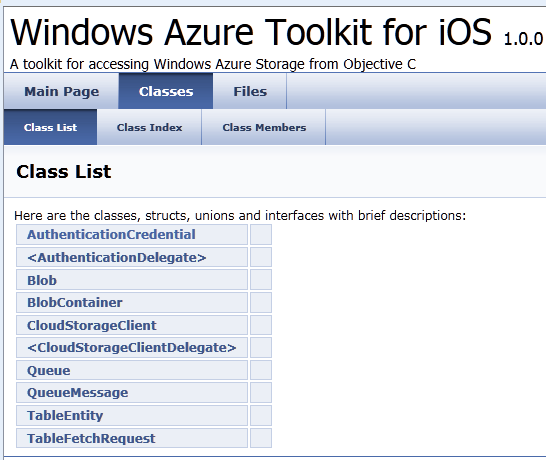
I downloaded the toolkit for iOS and took a look. It is a start, but it is really only a toolkit for Azure storage, excluding SQL Azure.

image

What would I hope for from an iOS toolkit for Azure? Access to SQL Server in Azure would be useful, as would a client for WCF (Windows Communication Foundation). In fact, I would suggest that the WCF RIA Services which Microsoft has built for Silverlight and other .NET clients has a more useful scope than the Azure toolkit; I realise it is not exactly comparing like with like, but most applications built on Azure will be .NET applications and iOS lacks the handy .NET libraries.

A few other observations. The rich documentation for WFC RIA Services is quite a contrast to the Doxyfile docs for the iOS toolkit and its few samples, though Wade Wegner has a walkthrough. One comment asks reasonably enough why the toolkit does not use a two or three letter prefix for its classes, as Apple recommends for third-party developers, in order to avoid naming conflicts caused by Obective C’s lack of namespace support.

The development tool for Azure is Visual Studio, which does not run on a Mac. Microsoft offers a workaround: a Cloud Ready Package which is a pre-baked Azure application; you just have to amend the configuration in a text editor to point to your own storage account, so developers without Visual Studio can get started. That is all very well; but I cannot imagine that many developers will deploy Azure services on this basis.

I never know quite what to make of these little open source projects that Microsoft comes up with from time to time. It looks like a great start, but what is its long-term future? Will it be frozen if its advocate within Microsoft happens to move on?

In other words, this looks like a project, not a strategy.

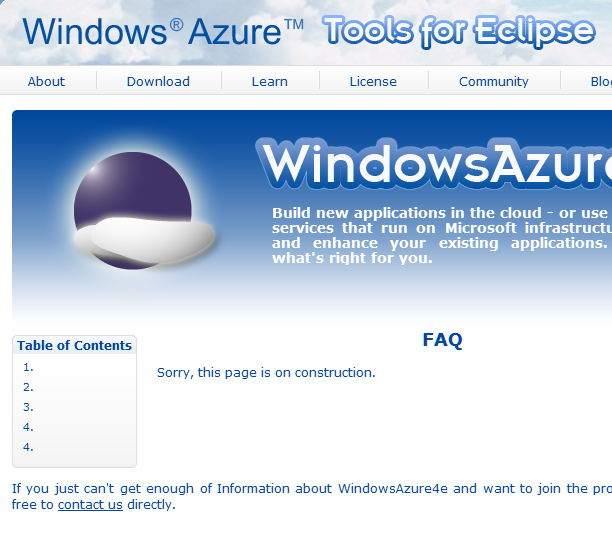
The Windows Azure Tools for Eclipse, developed by Soyatec and funded by Microsoft, is another example. I love the FAQ:

image

This sort of presentation says to developers: Microsoft is not serious about this, avoid.

That is a shame, because a strategy for making Azure useful across a broad range of Windows and non-Windows clients and devices is exactly what Microsoft should be working on, in order to compete effectively with other cloud platforms out there. A strategy means proper resources, a roadmap, and integration into the official Microsoft site rather than quasi-independent sites strewn over the web.

Microsoft’s Scott Guthrie moving to Windows Azure

According to an internal memo leaked to ZDNet’s Mary Jo Foley, Microsoft’s Scott Guthrie who is currently Corporate VP of the .NET Developer Platform is moving to lead the Azure Application Platform team. This means he will report to Ted Kummert who is in charge of the Business Platform Division, instead of S Somasegar who runs the Developer Division; however both divisions are part of the overall Server and Tools Division. Server and Tools is the division from which Bob Muglia was ousted as president in January; the reason for this is still not clear to me, though I would guess at some significant strategy disagreement with CEO Steve Ballmer.

Guthrie was co-inventor of ASP.NET and is one of the most approachable of senior Microsoft execs; he is popular and respected by developers and his blog is one of the first places I look for in-depth and hands-on explanations of new features in Microsoft’s developer platform, such as ASP.NET MVC and Entity Framework.

I have spent a lot of time researching and using Visual Studio 2010, and while not perfect it is among the most impressive developer products I know, from the detail of the editor and debug features right through to ALM (Application Lifecycle Management) aspects like Team Foundation Server, testing in various forms, and build management. Some of that quality is likely due to Guthrie’s influence. The successful evolution of ASP.NET from web forms towards the leaner and more flexible ASP.NET MVC is another achievement in which I am sure he played a significant role.

Is it wise to take Guthrie away from his first love and over to the Azure platform? Only Microsoft can answer that, and of course he will still be responsible for an ASP.NET platform. I’d guess that we will see further improvement in the Visual Studio tools for Azure as well.

Still, it is a bold move and one that underlines the importance of Azure to the company. In my own research I have gained increasing respect for Azure and I would expect Guthrie’s arrival there to be successful in winning attention from the Microsoft platform developer community.

Decent Microsoft results, but where is the cloud? where is mobile?

Microsoft has released its results for the quarter ending March 31 2011. The figures are pretty good; but despite much talk about the cloud there is little sign that Microsoft is reinventing its business – unless you count Xbox, which has had another excellent quarter and is delivering meaningful operating income for the company.

Quarter ending March 31 2011 vs quarter ending March 31 2010, $millions

Segment Revenue Change Profit Change
Client (Windows + Live) 4445 -205 2764 -399
Server and Tools 4104 398 1419 149
Online 648 82 -726 -17
Business (Office) 5252 911 3165 623
Entertainment and devices 1935 725 225 75

Windows is a little down in the quarter, which Microsoft says in the press release is “in line with PC trends”; a small statement which disguises what must be real concern about the market drift towards iPads and SmartPhones that are made by other companies.

Server and tools put in a decent but unspectacular performance. Office on the other hand was a powerhouse this quarter. Again, the press release statement is telling:

the integrated innovation with SharePoint, Exchange, Lync and Dynamics CRM is driving significant growth for the division

If you substitute “lock-in” for “integrated” you will not be far wrong. As an aside, I spoke to a major UK retailer last week about its move towards desktop virtualization. The exec I spoke to mentioned in passing that as they rolled out SharePoint 2010, they also realised that they would have to upgrade to Office 2010 at the same time, otherwise too much stuff just would not work properly. From Microsoft’s point of view, that is “integration” working as designed.

Online on the other hand, which I understand is mainly Bing and advertising revenue, had yet another miserable quarter. Microsoft says it is pleased that revenue increased; but the loss is bigger too, and the loss is comfortably bigger than the revenue which means it spent more than twice what it earned in this segment. Perhaps it is worth it, if Google is rattled even slightly by Bing’s growing search share, up to a claimed 13.9% in the US, but this is the longest of hauls.

So where’s the cloud? Azure is not mentioned in the release, and I am not even sure in which segment it lives; my guess is Server and Tools. Office 365, which is not yet launched, does get a mention. I think Office 365 will be big business for Microsoft, though it is going to cannibalise the server business a little.

Mobile? Somewhere lost in Entertainment and devices, where clearly the major element is Xbox. Something curious happened when Kinect launched; as a hands-free controller the device is imperfect but its genuine innovation seems to have boosted the profile and sales of the Xbox generally. A couple of years ago when we were all talking about the red ring of death I would not have expected such excellent figures.

This company remains a powerhouse, but the fact that its fortunes remain closely tied to those of the PC, and its lack of progress in mobile devices, are a concern.

Developers and mobile platforms: lies, damn lies and surveys

I’ve been reading the IDC/Appcelerator developer survey about their attitudes to mobile platforms. The survey covered 2,760 Appcelerator Titanium developers between April 11-13, so it is certainly current and with a sample just about big enough to be interesting.

The survey asks developers if they are “very interested” in developing for specific platforms, with the following results, and with comparisons to 3 months ago:

  • 91% iPhone (fractionally down)
  • 86% iPad (fractionally down)
  • 85% Android phones (down from 87%)
  • 71% Android tablets (down from 74%)
  • 29% Windows Phone 7 (down from 36%)
  • 27% Blackberry phones (down from 38%)

The survey is titled:

Apple shines, Google slows, and Microsoft edges RIM in battle for mobile developer mindshare.

Is that a fair summary? It is not what I would highlight. I cannot read the exact figures from the chunky graphic, but it is clear that the iOS figures are also fractionally down, maybe by just 1%, but hardly much different from the Android figures on a sample of this size. Both are pretty much flat.

The figures for Windows Phone 7 and Blackberry are more dramatic; though we should at least note that Appcelerator Titanium is a cross-platform toolkit that does not currently support Windows Phone 7, and that its support for Blackberry is only in preview. That was true last time round as well, but I’m not sure that asking developers about their plans for a platform which the toolkit does not currently support is the best way to gauge overall interest.

Another question that interests me: is developer interest a cause or an effect of a mobile platform’s success? A bit of each, no doubt; but personally I think the “effect” model is stronger than the “cause” model. Developers pick a platform either because they have immediate customers for apps on that platform, or because they think they can make money from it.

Nurturing a strong developer community is definitely important for a platform provider; but I doubt it ranks as highly as other factors, like building a strong retail presence, delivering excellent devices at the right price, and focusing on usability and a good end-user experience.

If you are interested in Appcelerator Titanium you might like to read my interview with the CEO at Mobile World Congress; and this discussion on whether Titanium really builds native apps.

Hands on with Office 365 – great service, some hassles

I have been trying Microsoft’s Office 365 which has recently gone into public beta, and is expected to go live later this year.

This cloud service provides Exchange 2010, SharePoint 2010 with Office Web Apps, and Lync Server to provide a complete collaboration service for organisations who prefer not to run these servers themselves – which is understandable give their cost and complexity.

Trying the beta is a little complex when you already have a working email and collaboration infrastructure. I chose to use a virtual machine running Windows 7 Professional. I also pre-installed Office 2010 Professional in an attempt to get the best experience.

Initial sign-up is easy and I was soon online looking at the admin screen. I could also sign into Outlook Web Access and view my SharePoint site.

image

Hassles started when I clicked to setup up desktop applications. This is done by a helper application which configures and updates Outlook, SharePoint and Lync on your desktop PC. At this point I had not configured my own domain; I was simply username@username.onmicrosoft.com.

setup-office-365

The wizard successfully configured SharePoint and Lync, but not Outlook.

image

There was a “Learn more” link; but I was in a maze of twisty passages, all alike, none of which seemed to lead to the information I needed.

Part of the problem – and I have noticed this with BPOS as well – is that the style of the online help is masterful at telling you things you know already, while neglecting to tell you what you need to know. It also has a patronising style that I find infuriating, and a habit of showing you marketing videos at every opportunity.

I did eventually find instructions for configuring Outlook manually for Office 365, but they did not work. I also noticed discrepancies in the instructions. For example, this document says that the Exchange server is ch1prd0201.mailbox.outlook.com and that the proxy server for Outlook over HTTP is pod51004.outlook.com. That did not match with the server given in my online account for IMAP, POP3 and SMTP use, which was a different podnnnnn.outlook.com. I tried all sorts of combinations and none worked.

Eventually I found this comment in another help document:

Currently, the only supported scenario for configuring Outlook to work with Office 365 is a fully migrated environment.

I am not sure if this is true, but it did seem to explain my problems. Of course it would be easy for Microsoft to surface this information in a more obvious place, such as building it into the setup wizard. Anyway, I decided to go for the full Office 365 experience and to set up a domain.

Fortunately I have a domain which I obtained for a bright idea that I have yet to find time for. I added it to Office 365. This is a process which involves first adding a CNAME record to the DNS in order to prove ownership, and then making Office 365 the authoritative nameserver for the domain. I was not impressed by the process, because when Microsoft took over the nameserver role it threw away existing settings. This means that if you have a web site or blog at that domain, for example, it will disappear from the internet after the transfer. Once transferred, you can reinstate custom records.

Still, I had chosen an unused domain so that I did not care about this. I set up a new user with an email address at the new domain, and I amended the default SharePoint web site address to use the domain as well.

image

That all worked fine; but what about Outlook? The bad news was that the setup wizard still failed to configure Outlook, and I still did not know the correct server settings.

I could have contacted support; but I had one last try. I went into the mail applet in control panel and deleted the Outlook profile, so Outlook had no profile at all. Then I ran Outlook, went through the setup wizard, and it all worked, using autodiscover. Out of interest, I then checked the server settings that the wizard had found, which were indeed different in every case from those in the various help documents I had seen.

A few hassles then, and I am not happy with the way this stuff is documented, but nevertheless it all looks good once set up. The latest Exchange and SharePoint does make a capable collaboration platform, the storage limits are generous – up to 25GB per Exchange mailbox – and I think it makes a lot of sense. I expect Microsoft’s online services to win huge amounts of business that is currently going to Small Business Server, and some business from larger organisations too. Migration from existing Microsoft-platform servers should be smooth.

The biggest disappointment so far is that in Lync online the Enterprise Voice feature is disabled. This means no general-purpose voice over IP, though you can call PC to PC. To get this you have to install Lync on-premise:

Organizations that want to leverage the full benefits of Microsoft Unified Communications can purchase and deploy Microsoft Lync Server 2010 on their premises as part of Microsoft Office 365. Lync Server 2010 on-premises delivers full enterprise voice and premises-based, dial-in audio conferencing, enabling customers to reduce costs and increase productivity by replacing or enhancing traditional PBX systems.

though it is confusing since Enterprise Voice is listed as a feature of the high-end E4 edition; I believe this implies an on-premise server alongside Office 365 in the cloud.

Perhaps the biggest question is the unknown: will Office 365 live up to its promised 99.9% scheduled uptime SLA, and how will its reliability compare to that of Google Apps?

Office 365 is priced at $10 per user per month for the basic service (E1), $16 to add Office Web Apps (E2), $24.00 to add licenses for Office Professional, archiving for Exchange (E3) and voicemail, and $27.00 to add Enterprise Voice (E4). The version in beta is E3.

Is Appcelerator Titanium native? And what does native mean anyway?

Of course we all know that Microsoft’s IE9 and the forthcoming IE10 are native – VP Dean Hachamovitch said so many times during his keynote at the Mix 2011 conference earlier this week. That has sparked a debate about what native means – so here is another interesting case.

Appcelerator’s Titanium cross-platform tool for mobile development is native, or at least that is what it claims:

image

Now, I am not sure that native has a precise definition, but to me it suggests a compiled application, rather than one interpreted at runtime. So this description of how Titanium executes JavaScript – its main language – is surprising:

In a Titanium Mobile application, your source code is packaged into a binary file and then interpreted at runtime by a JavaScript engine bundled in by the Titanium build process. In this guide, you will learn more about the JavaScript runtime environment that your code runs in. Titanium runs your application’s JavaScript using one of two JavaScript interpreters – JavaScriptCore on iOS (the interpreter used by Webkit) and Mozilla Rhino on Android and BlackBerry.

So a Titanium application is actually interpreted.

Native is a vague enough term that Appcelerator can no doubt justify its use here. “Native UI” is fair enough, so is “Native capabilities.” Native performance? That seems to me a stretch, though JavaScript performance is good and constantly improving. Appcelerator even has a web page devoted to what it means by native.

Titanium is also open source. Anyone doubtful about how it works need only consult the code.

In the light of Microsoft’s statements, it is interesting that what Appcelerator really means by native is “not a web page”:

Build Native Apps … Everything else is basically a web page.

So can an application be both native and interpreted? What about Silverlight apps on Windows Phone 7, are they native? Adobe AIR apps, surely they are not native? Google Android has a Native Development Kit which is introduced thus:

The Android NDK is a companion tool to the Android SDK that lets you build performance-critical portions of your apps in native code.

The implication is that byte code executed by the Dalvik virtual machine, which is the normal route for an Android app, is in some sense not native code. Which also implies that Appcelerator’s claims for Titanium are at least open to misunderstanding.