Category Archives: microsoft

Microsoft wrestles with HTML5 vs Silverlight futures

Former Microsoft Silverlight Product Manager Scott Barnes has posted a series of tweets following a visit to Microsoft:

So.. after a week in Microsoft HQ etc.. i have a lot of inside info that just basically puts into question the future of #Silverlight #wpf

he remarks, and then:

Right now there’s a faction war inside Microsoft over HTML5 vs Silverlight. oh and WPF is dead.. i mean..it kind of was..but now.. funeral.

Barnes positions it as a fight between Windows/IE9 backing HTML5, and the developer division backing Silverlight. He also suggests that Microsoft is contemplating a classic “Embrace and extend” strategy for HTML:

HTML5 is the replacement for WPF.. IE team want to fork the HTML5 spec by bolting on custom windows APi’s via JS/HTML5

He says further that Microsoft has “shut down the designer story” – I am not sure what that implies, though I can imagine that a lot of money has been sunk into the Expression tools without drawing significant market share from Adobe’s Creative Suite.

Barnes is a straight-talking guy but clearly this is all speculation. Nevertheless it is obvious that, on the eve of launching IE9 beta with its fast JavaScript engine, hardware accelerated graphics, and pixel-precise bitmap drawing, Microsoft has a tricky job positioning HTML5 vs Silverlight. For that matter, even positioning Silverlight vs desktop Windows Presentation Foundation is not easy.

Since we are also on the eve of launch for Windows Phone 7, which Microsoft has flagged as a strategic product and which uses Silverlight as its app platform, it seems unlikely that the technology will be sidelined; but rumours of internal divisions on the subject do not surprise me.

Silverlight versus HTML, Flash – Microsoft defends its role

Microsoft’s Brad Becker, Director of Product Management for Developer Platforms, has defended the role of Silverlight in the HTML 5 era. Arguing that it is natural for HTML to acquire some of the features previously provided by plug-ins – “because some of these features are so pervasive on the web that they are seen by users as fundamentally expected capabilities” – he goes on to identify three areas where Silverlight remains necessary. These are “premium” multimedia which merges video with application elements such as conferencing, picture in picture, DRM, analytics; consumers apps and games; and finally business/enterprise apps.

It is the last of these which interests me most. Becker’s statements come soon after the preview of Visual Studio LightSwitch, which is solely designed for data-driven business applications. Taking the two together, and bearing in mind that apps may run on the desktop as well as in browser, Silverlight is now encroaching on the territory which used to belong to Windows applications. With LightSwitch in particular, Microsoft is encouraging developers who might previously have built an app in Access or Visual Basic to consider Silverlight instead.

Why? Isn’t Microsoft better off if developers stick to Windows-only applications?

In one sense it is, as it gets the Windows lock-in – and yes, this is effective. I’m aware of businesses who are tied to Windows because of apps that they use, who might otherwise consider Macs for all or some of their business desktops. On the other hand, even Microsoft can see the direction in which we are travelling – cloud, mobile, diverse clients – and that Silverlight fits better with this model than Windows-only desktop clients.

Another consideration is that setup and deployment issues remain a pain-point for Windows apps. One issue is when it goes wrong, and Windows requires skilled surgery to get some app installed and working. Another issue is the constant energy drain of getting new computers and having to provision them with the apps you need. Microsoft has improved this no end for larger organisations, with standard system images and centralised application deployment, but Silverlight is still a welcome simplification; provided that the runtime is installed, it is pretty much the web model – just navigate to the URL and the app is there, right-click if you want to run on the desktop.

If Microsoft can also establish Windows Phone 7, which uses Silverlight as the runtime for custom apps, the platform then extends to mobile as well as desktop and browser.

The downside is that Silverlight apps have fewer capabilities than native Windows apps. Printing is tricky, for example, though Becker refers to “Virtualized printing” and I am not sure what exactly he means. He also highlights COM automation and group policy management, features that only work on Windows and which undermine Silverlight’s cross-platform promise. That said, via COM automation Silverlight has full access to the local machine giving developers a way of overcoming any limitations if they are willing to abandon cross-platform and browser-hosted deployment.

A winning strategy? Well, at least it is one that makes sense in the cloud era. On the other hand, Microsoft faces substantial difficulties in establishing Silverlight as a mainstream development platform. One is that Adobe was there first with Flash, which has a more widely deployed runtime, works on Android and soon other mobile devices, and is supported by the advanced design tools in Creative Suite. Another is the Apple factor, the popular iPhone and iPad devices which are a spear through the heart of cross-platform runtimes like Silverlight and Flash.

Finally, even within the Microsoft development community Silverlight is a hard sell for many developers. Some us recall how hard the company had to work to persuade Visual Basic 6 developers to move to .NET. The reason was not just stubborn individuals who dislike change – though there was certainly some of that – but also existing investment in code that could not easily be migrated. Both factors also apply to Silverlight. Further, it is a constrained platform, which means developers have to live with certain limitations. It is also managed code only, whereas some of the best developers for both desktop and mobile apps work in C/C++.

I suspect there is division even within Microsoft with regard to Silverlight. Clearly it has wide support and is considered a strategic area of development. At the same time, it is not helpful to the Windows team who will want to see apps that take advantage of new features in Windows 7 and beyond.

Yesterday Windows Phone 7 was released to manufacturing, which means the software is done. Another piece of the Silverlight platform is in place; and I guess over the next year or two we will see the extent to which Microsoft can make it a success.

Open season for patent litigation makes case for reform

It seems to be open season for software patent litigation. Oracle is suing Google over its use of Java in Android. Paul Allen’s Interval Licensing is suing AOL, Apple, eBay, Facebook, Google, Netflix, Yahoo and others – the Wall Street Journal has an illustrated discussion of the patents involved here. Let’s not forget that Apple is suing HTC and that Nokia is suing Apple (and being counter-sued).

What’s next? I was reminded of this post by former Sun CEO Jonathan Schwartz. He confirms the supposition that large tech companies refrain from litigation – or at least, litigate less than they might, refrain is too strong a word right now – because they recognize that while they may have valid claims against others, they also most likely infringe on patents held by others.

The gist of Schwartz’s post is that Microsoft approached Sun with the claim that OpenOffice, owned by Sun, infringes on patents held by Microsoft thanks to its work on MIcrosoft Office:

Bill skipped the small talk, and went straight to the point, “Microsoft owns the office productivity market, and our patents read all over OpenOffice.”

Sun’s retort was in relation to Java and .NET:

“We’ve looked at .NET, and you’re trampling all over a huge number of Java patents. So what will you pay us for every copy of Windows?”

following which everything went quiet. The value of .NET to Microsoft is greater than the value of OpenOffice to Sun or Oracle.

Oracle, however, seems more willing to litigate than Sun; and I doubt it cares much about OpenOffice. Might we see this issue reappear?

That said, Microsoft also has a large bank of patents; and who knows, some of them might be brought to bear against Java in the event of legislative war.

The risk though is that if everyone litigates, the industry descends into a kind of nuclear winter which paralyses everyone. Companies like Interval Licensing, which seemingly exist solely to profit from patents, have no incentive to hold back.

Can any good come of this? Well, increasing software patent chaos might bring some benefit, if it forces countries like the USA to legislate in order to fix the broken patent system.

Protecting intellectual property is good; but against that you have to weigh the potential damage to competition and innovation from these energy-sapping lawsuits.

We need patent reform now.

Cloud users get Microsoft Office Web Apps update first

Users of Office Web Apps have just been given some minor but welcome updates, described here.

They include printing in Word when in edit mode,new chart tools in Excel, and again in Excel the handy autofill tool, which lets you drag the bottom left corner of a selection to extend it automatically. In the example below, the blank cells fill with the remaining months of the year.

image

Office Web Apps also work on SharePoint 2010 deployed internally. However, the version of Office Web Apps for SharePoint has not been updated, so these users (who have to pay for Office licenses) now have an inferior version to that available for free users on SkyDrive.

Automatic and incremental bug-fixes and updates are one of the inherent advantages of cloud computing.

Visual Studio LightSwitch – model-driven architecture for the mainstream?

I had a chat with Jay Schmelzer and  Doug Seven from the Visual Studio LightSwitch team. I asked about the release date – no news yet.

What else? Well, Schmelzer and Seven had read my earlier blog post so we discussed some of the things I speculated about. Windows Phone 7? Won’t be in the first release, they said, but maybe later.

What about generating other application types from the same model? Doug Seven comments:

The way we’ve architected LightSwitch does not preclude us from making changes .. it’s not currently on the plan to have different output formats, but if demand were high it’s feasible in the future.

I find this interesting, particularly given that the future of the business client is not clear right now. The popularity of Apple’s iPad and iPhone is a real and increasing deployment problem, for example. No Flash, no Silverlight, no Java, only HTML or native apps. The idea of simply selecting a different output format is compelling, especially when you put it together with the fast JIT-compiled JavaScript in modern web browsers. Of course support for multiple targets has long been the goal of model-driven architecture (remember PIM,PSM and PDM?) ; but in practice the concept of a cross-platform runtime has proved more workable.

There’s no sign of this in the product yet though, so it is idle speculation. There is another possible approach though, which is to build a LightSwitch application, and then build an alternative client, say in ASP.NET, that uses the same WCF RIA Services. Since Visual Studio is extensible, it will be fun to see if add-ins appear that exploit these possibilities.

I also asked about Mac support. It was as I expected – the team is firmly Windows-centric, despite Silverlight’s cross-platform capability. Schmelzer was under the impression that Silverlight on a Mac only works within the browser, though he added “I could be wrong”.

In fact, Silverlight out of browser already works on a Mac; the piece that doesn’t work is COM interop, which is not essential to LightSwitch other than for export to Excel. It should not be difficult to run a LightSwitch app out-of-browser on a Mac, just right-click a browser-hosted app and choose Install onto this computer, but Microsoft is marketing it as a tool for Windows desktop apps, or Web apps for any other client where Silverlight runs.

Finally I asked whether the making of LightSwitch had influenced the features of Silverlight or WCF RIA Services themselves. Apparently it did:

There are quite a few aspects of both Silveright 4 and RIA services that are in those products because we were building on them. We uncovered things that we needed to make it easier to build a business application with those technologies. We put quite a few changes into the Silverlight data grid.

said Schmelzer, who also mentioned performance optimizations for WCF RIA Services, especially with larger data sets, some of which will come in a future service pack. I think this is encouraging for those intending to use Silverlight for business applications.

There are many facets to LightSwitch. As a new low-end edition of Visual Studio it is not that interesting. As an effort to establish Silverlight as a business application platform, it may be significant. As an attempt to bring model-driven architecture to the mainstream, it is fascinating.

The caveat (and it is a big one) is that Microsoft’s track-record on modelling in Visual Studio is to embrace in one release and extinguish in the next. The company’s track-record on cross-platform is even worse. On balance it is unlikely that LightSwitch will fulfil its potential; but you never know.

Ten things you need to know about Microsoft’s Visual Studio LightSwitch

Microsoft has announced a new edition of Visual Studio called LightSwitch, now available in beta, and it is among the most interesting development tools I’ve seen. That does not mean it will succeed; if anything it is too radical and might fail for that reason, though it deserves better. Here’s some of the things you need to know.

1. LightSwitch builds Silverlight apps. In typical Microsoft style, it does not make the best of Silverlight’s cross-platform potential, at least in the beta. Publish a LightSwitch app, and by default you get a Windows click-once installation file for an out-of-browser Silverlight app. Still, there is also an option for a browser-hosted deployment, and in principle I should think the apps will run on the Mac (this is stated in one of the introductory videos) and maybe on Linux via Moonlight. Microsoft does include an “Export to Excel” button on out-of-browser deployments that only appears on Windows, thanks to the lack of COM support on other platforms.

I still find this interesting, particularly since LightSwitch is presented as a tool for business applications without a hint of bling – in fact, adding bling is challenging. You have to create a custom control in Silverlight and add it to a screen.

Microsoft should highlight the cross-platform capability of LightSwitch and make sure that Mac deployment is easy. What’s the betting it hardly gets a mention? Of course, there is also the iPhone/iPad problem to think about. Maybe ASP.NET and clever JavaScript would have been a better idea after all.

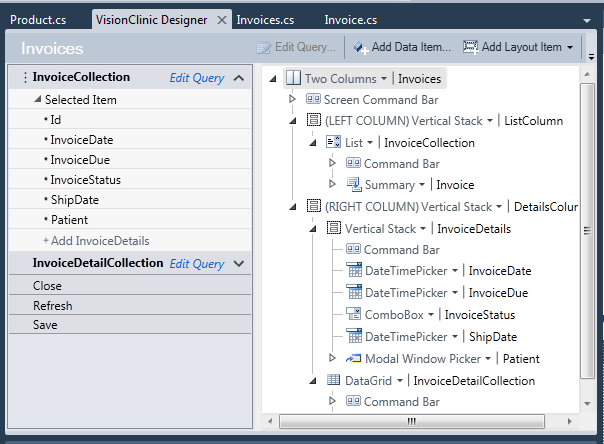
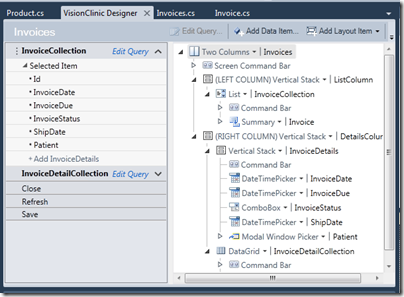
2. There is no visual form designer – at least, not in the traditional Microsoft style we have become used to. Here’s a screen in the designer:
image

Now, on one level this is ugly compared to a nice visual designer that looks roughly like what you will get at runtime. I can imagine some VB or Access developers will find this a difficult adjustment.

On the positive side though, it does relieve the developer of the most tedious part of building this type of forms application – designing the form. LightSwitch does it all for you, including validation, and you can write little snippets of code on top as needed.

I think this is a bold decision – it may harm LightSwitch adoption but it does make sense.

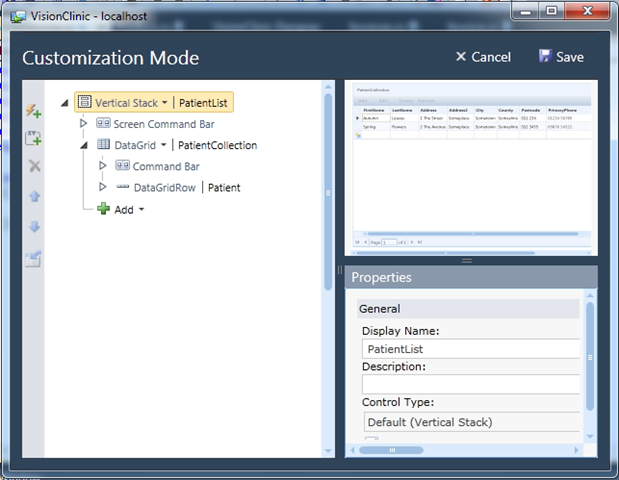
3. LightSwitch has runtime form customization. Actually it is not quite “runtime”, but only works when running in the debugger. When you run a screen, you get a “Customize Screen” button at top right:

image

which opens the current screen in Customization Mode, with the field list, property editor, and a preview of the screen.
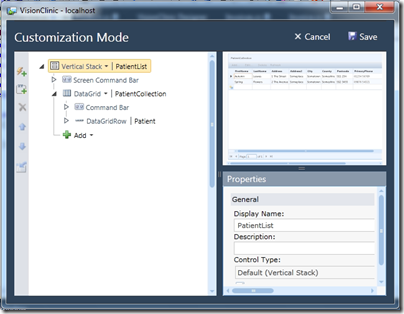
image

It is still not a visual form designer, but mitigates its absence a little.

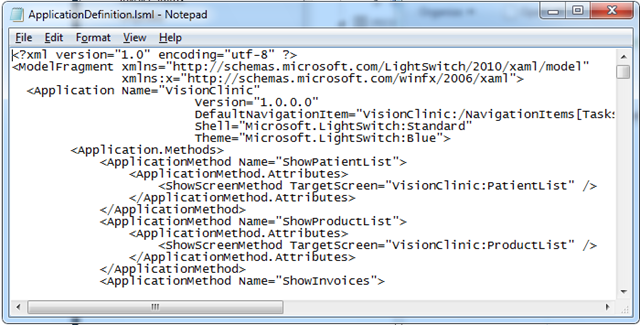
4. LightSwitch is model driven. When you create a LightSwitch application you are writing out XAML, not the XAML you know that defines a WPF layout, but XAML to define an application. The key file seems to be ApplicationDefinition.lsml, which starts like this:
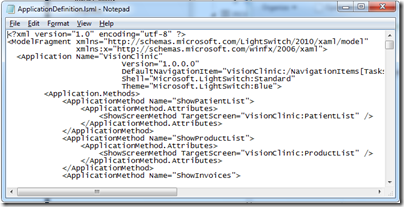
image

Microsoft has invested hugely in modelling over the years with not that much to show for it. The great thing about modelling in LightSwitch is that you do not know you are doing it. It might just catch on.

Let’s say everyone loves LightSwitch, but nobody wants Silverlight apps. Could you add an option to generate HTML and JavaScript instead? I don’t see why not.

5. LightSwitch uses business data types, not just programmer data types. I mean types like EmailAddress, Image, Money and PhoneNumber:

image

I like this. Arguably Microsoft should have gone further. Do we really need Int16, Int32 and Int64? Why not “Whole number” and “Floating point number”? Or hide the techie choices in an “Advanced” list?

6. LightSwitch is another go at an intractable problem: how to get non-professional developers to write properly designed relational database applications. I think Microsoft has done a great job here. Partly there are the data types as mentioned above. Beyond that though, there is a relationship builder that is genuinely easy to use, but which still handles tricky things like many-to-many relationships and cascading deletes. I like the plain English explanations in the too, like “When a Patient is deleted, remove all related Appointment instances” when you select Cascade delete.

image

Now, does this mean that a capable professional in a non-IT field – such as a dentist, shopkeeper, small business owner, departmental worker – can now pick up LightSwitch and and write a well-designed application to handle their customers, or inventory, or appointments? That is an open question. Real-world databases soon get complex and it is easy to mess up. Still, I reckon LightSwitch is the best effort I’ve seen – more disciplined than FileMaker, for example, (though I admit I’ve not looked at FileMaker for a while), and well ahead of Access.

This does raise the question of who is really the target developer for LightSwitch? It is being presented as a low-end tool, but in reality it is a different approach to application building that could be used at almost any level. Some features of LightSwitch will only make sense to IT specialists – in fact, as soon as you step into the code editor, it is a daunting tool.

7. LightSwitch is a database application builder that does not use SQL. The query designer is entirely visual, and behind the scenes Linq (Language Integrated Query) is everywhere. Like the absence of a visual designer, this is a somewhat risky move; SQL is familiar to everyone. Linq has advantages, but it is not so easy to use that a beginner can express a complex query in moments. When using the Query designer I would personally like a “View and edit SQL” or even a “View and edit Linq” option.

8. LightSwitch will be released as the cheapest member of the paid-for Visual Studio range. In other words, it will not be free (like Express), but will be cheaper than Visual Studio Professional.

9. LightSwitch applications are cloud-ready. In the final release (but not the beta) you will be able to publish to Windows Azure. Even in the beta, LightSwitch apps always use WCF RIA Services, which means they are web-oriented applications. Data sources supported in the beta are SQL Server, SharePoint and generic WCF RIA Services. Apparently in the final release Access will be added.

10. Speculation – LightSwitch will one day target Windows Phone 7. I don’t know this for sure yet. But why else would Microsoft make this a Silverlight tool? This makes so much sense: an application builder using the web services model for authentication and data access, firmly aimed at business users. The first release of Windows Phone 7 targets consumers, but if Microsoft has any sense, it will have LightSwitch for Windows Phone Professional (or whatever) lined up for the release of the business-oriented Windows Phone.

What users want in Windows 8

A number of blogs are running a coordinated poll on what users would most like to see in the next version of Windows. The results so far are unsurprising but still worth repeating, since there is a good chance that they differ from Microsoft’s priorities.

image

Note that users are less concerned about new features, more concerned about an OS that works better and faster.

Less bloat, currently number five in the list, will be hard to achieve while PC vendors still insist in bundling poor quality add-ons with their systems.

If you want to vote you can do so at any of various blogs including 4sysops – which has some notes expanding on what each category might mean – markwilson.it and Within Windows.

Dynamic language slowdown at Microsoft?

Jimmy Schementi, until recently a Program Manager at Microsoft working on IronRuby, has posted about why he is leaving the company; and in doing so answers a question I posed a few months back, Why F# rather than IronPython in Visual Studio 2010?

When my manager asked me, “what else would you want to work on other than Ruby,” I started looking for a new job outside Microsoft …. a year ago the team shrunk by half and our agility was severely limited. I’m omitting the internal reasons for this, as they are the typical big-company middle-management issues every software developer has. In short, the team is now very limited to do anything new, which is why the Visual Studio support for IronPython took so long. IronRuby’s IDE support in Visual Studio hasn’t been released yet for the same reasons. While this is just one example, many other roadblocks have cropped up that made my job not enjoyable anymore. Overall, I see a serious lack of commitment to IronRuby, and dynamic language on .NET in general … I invite the Ruby and .NET communities to come help us figure out how to continue the IronRuby project, assuming that Microsoft will eventually stop funding it.

The dynamic language work at Microsoft is very interesting and has done a lot to persuade the world that .NET is not just a C# and Visual Basic story. Personally I’d add my voice to those encouraging the company to re-invigorate its investment in IronRuby and IronPython.

A couple of other observations though. Schementi is talking about efforts to continue work on IronRuby irrespective of Microsoft’s funding, and if that succeeds it could bring the project to a better place rather than a worse one.

Second, one thing I learned in talking to Don Syme, the F# man at Microsoft, is that functional programming is in high demand in financial institutions, one of Microsoft’s most important markets. IronRuby and IronPython win Microsoft plenty of kudos, but the benefits in terms of revenue are presumably harder to identify.

Whatever happens to these languages, the impact of dynamic languages on the .NET platform has been significant, and C# now also has dynamic capability.

Internet Explorer 9 Preview gets to 95% on Acid 3

Microsoft has released the fourth platform preview for Internet Explorer 9, which you can download here. This is the last preview before the beta release, expected in September.

When IE9 was first previewed, back in March, it scored only 55% on the Acid3 standards test – well ahead of IE8 which scores around 20%, but far short of rivals like Google Chrome and Apple Safari which achieve full marks. Mozilla Firefox is at 94%.

Acid 3

The new preview is at 95%. IE9 is now up there with them – but why not 100%?

According to UK Web Product Manager Mark Quirk, it is down to three features, two of which are related to SVG (Scalable Vector Graphics). Two points are lost because of SMIL (Synchronized Multimedia Integration Language) presentations, which Microsoft does not intend to support because a similar feature will be part of CSS in future. Two points are lost because of SVG fonts, which again Microsoft does not intend to support because it sees WOFF (Web Open Font Format) as the future standard here. One point is lost because of the inability to draw SVG fonts on a path, though there are other ways to draw fonts on a path.

The bottom line: IE9 will most likely stay at 95% right through to its final release.

Incidentally, IE9 JavaScript performance is wildly faster than IE8, thanks to the new “Chakra” engine. IE9 is on the left, Firefox 4 on the right :

image

So when will we get IE9? Although it is not long to September, there is a major difference between the preview and the coming beta, which is that the preview does not have a full user interface. It is mainly to show off the rendering and JavaScript engine. Therefore we can expect new features in the beta versus the preview. Despite that, Quirk says that Microsoft intends the beta to be “good quality for any user”, not just for brave developers and testers.

But how long before the final release? Microsoft is not saying, though when I suggested the first half of 2011 as a reasonable guess, Quirk reminded me that the beta will be high quality and that the release should therefore follow “not too long” after.

Since we will get much of HTML 5 in IE alongside the other popular browsers, do we still need Silverlight?

“As the number of the things you can implement with HTML clearly goes up, the need for Silverlight and Flash goes down,” said Quirk, though he added hastily, “The value that those players add needs to go higher.”

I’d add that even if IE9 is all that we hope, it will take years before older versions fall out of use. Recently the UK government said it will stick with IE6, and whatever you think of that decision, it shows how hard it is to get browsers upgraded everywhere. By contrast, plug-ins like Flash and Silverlight get updated rather fast. I noticed on Riastats today that over 50% of browsers now have the latest Silverlight, and 39% already have Flash 10.1 – over 90% have Flash 10 or higher.

image

If you combine that issue with things like video playback that are problematic even in HTML 5, it suggests that plug-ins will be with us for the foreseeable future, though it is quite possible that their use may decline.

Another factor is tool support, mature for Flash and Silverlight, but not for the newest features of HTML. After IE9 appears, will Microsoft come up with tools that properly support it, in Expression Web and Visual Studio? “We have to, it’s as simple as that,” says Quirk, though he adds, “we haven’t said when.”

Apple iPad replacing PCs as well as paper?

Now here’s an article to strike fear into Microsoft. Stuart Sumner reports on iPad trials at the BBC and in the Army. The BBC’s CIO John Linwood says:

We’re seeding the organisation [with the devices]. We put some iPads into production and some into management and other roles to see if people would be able to give up their desktops.

He goes on to say that the iPad may enable paperless meetings.

What makes an iPad better than a laptop or netbook for a meeting? I find it curious, incidentally, that the report refers to replacing desktops rather than laptops.

Well, one reason I have always liked tablets is that they are more interactive and don’t put a barrier (the screen) between you and others. A stylus is actually nice for meetings – good for quick diagrams as well as handwriting. Apple’s iPad lacks the stylus, but has other advantages over Windows tablets – smaller, lighter, instant-on, long battery life, and so on.

Still, the humble netbook at one third of the price will do the job too, better in some ways. You have Excel, for example. Unfortunately it lacks the elegance, usability and desirability of Apple’s device.

Any excuse to justify handing out cool devices, then? Maybe; but there’s no law that says business equipment has to be dull and unpleasant to use.