Category Archives: software development

RIM’s new BlackBerry tablet, WebWorks developer platform – but who wants small tablets?

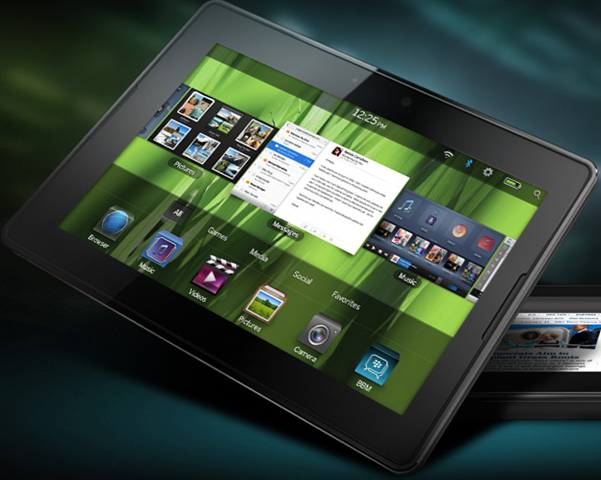
Blackberry has announced its pitch for the emerging tablet market, the 7” screen PlayBook. It has a new OS base on QNX Neutrino, a webkit-based web browser, Adobe Flash and AIR – offline Flash applications – front and rear cameras for video conferencing as well as taking snaps, and includes a USB port and HDMI out. There is wi-fi and Bluetooth but no 3G in the first release; you can connect to the Internet via your Blackberry. Storage is not yet specified as far as I can tell. There is no physical keyboard, which is surprising in some ways as the keyboard is the reason I hear most often for users choosing a BlackBerry smartphone over Apple’s iPhone.

image

Alongside the PlayBook RIM has announced a new developer platform. WebWorks is an HTML5 platform extended with access to local APIs, and targets both the Tablet OS and BlackBerry smartphones:

BlackBerry WebWorks applications can tap into the always-on, notification-based, push-enabled, contextual and social attributes of the BlackBerry smartphone. These applications can also access hardware features and integrate with other apps, and are powerful Super Apps that are fully integrated into the BlackBerry Application Platform.

In order to access local resources you need to package your app as a Blackberry application. Java and native C applications are also supported.

A winner? Well, there is a widespread industry presumption that we all want tablets; for example NVIDIA CEO Jen-Hsun Huang is planning on this basis, judging by what he said to the press last week. It is certainly a market in which every vendor wants a presence. There are a number of open questions though. The new tablet market is really defined by Apple’s iPad, and success for other operating systems and form factors is yet to be demonstrated. Personally I am not sure about the 7-inch screen, which is perhaps too large for a pocket and too small for the desktop-like web browsing you can do on an iPad. Here are the dimensions:

  • BlackBerry PlayBook:  7-inch 1024×600 screen,130mm x 193mm x 10mm
  • Apple iPad: 9.7-inch 1024×768 screen, 189.7mm x 242.8mm x 13.4mm

I doubt there will be much enthusiasm for carting around a phone, a small tablet, and a laptop, so in order to be viable as a portable device for work it has to be a laptop replacement. I do see this happening already with the iPad, though for me personally a netbook is both cheaper and more practical.

Apps are another key factor. It is smart of RIM to support Flash and AIR, which along with HTML 5 web applications are likely the best bet for supporting something like the PlayBook without a lot of device-specific work.

GPU programming for .NET

Exhibiting here at the NVIDIA GPU Technology Conference is a Cambridge-based company called tidepowerd, whose product GPU.NET brings GPU programming to .NET developers. The product includes both a compiler and a runtime engine, and one of the advantages of this hybrid approach is that your code will run anywhere. It will use both NVIDIA and AMD GPUs, if they support GPU programming, or fall back to the CPU if neither is available. From the samples I saw, it also looks easier than coding CUDA C or OpenCL; just add an attribute to have a function run on the GPU rather than the CPU. Of course underlying issues remain – the GPU is still isolated and cannot access global variables available to the rest of your application – but the Visual Studio tools try to warn of any such issues at compile time.

GPU.NET is in development and will go into public beta “by October 31st 2010” – head to the web site for more details.

I am not sure what sort of performance or other compromises GPU.NET introduces, but it strikes me that this kind of tool is needed to make GPU programming accessible to a wider range of developers.

NVIDIA CEO on the spot: explains Fermi delays, CUDA vs OpenCL, rise of the tablet

NVIDIA CEO Jen-Hsung Huang spoke to the press at the GPU Technology Conference and I took the opportunity to ask some questions.

image

I asked for his views on the cloud as a supercomputer and whether that would impact the need for local supercomputers of the kind GPU computing enables.

Although we expect more and more to happen in the cloud, in the meantime we’re going to keep buying devices with more and more solid state memory. The way to think about it is, storage is simply a surrogate for bandwidth. If we had infinite bandwidth none of us would need storage. As bandwidth improves the requirement for storage should reduce. But there’s another trend which is that the amount of data we collect is growing incredibly fast … It’s going to be quite a long time before our need for storage will reduce.

But what about local computing power, Gigaflops as opposed to storage?

Wherever there is storage, there’s GigaFlops. Local storage, local computing.

Next, I brought up a subject which has been puzzling me here at GTC. You can do GPU programming with NVIDIA’s CUDA C, which only works on NVIDIA GPUs, or with OpenCL which works with other vendor’s GPUs as well. Why is there more focus here on CUDA, when on the face of it developers would be better off with the cross-GPU approach? (Of course I know part of the answer, that NVIDIA does not mind locking developers to its own products).

The reason we focus all our evangelism and energy on CUDA is because CUDA requires us to, OpenCL does not. OpenCL has the benefit of IBM, AMD, Intel, and ourselves. Now CUDA is a little difference in that its programming approach is different. Instead of an API it’s a language extension. You program in C, it’s a different model.

The reason why CUDA is more adopted than OpenCL is because it is simply more advanced. We’ve invested in CUDA much longer. The quality of the compiler is much better. The robustness of the programming environment is better. The tools around it are better, and there are more people programming it. The ecosystem is richer.

People ask me how do we feel about the fact that it is proprietary. There’s two ways to think about it. There’s CUDA and there’s Tesla. Tesla’s not proprietary at all, Tesla supports OpenCL and CUDA. If you bought a server with Tesla in it, you’re not getting anything less, you’re getting CUDA more. That’s the reason Tesla has been adopted by all the OEMs. If you want a GPU cluster, would you want one that only does OpenCL? Or does OpenCL and CUDA? 80% of GPU computing today is CUDA, 20% is OpenCL. If you want to reach 100% of it, you’re better off using Tesla. Over time, if more people use OpenCL that’s fine with us. The most important thing is GPU computing, the next most important thing to us is NVIDIA’s GPUs, and the next is CUDA. It’s way down the list.

Next, a hot topic. Jen-Hsun Huang explained why he announced a roadmap for future graphics chip architectures – Kepler in 2011, Maxwell in 2013 – so that software developers engaged in GPU programming can plan their projects. I asked him why Fermi, the current chip architecture, had been so delayed, and whether there was good reason to have confidence in the newly announced dates.

He answered by explaining the Fermi delay in both technical and management terms.

The technical answer is that there’s a piece of functionality that is between the shared symmetric multiprocessors (SMs), 236 processors, that need to communicate with each other, and with memory of all different types. So there’s SMs up here, and underneath the memories. In between there is a very complicated inter-connecting system that is very fast. It’s nearly all wires, dense metal with very little logic … we call that the fabric.

When you have wires that are next to each other that closely they couple, they interfere … it’s a solid mesh of metal. We found a major breakdown between the models, the tools, and reality. We got the first Fermi back. That piece of fabric – imagine we are all processors. All of us seem to be working. But we can’t talk to each other. We found out it’s because the connection between us is completely broken. We re-engineered the whole thing and made it work.

Your question was deeper than that. Your question wasn’t just what broke with Fermi – it was the fabric – but the question is how would you not let it happen again? It won’t be fabric next time, it will be something else.

The reason why the fabric failed isn’t because it was hard, but because it sat between the responsibility of two groups. The fabric is complicated because there’s an architectural component, a logic design component, and there’s a physics component. My engineers who know physics and my engineers who know architecture are in two different organisations. We let it sit right in the middle. So the management lesson learned – there should always be a pilot in charge.

Huang spent some time discussing changes in the industry. He identifies mobile computing “superphones” and tablets as the focus of a major shift happening now. Someone asked “What does that mean for your Geforce business?”

I don’t think like that. The way I think is, “what is my personal computer business”. The personal computer business is Geforce plus Tegra. If you start a business, don’t think about the product you make. Think about the customer you’re making it for. I want to give them the best possible personal computing experience.

Tegra is NVIDIA’s complete system on a chip, including ARM processor and of course NVIDIA graphics, aimed at mobile devices. NVIDIA’s challenge is that its success with Geforce does not guarantee success with Tegra, for which it is early days.

The further implication is that the immediate future may not be easy, as traditional PC and laptop sales decline.

The mainstream business for the personal computer industry will be rocky for some time. The reason is not because of the economy but because of mobile computing. The PC … will be under disruption from tablets. The difference between a tablet and a PC is going to become very small. Over the next few years we’re going to see that more and more people use their mobile device as their primary computer.

[Holds up Blackberry] There’s no question right now that this is my primary computer.

The rise of mobile devices is a topic Huang has returned to on several occasions here. “ARM is the most important CPU architecture, instruction set architecture, of the future” he told the keynote audience.

Clearly NVIDIA’s business plans are not without risk; but you cannot fault Huang for enthusiasm or awareness of coming changes. It is clear to me that NVIDIA has the attention of the scientific and academic community for GPU computing, and workstation OEMs are scrambling to built Tesla GPU computing cards into their systems, but transitions in the market for its mass-market graphics cards will be tricky for the company.

Update: Huang’s comments about the reasons for Fermi’s delay raised considerable interest as apparently he had not spoken about this on record before. Journalist Nico Ernst captured the moment on video:

Is the triumph of the GPU the failure of the CPU?

I’m at NVIDIA’s GPU tech conference in San Jose. The central theme of the conference is that the capabilities of modern GPUs enable substantial performance gains for general computing, not just for graphics, though most of the examples we have seen involve some element of graphical processing. The reason you should care about this is that the gains are huge.

Take Matlab for example, a popular language and IDE for algorithm development, data analysis and mathematical computation. We were told in the keynote here yesterday that Matlab is offering a parallel computing toolkit based on NVIDIA’s CUDA, with speed-ups from 10 to 40 times. Dramatic performance improvements opens up new possibilities in computing.

Why has GPU performance advanced so rapidly, whereas CPU performance has levelled off? The reason is that they use different computing models. CPUs are general-purpose. The focus is on fast serial computation, executing a single thread as rapidly as possible. Since many applications are largely single-thread, this is what we need, but there are technical barriers to increasing clock speed. Of course multi-core and multi-processor systems are now standard, so we have dual-core or quad-core machines, with big performance gains for multi-threaded applications.

By contrast, GPUs are designed to be massively parallel. A Tesla C1060 has not 2 or 4 or 8 cores, but 240; the C2050 has 448. These are not the same as CPU cores, but nevertheless do execute in parallel. The clock speed is only 1.3Ghz, whereas an Intel Core i7 Extreme is 3.3Ghz, but the Intel CPU has a mere 6 cores.  An Intel Xeon 7560 runs at 2.266 Ghz and has 8 cores.The lower clock speed in the GPU is one reason it is more power-efficient.

NVIDIA’s CUDA initiative is about making this capability available to any application. NVIDIA made changes to its hardware to make it more amenable to standard C code, and delivered CUDA C with extensions to support it. In essence it is pretty simple. The extensions let you specify functions to execute on the GPU, allocate memory for pointers on the GPU, and copy memory between the GPU (called the device) and the main memory on the PC (called the host). You can also synchronize threads and use shared memory between threads.

The reward is great performance, but there are several disadvantages. One is the challenge of concurrent programming and the subtle bugs it can introduce.

Another is the hassle of copying memory between host and device. The device is in effect a computer within a computer. Shifting data between the two is relatively show.

A third is that CUDA is proprietary to NVIDIA. If you want your code to work with ATI’s equivalent, called Streams, then you should use the OpenCL library, though I’ve noticed that most people here seem to use CUDA; I presume they are able to specify the hardware and would rather avoid the compromises of a cross-GPU library. In the worst case, if you need to support both CUDA and non-CUDA systems, you might need to support different code paths depending on what is detected at runtime.

It is all a bit messy, though there are tools and libraries to simplify the task. For example, this morning we heard about GMAC, which makes host and device appear to use a single address space, though I imagine there are performance implications.

NVIDIA says it is democratizing supercomputing, bringing high performance computing within reach for almost anyone. There is something in that; but at the same time as a developer I would rather not think about whether my code will execute on the CPU or the GPU. Viewed at the highest level, I find it disappointing that to get great performance I need to bolster the capabilities of the CPU with a specialist add-on. The triumph of the GPU is in a sense the failure of the CPU. Convergence in some form or other strikes me as inevitable.

RunRev renames product to LiveCode, supports iPad and iPhone but not Windows Phone 7

Runtime Revolution has renamed its software development IDE and runtime to LiveCode, which it says is a “modern descendent of natural-language technologies such as Apple’s HyperCard.” The emphasis is on easy and rapid development using visual development supplemented with script.

It is now a cross-platform development platform that targets Windows, Mac and Linux. Android is promised soon, there is a pre-release for Windows Mobile, and a new pre-release targets Apple’s iOS for iPad and iPhone.

LiveCode primarily creates standalone applications, but there is also a plug-in for hosting applets in the browser, though this option will not be available for iOS.

Now that Apple has lifted its restrictions on cross-platform development for iOS, it is Microsoft’s Windows Phone 7 that looks more of a closed device. The problem here is that Microsoft does not permit native code on Windows Phone 7, a restriction which also prohibits alternative runtimes such as LiveCode. You have to code applications in Silverlight or XNA. However, Adobe is getting a special pass for Flash, though it will not be ready in time for the first release of Windows Phone 7.

If Windows Phone 7 is popular, I imagine other companies will be asking for special passes. The ubiquity of Flash is one factor holding back Silverlight adoption, so in some ways it is surprising that Microsoft gives it favoured treatment, though it makes a nice selling point versus Apple’s iPhone.

Oracle: a good home for MySQL?

I’m not able to attend the whole of Oracle OpenWorld / JavaOne, but I have sneaked in to MySQL Sunday, which is a half-day pre-conference event. One of the questions that interests me: is MySQL in safe hands at Oracle, or will it be allowed to wither in order to safeguard Oracle’s closed-source database business?

It is an obvious question, but not necessarily a sensible one. There is some evidence for a change in direction. Prior to the takeover, the MySQL team was working on a database engine called Falcon, intended to lift the product into the realm of enterprise database management. Oracle put Falcon on the shelf; Oracle veteran Edward Screven (who also gave the keynote here) said that the real rationale for Falcon was that InnoDB would be somehow jiggered by Oracle, and that now both MySQL and InnoDB were at Oracle, it made no sense.

Context: InnoDB is the grown-up database engine for MySQL, with support for transactions, and already belonged to Oracle from an earlier acquisition.

There may be something in it; but it is also true that Oracle has fine-tuned the positioning of MySQL. Screven today emphasised that MySQL is Oracle’s small and nimble database manager; it is “quite performant and quite functional”, he said; the word “quite” betraying a measure of corporate internal conflict. Screven described how Oracle has improved the performance of MySQL on Windows and is cheerful about the possibility of it taking share from Microsoft’s SQL Server.

It is important to look at the actions as well as the words. Today Oracle announced the release candidate of MySQL 5.5, which uses InnoDB by default, and has performance and scalability improvements that are dramatic in certain scenarios, as well as new and improved tools. InnoDB is forging ahead, with the team working especially on taking better advantage of multi-core systems; we also heard about full text search coming to the engine.

The scalability of MySQL is demonstrated by some of its best-known deployments, including Facebook and Wikipedia. Facebook’s Mark Callaghan spoke today about making MySQL work well, and gave some statistics concerning peak usage: 450 million rows read per second, 3.5 million rows changed per second, query response time 4ms.

If pressed, Screven talks about complexity and reliability with critical data as factors that point to an Oracle rather than a MySQL solution, rather than lack of scalability.

In practice it matters little. No enterprise currently using an Oracle database is going to move to MySQL; aside from doubts over its capability, it is far too difficult and risky to switch your database manager to an alternative, since each one has its own language and its own optimisations. Further, Oracle’s application platform is built on its own database and that will not change. Customers are thoroughly locked in.

What this means is that Oracle can afford to support MySQL’s continuing development without risk of cannibalising its own business. In fact, MySQL presents an opportunity to get into new markets. Oracle is not the ideal steward for this important open source project, but it is working out OK so far.

Latest job stats on technology adoption – Flash, Silverlight, iPhone, Android, C#, Java

It is all very well expressing opinions on which technologies are hot and which are struggling, but what is happening in the real world? It is hard to get an accurate picture – surveys tend to have sampling biases of one kind or another, and vendors rarely release sales figures. I’ve never been happy with the TIOBE approach, counting mentions on the Internet; it is a measure of what is discussed, not what is used.

Another approach is to look at job vacancies. This is not ideal either; the number of vacancies might not be proportionate to the numbers in work, keyword searches are arbitrary and can include false positives and omit relevant ads that happen not to mention the keywords. Still, it is a real-world metric and worth inspecting along with the others. The following table shows figures as of today at indeed.com (for the US) and itjobswatch (for the UK), both of which make it easy to get stats.

Update – for the UK I’ve added both permanent and contract jobs from itjobswatch. I’ve also added C, C++, Python and F#, (which hardly registers). For C I searched Indeed.com for “C programming”.

  Indeed.com (US) itjobswatch (UK permanent) itjobswatch (UK contract)
Java 97,890 17,844 6,919
Flash 52,616 2,288 723
C++ 48,816 8,440 2470
C# 46,708 18,345 5.674
Visual Basic 35,412 3,332 1,061
C 27,195 7,225 3,137
ASP.NET 25,613 10,353 2,628
Python 17,256 1,970 520
Ruby 9,757 968 157
iPhone 7,067 783 335
Silverlight 5,026 2,162 524
Android 4,755 585 164
WPF 4,441 3,088 857
Adobe Flex 2,920 1,143 579
Azure 892 76 5
F# 36 66 1

A few quick comments. First, don’t take the figures too seriously – it’s a quick snapshot of a couple of job sites and there could be all sorts of reasons why the figures are skewed.

Second, there are some surprising differences between the two sites in some cases, particularly for Flash – this may be because indeed.com covers design jobs but itjobswatch not really. The difference for Ruby surprises me, but it is a common word and may be over-stated at Indeed.com.

Third, I noticed that of 892 Azure jobs at Indeed.com, 442 of the vacancies are in Redmond.

Fourth, I struggled to search for Flex at Indeed.com. A search for Flex on its own pulls in plenty of jobs that have nothing to do with Adobe, while narrowing with a second word understates the figure.

The language stats probably mean more than the technology stats. There are plenty of ads that mention C# but don’t regard it as necessary to state “ASP.NET” or “WPF” – but that C# code must be running somewhere.

Conclusions? Well, Java is not dead. Silverlight is not unseating Flash, though it is on the map. iPhone and Android have come from nowhere to become significant platforms, especially in the USA. Beyond that I’m not sure, though I’ll aim to repeat the exercise in six months and see how it changes.

If you have better stats, let me know or comment below.

Delphi XE includes licenses for older versions back to Delphi 7

I’ve just picked up that Delphi XE, the latest RAD Windows development suite from Embarcadero, includes licenses for older versions going back to Delphi 7.

There’s an explanation and list of what’s on offer here. Delphi 7 was the last version to use the old fully native code IDE and is delightfully fast and lightweight by today’s standards. Delphi 2007 was the last version before big Unicode changes in Delphi 2009, which often broke code, so could be useful for older projects.

The FAQ includes a few points of interest. Embarcadero is dismissive of the old Delphi for .NET (before Prism) and will not supply it:

That is an old technology that was replaced by Delphi Prism and we don’t want to encourage use of that old product.

If you have purchased XE and want to take advantage of the offer, you must do so within 180 days.

Microsoft’s Scott Guthrie: We have 200+ engineers working on Silverlight and WPF

Microsoft is countering rumours that WPF (Windows Presentation Foundation) or Silverlight, a cross-platform browser plug-in based on the same XAML markup language and .NET programming combination as WPF, are under any sort of threat from HTML 5.0.

We have 200+ engineers right now working on upcoming releases of SL and WPF – which is a heck of a lot.

says Corporate VP .NET Developer Platform Scott Guthrie in a Twitter post. Other comments include this one:

We are investing heavily in Silverlight and WPF

and this one:

We just shipped Silverlight for Windows Phone 7 last week, and WPF Ribbon about 30 days ago: http://bit.ly/aB6e6X

In addition, Microsoft has been showing off IIS Media Services 4.0 at the International Broadcasting Conference, which uses Silverlight as the multimedia client:

Key new features include sub-two-second low-latency streaming, transmuxing between H.264 file formats and integrated transcoding through Microsoft Expression Encoder 4. Microsoft will also show technology demonstrations of Silverlight Enhanced Movies, surround sound in Silverlight and live 3-D 1080p Internet broadcasting using IIS Smooth Streaming and Silverlight technologies.

No problem then? Well, Silverlight is great work from Microsoft, powerful, flexible, and surprisingly small and lightweight for what it can do. Combined with ASP.NET or Windows Azure it forms part of an excellent cloud-to-client .NET platform. Rumours of internal wrangling aside, the biggest issue is that Microsoft seems reluctant to grasp its cross-platform potential, leaving it as a Windows and desktop Mac solution just at the time when iPhone, iPad and Android devices are exploding in popularity. 

I will be interested to see if Microsoft announces Silverlight for Android this autumn, and if it does, how long it will take to deliver. The company could also give more visibility to its work on Silverlight for Symbian – maybe this will come more into the spotlight following the appointment of Stephen Elop, formerly of Microsoft, as Nokia CEO.

Apple is another matter. A neat solution I’ve seen proposed a few times is to create a Silverlight-to-JavaScript compiler along the lines of GWT (Google Web Toolkit) which converts Java to JavaScript. Of course it would also need to convert XAML layout to SVG. Incidentally, this could also be an interesting option for Adobe Flash applications.

As for WPF, I would be surprised if Microsoft is giving it anything like the attention being devoted to Silverlight, unless the Windows team has decided to embrace it within the OS itself. That said, WPF is already a mature framework. WPF will not go away, but I can readily believe that its future progress will be slow.

More on Microsoft’s difficult choices: WPF, Silverlight, HTML 5

Earlier today I posted a story speculating about the future direction of Microsoft’s development platform, which has proved controversial and to some extent has been misunderstood. Although it is speculative, the issues are important since developers want to target platforms with a strong future. Here’s another take on why Microsoft, whichever way it decides to go, faces some difficult choices.

First, let me be clear: I don’t see Microsoft abandoning Windows Presentation Foundation let alone Silverlight. Microsoft has an good track record when it comes to continuing support for its technologies, better than competing platforms. Visual Basic 6 applications mostly still run today on Windows 7, perhaps with a few issues caused by User Account Control for which there are workarounds. Whatever you target, there is an excellent chance Microsoft will continue to support it long into the future. The main exception I can think of is Windows Mobile, which is incompatible with the new Windows Phone 7 series, but given the challenges Microsoft faces in mobile you can understand the decision.

Nor is there any chance of Microsoft reviving old frameworks. There will not be a return to Windows Forms. WPF is a better GUI framework in every way, other than performance on older systems – though note that Windows Forms applications still run fine today, and I imagine will run fine on Windows 8 and probably 9 as well.

The real question is not about support, but future investment. Microsoft has finite resources. It is in overdrive right now on Internet Explorer, on Silverlight, on Windows Phone 7, and on Azure, for example. There will be other products and technologies that receive less attention, because someone has decided they are not strategic.

It also seems to me that Microsoft’s server and cloud story is less conflicted. From the developer’s perspective it is thoroughly .NET based, and you can be confident that technologies like C#, IIS, ASP.NET, SQL Server, Exchange and SharePoint will be around for the foreseeable future.

With that out of the way, a few further comments.

Windows Presentation Foundation

The history of WPF goes back to the early days of Windows Vista, then called Longhorn. WPF was one of the the “three pillars”, Avalon, where the others were Indigo (WCF) and WinFS. Avalon was the future of the Windows GUI API, based on .NET code and XAML layout.

If Longhorn has proceeded as planned, WPF would be the loose equivalent of Cocoa on Apple’s OS X, the standard way to code Windows GUI applications. Unfortunately, in 2004, Microsoft discovered that Longhorn was heading for disaster. The project was reset, delaying release and resulting in Vista being both late and rushed. The reset project included Avalon as a supported framework, but made it incidental to the workings of Windows itself. The Windows team, in other words, lost faith in Avalon and reverted to native code with a dash of DirectX.

Windows 7 is more of the same. WPF is there but it is not at the heart of the OS. Developers are encouraged to use it for their own apps, but the Windows team is focused on native code.

When Visual Studio 2010 was released, with a shell built in WPF, Microsoft made some noise about how it showed its commitment to the framework. It was also noted that the Visual Studio team had worked with the WPF team to fix some issues. However, there is little sign of WPF changing its role as a layer in Windows primarily to support custom applications, rather than being used for the shell of Windows itself.

The question now: how much should Microsoft invest in future WPF development? It is not essential for Windows itself. Nor it is compelling for developers wanting to take advantage of the cloud model and support diverse clients. Frankly it does not look strategic unless it becomes the Windows shell API; and you could understand Microsoft having a “once bitten twice shy” attitude to that possibility.

I find it plausible that Microsoft would throttle back on WPF development.

Silverlight

Silverlight by contrast is strategic. Silverlight is a framework that runs in the browser, out of browser, and on Windows Phone 7. It is lightweight and cloud-oriented, and it runs .NET code, ticking lots of boxes for developers moving on from Windows desktop applications. It is also designer-friendly, with rich graphics and multimedia support. There are still a few gaps – printing is crude, for example – but it makes more sense for Microsoft to invest in Silverlight than WPF. It is significant that the new LightSwitch tool for rapid development of database apps targets Silverlight, not WPF, and not ASP.NET (except on the server). Silverlight is also the application platform for Windows Phone 7.

Then again, Silverlight is WPF. It was originally WPF/Everywhere, and uses the same XAML language for layout.

I will be surprised if Microsoft back-pedals on Silverlight. Nevertheless, I can also understand this being a matter of debate. Despite Microsoft’s efforts to distinguish them, there is considerable overlap between what Silverlight does, and what HTML 5 in IE9 does, especially when in the browser. There is also the Apple problem: HTML applications will run on iPhone and iPad, but Silverlight will not. What if Microsoft focused on the new IE engine instead of Silverlight, supporting it properly in Visual Studio, and providing ways for developers to create out-of-browser apps that run with full trust and have access to local system APIs? This would be along the same lines as the Palm WebOS and Google’s Chrome OS.

Put another way, does it make sense for Microsoft to invest equally in HTML 5 and Silverlight, when possibly IE 9 could be the basis of a unifying technology, a subset of which would work on any modern browser on any client?

It seems to me that Microsoft will have to invest in tooling for HTML 5 clients in some forthcoming edition of Visual Studio, and that this will be a selling point for its cloud platform, while possibly undermining the role of Silverlight.

There is also a continuing case for Silverlight, both because of the inherent advantages of a plug-in – consistency of client platform as well as features that HTML 5 lacks – and because it supports .NET. The .NET languages (Mono aside) tie developers to Visual Studio and to Microsoft’s platform. Visual Studio combined with .NET is a formidable tool for both client and server and a key advantage for the platform.

Watch this space.