Tag Archives: microsoft

Windows 8 is another Vista says Samsung memory guy: is he right?

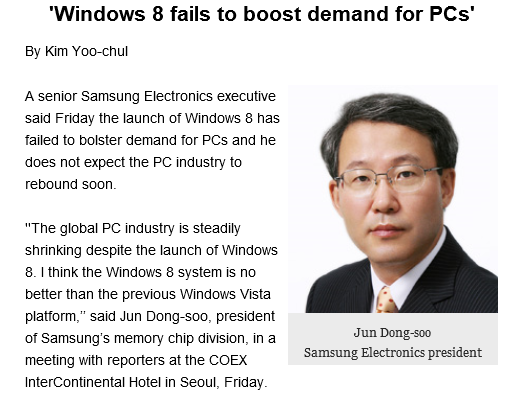
Samsung’s Jun Dong-soo, president of the memory chip division, has likened Windows 8 to Vista and says it has failed to boost PC sales.

”The global PC industry is steadily shrinking despite the launch of Windows 8. I think the Windows 8 system is no better than the previous Windows Vista platform,” he said in a press briefing in Seoul, as reported by the Korea Times. [The link no longer works for me, though the article lives on in Google’s cache].

image

Is he right? I suspect that the tech world from the perspective of a memory chip manufacturer looks different than it does, say, from the perspective of someone considering Microsoft’s Windows strategy more broadly. Has Windows 8 stimulated demand for PCs, and therefore the memory that goes in them? Generally, no.

Equally, just as in the days of Vista, there is plenty of folk wisdom out there advising people to stick with the previous version of Windows, since the new one is more trouble than it is worth.

The parallel is not unreasonable then. Look a bit closer though, and there are as many differences and likenesses. I wondered if this could be expressed as a table, though no doubt there will be debate over the detail and other things that could be included.

  Strategic reasons for failure – necessary annoyances Long-term goal
Windows Vista User Account Control – usability and compatibility problems. Annoying and confusing prompts. Better security in Windows, better behaved applications
  Performance issues, high memory demand caused by Desktop Windows Manager Rich hardware-accelerated graphics, taskbar thumbnails etc
  Bugs and mistakes  
  Stuttering audio caused by poor drivers  
OEM vendors release Vista on underpowered hardware, laden with usual trialware rubbish  
Windows 8 Strategic reasons for failure – necessary annoyances Long-term goal
  Combining new tablet platform with old desktop jarring and confusing for users. Absence of Start menu from desktop disorienting. Establish Windows as a viable tablet platform and one that can plausibly converge with Windows Phone.
  Create ARM build of Windows, locked down so that no new desktop apps can be installed. Windows tablets that benefit from ARM efficiency, are not weighed down with legacy app compatibility issues, and which are more secure and less prone to degrade over time.
  Bugs and mistakes  
  Release Windows 8 with poor Windows Store apps pushing users to desktop alternatives  
  Windows Runtime platform not really ready, too difficult for developers to make great apps  
  Failure to get Windows OEMs and retail channel to understand and promote it as a tablet platform  
  ARM machines including Surface RT too slow; really needs next generation eg Tegra 4  

The point of the above is both positive and negative for Microsoft. On the negative side, it has nobody but itself to blame for some of the problems around the launch of Windows 8. The Windows Runtime platform should have been in a better state for launch, the built-in apps should have been better (especially Mail), and despite ample evidence of the difficulty new users had when first encountering Windows 8, little regard was paid to the problem. OEM and retail partners then compounded the error by simply turning the handle and putting out a bunch of laptops with Windows 8 in place of Windows 7. I regularly see “Windows 8” displays where there is not a single touch-capable machine, which is extraordinary given that support for touch was the primary new feature and goal.

On the other hand, if you look at the pain points in Vista that were strategic rather than blunders, you can see that they did, eventually, succeed. Windows 7 builds on Vista and by general consensus is the best ever version of Windows. While I prefer 8 for various reasons, including its better performance and some useful UI improvements on the desktop side, Windows 7 has the more coherent and satisfying user interface.

The further implication is that the Windows 8 pain may yet prove worthwhile, if Microsoft can fix the annoyances and improve the Windows Runtime platform, and if OEMs can grasp the demand for Windows tablets when done right.

The difficulty with the above is that when Vista came out there was really nowhere to go, other than to the Mac for those looking for high-end personal laptops or desktops (and Vista was generally helpful to Apple). Windows 8 on the other hand has appeared at a time when the PC ecosystem seems under threat from the surge towards mobile and towards Android and iOS tablets. Even if Microsoft gets it right next time, it is unlikely to dominate as before.

Internal Windows Runtime apps are prohibitively expensive to deploy, says Microsoft Regional Director

Now we know why Microsoft has been so reluctant to divulge details of how to deploy a business app that uses the Windows Runtime (also known as Metro apps or Windows Store apps; though in this case the Windows Store app designation is particularly silly since these apps are precisely not Store apps).

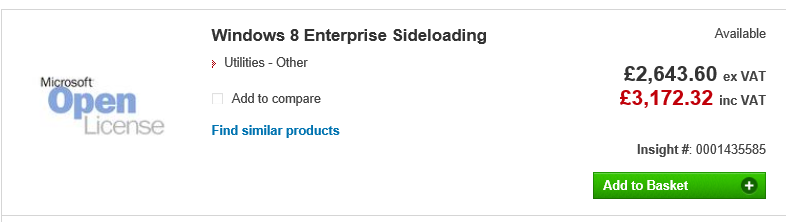
Presuming Windows MVP and Regional Director Rockford Lhotka is correct, a business that wishes to sideload Windows Runtime apps (in other words, to deploy but not via the Windows Store), a business needs to purchase a $30 sideloading key which, by a stroke of marketing genius, is only available in packs of 100.

image

Note the above screen grab shows a price of more than $30.00. I believe this is because Lhotka’s figures do not allow for any reseller markup, though there could be regional differences as well.

Here is what Microsoft’s Antoine Leblond said back in April 2012:

To enable sideloading of a Metro style app onto a PC:

  • Set Group Policy for “Allow all trusted apps to install”. If you cannot use Group Policy, then you can set this through the following setting: HKEY_LOCAL_MACHINE\Software\Policies\Microsoft\Windows\Appx\AllowAllTrustedApps = 1
  • Verify that the app is signed by a CA that is trusted on the target machines
  • Activate a special product key by using a script on the target machine to enable sideloading. We’ll go into more detail about how the IT admin will acquire the product keys in an upcoming blog post. The product key only needs to be install and activated once on the PC.

I have not seen the promised upcoming blog post but would be interested in doing so if anyone has a link?

Sideloading keys are only valid on Windows 8 Pro or Windows 8 Enterprise.

As a further disincentive, if you want to avoid running a PowerShell script on each target machine, you will need either System Center or InTune to manage the PCs. InTune is the cheaper option, at $6.00 per device per month. Lhotka calculates:

Let’s assume that your organization has 100 Windows RT or Windows 8 Pro devices, so you buy $3000 worth of side-loading keys. And let’s assume you use InTune. Finally let’s assume your devices have a 3 year life – which is pretty typical for corporate devices where you buy a service agreement from Lenovo or Dell or another vendor.

These 100 devices will cost $3000 for keys, plus $6 per device per month. This means that your org with 100 devices will pay around $23,000 extra to deploy a WinRT app just for this licensing.

and he concludes:

Right now it appears that Microsoft has worked very hard to devise a licensing and deployment scheme for WinRT apps designed specifically to discourage the creation of any WinRT business apps. Whether this is intentional or accidental I can’t say, but it is surely the case that no responsible business or IT manager could look at these scenarios and think that a move to WinRT for business app development makes sense at this time

That said, I am not sure he is being completely fair. I doubt a business will subscript to InTune just to support sideloading, and for those who do not want to subscribe, running a PowerShell script is not that hard. It seems to me that the problem could be mostly fixed by offering the sideloading keys in smaller packs.

I would add that now is probably not the moment to deploy a Windows Runtime app. The platform is not as good as it should be, and there is a case for waiting for the first major update in my opinion.

Still, $3000 for a licence pack is substantial, especially for a small business with fewer than 100 PCs.

The “Modern UI” side of Windows 8 has not taken off as yet, and a rational approach would be to encourage rather than discourage corporate developers to target the platform.

Note: a Microsoft Regional Director does not work directly for Microsoft. Lhotka works for Magenic. A Regional Director is an independent professional who is recognized for their ability to train and evangelise development on Microsoft’s platform.

Windows Phone 8 enterprise security versus Blackberry 10 Balance and Samsung Knox

How good is Windows Phone 8 security? Actually, pretty good. The key features are described here [pdf]:

  • Trusted Boot prevents booting to an alternative operating system, using the UEFI secure boot standard.
  • Only signed operating system components and apps can run.
  • App sandboxing:

    No communication channels exist between apps on the phone other than through the cloud. Apps are isolated from each other and cannot access memory used or data stored by other applications, including the keyboard cache.

  • Private internal app distribution by businesses who register with Microsoft
  • Password policies set through Exchange ActiveSync (EAS)
  • Built-in device management client
  • Bitlocker encryption when set by EAS RequireDeviceEncryption policy. AES 128 encryption linked to UEFI Trusted Boot.
  • SD card data is not encrypted, but the OS only allows media files to be stored on SD cards.
  • Information Rights Management can prevent documents being edited, printed, or text copied (other than tricks like photographing the screen).
  • Remote Wipe

The security features in Windows Phone 8 are largely based on those in full Windows, since the core operating system is the same. However, devices are more secure since they are not afflicted by the legacy which makes desktop Windows hard to lock down without damaging usability.

While the above sounds good, note that in most cases a simple PIN will get you access to everything. On the other hand, unless the PIN is seen it is not all that insecure, since you can set policies that lock or wipe the phone after a few wrong attempts.

Does Microsoft therefore have a good story versus Blackberry 10 Balance and Samsung Knox, both of which feature secure containers that isolate business apps and data from personal? The approach is different. In Windows Phone the focus is on the whole device, whereas the other two have the concept of segmentation, letting users do what they like (including installation of games and so on) in one segment, while the business gets to control the other.

Windows Phone does in fact have a somewhat similar feature aimed at children. Kids Corner lets you create a "fun" segment containing specified apps and games, sandboxed from the main operating system. While this is currently designed for children borrowing your phone, you can see how it could be adapted to create a personal/business split if Microsoft chose to do so.

For the time being though, you might worry about the potential for users to install a malicious app or game that manages to exploit a bug in Windows Phone and compromise security.

Even if the business can lock down the device so that users cannot install apps, this impairs the user experience to the extent that most users will want another phone for personal use. The attraction of the Blackberry and Samsung approach is the way it combines user freedom with business security.

Is Microsoft doing a good job of articulating the enterprise features of Windows Phone 8? That is a hard question to answer; but my observation is that Nokia, the main Windows Phone vendor, seems to focus more on consumer features like the camera and music, or general features like maps and turn by turn navigation. Enterprise features are hardly mentioned on the Nokia stand here at Mobile World Congress in Barcelona, while Microsoft does not have a stand at all. On the other hand, you would think that the company’s strong partner ecosystem would be effective in communicating the presence of these features to enterprises.

Power shifts at Mobile World Congress: Samsung rises, Apple absent, Google hidden, Microsoft missing

Mobile World Congress, now under way in Barcelona, is a big event. Exact numbers are not available, but I have heard talk of 70,000 trade attendees; it is not something you can safely ignore if you have a presence in the mobile industry.

image

Nevertheless Apple chooses to ignore it, preferring its own exclusive events. This is a strategy that has worked in the past, but this year it may be less clever. Several have said to me that Apple is falling behind, being too slow to innovate its iOS device family. Of course many here are using Apple devices, but the momentum for now is elsewhere, though one magical announcement could change that any time.

Samsung on the other hand has the biggest stand here (actually several stands) and is everywhere. The underlying story is how Samsung is moving on from being an Android device vendor and focusing on Samsung-specific features. In the consumer world that means hooks into Samsung TVs or its new HomeSync media box with a Terabyte of storage, intended to be the place for all your music and video, as well as enabling Android games in your living room.

The bigger Samsung news though is its enterprise offering, called Knox, which creates a secure, encrypted container on your Samsung smartphone or tablet exclusively for business use. IT admins have full control over access and app deployment. This is the same approach used by Blackberry with the Balance feature in its new Blackberry 10 devices. Knox is implemented by third-parties, and links with Active Directory, making this an attractive proposition for businesses getting to grips with the challenge of mobile device management.

Crucially, Knox works only with Samsung devices. It is based on a secure edition of Linux and includes a hardware element so that other device vendors cannot implement Knox, though they could create their own similar system.

Blackberry on the other hand has not taken a stand at this event. Instead, it has parked itself in a hotel across the road, which its staff informally call Blackberry Towers. The symbolism is unfortunate. Last year it had a big stand; this year it is out of the mainstream. Blackberry’s new devices look good but its key business selling point is Balance, which means it will not be happy about Samsung’s Knox.

Microsoft is a puzzle, as is not uncommon for the company. Via Windows Phone it is a premier sponsor (which I imagine means a ton of cost) but does not have a stand. Windows Phone is mainly represented by Nokia, though it can be glimpsed elsewhere such as on the HTC stand. This is a company that wants to convince us that it is a serious force in mobile? Windows 8 is meant to be a new start on tablets; so where is Surface RT or Surface Pro?

I also wonder if the company has left it too late to establish Windows Phone as the best choice for secure mobility. I have been talking to Centrify here at Mobile World Congress, one of the third-parties implementing Knox solutions. Everything in a Centrify Knox deployment is controlled by Active Directory, and it forms an elegant and secure option for enterprises who want to give employees the freedom of a personal device combined with the security and manageability of a mobile device. I also saw how app developers can query Active Directory attributes on Knox Android devices just as they would with a Windows application.

So where is Microsoft with its enterprise smartphone story? It has all the pieces, including Active Directory itself, Bitlocker for device encryption, and System Center for management, but it has not yet assembled them for Windows Phone.

At least it is better than last year when it ran embarrassing "smoked by Windows Phone" demos.

Google is another puzzle. Last year a huge stand and a hall dedicated to Android; this year, nothing. Android may have won the mobile OS wars, but do initiatives like Knox show how Google is failing to reap the benefits? Possibly. It does seem to me that Google is now engaged in differentiating its own products and services from what you might call generic Android; and its absence from Mobile World Congress is likely part of that effort.

Cross-platform frameworks ordered by percentage of shared code

Following my piece on different approaches to building the user interface in cross-platform frameworks, twitter user Sam Hogarth pointed me to the PropertyCross project. This implements a non-trivial application in 8 different cross-platform tools, covering Android, iOS and Windows Phone. Note that only four of the frameworks support Windows Phone.

Using the pie charts presented for each framework, I was able to order them by percentage of shared code as follows:

1= Adobe AIR (100%), JQTouch (100%) , RhoMobile (100%), Sencha Touch (100%)

5. Appcelerator Titanium (around 90%)

6. JQuery Mobile (around 80%)

7. Xamarin (around 40%)

8. Native (0%)

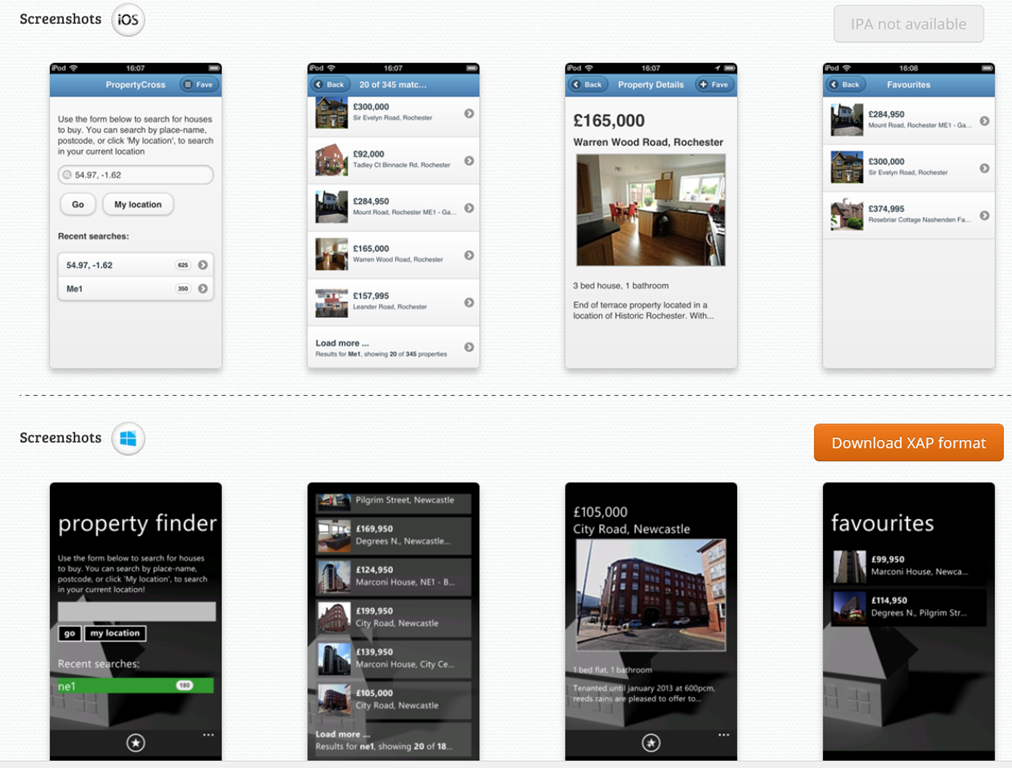
A couple of notes. Of the 100% frameworks, three do not support Windows Phone, and the one which does (Rhomobile) seems to be a bit broken on Windows Phone, judging by the screenshots. The Property Details and Favourites pages do not render properly.

You would get more code sharing with Xamarin if you only supported two rather than three platforms. That is logical: since it does not abstract the GUI.

In most cases (not Rhomobile) it is striking how different Windows Phone appears versus iOS and Android, even with jQuery Mobile which uses HTML5.

image

Windows Phone 7.8 Live Tiles are buggy, say users

When Microsoft announced Windows Phone 8, one disappointment was that existing phones would not be upgraded to the new mobile operating system. In mitigation, Microsoft promised Windows Phone 7.8 instead, an upgrade to Windows Phone 7.5 that implements the most visible feature of WP8, a new Start screen with more flexible live tiles that can be sized small and other new features.

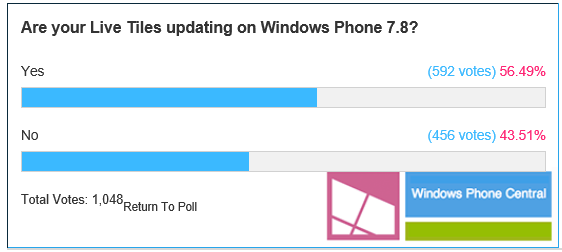
Some users are now receiving 7.8 upgrades, but the news is not all good. According to reports on the Windows Phone Central forum, many users find that the Live Tiles are not refreshing correctly after the upgrade.

image

The idea of Live Tiles is that they refresh in the background with the latest data, such as news alerts or incoming emails.

Developers Heathcliff writes in detail about the problem. He describes three methods to update a Live Tile. The basic ShellTile.Update method works OK, he says. However, if you use an external URL to update a tile, using ShellTileSchedule.Start, it “behaves erratically” and may trigger a problem that drains your battery and makes excessive use of your data connection. Finally, HttpNotificationChannel.BindToShellTile, which uses Microsoft’s notification servers, does not seem to work at all.

On WP 7.5 this method just works as expected. I actually hope I did something wrong here. Or else I don’t understand how this could ever get past the Microsoft Quality Assurance department.

he says.

Finally, users also complain of slower performance after the update, which makes starting apps more laggy.

If Microsoft has put more effort into its new Windows Phone 8 operating system than into an update for existing user, that is understandable, but short-sighted. Those existing users are the best possible evangelists for the platform as well as potential repeat customers; and Windows Phone with its tiny 2.6 per cent global market share, according to IDC, needs all the help it can get.

That said, with decent new WP8 phones like the Nokia 620 available cheaply (O2 in the UK offered this for £120 pay as you go earlier this week), existing Windows Phone 7 users who want to stay up to date are better off buying a new device.

Windows 8: Forget Surface Pro, what matters is the app platform

Microsoft has launched Surface Pro, its own-brand Windows 8 tablet, causing the usual agitation.

  • The 128GB model is sold out online, but has it sold well, or did Microsoft only make a few?
  • Is it too expensive for the spec?
  • Is the battery life too poor?
  • Can you type properly with it on your lap?

All reasonable questions, but to me rather unimportant.

When Microsoft “reimagined” Windows, its goal was to establish its operating system as a new tablet platform. Otherwise, there would have been no sense in upsetting millions of Windows users who were broadly happy with Windows 7, by imposing a new touch-friendly, blocky, mainly single-tasking platform on top of the old familiar Windows.

How is it doing so far? Not well. The reviews for Surface Pro are a symptom of this. It is being treated mainly as an Ultrabook with a detachable keyboard rather than as a tablet. That is a shame, since Surface (RT and Pro) is designed to be tablet-first, with the keyboard cleverly designed into the cover to mitigate the difficulty of using touch alone when you have to use desktop apps.

There are several reasons why Surface is seen as a kind of laptop rather than as a tablet.

First, Microsoft has so far failed to change the way Windows is perceived. People buy Windows devices to run Windows apps, by which they mean Microsoft Office, Skyrim, Foobar2000, and/or their corporate apps written in Visual Basic or C#. The existence of the new Windows Runtime platform is incidental and mainly annoying, since it can get in the way if you only want to run Windows.

This could soon change if there were numerous compelling apps on the new platform; but there are not, and that is reason number two. Which Windows Store apps are better (presuming you have a tablet) than their desktop equivalent, or which are great apps that have no desktop equivalent? It is a short list. Personally I would name the Wordament game, Maps, and the Weather app as examples; and yes, I know how lame that sounds.

Microsoft slipped up badly by spending so little effort on the built-in apps, especially Mail, but also Music and others. The result is that users spend little time in the new user interface (I am guessing but have anecdotal evidence). The further result is that the platform is unattractive to developers, despite the size of the Windows market.

Take a look at the MetroStore Scanner  and you can see that around two hundred apps are added most days (green is updates rather than additions).

image

That in itself does not tell us much. Just one hundred great new apps would be fantastic news for the platform. But no, they are mostly trivial and/or poor and/or repetitive and/or uninteresting.

Why are developers not building more and better apps? That indeed is the question. The main reason of course is that size of the market, not in terms of the numbers of Windows 8 users out there, but in terms of likely sales or adoption.

This is circular though. Good apps will increase the size of the market. So what else?

My views on this changed when I sat down to build my own app, simple though it is. This was harder than I expected, and there is still a z-order bug which I have not got round to fixing. A core question though is this: does the platform help developers to build apps that delight the user? In this respect it is not yet good enough. The kind of app you will build if you follow all the guidelines will be genuinely touch-friendly, but look a bit blocky and spaced out too much. There is also the problem of the disappearing menu bar and the fact that users do not always discover options hidden in the Charms bar. It is too easy to build apps that are not good enough. I regard the poor quality of apps like Mail as evidence of this.

Put another way, it is not yet a platform that inspires developers and makes them want to support it, despite its immaturity.

Windows 8 is not going well then; but I do not write it off. Better apps surely will appear. Further, Microsoft’s next go at this, whether it is called Blue or Windows 8.5 or Windows 9, should be better as the team fix annoyances and add compelling features.

As yet though, there is no sign of Microsoft averting the march of Windows towards being a business-oriented, desktop platform occupying an ever-smaller niche in a world of mobile and browser apps. If I were CEO Steve Ballmer, I would find that a concern.

Microsoft Dynamics CRM 2011 hassles: asynchronous processing service stopped

I installed Microsoft Dynamics CRM 2011 a few days ago – rarely a straightforward task, thanks to Active Directory dependencies and the complexities of Windows security. There also seem to be unfixed bugs in the setup. For example, I always find that the trace directory is incorrectly configured and has to be fixed via PowerShell, even with a new install on a new installation of Windows Server 2008 R2.

Never mind. This time I came across a new problem. After a successful install, users reported errors in scheduled jobs and imports. An attempted import resulted in the message Waiting for Resources.

The problem was that the two CRM Asynchronous Processing Services were not running. Start them manually, and everything works.

The event log reported Event ID 7000 after the last reboot – “the service did not respond to the start or control request in a timely fashion”.

The solution in my case was to set the start action on these services to Automatic (Delayed Start). They now start OK after a reboot.

I suspect this problem may be related to update rollup 12, since the very same problem appeared on another Dynamics CRM 2011 install after applying this.

I also wonder if the fact that SQL Server is on the same VM is related. If CRM starts before SQL Server is fully running, you get this kind of problem.

Office 2013 annoyances: Avoiding the Backstage, slow typing in SkyDrive

I have been using Microsoft Office 2013 since the first public previews. It is a high quality release, though washed-out in appearance, but there is one thing I find annoying.

In previous versions of Office, if you start a new document and hit Save you get a Save As dialog pointing at your default save location. Type a document name, press Enter and you are done.

In Office 2013, the same steps open the Backstage, a full window view where you have first to select a location. You cannot type a document name immediately, even if you are saving to your default folder.

image

It is only one or two extra clicks, but it is annoying.

The fix is to go to File – Options and check Don’t show the Backstage when opening or saving files.

image

Now Save works in the same way as before.

If you also check Save to Computer by default, it will no longer try to save in SkyDrive every time.

This reminds me of another problem, which I doubt is unique to me. I like using SkyDrive, but there is something broken about the way Office communicates with SkyDrive. It seems to be chatty, checking perhaps whether another person is editing the online version of the document. The consequence is that sometimes (but not always) editing in Word slows to a crawl. You have to wait after each keystroke for the letter to appear. Usually this problem appears only after I have been working in a document for a while. The workaround I have found is to Save As to a local folder, and to remember to put your updated version back on SkyDrive afterwards.

Maybe there is a fix for this behaviour as well. If you know of one, please comment below.

Microsoft financials: record revenue, signs of Windows 8 concern

Yesterday Microsoft released its financial figures for the last three months of 2012.

Quarter ending December 31st 2012 vs quarter ending December 31st 2011, $millions

Segment Revenue Change Profit Change
Client (Windows + Live) 5881 +1140 3296 +416
Server and Tools 5186 +171 2121 +409
Online 869 +85 -283 +176
Business (Office) 5691 -619 3565 -623
Entertainment and devices 3772 -466 596 +79

Although Microsoft reported record revenue, I do not consider these figures all that revealing. The transcript of the earnings call is more to the point. A few notable remarks from CFO Peter Klein and General Manager Investor Relations Chris Suh

  • 60 million Windows 8 licenses sold and 100 million apps downloaded. At 1.66 apps per license that shows lack of interest in the new Windows Store and raises suspicions that some of those sales may actually be downgraded to Windows 7. The remarks from Klein confirm that the new platform is off to a slow start:

It’s early days and an ambitious endeavor like this takes time. Together with our partners, we remain focused on fully delivering the promise of Windows 8.

While the number of apps in the Windows Store has quadrupled since launch, we clearly have more work to do. We need more rich, immersive apps that give users’ access to content that informs, entertains and inspires.

  • Suh states that Windows is selling better to businesses than consumers. Declining interest from consumers is obvious if you walk around a few retailers selling Windows PCs:

Within the x86 PC market, we saw similar trends to prior quarters, with emerging markets outperforming developed markets, and business outperforming consumer. The consumer segment was most impacted by the ecosystem transition, as demand exceeded the limited assortment of touch devices available.

  • System Center 18% revenue growth
  • SQL Server revenue 16% growth
  • Online revenue (this is Bing not Azure) up 11%
  • Windows Phone sales 4 times higher than last year
  • Skype calls up 59%

The company says little about Office 365 and Azure, but my perception is that both are growing fast though how significant they are versus traditional software license sales is less clear.

Trouble ahead? With Windows 8 struggling for acceptance, Office under threat from online and device alternatives, the games console business (overall not just Microsoft) probably in permanent decline, and Windows Phone not yet quite mainstream, you would think so. On the other hand, this is a company with a broad and deep product range and looking at the solid performance of the server products and continuing strength of Windows and Office in business, we may continue to be surprised at its resilience.