Tag Archives: microsoft

Windows 8 Release Preview now available, Adobe Flash included, finished version expected August 2012

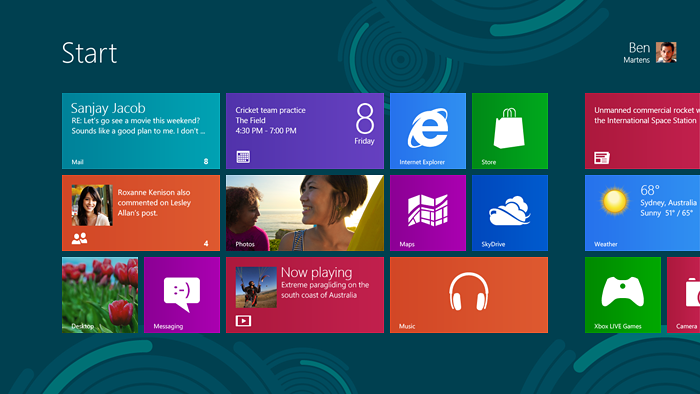
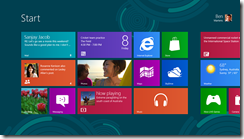
Microsoft has made the Release Preview of Windows 8 available to download. So what’s new?

image

The press release:

  • Confirms that a “touch-friendly and power-optimized Adobe Flash Player” is integrated into Internet Explorer 10
  • Announces new Family Safety features
  • States that IE10 is “Do not track” by default
  • Announces new apps and improvements to existing ones

All of which will come as a disappointment to those hoping for any sort of change of direction following a mixed-to-negative reception for the Consumer Preview.

Windows chief Steven Sinofsky says:

If the feedback and telemetry on Windows 8 and Windows RT match our expectations, then we will enter the final phases of the RTM process in about 2 months.

My guess that feedback along the lines of “Bring back the Start menu” will not count as an obstacle.

The application that would not uninstall

I install a ton of pre-release and test software so it is not surprising that I sometimes run into Windows Installer issues. Here is an entertaining error though. It is unlikely, I guess, that you will hit this problem; but I present it as an illustration of what can go wrong, as we move into the era of locked-down operating systems and easy app installs. Though even these are not perfect. Notice how the operating system fights me all the way.

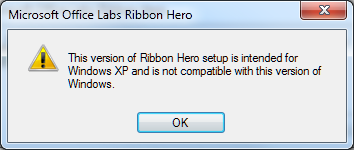
Years ago I installed Microsoft’s Office Labs Ribbon Hero, a tutorial add-on for Office. At the time I was running Windows Vista. Since then I have done an in-place upgrade to Windows 7. I tried to remove it today through Control Panel and got this message:

image

After presenting this information setup closed and the application was not uninstalled.

So … the application does not support Windows 7 and therefore you cannot remove it. Clever, and I found this a tricky problem to get around.

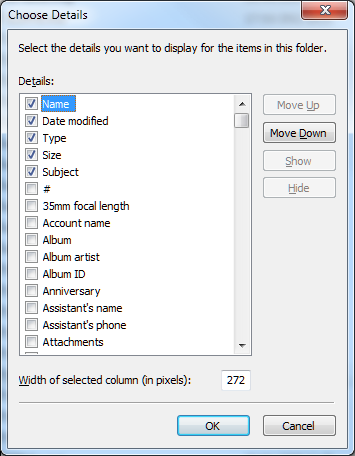
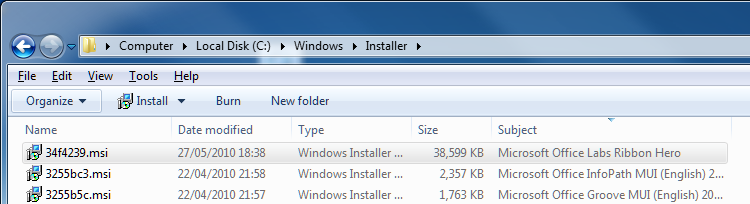
I took a look at the Windows installer files which you can find in %SYSTEMROOT%\Installer. All the msi files have random names. However, you can right-click the column heading area and choose More, then check Subject in the list. Click OK, and now the application to which each msi relates appears.

image

Now you can click the column heading to sort by subject and find the problem msi.

image

I copied the msi to my desktop.

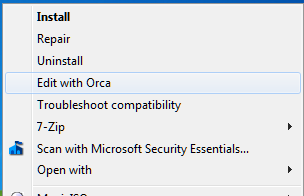
For the next step you need the Orca tool from the Windows Installer SDK. If Orca is installed, you can right-click the MSI and choose Edit with Orca.

image

I then selected LaunchCondition and deleted the launch condition that required Windows XP.

INSTALLED OR VersionNT = 501 OR APPLYING_AUTOUPDATE

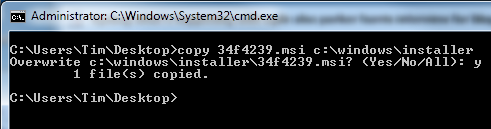
Hmm, something odd here as it should pass INSTALLED? Still, save, right-click the msi, choose Uninstall. You still hit the error. Why? Somehow, Windows works out that you are uninstalling a product for which an msi exists in the official location and uses that one instead. You have to copy your modified msi to the correct location. Open an administrator command prompt:

image

Now right-click the msi and choose Uninstall.

It worked. Phew.

Making sense of Microsoft’s Windows 8 strategy

Here are two things we learn from Jensen Harris’s post of 18 May.
image

First, Microsoft cares more about WinRT and Metro, the new tablet-oriented user interface in Windows 8, than about the desktop. In the section entitled Goals of the Windows 8 user experience, Harris refers almost exclusively to WinRT apps. Further, he asks the question: what is the role of desktop in Windows 8?

It is pretty straightforward. The desktop is there to run the millions of existing, powerful, familiar Windows programs that are designed for mouse and keyboard. Office. Visual Studio. Adobe Photoshop. AutoCAD. Lightroom. This software is widely-used, feature-rich, and powers the bulk of the work people do on the PC today.

Does that mean the desktop is for legacy, like XP Mode in Windows 7? Harris denies it:

We do not view the desktop as a mode, legacy or otherwise—it is simply a paradigm for working that suits some people and specific apps.

He adds though that “We think in a short time everyone will mix and match” desktop and Metro apps – though he does not call them Metro apps, he calls them “new Windows 8 apps.”

Second, Microsoft considers that the poor reaction to the Consumer Preview can be fixed by tweaking the detail rather than by changing the substance of how Windows 8 is designed.

But fundamentally, we believe in people and their ability to adapt and move forward. Throughout the history of computing, people have again and again adapted to new paradigms and interaction methods—even just when switching between different websites and apps and phones. We will help people get off on the right foot, and we have confidence that people will quickly find the new paradigms to be second-nature.

In fact, this post is peppered with references to negative reactions for previous versions of Windows. Microsoft is presuming that this is normal and that history will repeat:

Although some people had critical reactions and demanded changes to the user interface, Windows 7 quickly became the most-used OS in the world.

This is revisionist, as I am sure Harris and his team are aware. The reaction to Windows 7 was mainly positive, from the earliest preview on. It was better than Windows Vista; it was better than Windows XP.

Windows Vista on the other hand had a troubled launch and was widely disliked. User Account Control and its constant approval prompts was part of the problem, but more serious was that OEMs released Vista machines with underpowered hardware further slowed down by foistware and in many cases it Vista worked badly out of the box. You could get Vista working nicely with sufficient effort, but many just stayed with Windows XP.

The failure of Vista was damaging to Microsoft, but mitigated in that most users simply skipped a version and waited for Windows 7. The situation now is more serious for Microsoft, both because of the continuing popularity of the Mac and the rise of tablets, especially Apple’s iPad.

It is precisely because of that threat that Microsoft is making such a big bet on Metro and WinRT. The reasoning is that while shipping a build of Windows that improves on 7 would please the Microsoft platform community, it would be ineffective in countering the iPad. It would also fail to address problems inherent in Windows: lack of isolation between applications, and between applications and the operating system; the complexity of application installs and the difficulty of troubleshooting them when they go wrong; and the unsuitability of Windows for touch control.

There is also a hint in this most recent post that classic Windows uses too much power:

Once we understood how important great battery life was, certain aspects of the new experience became clear. For instance, it became obvious early on in the planning process that to truly reimagine the Windows experience we would need to reimagine apps as well. Thus, WinRT and a new kind of app were born.

Another key point: Microsoft’s partnership with hardware manufacturers has become a problem, since they damage the user experience with trialware and low quality utilities. The Metro-style side of Windows 8 fixes that by offering a locked-down environment. This will be most fully realised in Windows RT, Windows on ARM, which only allows WinRT apps to be installed.

Microsoft decided that only a new generation of Windows, a “reimagining”, would be able to compete in the era of BYOD (Bring Your Own Device).

One thing is for sure: the Windows team under Steven Sinofsky does not lack courage. They have form too. Many of the key players worked on the Office 2007 Ribbon UI, which was also controversial at the time, since it removed the familiar drop-down menus that had been in every previous version of Office. They stuck by their decision, and refused to add an option to restore the menus, thereby forcing users to use the ribbon even if they disliked it. That strategy was mostly successful. Users got used to the ribbon, and there was no mass refusal to upgrade from Office 2003, nor a substantial migration to OpenOffice which still has drop-down menus.

I have an open mind about Windows 8. I see the reasoning behind it, and agree that it works better on a real tablet than on a traditional PC or laptop, or worst of all, a virtual machine. Harris says:

The full picture of the Windows 8 experience will only emerge when new hardware from our partners becomes available, and when the Store opens up for all developers to start submitting their new apps.

Agreed; but it also seems that Windows 8 will ship with a number of annoyances which at the moment Microsoft looks unlikely to fix. These are mainly in the integration, or lack of it, between the Metro-style UI and the desktop. I can live without the Start menu, but will miss the taskbar with its guide to running applications and its preview thumbnails; these remain in the desktop but do not include Metro apps. Having only full-screen apps can be irritation, and I wonder if the commitment to the single-app “immersive UI” has been taken too far. When working in Windows 8 I miss the little clock that sits in the notification area; you have to swipe to see the equivalent and the fast and fluid UI is making me work harder than before.

I believe Microsoft will listen to complaints like these, but probably not until Windows 9. I also believe that by the time Windows 9 comes around the computing landscape will look very different; and the reception won by Windows 8 will be a significant factor in how it is shaped.
Microsoft appeals to Windows 8 Metro developers not to stray from the official API

Microsoft’s John Hazen has posted on the official Building Windows 8 blog about the security and reliability principles in the Metro platform in Windows 8. Hazen explains how apps are installed from the Windows store, use contracts to interact with the operating system, and have to ask user consent for access to device capabilities such as the webcam or GPS, or to access user data such as documents and music.

The most intriguing part of the document comes when Hazen appeals to developers to stick to the API that is referenced in the official Windows 8 Metro SDK:

Resist the temptation to find ways to invoke APIs that are not included in the SDK. This ultimately undermines the expectations that customers have for your app. APIs that are outside the SDK are not guaranteed to work with Metro style apps either in this release or in future releases, so you may find that your app doesn’t function properly for all customers. These APIs may also not function properly in the async environment that is foundational to Metro style app design. Finally these APIs may undermine customer confidence by accessing resources or data that Metro style apps would not normally interact with. For all these reasons, we have provided checks in the Windows App Certification Kit to help you catch places where you might have inadvertently called interfaces not exposed by the SDK.

While it is possible to hide or obfuscate calls to APIs that are not included in the SDK, this is still a violation of customer expectations and Store policy. In the end, we have created this platform to help developers like you to build amazing apps that work well with the system and with other apps and devices to delight customers. Working with the Metro style SDK is fundamental to your realizing that goal.

The worrying aspect of this appeal to developers to play nice is Hazen’s admission that crafty developers may find ways to escape the Metro sandbox, undermining both the security and the privacy protection built into Metro. The main protection against this is such such an app should be blocked from the Windows Store, but can Microsoft check with 100% confidence that no hidden or obfuscated API calls exist? How effective is the Metro sandbox?

My guess is that the danger will be greater on the x86 version of Windows 8 than in Windows RT, which is locked down to prevent any third-party desktop applications from being installed. Nevertheless, a large part of the non-Metro Windows API must exist in Windows RT, to support the desktop, Explorer and Microsoft Office.

NVIDIA’s GPU in the cloud: will you still want an Xbox or PlayStation?

NVIDIA’s GPU Technology conference is an unusual event, in part a get-together for academic researchers using HPC, in part a marketing pitch for the company. The focus of the event is on GPU computing, in other words using the GPU for purposes other than driving a display, such as processing simulations to model climate change or fluid dynamics, or to process huge amounts of data in order to calculate where best to drill for oil. However NVIDIA also uses the event to announce its latest GPU innovations, and CEO Jen-Hsun Huang used this morning’s keynote to introduce its GPU in the cloud initiative.

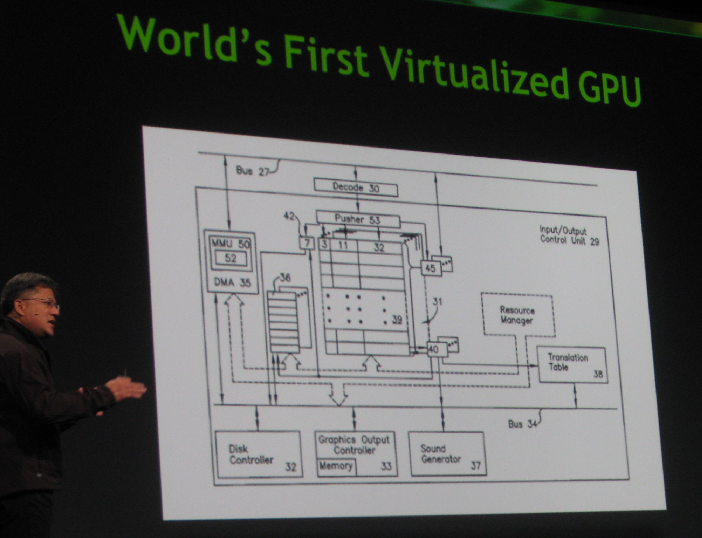
This takes two forms, though both are based on a feature of the new “Kepler” wave of NVIDIA GPUs which allows them to render graphics to a stream rather than to a display. It is the world’s first virtualized GPU, he claimed.

image

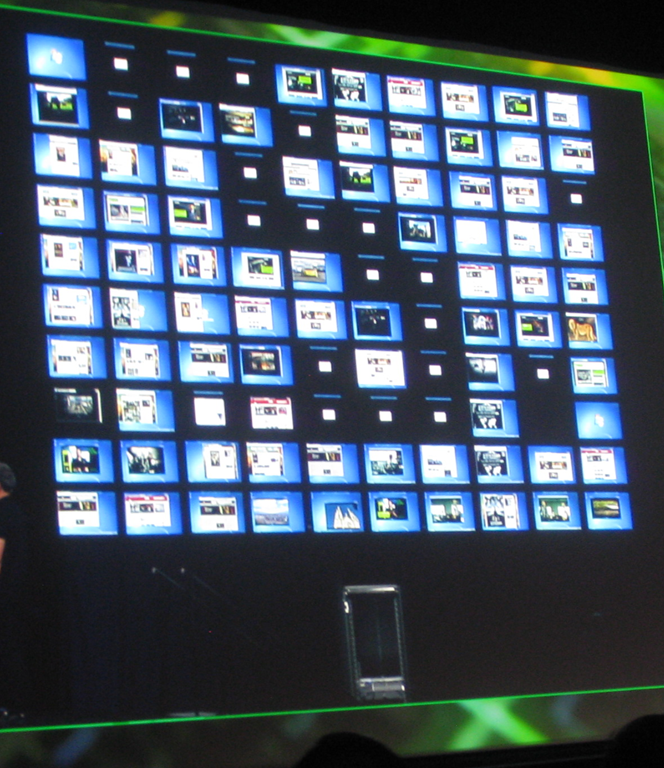
The first target is enterprise VDI (Virtual Desktop Infrastructure). The idea is that in the era of BYOD (Bring Your Own Device) there is high demand for the ability to run Windows applications on devices of every kind, perhaps especially Apple iPads. This works fine via virtualisation for everyday applications, but what about GPU-intensive applications such as Autocad or Adobe Photoshop? Using a Kepler GPU you can run up to 100 virtual desktop instances with GPU acceleration. NVIDIA calls this the VGX Platform.

image

What actually gets sent to the client is mostly H.264 video, which means most current devices have good support, though of course you still need a remote desktop client.

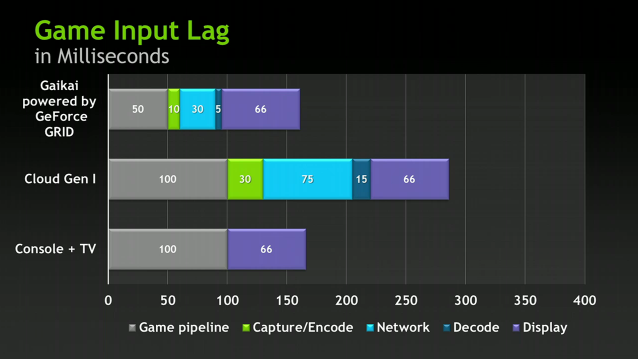
The second target is game streaming. The key problem here – provided you have enough bandwidth – is minimising the lag between when a player moves or clicks Fire, and when the video responds. NVIDIA has developed software called the Geforce GRID which it will supply along with specially adapted Kepler GPUs to cloud companies such as Gaikai. Using the Geforce GRID, lag is reduced, according to NVIDIA, to something close to what you would get from a game console.

image

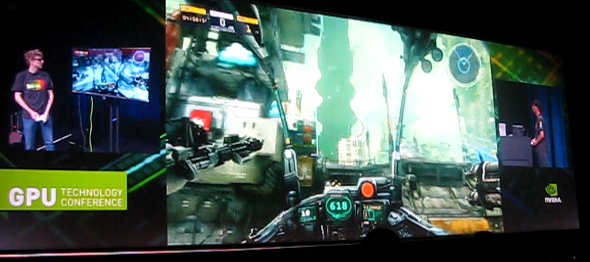
We saw a demo of a new Mech shooter game in which one player is using an Asus Transformer Prime, an Android tablet, and the other an LG television which has a streaming client built in. The game is rendered in the cloud but streamed to the clients with low latency.

image

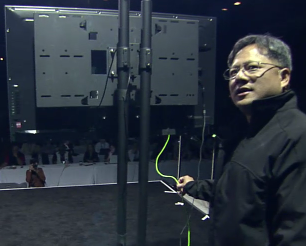
“This is your game console,” said NVIDIA CEO Jen-Sun Huang, holding the Ethernet cable that connected the TV to the internet.

image

The concept is attractive for all sorts of reasons. Users can play games without having to download and install, or connect instantly to a game being played by a friend. Game companies are protected from piracy, because the game code runs in the cloud, not on the device.

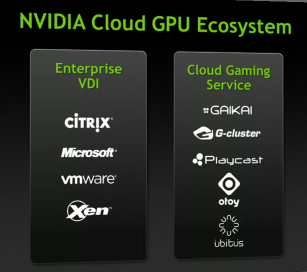
NVIDIA does not plan to run its own cloud services, but is working with partners, as the following slide illustrates. On the VDI side, Citrix, Microsoft, VMWare and Xen were mentioned as partners.

image

If cloud GPU systems take off, will it cannibalise the market for powerful GPUs in client devices, whether PCs, game consoles or tablets? I put this to Huang in the press Q&A after the keynote, and he denied it, saying that people like designers hate to share their PCs. It was an odd and unsatisfactory answer. After all, if Huang is saying that your games console is now an Ethernet cable, he is also saying that there is no need any longer for game consoles which contain powerful NVIDIA GPUs. The same might apply to professional workstations, with the logic that cloud computing always presents: that shared resources have better utilisation and therefore lower cost.

Fast service at Microsoft store in San Jose

I made a brief visit to the Valley Fair mall in San Jose yesterday and took a quick look at the Microsoft and Apple stores.

Personally I like the Microsoft stores. It is probably not the cheapest place to buy a Windows machine, but you do get the Signature install which as Microsoft notes:

Many new PCs come filled with lots of trialware and sample software that slows your computer down—removing all that is a pain, so we do it for you!

So much for the famous Windows partner ecosystem, eh! But I reckon this is worth the extra cost for most people.

Now, before looking at the following images, which were just snapped as I passed, note that:

1. It was a quiet Monday afternoon and none of the stores was busy.

2. I guess San Jose is Apple land; certainly I have not seen the Seattle store this quiet.

Nevertheless, there did seem to be a mismatch between the numbers of staff and customers. When I went in I was offered help three times and a free drink once.

The guy in yellow at the front left is protesting about some alleged Microsoft misdemeanour.

image

The Apple store was not exactly heaving and there were plenty of blue shirts, but a few more customers.

image

Review: Digital Wars by Charles Arthur

Subtitled Apple, Google, Microsoft and the battle for the internet, this is an account by the Guardian’s Technology Editor of the progress of three tech titans between 1998 and the present day. In 1998, Google was just getting started, Apple was at the beginning of its recovery under the returning CEO Steve Jobs, and Microsoft dominated PCs and was busy crushing Netscape.

Here is how the market capitalization of the three changed between 1998 and 2011:

  End 1998 Mid 2011
Apple $5.4 billion $346.7 billion
Google $10 million $185.1 billion
Microsoft $344.6 billion $214.3 billion

This book tells the story behind that dramatic change in fortunes. It is a great read, written in a concise, clear and engaging style, and informed by the author’s close observation of the technology industry over that period.

That said, it is Apple that gets the best quality coverage here, not only because it is the biggest winner, but also because it is the company for which Arthur feels most affinity. When it comes to Microsoft the book focuses mainly on the company’s big failures in search, digital music and smartphones, but although these failures are well described, the question of why it has performed so badly is not fully articulated, though there is reference to the impact of antitrust legislation and an unflattering portrayal of CEO Steve Ballmer. The inner workings of Google are even less visible and if your main interest is the ascent of Google you should look elsewhere.

Leaving aside Google then, describing the success of Apple alongside Microsoft’s colossal blunders makes compelling reading. Arthur is perhaps a little unfair to Microsoft, because he skips over some of the company’s better moments, such as the success of Windows 7 and Windows Server, or even the Xbox 360, though he would argue I think that those successes are peripheral to his theme which is internet and mobile.

The heart of the book is in chapters four, on digital music, and five, on smartphones. The iPod, after all, was the forerunner of the Apple iPhone, and the iPhone was the forerunner of the iPad. Microsoft’s famous ecosystem of third-party hardware partners failed to compete with the Ipod, and by the time the company got it mostly right by abandoning its partners and creating the Zune, it was too late.

The smartphone story played out even worse for Microsoft, given that this was a market where it already had significant presence with Windows Mobile. Arthur describes the launch of the iPhone, and then recounts how Microsoft acquired a great mobile phone team with a company called Danger, and proceeded to destroy it. The Danger/Pink episode shows more than any other how broken is Microsoft’s management and mobile strategy. Danger was acquired in February 2008. There was then, Arthur describes, an internal battle between the Windows Mobile team and the Danger team, won by the Windows Mobile team under Andy Lees, and resulting in 18 months delay while the Danger operating system was rewritten to use Windows CE. By the time the first new “Project Pink” phone was delivered it was short on features and no longer wanted by Verizon, the partner operator. The “Kin” phone was on the market for only 48 days.

The Kin story was dysfunctional Microsoft at its worst, a huge waste of money and effort, and could have broken a smaller company. Microsoft shrugged it off, showing that its Windows and Office cash cows continue to insulate it against incompetence, probably too much for its own long-tem health.

Finally, the book leaves the reader wondering how the story continues. Arthur gets the significance of the iPad in business:

Cook would reel off statistics about the number of Fortune 500 companies ‘testing or deploying’ iPads, of banks and brokers that were trying it, and of serious apps being written for it. Apple was going, ever so quietly, after the business computing market – the one that had belonged for years to Microsoft.

Since he wrote those words that trend has increased, forming a large part of what is called Bring Your Own Device or The Consumerization of IT. Microsoft does have what it hopes is an answer, which is Windows 8, under a team led by the same Steven Sinofsky who made a success of Windows 7. The task is more challenging this time round though: Windows 7 was an improved version of Windows Vista, whereas Windows 8 is a radical new departure, at least in respect of its Metro user interface which is for the Tablet market. If Windows 8 fares as badly against the iPad as Plays for Sure fared against the iPod, then expect further decline in Microsoft’s market value.


System Center 2012, Windows 8 and the BYOD revolution

Yesterday I attended a UK Microsoft MMS catch-up session in Manchester, aimed at those who could not make it to Las Vegas last month. The subject was the new System Center 2012, and how it fits with Microsoft’s concept of the private cloud, and its strategy for supporting Bring Your Own Device (BYOD), the proliferation of mobile devices on which users now expect to be able to receive work email and do other work.

The session, I have to say, was on the dry side; but taken on its own terms System Center 2012 looks good. I was particularly interested in how Microsoft defines “private cloud” versus just a bunch of virtual machines (JBVM?). Attendees where told that a private cloud has four characteristics:

  • Pooled resources: an enterprise cloud, not dedicated servers for each department.
  • Self service: users (who might also be admins) can get new server resources on demand.
  • Elasticity: apps that scale on demand.
  • Usage based: could be charge-back, but more often show-back, the ability to report on what resources each user is consuming.

Microsoft’s virtualization platform is based on Hyper-V, which we were assured now represents 28% of new server virtual machines, but System Center has some support for VMWare and Citrix Xen as well.

System Center now consists of eight major components:

  • Virtual Machine Manager: manage your private cloud
  • Configuration Manager (SCCM): deploy client applications, manage your mobile devices
  • Operations Manager: monitor network and application health
  • Data Protection Manager: backup, not much mentioned
  • Service Manager: Help desk and change management, not much mentioned
  • Orchestrator: a newish product acquired from Opalis in 2009, automates tasks and is critical for self-service
  • App Controller: manage applications on your cloud
  • Endpoint protection: anti-malware, praised occasionally but not really presented yesterday

I will not bore you by going through this blow by blow, but I do have some observations.

First, in a Microsoft-platform world System Center makes a lot of sense for large organisations who do not want public cloud and who want to move to the next stage in managing their servers and clients without radically changing their approach.

Following on from that, System Center meets some of the requirements Microsoft laid out as the start of the session, but not all. In particular, it is weak on elasticity. Microsoft needs something like Amazon’s Elastic Beanstalk which lets you deploy an application, set a minimum and maximum instance count, and have the platform handle the mechanics of load balancing and scaling up and down on demand. You can do it on System Center, we were told, if you can write a bunch of scripts to make it work. At some future point Orchestrator will get auto scale-out functionality.

Second, it seems to me unfortunate that Microsoft has two approaches to cloud management, one in System Center for private cloud, and one in Azure for public cloud. You would expect some differences, of course; but looking at the deployment process for applications on System Center App Controller it seems to be a different model from what you use for Azure.

Third, System Center 2012 has features to support BYOD and enterprise app stores, and my guess is that this is the way forward. Mobile device management in Configuration Manager uses a Configuration Manager Client installed on the device, or where that is not possible, exploits the support for Exchange ActiveSync policies found in many current smartphones, including features like Approved Application List, Require Device Encryption, and remote wipe after a specified number of wrong passwords entered.

The Software Center in Configuration Manager lets users request and install applications using a variety of different mechanisms under the covers, from Windows Installer to scripts and virtualised applications.

Where this gets even more interesting is in the next version of InTune, the cloud-based PC and device management tool. We saw a demonstration of a custon iOS app installed via self-service from InTune onto an iPhone. I presume this feature will also come to Software Center in SCCM though it is not there yet as far as I aware.

You can also see this demonstrated in the second MMS keynote here – it is the last demo in the Day 2 keynote.

image

InTune differs from System Center in that it is not based on Windows domains, though you can apply a limited set of policies. In some respects it is similar to the new self-service portal which Microsoft is bringing out for deploying Metro apps to Windows RT (Windows on ARM) devices, as described here.

This set me thinking. Which machines will be easier to manage in the enterprise, the Windows boxes with their group policy and patch management and complex application installs? Or the BYOD-style devices, including Windows RT, with their secure operating systems, isolated applications, and easy self-service app install and removal?

The latter approach seems to me a better approach. Of course most corporate apps do not work that way yet, though app virtualisation and desktop virtualisation helps, but it seems to me that this is the right direction for corporate IT.

The implication is two-fold. One is that basing your client device strategy around iPads makes considerable sense. This, I imagine, is what Microsoft fears.

The other implication is that Windows RT (which includes Office) plus Metro apps is close to the perfect corporate client. Microsoft VP Steven Sinofsky no doubt gets this, which is why he is driving Metro in Windows 8 despite the fact that the Windows community largely wants Windows 7 + and not the hybrid Metro and desktop OS that we have in Windows 8.

Windows 8 on x86 will be less suitable, because it perpetuates the security issues in Windows 7, and because users will tend to spend their time in familiar Windows desktop applications which lack the security and isolation benefits of Metro apps, and which will be hard to use on a tablet without keyboard and mouse.

A little colour returns to Visual Studio 11 – but not much

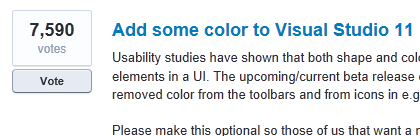
Microsoft has responded to user feedback by re-introducing colour into the Visual Studio 11 IDE. The top request in the official feedback forum was for more colour in the toolbars and icons.

image

Now Microsoft’s Monty Hammontree, who is Director of User Experience, Microsoft Developer Tools Division – it is interesting that such a post exists – has blogged about the company’s response:

We’ve taken this feedback and based on what we heard have made a number of changes planned for Visual Studio 11 RC.

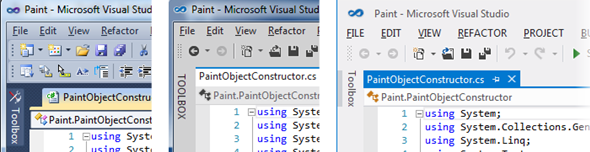
That said, developers expecting a return to the relatively colourful icons in Visual Studio 2010 will be disappointed. Hammontree posted the following side by side image:

image

This shows Visual Studio 10 first, then the beta, and then the forthcoming release candidate. Squint carefully and you can see a few new splashes of colour.

image

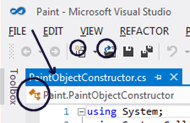
You can also see the the word toolbox is no longer all upper case, another source of complaint.

Hammontree explains that colour has been added to selected icons in order to help distinguish between common actions, differentiate icons within the Solution Explorer, and to reintroduce IntelliSense cues.

Did Microsoft do enough? Some users have welcomed the changes:

You have to appreciate a company that listens to there [sic] users and actually makes changes based off feedback. You guys rock!

while others are doubtful:

with respect, I fear that the changes are token ones and that whoever’s big idea this monochromatic look is, is stubbornly refusing to let go of it in spite of the users overwhelming rejection of it.

or the wittier:

I’m glad you noticed all the feedback about the Beta, when people were upset that you chose the wrong shade of gray.

While the changes are indeed subtle, they are undoubtedly an improvement for those hankering for more colour.

Another issue is that by the time a product hits beta in the Microsoft product cycle, it is in most cases too late to make really major changes. The contentious Metro UI in Windows 8 will be another interesting example.

That said, there are more important things in Visual Studio 11 than the colour scheme, despite the attention the issue has attracted.

Microsoft’s Visual Studio LightSwitch: does it have a future?

A recent and thorough piece on Visual Studio LightSwitch prompted a Twitter discussion on what kind of future the product has. Background:

  • LightSwitch is an application generator which builds data-driven applications.
  • A LightSwitch application uses ASP.NET on the server and Silverlight on the client.
  • LightSwitch applications can be deployed to Windows Azure
  • LightSwitch apps can either be browser-hosted or use Silverlight out of browser for the desktop
  • LightSwitch is model-driven so in principle it could generate other kinds of client, such as HTML5 or Windows 8 Metro.
  • LightSwitch first appeared last year, and has been updated for Visual Studio 11, now in beta.

I have looked at LightSwitch in some detail, including a hands-on where I built an application. I have mixed feelings about the product. It was wrongly marketed, as the kind of thing a non-professional could easily pick up to generate an application for their business. In my opinion it is too complex for most such people. The real market is professional developers looking for greater productivity. As a way of building a multi-tier application which does its best to enforce good design principles, LightSwitch is truly impressive; though I also found annoyances like skimpy documentation, and that some things which should have been easy turned out to be difficult. The visual database designer is excellent.

The question now: what kind of future does LightSwitch have? Conceptually, it is a great product and could evolve into something useful, but I question whether Microsoft will stick with it long enough. Here is what counts against it:

  • The decision to generate Silverlight applications now looks wrong. Microsoft is not going to do much more with Silverlight, and is more focused on HTML5 and JavaScript, or Windows Runtime for Metro-style apps in Windows 8 and some future Windows Phone. There is some family resemblance between Windows Runtime and Silverlight, but not necessarily enough to make porting easy.
  • There is no mobile support, not even for Windows Phone 7 which runs Silverlight.
  • I imagine sales have been dismal. The launch product was badly marketed and perplexing to many.

What about the case in favour? Silverlight enthusiast Michael Washington observes that the new Visual Studio 11 version of LightSwitch generates OData feeds on the server, rather than WCF RIA Services. OData is a REST-based service that is suitable for consumption by many different kinds of client. To prove his point, Washington has created demo mobile apps using HTML5 and JQuery – no Silverlight in sight.

image

Pic from here.

Washington also managed to extract this comment from Microsoft’s Steve Hoag on the future of LightSwitch, in an MSDN forum discussion:

LightSwitch is far from dead. Without revealing anything specific I can confirm that the following statements are true:

– There is a commitment for a long term life of this product, with other versions planned

– There is a commitment to explore creation of apps other than Silverlight, although nothing will be announced at this time

Hoag is the documentation lead for LightSwitch.

That said, Microsoft has been known to make such commitments before but later abandon them. Microsoft told me it was committed to cross-platform Silverlight, for example. And it was, for a bit, at least on Windows and Mac; but it is not now. Microsoft was committed to IronRuby and IronPython, once.

For those with even longer memories, I recall a discussion on CompuServe about Visual Basic for DOS. This was the last version of Microsoft Basic for DOS, a fine language in its way, and with a rather good character-based interface builder. Unfortunately it was buggy, and users were desperate for a bug-fix release. Into this discussion appeared a guy from Microsoft, who announced that he was responsible for the forthcoming update to Visual Basic for DOS and asked for the top requests.

Good news – except that there never was an update.

The truth is that with LightSwitch still in beta for Visual Studio 11, it is unlikely that any decision has been made about its future. My guess, and it is only that, is that the Visual Studio 11 version will be little used and that there will be no major update. If I am wrong and it is a big hit, then there will be an update. If I am right about its lack of uptake, but its backing within Microsoft is strong enough, then maybe in Visual Studio 12 or even sooner we will get a version that does it right, with output options for cross-platform HTML5 clients and for Windows Phone and Windows Metro. But do not hold your breath.