Tag Archives: microsoft

nginx market share growing faster than any other web server

According to the latest netcraft web survey nginx market share is growing faster than that of any other web server, even though it is still small relative to Apache or Microsoft IIS. In December 2010 nginx share grew by 0.88% to 7.5% – which can also be expressed as a 13.3% increase.

Apache 59.13%
Microsoft 21.00%
nginx 7.50%
Google 5.53%
lighttpd 0.68%

I did not take much notice of nginx until hearing Ryan Dahl evangelise it at Cloudstock, a Dreamforce event, last month. Now I plan to install it at itwriting.com when I find the time.

Microsoft WebMatrix released: a simple editor for ASP.NET Razor and more, but who is the target user?

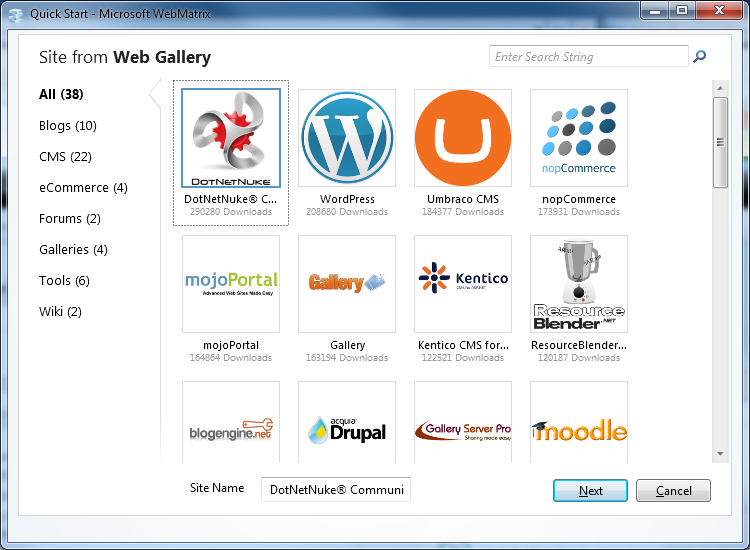
Microsoft has released WebMatrix, a free tool for creating web sites for Microsoft’s web server. It uses the Web Platform Installer and installed smoothly on my Windows 7 64-bit box. What you get is a cleanly-designed tool which lets you start web sites from templates or from standard installs of popular applications including WordPress, Drupal and Moodle.

image

Yes, you can use PHP and MySQL as well as .NET web applications, though the common factor is that all are configured for IIS, Microsoft’s web server.

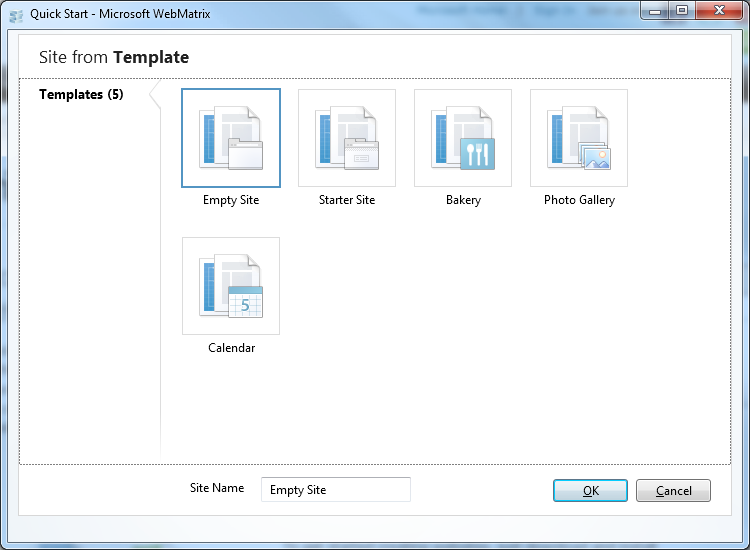
With many ISPs already offering instant installs of apps like WordPress, it is more interesting to look at the site templates in WebMatrix, though the selection is smaller.

image

What is interesting about these is that they create sites based on Razor, an alternative view engine for ASP.NET. Microsoft VP Scott Guthrie describes Razor here. It is odd though: Razor is a feature of ASP.NET MVC 3, currently in release candidate phase, but you cannot create ASP.NET MVC sites in Web Matrix.

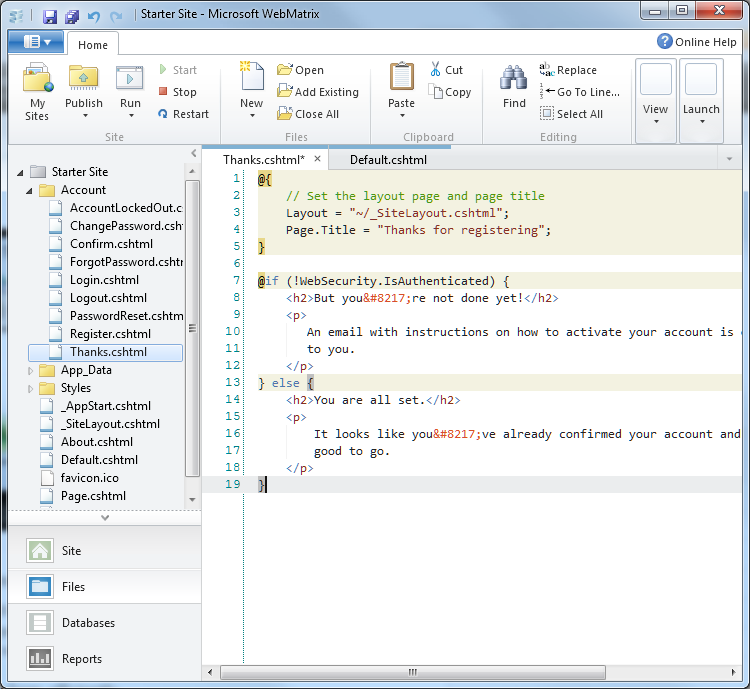
Once a site is created, you can modify it in the WebMatrix editor.

image

You can run the site on IIS Express with one click. WebMatrix will show you all the requests as you run, which could be handy for tracing problems. There is also a database management workspace which uses SQL Server Compact Edition, a reporting workspace which will analyse your site for problems, and the ability to publish a site using  FTP or Microsoft’s Web Deploy.

I like the clean look of WebMatrix, and that it is lightweight and fast; but who is the target user? It appears to be aimed at non-professionals; but this is a techie product that will not appeal to users looking for an easy to use web site builder. There is no visual editor; users are just chucked in at the deep end editing raw HTML and C#. There is not even any intellisense code completion. Clicking Online Help just brings up a Microsoft search form. There is no debugger to speak of; you are expected to upgrade to Visual Studio. Which raises the question, why not just get Visual Web Developer 2010 Express, which is also free, and has a better editor and debugging features? Of course you could use the two together; but Web Matrix is not adding much value. Features like the SEO analysis seem to be be based on the existing Search Engine Optimization Toolkit, which you can install without Web Matrix.

WebMatrix has been available in beta for six months, but its forum is relatively quiet.

Still, if nothing else Web Matrix is a handy way to take a look at Razor, which deserves attention. Shay Friedman has a technical introduction here.

Guthrie has a detailed look at the WebMatrix beta here.

Half-baked Android tablets will help Apple, give hope to Microsoft

The downside of open is fragmentation. CES earlier this month was overflowing with Android tablets and smartphones, but since anyone can use Android, device manufacturers may disappoint users, for example by shipping tablets that do not use a version of Android designed for tablets, or shipping devices that do not have access to the official Android Market.

The Inquirer reported yesterday that the Asus tablets announced at CES will not in fact ship with Android 3.0 Honeycomb. The reason stated is that:

because the company did not know the detailed technical specifications requirements of the Android 3.0 Honeycomb operating system, it could not confirm that Honeycomb will be the tablets’ OS.

Although it is stated that the tablets will ship with Android 2.3 Gingerbread, I get the impression that Asus might upgrade them to Honeycomb eventually; and since they are now apparently not due until the third quarter there is time for plans to change.

Not all Android devices have Google’s official compatibility blessing.  The frequently asked questions make a good read:

Anyone is welcome to use the Android source code, but if the device isn’t compatible, it’s not considered part of the Android ecosystem.

Only devices that have passed Google’s compatibility tests get access to the Android Market. This leads to a surprising situation for users: you might buy an Android tablet or smartphone and find that it has no access to the Android Market.

Vendors can get round this to some extent by creating their own Android app stores, though this kind of fragmentation is likely to have a bad outcome, with a limited selection of apps and insufficient market share to attract developer attention.

This means that a handy question to ask a salesman is: does this gadget have the Android Market? If the answer is anything less than a demo of the official Google Android Market client, that is reason for caution.

The context is that all these devices have to compete with Apple; and the App Store is a significant part of the appeal of iOS devices. Therefore an Android device without access to the Android Market is disadvantaged, though it is not something you are likely to find mentioned on the box.

There is an obvious danger for Android, that customers confronted with a vast range of Android offerings will find it hard to distinguish between what is excellent, what is reasonable, and horrible implementations like the Next Tablet.

Even the element of uncertainty is enough to help Apple, which is likely to announce a second generation iPad soon. It may even give hope to Microsoft, depending on when “Windows 8” tablets come to market and how good they prove to be.

The challenge for Google is how to keep Android open, while also preventing its brand from being damaged by too many sub-standard devices.

Visual Studio 2010 nine months on: how good has it proved?

Visual Studio 2010 was released on April 12th 2010. Nine months on, how good has it proved to be?

image

I researched deeply into Visual Studio 2010 at the time, and was impressed overall. It was a huge release, partly because the IDE was rebuilt using Windows Presentation Foundation, and partly because of a large number of new features including the F# language. Performance was always going to be an issue with the move to a .NET-based IDE, but on my machines I found it satisfactory.

Others have been less pleased with the performance. The comments to Jason Zander’s announcement of the Service Pack 1 beta last month make interesting reading. Here is the negative:

I am a professional .NET developer and I am really upset with VS 2010. It crashes more often than VS 2008. It is slow as hell. It even crashes when debugging. VS 2010 is built with WPF which is causing all these problems.

and here is the positive:

I don’t know what y’all complaining about – VS2010 is blazingly fast… at least on my machine.

I am not sure whether the performance issues are more dependent on the the type of work you are doing, or the size of the projects, or some other factor. One issue may be graphics performance, since this will make a big difference to WPF whereas not so much with Visual Studio 2008 and earlier.

Thinking back to this time last year, I also recall how Visual Studio 2010 seems so focused on .NET, including Silverlight. Later on we got the announcement of Visual Studio LightSwitch, a RAD database application tool which builds Silverlight clients. It now seems obvious, especially following the PDC (Professional Developers) conference in November, that the vision of the developer team at Microsoft did not align with the vision of the Windows team; and that the Windows team seemed to win that argument internally. It is odd, because Silverlight has the potential to solve problems for the company. It is a technology that extends from the desktop to Windows Phone 7, which is well-suited to app store deployment thanks to the way apps are isolated, and which potentially can run on multiple platforms. Now with Silverlight 5, promised for release this year, Microsoft is adding more Windows-specific features and allowing more fragmentation between versions. Silverlight on Windows Phone 7 is based on version 3, the Mac version has more limited capabilities than the Windows version, and so on.

Microsoft said at PDC that “HTML 5” is its broad-reach platform. That suggests that what Visual Studio needs is HTML 5 designers and JavaScript libraries that integrate with Microsoft’s server technologies and which make it easier to develop HTML application for multiple form factors including small devices.

It is a confusing story, and I would love to know if the subject came up in CEO Steve Ballmer’s discussions with Bob Muglia, VP of Server and Tools, recently. The outcome of those discussions is that Muglia will be leaving Microsoft in the summer.

We will have to wait for Visual Studio 2012, maybe, to discover any change in its direction. In the meantime, SP1 adds a new help viewer, in response to many complaints, as well as a few new features for testing and debugging. There is also a list of bug-fixes, some of which look significant:

and so on. Let me add that while the list looks bad, it is no more than you would expect for a tool of this complexity and in my own testing Visual Studio 2010 has worked well.

I agree though with some of the commenters who note that Microsoft is slow to react when bugs are reported. It will be more than a year after the initial release when SP1 is finished, though you can use the beta for production code if you dare.

I would be interested in hearing from users of Visual Studio 2010. How are you finding it, or did you try it and go back to Visual Studio 2008? I realise that adoption of a new IDE for production work tends to be slow, because developers are reluctant to switch mid-project.

Google flexes its Chrome browser muscles, removes support for H.264 video – but what about Adobe Flash?

Google has announced that it will remove support for the H.264 video codec in its Chrome browser:

…we are changing Chrome’s HTML5 <video> support to make it consistent with the codecs already supported by the open Chromium project. Specifically, we are supporting the WebM (VP8) and Theora video codecs, and will consider adding support for other high-quality open codecs in the future. Though H.264 plays an important role in video, as our goal is to enable open innovation, support for the codec will be removed and our resources directed towards completely open codec technologies.

The reason given is that Google wishes to support open standards. That sounds good for open standards, but not so good for users who simply want a video to play.

Google’s position contrasts that of Microsoft with IE9:

In its HTML5 support, IE9 will support playback of H.264 video as well as VP8 video when the user has installed a VP8 codec on Windows

Still, at least IE9 will play VP8 if the codec is installed, so that makes VP8 look a better option for content providers – which is the outcome Google is hoping for.

I have mixed feelings about this approach, because while it is good for open standards it is bad for compatibility. I am also not sure that it is consistent. Google announced in June that it is integrating Adobe Flash support into the browser; yet Flash is not an open standard.

That also suggests that H.264 video will still play in Chrome, provided it is in a Flash wrapper.

Maybe Google is learning from Apple how to deprecate technologies by removing support. Apple refuses to allow Java or Flash on iOS, and has stopped doing its own build of Java for OS X. Apple has also stated that these “optional” components may not be used in apps that are deployed in the Mac App Store, thus making a disincentive for developers considering those runtimes.

Apple has not squashed Flash though; and Google may find it equally hard to squash H.264, which is widely supported throughout the industry, has the best tools, and for which hardware is optimised. Apple supports H.264 but is unlikely to support WebM or Theora any time soon. Here’s what Apple CEO Steve Jobs said in April 2010:

To achieve long battery life when playing video, mobile devices must decode the video in hardware; decoding it in software uses too much power. Many of the chips used in modern mobile devices contain a decoder called H.264 – an industry standard that is used in every Blu-ray DVD player and has been adopted by Apple, Google (YouTube), Vimeo, Netflix and many other companies.

Although Flash has recently added support for H.264, the video on almost all Flash websites currently requires an older generation decoder that is not implemented in mobile chips and must be run in software. The difference is striking: on an iPhone, for example, H.264 videos play for up to 10 hours, while videos decoded in software play for less than 5 hours before the battery is fully drained.

When websites re-encode their videos using H.264, they can offer them without using Flash at all. They play perfectly in browsers like Apple’s Safari and Google’s Chrome without any plugins whatsoever, and look great on iPhones, iPods and iPads.

It seems Jobs spoke too soon when he said H.264 would play perfectly in Chrome.

Post updated to add Apple quote

How Microsoft SharePoint makes simple things hard

When I was asked how to show file extensions in lists of documents on SharePoint sites I thought it would be a simple change to make. I did a quick Google and found several answers; but some of them involved editing core files that instinctively I thought should be left alone. I took a closer look and worked out the steps.

It turns out that you need SharePoint designer, plus you have to convert a web part to XSLT, and then figure out what to change in the rather complex page that is then generated.

A few observations.

First, I am surprised that Microsoft did not build in some easy way of showing the file extensions in a document library, which seems an obvious thing to want to do. There are hundreds of much more obscure things you can easily show, but not this one.

Second, it is nice that Microsoft has made its SharePoint Designer tool free, but I am not sure that the way it is presented is quite right. It is a techie product but I did not find Help particularly helpful. You know the kind of thing; you are in the Formula Editor, you hit F1, and you get a description of the dialog, when what you want of course is a reference to the formulae.

Third, when I did find the documentation I found it obscure. Here’s the reference for the @LinkFileName formula:

Returns a GUID that represents the icon that is used to create a link to a file in a document library, where the file can be edited by using a menu.

Hmm. I am not sure how many fat SharePoint books you need to read to understand why this particular formula is used as it is in SharePoint, or why String(@LinkFileName) returns the file name with its extension.

Fourth, I discovered that SharePoint deliberately hides the file extension. You can show the extension by removing the function that strips it off, in the formula that determines the contents of that cell.

Now I know why SharePoint is such good business for specialists.

Apple’s Mac App Store – and the forgotten Windows Marketplace

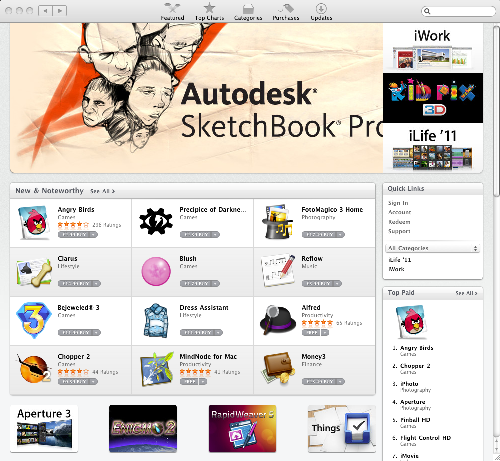
Apple launched the Mac App Store yesterday and I had a look this morning. It is only available to users of Mac OS X Snow Leopard, where it comes with the latest system update.

image

It is interesting that Apple has not used iTunes for the App Store, but has developed new client software. Maybe it is coming round to opinion that iTunes has become bloated; it is only for historic reasons that a music player has become an all-purpose app installer.

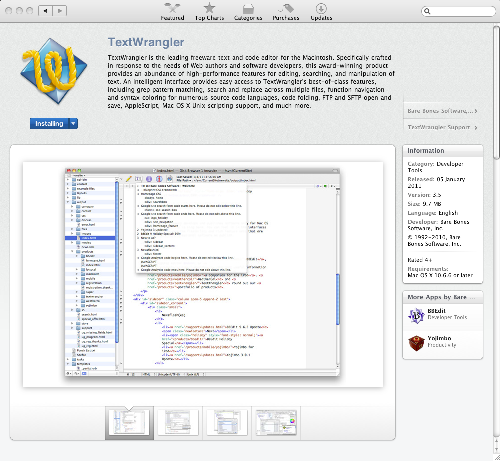
The store itself worked well for me. I picked a free app, TextWrangler, and signed in with my Apple ID. The UI showed Installing, then Installed, and I was done.

image

The TextWrangler icon appeared in the Dock so I could start the app easily.

What counts is what I did not have to do – reboot, select from setup options, or deal with perplexing error messages.

Users will also like the common-sense licensing, which lets you download and install a purchased app on any Mac you use, controlled by your App Store log-in. I am not sure what happens if you install your app on your friend’s Mac, then sign out of the App Store. There is some link between the app and your Apple ID, because if you copy the application to another Mac it will ask for your sign-in details when you first run it, but I am not clear whether this is checked on every run to deter piracy.

Most important, there is an attractive range of apps at good prices. In the UK, Angry Birds is £2.99, Pinball HD £1.79, and Apple Pages or Keynote £11.99 each. That is less than typical Apple Store shrink-wrap prices. The prices for Pages and Keynote makes the price Microsoft charges for Office look impossibly expensive. Good for customers; but worrying for independent software vendors who want to make a living.

Developers pay $99.00 per year to join the Mac Developer Program and then 30% commission to Apple on every sale. Of course, like the iPhone App Store, apps are subject to Apple’s approval.

Lest you think it is clever of Apple to invent an app store for the desktop, it is worth noting that the concept is an old one. Linux has delivered free software like this for years, and some distributions have also featured paid app installers integrated into the OS.

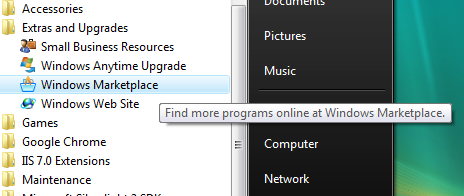
So has Microsoft, which has run various varieties of Windows Marketplace over the years, for mobile and desktop applications. Windows Vista shipped with an app store for both Microsoft and third-party apps built-in. It was on the Start menu:

image

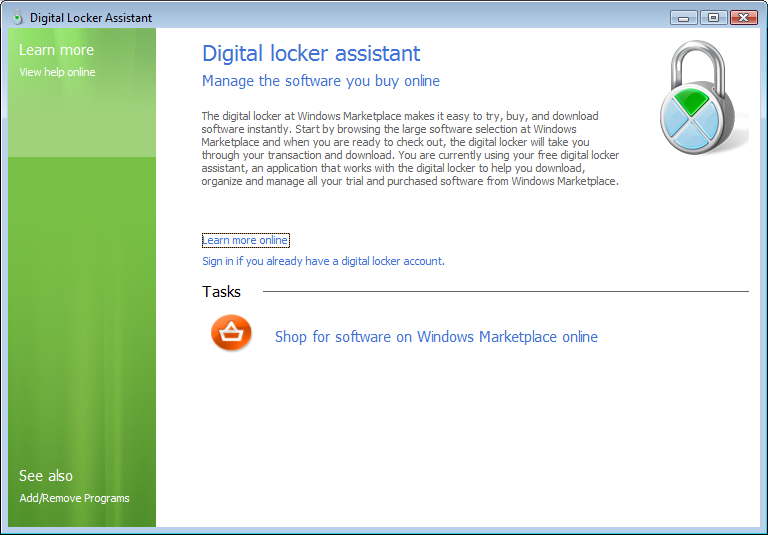
as well as in Control Panel:

image

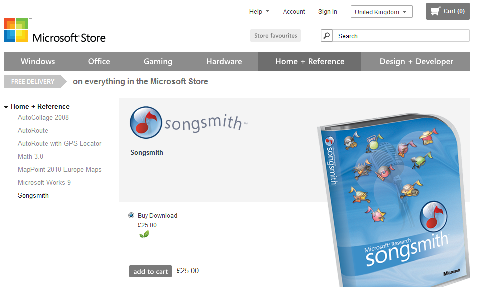
On November 1st 2008 Microsoft shut down Windows Marketplace and “transitioned” it to a referral site. There was some angst at the time about the closing of the digital locker, which proved insecure against the threat of corporate mind-changing. It still runs the online Microsoft Store, but this is for Microsoft-only products. For example, you can download Microsoft Songsmith for £25.00:

image

Why did Windows Marketplace fail? Well, the user experience was poor, it was insufficiently prominent in the Vista user interface, setup could be troublesome. Major Windows app vendors figured out that they would be better off drawing potential customers to their own web sites, where they have full control. As is often the case, Microsoft was conflicted over whether it wanted to drive customers to the online store, or to partner retailers, or to app vendor sites; and the OEMs would have their say as well, when customising Windows for their own PCs.

Another factor is that Windows apps are often not well isolated. Silverlight actually solves this problem – out-of-browser apps are well isolated and secure – but Microsoft does not even ship Silverlight by default with Windows.

The indications are that Microsoft will have another go in Windows 8. Documents leaked last year show an app store. From my post at the time:

There’s a pattern here. Microsoft gets bright idea – Tablet, Windows Marketplace, Passport. Does half-baked implementation which flops. Apple or Google works out how to do it right. Microsoft copies them.

Steve Ballmer at CES: Microsoft pins mobile hopes on Windows 8

Microsoft CEO Steve Ballmer gave the keynote at CES in Las Vegas last night. It was a polished performance and everything worked, but was short on vision or any immediate answer to the twin forces of Apple iPad and Google Android which are squeezing out Microsoft in the mobile world – smartphones and tablets – which currently forms the centre of attention in personal computing.

That said, CES stands for Consumer Electronics Show; and Ballmer did a good job showing off how well Kinect is performing, claiming sales of 8 million already. He showed more examples of controlling Xbox through speech and gesture, and said that Kinect is also boosting sales of the console; clearly it is now taking it beyond the hardcore market of first-person shooters.

We saw some fun new Windows devices, such as Acer’s dual-screen Iconia laptop.

image

There was also a demonstration of the updated Microsoft Surface which now runs full Windows 7 and does not require hidden cameras, so that it can now be used in more scenarios, such as for interactive digital signage.

All well and good; but what about mobile? We got a Windows Phone 7 demo, but no sales figures, nor any mobile partners on stage; I’m guessing they are too busy promoting their new Android devices. Ballmer did say that the phone is coming on Verizon and Sprint in the first half of this year. Application availability is improving, but how will Microsoft win attention for its smartphone? My local high street is full of mobile phone shops, none of which even stock it as far as I can tell. There is a tie-in with Xbox Live which may help a little.

The problem though is that Microsoft does not seem to be wholeheartedly behind the Windows Phone 7 OS, which is based on Windows CE with a new GUI and Silverlight/XNA runtime for applications. Rather, Microsoft is signalling that full Windows is its future mobile operating system. At CES it announced Windows on ARM, the processor of choice in mobile, and during the keynote we saw the next version of Windows (though with the Windows 7 GUI) running on various ARM devices.

The power available in new System on a Chip packages like NVIDIA’s Tegra 2 leaves me in no doubt that full Windows could technically run on almost any size of device; but that does not make it the sensible choice for all form factors. Note also that while it was not mentioned at CES, NVIDIA has said that Tegra 2 is optimized for Android.

Microsoft could plausibly have released a tablet based on the Windows Phone 7 OS, which is built for touch control, this year. Instead, it will be at least 2012 before we see a Windows 8 tablet, and we are taking it on trust that this will really work nicely with touch and not need a stylus dangling at the side. By then Apple will, I presume, be releasing iPad generation 3.

Putting this in a developer context, what is Microsoft’s mobile development platform? Silverlight and XNA? The full Windows native API? Or HTML 5? Each of these is very different and it seems to me a muddled story.

Xbox Kinect has sold 8 million since launch, and is driving more controller-free features

At CES in Las Vegas today, Microsoft CEO Steve Ballmer announced that Microsoft has sold 8 million Kinect sensor devices since its launch late last year.

He also announced an AvatarKinect feature for Xbox Live subscribers, which enables your avatar to mimic your movements and expressions, and controller-free selection of movies from Netflix and Hulu as well as the Zune marketplace, using gestures and voice.

I got Kinect at launch and have mixed feelings about it. It has not had much use because the games we have so far are not particularly exciting.

The device itself is exciting though; and given its rapid adoption it seems reasonable to expect that the next batch of games will be more compelling.

The evidence is that the controller-free concept has caught people’s imagination. It has also done something important for the Xbox: rescued it from the niche of hardcore first-person shooters in which it was to some extent trapped.

Windows 8 will run on ARM processors – a natural home for Silverlight?

Microsoft announced today at CES in Las Vegas that the next version of Windows will run on ARM as well as Intel CPUs. But why? The reason is that ARM CPUs have huge momentum in mobile computing, thanks to their low power consumption. Microsoft wants Windows to support System on a Chip (SoC) architectures such as NVIDIA’s Tegra 2, which has two ARM Cortex-A9 CPUs combined with an HD-capable graphics processor in a single package. In its press release, the company is careful not to upset established x86/x64 partners Intel and AMD too much, emphasising that Windows will run on SoC packages based on those CPUs as well.

It is an interesting announcement, but one that raises as many questions as answers. The first concerns Microsoft’s mobile strategy, with Windows now seeming to encroach on territory that you have thought belonged to its embedded operating system, Windows CE, which underlies both Windows Mobile and Windows Phone 7. With all its legacy APIs, full-blown Windows does not seem ideal for low-powered, resource-constrained mobile devices; yet the company seems set on bringing full Windows rather than something based on Windows Phone 7 to the emerging tablet market.

The second issue is that applications will need at least re-compiling, and in many cases some re-coding, in order to run on ARM CPUs. Microsoft says it will deliver Office for ARM:

Sinofsky: Microsoft Office is an important part of customers’ PC experience and ensuring it runs natively on ARM is a natural extension of our Windows commitment to SoC architectures.

Windows and Office alone is enough for a decent business device; but customers who buy Windows on ARM expecting their existing games or applications to run will be disappointed.

We have been here before. In the early days of Windows CE, devices ran a variety of processors such as MIPS or Hitachi SH3, and developers had to compile multiple binaries and create setups that installed the right one on each device. In an attempt to overcome the friction this created, Microsoft introduced the Common Executable Format (CEF) with Windows CE 3.0 in 2000. This was an intermediate language format which was translated to native code by a “translator” when it was installed onto a device.

It sounds  a bit like .NET or Java; and it was indeed a forerunner of the .NET Common Language Runtime, which appeared in 2002. However, CEF never really caught on. Although it solved deployment issues, it introduced performance problems and was troublesome to debug. Most developers preferred to stick with true native code.

Today though .NET is mature; and we also have Silverlight, a cross-platform implementation of the .NET Framework combined with multimedia player and graphics framework. If Microsoft includes .NET and Silverlight in its ARM build of Windows, that would solve some of the deployment problems, especially for business devices. Many custom applications are built for .NET; and these would in principle run without any need to recompile, since a .NET executable is intermediate code which is compiled to native code at runtime, though any code which includes “platform invoke” calls to native APIs would not work.

It is surprising therefore that neither .NET nor Silverlight is mentioned in Windows president Steve Sinofsky’s Q&A about Windows on ARM. Still, we should not read too much into that. It would be madness if Microsoft did not support its .NET technologies on this new platform, would it not?