Tag Archives: microsoft

What will it take to get developers to try Windows Azure? Microsoft improves its trial offer

Microsoft has announced an improved introductory trial for Windows Azure. You can now get:

  • 750 hours of an Extra Small Compute Instance
  • 25 hours of a Small Compute Instance
  • 500MB storage
  • 10,000 storage transactions
  • 500MB in / 500MB out data transfer
  • 1G Web Edition SQL Azure database

The offer lasts until the end of June, after which you will be charged at standard rates. The allowances are I believe per month – note that 750 hours is approximately the number of hours in a month so you can run an extra small instance continuously. This is the main change from the previous trial, which only offered 25 hours of a small compute instance.

You cannot sign up without handing over credit card details.

Further, some of these limits are not really generous. This blog, for example, would chew through those data transfer limits in no time.

Microsoft is also less generous than Amazon, which offers a year of free usage with data transfer of 15GB in and 15GB out per month. Google App Engine is free up to 1GB or persistent storage and about 5 million pages views a month.

I guess Microsoft needs to figure out whether it wants to target mainly enterprise and large-scale applications, or to offer a commodity platform to a broader market. I doubt this offer is aimed at enterprises. After all, serious commercial developers on Microsoft’s platform have MSDN subscriptions, which with premium and ultimate subscriptions already offer inclusive Azure time that is better than this: 7GB in and 14 GB out per month, for example. Startups on the BizSpark scheme also get this allowance.

This offer is for the rest of us then. It is certainly getting easier to try Azure, but is this enough to encourage experimentation? I suspect Microsoft may need to come even closer to what is offered by the competition.

Microsoft’s BPOS password madness driving users to Google Apps

A friend uses Microsoft’s Exchange Online service for his small company. All was going well until one day he found himself locked out of his email. He had no idea why.

The reason, it turned out, was the password policy set by Microsoft and outlined here:

To help maintain security, you must periodically change your password. When you change your password, be aware of the following:

  • You cannot repeat your previous 24 passwords.
  • You must change your password at least once every 90 days.

In addition:

Microsoft Online Services uses an account lockout policy to help protect the accounts of service administrators and end users. The user can try to sign in to the Administration Center or the Sign In application five times. After five failed attempts with an invalid user name or an incorrect password, users are locked out for 15 minutes. This condition cannot be manually reset.

In this case, Microsoft’s PC sign-in applications prompted the user to change his password. He did so. All seemed well, except that his mobile – in which email settings are deeply buried – did not know about the password change and made repeated attempts to collect email. Result: lock-out, and a horrible user experience.

According to this thread, Microsoft has been so besieged with requests to remove the expiration policy that it solved them at a stroke: by refusing them all.

I find this curious. First, it is doubtful whether frequent password changes really enhance security. Users in this case need new non-repeating passwords every 90 days, which means they are more likely to be written down. Remember, you cannot repeat your previous 24 passwords.

Second, it is odd that BPOS admins do not have the ability to disable password expiration policies in their online management tools.

It may seem a small issue, but for some it is a deal-breaker:

At this moment it is not possible to disable password expiration at all. I opened a ticket and technical support told me multiple times they won’t offer that option anymore… It’s disappointing since I lose customers who choose Google Apps over Microsoft Online just because of the password issue.

Apparently this may be fixed in the forthcoming Office 365.

Exchange 2007 to 2010 migration hassles

I have been running Exchange 2010 for a while now, but over the weekend decided to retire Exchange 2007 which was running alongside it in a “just in case” kind of way. This turned out to be more hassle than I had expected. In principle removing your last Exchange 2007 box is simple enough: first check that that all the data has been migrated, then uninstall it from Control Panel. The catch is that Exchange will refuse to uninstall if it detects certain conditions.

The first problem I discovered was that my Exchange public folders had not replicated to Exchange 2010, even though I thought I had set this up. You are meant to run the script MoveAllReplicas.ps1, but I ran into an error that, from what I can tell, is a common one:

Set-PublicFolder : The parameter "Replicas" cannot be $null or an empty array.

Although I found many references to this error, I did not come across any direct solutions. However, I did find Microsoft’s public folder management utility – no, not the one built into the Exchange Management Console, but one of those little utilities created by a member of the Exchange team to make up for deficiencies in the official tools. This is called Exfolders, and replaces a similar tool called PFDAVAdmin. When I ran Exfolders I found I could not log on to the Exchange database, with the error reported being:

An error occurred while trying to establish a connection to the Exchange server. Exception: The Active Directory user wasn’t found.

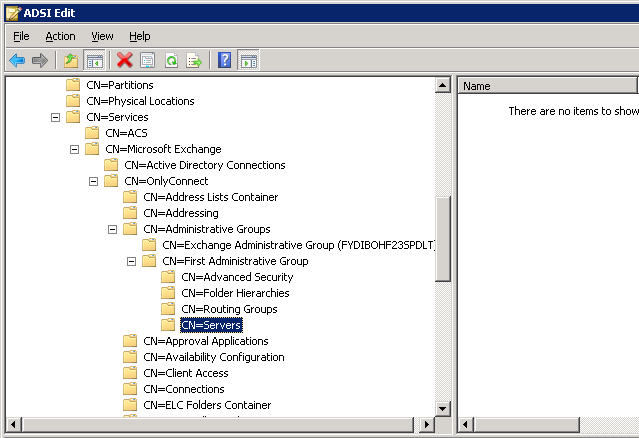
This led me to an informative blog post that refers to this official post, which describes a problem which occurs on Exchange systems on which Exchange 2000 or 2003 previously existed. Read the post for more details; but the fix is to dive into ADSI Edit (Active Directory Services Interface Editor) which is a low-level editing tool for Active Directory similar in some respects to Regedit and equally hazardous. You have to find and delete the empty Servers container relating to the obsolete Exchange 2003 First Administrative Group.

image

No, it is not intuitive; yes, most would consider it a bug; and Microsoft now adds:

Removed the reference to upcoming fix (no fix current planned)

The benefit though was that ExFolders now worked. Using this tool I manually created public folder replicas on Exchange 2010 and replication happened at last.

I waited for replication to complete, then tried again with MoveAllReplicas.ps1. I still got the same error though. I went back to ExFolders and successfully deleted the replicas shown on the old Exchange 2007 box, but when I tried to delete the public folder database itself got an error stating that replicas existed. In consequence, Exchange 2007 could not be uninstalled. Of course I could just have shut the machine down forever; but I do not recommend this – you end up with references in Active Directory to an Exchange server that no longer exists, which only causes problems.

The solution was to go back to ADSI Edit and delete the reference to the obstinate Public Folder Store, as recommended by Microsoft’s Ben Winzenz here.

Exchange 2007 now uninstalled cleanly and I have the VM space I need to try Microsoft Lync, which I noticed getting some attention at Mobile World Congress last week.

Nokia’s Elop fears mobile duopoly, but it is already here

It is day two of Mobile World Congress here in Barcelona; and everyone is pondering the implications of Nokia’s Windows Phone partnership with Microsoft. It is a pivotal moment for the industry, but not necessarily in the sense that the two partners hope.

Let me state the obvious for a moment. This is not good for Nokia, though it might be “the least bad of all the poor choices facing Nokia”, as Mikael Hed of Rovio (Angry Birds) put it yesterday. Nokia has huge market share, but it was already falling sharply, as these figures from late last year illustrate. Nokia’s total market share declined from 36.7% in Q3 2009 to 28.2% in Q3 2010; and its Smartphone (Symbian) share from 44.6% to 36.6%. These are still big numbers, but will inevitably decline further.

Following last week’s announcement, though, Nokia will transition from a company which formerly commanded its own destiny with Symbian, to one that is an OEM for Microsoft. The savings will be substantial, as CEO Stephen Elop noted at the press event here on Sunday evening, but it is a lesser role.

Why has Nokia turned to Microsoft? It is not a matter of Microsoft planting its own man in Nokia in a desperate effort to win market share. On Sunday Elop said he was no trojan horse, and also laid to rest rumours that he is conflicted thanks to a large Microsoft shareholding; he is selling as fast as the law allows, he said, and his shareholding was nowhere close to what was alleged in any case.

Rather, the Nokia board brought Elop in specifically to make tough decisions and likely form an alliance with either Google or Microsoft. I am not sure that former Nokia exec Tomi Ahonen is the best source of commentary – he is unremittingly negative about the alliance – but I like his piece on the choices facing the board last year, when it must have decided that MeeGo, the mobile Linux co-sponsored by Intel, could not deliver what was needed.

Elop chose Microsoft, his argument being that the choice was between Android and Windows, and that going Android would have created a duopoly that was good for Google but bad for the industry. By going Windows Phone “we have created a three horse race,” he said.

It is a fair point as far as it goes – though maybe he takes too little account of RIM, especially in the enterprise market – but whether Nokia can really break that duopoly is an open question. It is not a question of how the duopoly can be avoided: it already exists.

image

Given the absence of Apple, this Mobile World Congress could almost be called the Android World Congress, such is the dominance of Google’s mobile OS. It works, it is well-known, it is freely customisable by manufacturers and operators. Android is not perfect, but it is a de facto standard which nicely meets the needs of the non-Apple mobile industry.

This morning three significant far Eastern manufacturers announced new Android devices; none announced Windows Phone devices. The three are HTC, Alcatel Onetouch (which claims to be the fastest-growing handset provider in the world), and Huawei. At the Alcatel Onetouch press conference I asked CEO George Guo why his company was focused on Android:

Why Android? Android is a phenomena. It is what every operator wants and also what the consumer is looking for. The iPhone is great but just has one type, and also it is highly priced. People want something different so are looking for variety. Android-based phones provide that opportunity. With Android phones you can range from $100 up to several hundred. Also we can make customisations based on the Android system. We can fit different kinds of customers’ needs. That’s why, from the whole ecosystem point of view, because recently (laughs) people talk about this a lot, we think that Android does provide quite an ecosystem.

Note how Guo (unprompted) makes reference both to the other member of the duopoly, Apple, and the new pretender, Microsoft/Nokia.

However good their products, rivals such as RIM with its new QNX-based OS and HP with WebOS will struggle to compete for developer and public attention.

Does Windows Phone have better chances? If Nokia could easily translate its Symbian sales last year to Windows Phone sales next year, then sure, but that would take a miracle that beleaguered Nokia is unlikely to deliver. Windows Phone 7, launched last year, demonstrates that despite its desktop dominance Microsoft cannot easily win mobile market share, and that partners such as HTC, Samsung and LG are focused elsewhere. Nokia’s commitment will greatly boost Microsoft’s market share in mobile, but to what percentage is frankly hard to guess.

There are a couple of other unanswered questions. One is about differentiation. In order to compete with Apple, Microsoft has made a point of locking down the Windows Phone 7 specification, despite its multiple manufacturers, requiring Qualcomm Snapdragon for the chipset, specific hardware features, and a relatively unmolested GUI. If Microsoft continues along these lines, it will be hard for Nokia to be truly distinctive. On the other hand, if it abandons them, then it risks spoiling the consistency of the platform.

Another big question relates to tablets. Microsoft has no announced tablet strategy, except insofar as it is not using the Windows Phone 7 OS for tablets and has hinted that the next full version of Windows  will be tablet-optimized. By contrast, both Apple and Google support both smartphones and tablets with a single OS; indeed, it is hard to define the difference between a small tablet and a smartphone. Here at Mobile World Congress, Viewsonic told me that a 4” screen defines it: less than that, it’s a smartphone; more than that, it’s a tablet.

What are Nokia’s tablet plans? Will it change Microsoft’s mind, or wait for Windows 8 following meekly in Redmond’s footsteps, or do something with MeeGo?

Elop has also in my view made a mistake in shattering Nokia’s Qt-based developer community. Qt was the unifying platform between Symbian and MeeGo, and could have been the same for Windows Phone 7. Why? Here’s what Elop told us on Sunday:

What is happening to Qt: “Will Nokia put Qt on Windows Phone? No that’s not the plan. Here is the reason. If we, on the Windows Phone platform, encourage a forking between what natively is provided on the Windows Phone platform and Qt, then we create an environment where potentially we could confuse the developers, confuse the consumers, and even create an environment where Windows Phone could advance slower than the competition because we are carrying two principal development platforms.

I respect Elop; but I think he has been sold a line here. Developers are not easily confused – how patronising – and Windows Phone already has a native code SDK, available to operators and manufacturers. Many of Microsoft’s own applications for the phone are native rather than Silverlight or XNA. In principle, there is no reason why consumers would be able to tell the difference. I think Microsoft is protecting its own development stack and sacrificing Nokia’s developer community in the process.

On a more positive note, I do not forget that Elop is a software guy. I think he recognises that unless you are Apple, hardware commoditisation is inevitable whatever OS you choose. Asked about Windows Phone, the Huawei exec at this morning’s briefing said his company would consider it when the next version comes out. What he means is: if the demand is there, they will make it. If they make it, then Nokia is competing with the same economies of scale and labour that apply to Android.

Elop sees an answer in apps, ads and services: the ecosystem about which he constantly reminds us. On Sunday he noted that the partnership with Microsoft includes an advertising platform, and that this is potentially a significant source of future revenue. The new Nokia may be a lesser company than the old, but one that is better able to survive the challenge of making money from handsets.

IE9 in Windows Phone will be good for cross-platform JavaScript and HTML5 apps

Microsoft CEO Steve Ballmer, accompanied by Nokia’s Stephen Elop, showed coming updates for Windows Phone 7 at a Mobile World Congress keynote last night.

A minor update due in early March will add copy and paste, and CDMA support is also coming in the first half of 2011.

The more interesting update is planned for the second half of 2011 – I’m guessing late this year – and will have multi-tasking for 3rd party apps, as well as a mobile version of Internet Explorer 9. We were told that this will feature the same HTML 5 standards support and hardware acceleration as in the desktop version.

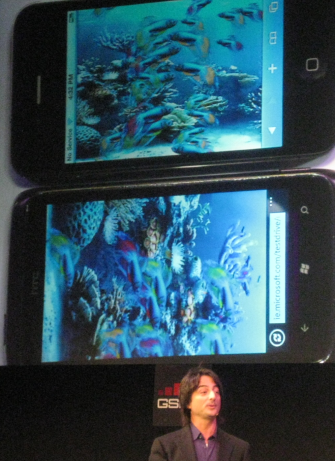
Windows Phone VP Joe Belfiore showed the fish demo running on Windows Phone with IE9 alongside Safari on the iPhone. The iPhone fish jerk slowly across the screen.

image 

Note that Apple will likely have a new iPhone out before mobile IE9 is ready, which may well equal or exceed IE9’s graphics performance.

Nevertheless, this is interesting for developers since it means that the fast “Chakra” JavaScript runtime will be available on the device. HTML and JavaScript is one route to cross-platform mobile applications.

Silverlight on Windows Phone includes a WebBrowser control which has access to isolated storage. This means you could write most of your app in cross-platform JavaScript and HTML, but wrap it in Silverlight for access to native phone features.

It is a shame though that Microsoft does not include the Sqlite local database engine found in WebKit-based mobile browsers. Sqlite is in the public domain so this may be an example of the “not invented here” syndrome. Microsoft does not even have SQL Compact Edition in Windows Phone 7, though it would not surprise me if this also appears in the autumn update. Full details are being held back until the Mix conference in April.

Although it has not been stated, it would make sense for this update to be used in the first Windows Phones from Nokia. On Sunday evening, Nokia stated its desire to deliver a Windows Phone device before the end of the year.

Intel disappointed with Nokia’s Microsoft move, still backing MeeGo

Intel’s Suzy Ramirez has posted about the future of MeeGo Linux following Nokia’s decision to base its smartphone strategy on Microsoft’s Windows Phone operating system. Nokia was Intel’s key partner for MeeGo, which was formed by merging Intel’s Moblin with Nokia’s Maemo.

Although Nokia has been an important partner to Intel and MeeGo and we are disappointed by this decision, it’s important to know that this is by no means the end of MeeGo or the end to Intel’s commitment

says Ramirez, adding that “MeeGo is not just a phone OS”.

True; but with the focus also moved away from netbooks it is getting hard to see where MeeGo will have an opportunity to shine.

Intel promises to outline its mobile strategy this week at Mobile World Congress. I will be reporting from Barcelona in due course.

MeeGo, Qt, and the new Nokia: developers express their doubts

What are the implications of the new partnership between Nokia and Microsoft for MeeGo, the device-oriented Linux project sponsored by Intel and Nokia? What about Qt, the application framework that unifies Symbian and MeeGo development?

Here is what Nokia says:

Under the new strategy, MeeGo becomes an open-source, mobile operating system project. MeeGo will place increased emphasis on longer-term market exploration of next-generation devices, platforms and user experiences. Nokia still plans to ship a MeeGo-related product later this year.

Nokia is retaining MeeGo but it has moved from centre-stage to become more niche and experimental.

The snag for developers is that there are no known plans to support Qt on Windows phone. According to the letter to developers, Qt developers can look forward to the targeting low-end Symbian devices and at least one solitary MeeGo phone:

Extending the scope of Qt further will be our first MeeGo-related open source device, which we plan to ship later this year. Though our plans for MeeGo have been adapted in light of our planned partnership with Microsoft, that device will be compatible with applications developed within the Qt framework and so give Qt developers a further device to target.

Reaction from developers so far is what you might expect:

By this announcement, I’m afraid you’ve lost many faithful people (developer and consumers) like myself, who’s been a Nokia user ever since I’ve started using cellphones..

and

Wow what can I say, nokia just flat out killed any enthusiasm I had to develop on nokia platforms, I never have and never will use a windows platform. You have just killed QT, even worse killed the most promising OS out there in Meego. Elop is the worst thing that has ever happened Nokia.

and

Weak on execution, you choose to flee. What a sad day in the history of a once proud and strong company.

Nokia could fix this by demanding Qt support for Windows Phone 7.

Nokia adopts Windows Phone 7: game on

Nokia and Microsoft have announced a strategic partnership in which Nokia is to adopt Windows Phone as its “principal smartphone strategy”.

imageimage

There is a smidgen of uncertainty. The release says “Nokia and Microsoft intend…” Still, I think we should assume it will go ahead.

The key elements of the agreement:

  • Nokia adopts Windows Phone for most of its smartphones. The word “principal” leaves space for others.
  • Nokia will contribute hardware design, language support, and “help bring Windows Phone to a larger range of price points”.
  • Nokia will adopt Bing search and use Microsoft adCenter.
  • Nokia Maps will be integrated with Microsoft’s mapping services.
  • Nokia’s app store will be integrated with Microsoft Marketplace.

A few observations.

  • First, this is what Windows Phone 7 needs. It is a decent mobile OS with potential for excellence, but needs better than the luke-warm support it has received so far from Microsoft’s hardware partners. I have thought in the past that Microsoft needs to make its own hardware, but this deal is better.
  • It also plays to Nokia’s strength in mobile hardware design. Recent high-end Nokia devices have had excellent hardware engineering spoilt by poor software.
  • Windows Phone 7 already has strong development tools; I have seen comments from developers that the same app takes less time to develop than on Apple’s iOS or Google Android. What it has lacked is a true mass market; this deal has the potential to change that. Windows Phone 7 is invisible in my local town centre, despite the presence of three specialist mobile phone retailers. That has to change for Microsoft’s OS to succeed.

Sounds good, but there are also reasons why this might not work out well.

  • Currently Apple iOS and Google Android are the Smartphone operating systems to beat. There is no guarantee that Nokia’s change of direction will move the market. After all, if Nokia’s current Smartphones underperform, its new Windows devices may underperform too.
  • A major change of direction is costly in both time and skills. Can Nokia deliver excellent Windows phones in time to claw back market share? In its press release, Nokia says:

    Nokia expects 2011 and 2012 to be transition years, as the company invests to build the planned winning ecosystem with Microsoft.

  • There is no tablet form factor for Windows Phone 7, and Microsoft seems resistant to the idea. Apple and Android exploit the potential of tablets and give app developers the benefit of two similar platforms for both small and medium size mobile devices.
  • Historically, Microsoft has proved a difficult partner. The tie-up with Palm for Windows Mobile a few years back did not save Palm. In mitigation, Nokia CEO Stephen Elop is ex-Microsoft, and if anyone knows how to make this work, he will do.
  • Nokia will have a tough job convincing its own people of the value of this deal – by which I mean employees as well as third-party developers and partners. It is discarding a huge amount of previous investment. This could be mitigated if Nokia is able to support Qt, its primary development platform, on Windows Phone 7; but I have not seen any hint of that yet. In my view Windows Phone 7 needs a native code development option, and Nokia should press to allow it.

Nevertheless, the battle for mobile has just become more interesting. This is a huge boost to Microsoft’s phone and many in the industry will now be taking it seriously for the first time.

Microsoft’s new President of Server and Tools–Satya Nadella, from Bing division

Microsoft has appointed a new President of Server and Tools to replace Bob Muglia. He is Satya Nadella, 43, and has been leading the Online Services Division, the bit in charge of Bing, MSN and adCenter. Before that, Nadella led Microsoft Business Solutions, focused on the Dynamics CRM application.

image

It is a big role, and no doubt it is significant that Nadella has a cloud-oriented background within Microsoft. In his first memo in the new role, Nadella says:

I like to have my head in the clouds and feet on the ground (something I learned from Qi).

I track Microsoft financials in a small way, and have observed that while Muglia’s Server and Tools has turned in stellar figures for several years, the Online Services Division by contrast has delivered large losses.

Then again, competing with Google in search is not easy, and Bing is perhaps doing as well as can be expected.

CEO Steve Ballmer has also announced that Amitabh Srivastava, the well-regarded senior vice president in the Server and Tools Business is leaving Microsoft.

Puzzling moves, which suggest to me significant strategy disagreements between Ballmer and the old Server and Tools leadership.

MeeGo NoGo: things look bad for the Intel/Nokia Linux project

A sad post yesterday from MeeGo contributor Andrew Wafaa suggests that MeeGo on netbooks may no longer happen:

Basically by all accounts MeeGo is stopping all work on the Netbook UX. Yup, all our hard work is now almost for nothing 🙁

This is remarkable. The original Moblin project, sponsored by Intel, was all about bringing an excellent user experience to Linux on netbooks. The first netbooks ran Linux, but met resistance from a general public familiar with Windows; yet Linux is more suitable for netbooks than Windows in its present form.

Moblin is different. It’s a friendly way to get the most out of your netbook. It doesn’t work like most other computers because it’s optimized for enjoying media, interacting with your social networks and the internet.

wrote Moblin Community Manager Paul Cooper back in 2009, when netbooks were hot.

The problem: tech trends sometimes outpace corporate planning. Moblin was a good idea in 2008, but nothing was delivered; and by the time it looked like it might be ready, the market seemed to want tablets – or Apple iPads – rather than netbooks; and whatever problem Moblin was addressing was already solved by Google Android.

image

Two years later, in February 2010, Moblin merged with Nokia’s Maemo, creating a new project called MeeGo. The new focus would be tablets and smartphones:

The power and capability of handhelds has reached astounding levels – netbooks have been a runaway success – and connected TVs, tablets, in-vehicle infotainment, and media phones are fast growing new markets for devices with unheard of performance. Our goal is to develop the best software to go with these devices.

said Intel’s Imad Sousou.

So where are the MeeGo smartphones? Well, maybe we will see one at Mobile World Congress next week. But Nokia is in disarray. According to a leaked memo from new CEO Stephen Elop:

The first iPhone shipped in 2007, and we still don’t have a product that is close to their experience. Android came on the scene just over 2 years ago, and this week they took our leadership position in smartphone volumes. Unbelievable.

We have some brilliant sources of innovation inside Nokia, but we are not bringing it to market fast enough. We thought MeeGo would be a platform for winning high-end smartphones. However, at this rate, by the end of 2011, we might have only one MeeGo product in the market.

Perhaps Nokia will progress MeeGo smartphones with renewed vigour; but what looks more likely is that Nokia will embrace a rival platform, maybe Google Android or Microsoft’s Windows Phone 7.

That might well be alongside MeeGo, rather than replacing it, but Nokia needs to focus its energy and I would guess that MeeGo will lose out.

It may be the beginning of the end for a promising project that has progressed too slowly.

Update: Reuters is reporting that “two industry sources close to the company” say Nokia has ended development of its first MeeGo smartphone