Tag Archives: microsoft

First impressions of Microsoft Kinect – great hardware waiting for great software

The moment of magic comes when someone walks through the gaming area and Xbox flashes up the message that they have signed in. No button was pressed; this was face recognition working in the background during gameplay.

So Kinect is amazing. And it is amazing: it is controller-less video gaming that works well enough to have a lot of fun. That said, I also have reservations about the device, though these are first impressions only, and feel it is let down in a big way by the games currently available.

My device arrived on the UK launch day, November 10th. It is a relatively compact affair, around 28 cm wide on a stubby stand. The first task is positioning it, which can be a challenge. You are meant to place it above or below your TV screen, at a height of between 0.6m to 1.8m. I was lucky, in that our TV is on a stand that has space for it; the height is fractionally below 0.6m but it seems to be happy. Alternatively, you can purchase a free-standing support or a bracket that clips to the top of a TV. I imagine there are some frustrated first-day purchasers who received a device but cannot satisfactorily position it.

You also need free space in front of the set. Our coffee table got moved when the Nintendo Wii arrived, so the 6ft required for one-player play is not a problem.  Two-player is more difficult; we can do it but it means moving furniture, which is a nuisance. Overall it is more intrusive than the Wii, but less than Rock Band or Guitar Hero with the drum kit, so not a deal-breaker.

Microsoft takes full advantage of over-the-wire updates with Kinect. After connecting, the Xbox, the device firmware, and the bundled Kinect Adventures game all received patches; but the procedure went smoothly.

Kinect is a sophisticated device, a lot more than just a camera. There are three major subsystems in Kinect: optical, audio and motor.

  • Motor is the simplest – the stubby stand also contains a motor assembly that swivels the device up and down, enabling it to allow for different positions and to find the optimal angle for players of different heights.
  • The optical subsystem includes two cameras and an infra-red projector. The projector overlays a pattern on the field of view. This allows the first camera, a depth sensor, to map the position of the players in three dimensions. This lets the system detect hand movements, for example, which are usually closer to the camera than the rest of the body. The second camera is a colour device more like the one in your webcam, and enables Kinect to take pictures of your gaming antics which you can share with the world if you feel so inclined, as well as presumably feeding into the positioning system.
  • The audio subsystem includes no less than four microphones. The reason is that Kinect does voice recognition at a distance, so needs to be able to compensate for both the sounds of the video game and other background noise. Using multiple microphones enables the audio processor to calculate the position of sounds, since each microphone will receive a sound at a fractionally different time.

These sensors systems are backed by considerable processing power – necessary because the Xbox itself devotes most of its processing to the game being played. The trade-off in systems like this is that the more processing means more accurate interpretation of voice and gestures, but taking too much time introduces lag. As I saw at the NVIDIA GPU conference in September – see here and here for posts – very rapid processing enables magic like robotic pinhole surgery on a beating heart – and like Kinect, that magic is based on real-time interpretation of physical movement. Kinect is not at that level, but has audio and image processor chips and 512MB RAM, along with other components including for some reason an accelerometer, mounted on three circuit boards squashed into the slim plastic container. See for yourself in the ifixit teardown.

But how is it in practice? It certainly works, and we had a good and energetic time playing Kinect Adventures and a little bit of Joy Ride. Playing without a controller is a liberating experience. That said, there were some annoyances:

  • Kinect play is more vulnerable to interference than controller gaming. If someone walks across the play area, for example, it will interfere.
  • In the Kinect system, there is no such thing as a click. Therefore, to activate an option you have to hover over it for a short period while a progress circle fills; when the circle is filled, the system decides that you have “clicked”. It is slower and less reliable than clicking a button.
  • The audio system enables voice control which seems to work well when available, but most of the time it seems not to be available. Considering the amount of hardware dedicated to this, it seems rather a waste; but presumably more is to come. Controlling Sky player by voice, for example, would be great; no more hunting for the remote.
  • The Kinect seems to work best when you are standing. For something like a driving game, that is not what you want. Apparently seated gameplay is supported, but does not work properly with the launch games; so watch this space.

Launching stuff before it is really ready seems to be ingrained in Microsoft’s culture. Is Kinect another example? To some extent I suspect it is. I recall the early days with the Nintendo Wii as exciting moments of discovery: the system worked well from the get-go, and the bundled Wii Sports game is a masterpiece. The Kinect games so far are less impressive.

In fact, my overwhelming impression so far is that this is great hardware waiting for software to show what it can do. The 20,000 Leaks mini-game in Adventures is not very good – you are in a glass cage underwater and have to cover leaks to stem them – but it is interesting because you have to use head, hands and feet to play it. It could not be duplicated with a conventional controller, because a conventional controller does not allow you to move one thing this way, and another thing that way, at the same time.

It follows that Kinect should enable some brilliant new gaming concepts. I’d love to see a stealth adventure done for Kinect, for example; there are new possibilities for realism and excitement.

As it is, the Kinect launch games show little imagination and seem to be heavily Wii-influenced – and if you compare Kinect with Wii on that basis, you might well conclude that the Wii is better in some ways, worse in others, but cheaper and with better games, and without the friction of Kinect’s somewhat fussy requirements.

Such a comparison is not fair to Kinect, which in concept and hardware is a generation ahead of Wii or PlayStation Move. It now awaits software to take advantage.

The cloud permeates Microsoft’s business more than we may realise

I’m in the habit of summarising Microsoft’s financial results in a simple table. Here is how it looks for the recently announced figures.

Quarter ending September 30 2010 vs quarter ending September 30 2009, $millions

Segment Revenue Change Profit Change
Client (Windows + Live) 4785 1905 3323 1840
Server and Tools 3959 409 1630 393
Online 527 40 -560 -83
Business (Office) 5126 612 3388 561
Entertainment and devices 1795 383 382 122

The Windows figures are excellent, mostly reflecting Microsoft’s success in delivering a successor to Windows XP that is good enough to drive upgrades.

I’m more impressed though with the Server and tools performance – which I assume is mostly Server – though noting that it now includes Windows Azure. Microsoft does not break out the Azure figures but said that it grew 40% over the previous quarter; not especially impressive given that Azure has not been out long and will have grown from a small base.

The Office figures, also good, include Sharepoint, Exchange and BPOS (Business Productivity Online Suite), which is to become Office 365. Microsoft reported “tripled number of business customers using cloud services.”

Online, essentially the search and advertising business, is poor as ever, though Microsoft says Bing gained market share in the USA. Entertainment and devices grew despite poor sales for Windows Mobile, caught between the decline of the old mobile OS and the launch of Windows Phone 7.

What can we conclude about the health of the company? The simple fact is that despite Apple, Google, and mis-steps in Windows, Mobile, and online, Microsoft is still a powerful money-making machine and performing well in many parts of its business. The company actually does a poor job of communicating its achievements in my experience. For example, the rather dull keynote from TechEd Berlin yesterday.

Of course Microsoft’s business is still largely dependent on an on-premise software model that many of us feel will inevitably decline. Still, my other reflection on these figures is that the cloud permeates Microsoft’s business more than a casual glance reveals.

The “Online” business is mainly Bing and advertising as far as I can tell; and despite CTO Ray Ozzie telling us back in 2005 of the importance of services financed by advertising, that business revolution has not come to pass as he imagined. I assume that Windows Live is no more successful than Online.

What is more important is that we are seeing Server and tools growing Azure and cloud-hosted virtualisation business, and Office growing hosted Exchange and SharePoint business. I’d expect both businesses to continue to grow, as Microsoft finally starts helping both itself and its customers with cloud migration.

That said, since the hosted business is not separated from the on-premise business, and since some is in the hands of partners, it is hard to judge its real significance.

Adobe MAX 2010 – it’s all about the partners

Last week was all conferences – Adobe MAX 2010 followed by Microsoft PDC – which left me with plenty of input but too little time to write it up. It is not too late though; and one advantage of attending these two events back-to-back was to highlight the tale of two runtimes, Adobe Flash and Microsoft Silverlight. MAX was a good event for Flash, and PDC a bad one for Silverlight, though the tale has a long way yet to run.

The key difference at this point is not technical, but all about partners. At MAX we saw how the Flash runtime is integral to the Blackberry PlayBook, with RIM founder Mike Lazaridis coming on stage to tell us so. Flash is also built into Google TV, and Andres Ferrate and Daniels Lee from Google Developer Relations presented a session on creating web apps for the platform – worth watching as it brings out the difference between developing for a TV “lean back” environment and traditional mouse or touch user interfaces -  and we also heard from Samsung about its Flash-enabled TVs coming in 2011. In each case, it is not just Flash but AIR, for applications that run outside the browser, which is supported. Google TV runs Android; and AIR for Android in general drew attention at MAX, encouraged by free Motorola Droid 2 smartphones handed out to attendees.

If the task was to convince Flash developers – and those on the fence – that the platform has a future, MAX delivered in spades; and Adobe can only benefit from the uncertainty surrounding the most obvious runtime rivals to Flash, Java and Silverlight.

But what about that other platform, HTML? Well, Adobe made a bit of noise about projects like EDGE, which exports animations and transitions to SVG and JavaScript using an extended JQuery library, as well as showing a “sneak peek” of a tool to export a Flash animation (but not application) to  HTML. Outside the Adobe fan club there is still considerable aversion to Flash, stoked by Apple; in one of the sessions at MAX we were told that Steve Jobs’ open memo Thoughts on Flash has done real damage.

My impression though is that Adobe still has a Flash-first philosophy. The Solution Accelerators announced for LiveCycle 2.5, for example, all seem to be based on Flash clients, which could prove difficult if Apple’s iPad continues to take off in the enterprise. Adobe could do more to provide JavaScript libraries for LiveCycle clients, and tools for creating HTML applications. If you came to MAX looking for evidence that Adobe is moving towards web standard HTML clients, you would have been largely disappointed; though seeing JQuery guy John Resig in the day two keynote would give you some comfort.

Some other MAX highlights:

  • Round-tripping between Catalyst and Flash Builder at last. This makes Catalyst more useful, though I still find myself thinking that the Catalyst features could be rolled into one of the other products, either as a designer personality for Flash Builder, or maybe in Flash Professional. The former would be easier as both Catalyst and Flash Builder are built on Eclipse.
  • Enhancements in the Flash Player – I am writing a separate piece on this, but it is great to see the 3D extensions codenamed Molehill, which together with game controller support lay the foundations for Flash games that compete more closely with console games.
  • Analytics – Adobe’s acquisition of Omniture a year ago was a far-sighted move, and the company talked about analytics in the context of applications as well as web sites. Despite unsettling privacy implications, the ability for developers to drill down into exactly how an application is used, and which parts are hardly used, has great potential for improving usability.
  • Digital publishing – it was fascinating to hear from publisher Condé Nast about its plans for digital publishing, using Adobe’s Digital Publishing Suite to create files targeting Adobe’s content viewer on iOS and eventually AIR. As a web enthusiast I have mixed feelings, and there was some foot-shuffling when I asked about SEO (Search Engine Optimisation); but as someone with a professional interest in a flourishing media industry I also hope this becomes a solid and profitable platform.

Disappointments? I was sorry to hear that Adobe is closing down contributions and reducing transparency in the open source Flex SDK, though it is said to be temporary. It also seems that plans to enhance ActionScript are not well advanced; Silverlight remains well ahead in this respect with its C# and .NET support.

What about Adobe’s enterprise ambitions? Klint Finley’s post on the Adobe Stack and what it means for Enterprise Development is a good read. The pieces are almost in place, but the focus on document processing at the back end, and Flash and Acrobat on the front end, makes this a specialist rather than a generic application platform.

Overall though it was a strong MAX. I appreciate Adobe for not being Google or Apple or Microsoft or IBM, and hope that takeover rumours remain as rumours.

See also my earlier post Adobe aims to fill mobile vacuum with AIR.

Microsoft pledges commitment to Silverlight – but is it enough?

Microsoft’s president of Server and Tools Bob Muglia has posted a response to the widespread perception that the company is backing off its commitment to Silverlight, a cross-browser, cross-platform runtime for rich internet applications. He is the right person to do so, since it was his remark that ”Our strategy with Silverlight has shifted” which seemed to confirm a strategy change that had already been implied by the strong focus in the keynote on HTML 5 as an application platform.

Muglia says Silverlight is in fact “very important and strategic to Microsoft”. He confirms that a new release is in development, notes that Silverlight is the development platform for Windows Phone 7, and affirms Silverlight both as a media client and as “the richest way to build web-delivered client apps.”

So what is the strategy change? It is this:

When we started Silverlight, the number of unique/different Internet-connected devices in the world was relatively small, and our goal was to provide the most consistent, richest experience across those devices.  But the world has changed.  As a result, getting a single runtime implementation installed on every potential device is practically impossible.  We think HTML will provide the broadest, cross-platform reach across all these devices.  At Microsoft, we’re committed to building the world’s best implementation of HTML 5 for devices running Windows, and at the PDC, we showed the great progress we’re making on this with IE 9.

The key problem here is Apple’s iOS, which Muglia mentioned specifically in his earlier interview:

HTML is the only true cross platform solution for everything, including (Apple’s) iOS platform.

Muglia’s words are somewhat reassuring to Silverlight developers; but not, I think, all that much. Silverlight will continue on Windows, Mac and on Windows Phone; but there are many more devices which developers want to target, and it sounds as if Microsoft does not intend to broaden Silverlight’s reach.

Faced with the same issues, Adobe has brought Flash to device platforms including Android, MeeGo, Blackberry and Google TV; and come up with a packager that compiles Flash applications to native iOS code. There is still no Flash or AIR (out of browser Flash) on Apple iOS; but Adobe has done all possible to make Flash a broad cross-platform runtime.

Microsoft by contrast has not really entered the fight. It has been left to Novell’s Mono team to show what can be done with cross-platform .NET, including MonoTouch for iOS and MonoDroid for Google’s Android platform.

Microsoft could have done more to bring Silverlight to further platforms, but has chosen instead to focus on HTML 5 – just as Muglia said in his earlier interview.

Whether Microsoft is right or wrong in this is a matter for debate. From what I have seen, the  comments on Microsoft’s de-emphasis of Silverlight at PDC have been worrying for .NET developers, but mostly cheered elsewhere.

The problem is that HTML 5 is not ready, nor is it capable of everything that can be done in Silverlight or Flash. There is a gap to be filled; and it looks as if Microsoft is leaving that task to Adobe.

It does seem to me inevitable that if Microsoft really gets behind HTML 5, by supporting it with tools and libraries to make it a strong and productive client for Microsoft’s server applications, then Silverlight will slip further behind.

Reflections on Microsoft PDC 2010

I’m in Seattle airport waiting to head home – so here are some quick reflections on Microsoft’s Professional Developers Conference 2010.

Let’s start with the content. There was a clear focus on two things: Windows Azure, and Windows Phone 7.

On the Azure front, the cloud platform, Microsoft impressed. Features are being added rapidly, and it looks solid and interesting. The announcements at PDC mean that Azure provides pretty much the complete Windows Server platform, should you want it. You will get elevated privileges for complete control over a server instance; and full IIS functionality including support for multiple web sites and the ability to install modules. You will also be able to remote desktop into your Azure servers, which is going to make Windows admins feel more comfortable with Azure.

The new virtual machine role is also a big deal, even though in some ways it goes against the multi-tenanted philosophy by leaving the customer responsible for patches and updates. Businesses with existing virtual servers can simply move them to Azure if they no longer wish to run their own hardware. There are also existing tools for migrating physical servers to virtual.

I asked Bob Muglia, president of server and tools at Microsoft, whether having all these VMs maintained by customers and potentially compromised with malware posed a security threat to the platform. He assured me that they are fully isolated, and that the main danger is to the customer who might consume unexpected amounts of bandwidth.

Simply running on an Azure VM does not take full advantage of the platform though. It makes more sense to hook into Azure services such as SQL Azure, or the non-relational storage services, and deploy to Azure web or worker roles where Microsoft take care of maintenance. There is also a range of middleware services called AppFabric; see here for a few notes on these.

If there was one gap in the Azure story at PDC, it was a lack of partner announcements. Microsoft says there are more than 20,000 applications running on Azure, but we did not hear much about them, or about notable large customers embracing Azure. There is still a lot of resistance to the cloud among customers. I asked some attendees at lunch whether they expect to use Azure; the answer was “no, we have our own datacenter”.

I think the partner announcements will come. Microsoft is firmly behind Azure now, and it makes sense for its customers. I expect Azure to succeed; but whether it will do well enough to counter-balance the cost to Microsoft of migration away from on-premise servers is an open question.

Alongside Azure, though hardly mentioned at PDC, is the hosted application business originally called BPOS and now called Office 365. This is not currently hosted on Azure, though Muglia told me that most of it will in time move there. There are some potential synergies here, for example in Azure workflow applications that handle SharePoint forms or documents.

Microsoft’s business is primarily based on partners selling Windows hardware and licenses for on-premise or client software. Another open question is how easily the company can re-orient itself to be a cloud platform and services company. It is a massive shift.

What about Windows Phone? Microsoft has some problems here, and they are not primarily to do with the phone itself, which is decent. There are a few issues over the design of the launch devices, and features that are lacking initially. Further, while the Silverlight and XNA SDK forms a strong development platform, there is a need for a native code SDK and I expect this will follow at some point.

The key issue though is that outside the Microsoft bubble there is not much interest in the phone. Google Android meets the needs of the OEM hardware and operator partners, being open and easily customised. Apple owns the market for high-end devices with the design quality and ease of use that comes from single-vendor control of the whole stack. The momentum behind these platforms is such that it will not be easy for Microsoft to grab much market share, or attention from third-party app developers. It deserves to do well; but I will not be surprised if it under-performs relative to its quality.

There was also some good material to be found on the PDC sidelines, as it were. Andes Hejlsberg presented on new asynchronous features coming in C# 5.0, which look like a breakthrough in making concurrent programming safer and easier. He also showed a bit of Microsoft’s work on compiler as a service, which has huge potential. Patrick Smaccia has an enthusiastic report on the C# presentation. Herb Sutter gave a brilliant talk on lambdas.

The PDC site lets you stream pretty much all the sessions and seems to work very well. The player application is written in Silverlight. Note that there are twice as many sessions as appear in the schedule, since many were pre-recorded and only show in the full session list.

Why did Microsoft run such a small event, with only around 1000 attendees? I asked a couple of people about this; the answer seems to be partly as a cost-saving measure – it is much cheaper to run an event on the Microsoft campus than to hire an external venue and pay transport and expenses for all the speakers and staff – and partly to emphasise the virtual aspect of PDC, with a global audience tuning in.

This does not altogether make sense to me. Microsoft is still generating a ton of cash, as we heard in the earnings call at the event, and PDC is a key opportunity to market its platform to developers and influencers, so it should not worry too much about the cost. Second, you can do virtual as well as physical; they are not alternatives. You get more engagement from people who are actually present.

One of the features of the player is that you see how many are currently streaming the content. I tuned into Mark Russinovich’s excellent session on Azure – he says he has “drunk the cloud kool-aid” – while it was being streamed live, and was surprised to see only around 300 virtual attendees. If that figure is accurate, it is disappointing, though I am sure there will be thousands of further views after the event.

Finally, what about all the IE9/HTML 5 vs Silverlight discussion generated at PDC? Clearly Microsoft’s messaging went badly awry here, and frankly the company has only itself to blame. It cannot be surprised if after making a huge noise about how IE9 forms a great client for web applications, standards-based and integrated with Windows, that people question what sort of role is envisaged for Silverlight. It did not help that a planned session on Silverlight futures was apparently cancelled, probably for innocent reasons such as not being quite ready to show, but increasing speculation that Silverlight is now getting downplayed.

Microsoft chose to say nothing on the subject, other than some remarks by Bob Muglia to freelance journalist Mary-Jo Foley which seem to confirm that yes, Silverlight is no longer Microsoft’s key technology for cross-platform web applications.

If that was not quite the message Microsoft intended, then why not clarify the matter to press, myself included, as we sat in the press room on Microsoft’s campus?

My take is that while Silverlight is by no means dead, it seems destined for a lesser role than was once envisaged – a shame, as it is an excellent cross-platform .NET client.

Microsoft’s Silverlight dream is over

Remember “WPF Everywhere”? Microsoft’s strategy was to create a small cross-platform runtime that would run .NET applications on every popular platform, as well as forming a powerful multimedia player. Initially just a browser plug-in, Silverlight 3 and 4 took it to the next level, supporting out of browser applications that integrate with the desktop.

The pace of Silverlight development was unusually fast, from version 1.0 in 2007 to version 4.0 in April 2010, and Microsoft bragged about how many developer requests it satisfied with the latest version.

Silverlight has many strong features, performs well, and to me is the lightweight .NET client Microsoft should have done much earlier. That said, there have always been holes in the Silverlight story. One is Linux support, where Microsoft partnered with Novell’s open source Mono project but without conviction. More important, device support has been lacking. Silverlight never appeared for Windows Mobile; there is a Symbian port that nobody talks about; a version for Intel’s Moblin/Meego was promised but has gone quiet – though it may yet turn up – and there is no sign of a port for Android. Silverlight is no more welcome on Apple’s iOS (iPhone and iPad), of course, than Adobe’s Flash; but whereas Adobe has fought hard to get Flash content onto iOS one way or another, such as through its native code packager, Microsoft has shown no sign of even trying.

In the early days of Silverlight, simply supporting Windows and Mac accounted for most of what people wanted from a cross-platform client. That is no longer the case.

Further, despite a few isolated wins, Silverlight has done nothing to dent the position of Adobe Flash as a cross-platform multimedia and now application runtime. Silverlight has advantages, such as the ability to code in C# rather than ActionScript, but the Flash runtime has the reach and the partners. At the recent MAX conference RIM talked up Flash on the Blackberry tablet, the Playbook, and Google talked up Flash on Google TV. I have not heard similar partner announcements for Silverlight.

Why has not Microsoft done more to support Silverlight? It does look as if reports of internal factions were correct. Why continue the uphill struggle with Silverlight, when a fast HTML 5 browser, in the form of IE9, meets many of the same needs and will work across the Apple and Google platforms without needing a non-standard runtime?

Here at PDC Microsoft has been conspicuously quiet about Silverlight, other than in the context of Windows Phone 7 development. IE9 man Dean Hachamovitch remarked that “accelerating only pieces of the browser holds back the web”, and last night Microsoft watcher Mary-Jo Foley got Server and Tools president Bob Muglia to admit that “our strategy has shifted” away from Silverlight and towards HTML 5 as the cross-platform client runtime, noting that this was a route to running on Apple’s mobile devices.

The Silverlight cross-platform dream is over, it seems, but let me add that Silverlight, like Microsoft itself, is not dead yet. Microsoft is proud of its virtual PDC streaming application, which is built in Silverlight. The new portal for Windows Azure development and management is Silverlight. The forthcoming Visual Studio Lightswitch generates Silverlight apps. And to repeat, Silverlight is the development platform for Windows Phone 7, about which we have heard a lot at PDC.

Let’s not forget that IE9 is still a preview, and HTML 5 is not a realistic cross-platform application runtime yet, if you need broad reach.

Muglia’s remarks, along with others here at PDC, are still significant. They suggest that Microsoft’s investment in Silverlight is now slowing. Further, if Microsoft itself is downplaying Silverlight’s role, it will tend to push developers towards Adobe Flash. Alternatively, if developers do migrate towards HTML 5, they will not necessarily focus on IE9. Browsers like Google Chrome are available now, and will probably stay ahead of IE in respect of HTML 5 support.

I hope these latest reports will trigger further clarification of Microsoft’s plans for Silverlight. I’d also guess that if Windows Phone 7 is a big success, then Silverlight on the Web will also get a boost – though judging from the early days in the UK, the new phone is making a quiet start.

Finally, if Microsoft is really betting on HTML 5, expect news on tools and libraries to support this new enthusiasm – maybe at the Mix conference scheduled for April 2011.

Microsoft PDC big on Azure, quiet on Silverlight

I’m at Microsoft PDC in Seattle. The keynote, introduced by CEO Steve Ballmer, started with a recap of the company’s success with Windows 7 – 240 million sold, we were told, and adoption plans among 88% of businesses – and showing off Windows Phone 7 (all attendees will receive a device) and Internet Explorer 9.

IE9 guy Dean Hachamovitch demonstrated the new browser’s hardware acceleration, and made an intriguing comment. When highlighting IE9’s embrace of web standards, he noted that “accelerating only pieces of the browser holds back the web.” It sounded like a jab at plug-ins, but what about Microsoft’s own plug-in, Silverlight? A good question. You could put this together with Ballmer’s comment that “We’ve tried to make web the feel more like native applications” as evidence that Microsoft sees HTML 5 rather than Silverlight as its primary web application platform.

Then again you can argue that it just happens Microsoft had nothing to say about Silverlight, other than in the context of Windows Phone 7 development, and that its turn will come. The new Azure portal is actually built in Silverlight.

The messaging is tricky, and I found it intriguing, especially coming after the Adobe MAX conference where there were public sessions on Flash vs HTML and a focus in the day two keynote emphasising the importance of both. All of which shows that Adobe has a tricky messaging problem as well; but it is at least addressing it, whereas Microsoft so far is not.

The keynote moved on to Windows Azure, and this is where the real news was centered. Bob Muglia, president of the Server and Tools business, gave a host of announcements on the subject. Azure is getting a Virtual Machine role, which will allow you to upload server images to run on Microsoft’s cloud platform, and to create new virtual machines with full control over how they are configured. Server 2008 R2 is the only supported OS initially, but Server 2003 will follow.

Remote Desktop is also coming to Azure, which will mean instant familiarity for Windows admins and developers.

Another key announcement was Windows Azure Marketplace, where third parties will be able to sell “building block components training, services, and finished services and applications.” This includes DataMarket, the new name for the Dallas project, which is for delivering live data as a service using the odata protocol. An odata library has been added to the Windows Phone 7 SDK, making the two a natural fit.

Microsoft is also migrating Team Foundation Server (TFS) to Azure, interesting both as a case study in moving a complex application, and as a future option for development teams who would rather not wrestle with the complexities of deploying this product.

Next came Windows Azure AppFabric Access Control, which despite its boring name has huge potential. This is about federated identity – both with Active Directory and other identity services. In the example we saw, Facebook was used as an identity provider alongside Microsoft’s own Active Directory, and users got different access rights according to the login they used.

In another guide Azure AppFabric – among the most confusing Microsoft product names ever – is a platform for hosting composite workflow applications.

Java support is improving and Microsoft says that you will be able to run the Java environment of your choice from 2011.

Finally, there is a new “Extra small” option for Azure instances, aimed at developers, priced at $0.05 per compute hour. This is meant to make the platform more affordable for small developers, though if you calculate the cost over a year it still amounts to over $400; not too much perhaps, but still significant.

Attendees were left in no doubt about Microsoft’s commitment to Azure. As for Silverlight, watch this space.

Lessons from Evernote’s flight from .NET

Evernote has released version 4.0 of its excellent note-taking product. Software developers have taken particular interest in the blog post announcing its release, because of what it says about .NET, in this case the Windows Presentation Foundation, versus native code:

Evernote 4 is a major departure from Evernote 3.5 in every way. While 3.5 added tons of great new features, there were some problems we simply couldn’t fix: the blurry fonts, slow startup times, large memory footprint, and poor support for certain graphics cards were all issues that the technology behind 3.5 (Windows .net and WPF) was incapable of resolving. As a result, we ended up chasing down platform bugs rather than adding the great features our users wanted.

So we decided to start over from scratch, with fast, native C++ that we knew we could rely on. As you’ll see, the results are amazing. This new version will set a foundation for rapid improvement.

Evernote 4 is designed to give you a great experience on any computer that you use, whether you’re on a netbook, a five year old Windows XP machine or a super fast top-of-the-line Windows 7 computer.

On our test hardware, Evernote 4 starts five times faster, and uses half the memory of Evernote 3.5.

A bit of background. WPF was introduced in Windows Vista and was originally intended to be the main GUI API for Windows, until the notorious reset midway through the Vista development cycle which marked a retreat from managed code back to native code in the operating system. I’d guess that the issues faced by the Evernote team were not so different from those faced back then by the Windows team at Microsoft.

WPF is not only based on .NET. It also uses DirectX and hardware acceleration under the covers, enabling rich multimedia effects. The layout language of WPF is XAML, giving freedom from scaling issues which cause hassles in the native API.

So what are the lessons here? Is WPF no good?

It is not so simple. WPF is brilliant in many ways, offering the productivity of .NET coding and a powerful layout framework. However it was a technology which Microsoft itself hardly used in its key products, Windows and Office – a warning sign.

When Microsoft built Visual Studio 2010 and .NET 4.0, the development team used WPF for the Visual Studio shell. This move by an internal team to create such a complex product in WPF was good for the framework itself. The font issue was addressed, performance improved. Evernote might not have found all its issues fixed in version 4.0, but it would likely have been better.

After I tweeted about Evernote’s experience, a couple of Microsoft folk contacted me to make this point. The trouble is, even version 3.5 of WPF was not the first version, and it never sounds altogether convincing if, when a customer complains about your product, you tell them everything is fine in the latest and greatest build. Why did Microsoft not get this right before?

That said, I am sure the latest WPF is better than before, though it is still heavyweight relative to native code. Factors that might suggest a WPF solution include:

  • The application only needs to run on Windows
  • There is no need to support older machines
  • The application makes use of data visualisation or other multimedia effects
  • The development team lacks the resources to build equivalent functionality in native code

The last point is important. Maybe a hotshot team of C/C++ developers could make a better job, but if you don’t have such a team or the money to hire it, it is not so relevant.

There is another possible approach, without abandoning .NET. Silverlight has many of the features of WPF, is lightweight, and runs on the Mac as well as Windows.

An honest assessment of Windows Phone 7

I’ve been using Windows Phone 7 for a week and a half now, in the shape of an HTC Mozart on Orange. So what do I think?

I am not going to go blow-by-blow through the features – others have done that, and while it is important to do, it does not convey well what the phone is like to use. Instead, this is my first impression of the phone together with some thoughts on its future.

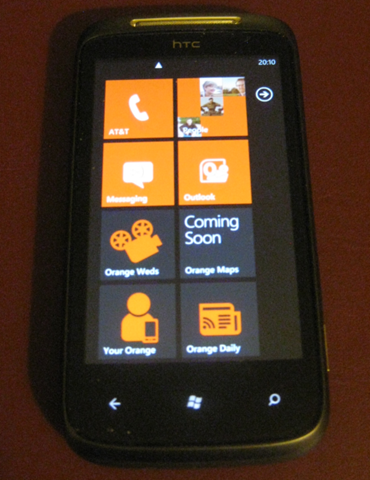
image

First, it is a decent smartphone. Take no notice of comments about the ugliness of the user interface. Although it looks a little boxy in pictures, in practice it is fun to use.

Some things take a bit of learning. For example, There is a camera button on the phone, and a full press on this activates the camera from almost anywhere. Within the camera, a full press takes a picture, but a half press or a press and hold activates autofocus. I did not find this behaviour immediately intuitive, but it is something you get used to.

There is plenty to like about the phone. This includes the dynamically updating tiles; the picture hub and the ability to auto-upload pictures to Skydrive, Microsoft’s free cloud storage; and neat touches such as the music controls which appear over the lock screen when you activate the screen during playback; or the Find your Phone feature which can ring your phone loudly even if it is set to silent, or lock the phone and add an if found message.

The People hub is fabulous if you use Facebook. I don’t use Facebook much, but even with my limited use, I noticed that as soon as I linked with Facebook, the phone felt deeply personalised to me, with little pictures of people I know in the People tile. The ability to link two profiles to one contact is good.

I also like the Office hub which includes Sharepoint workspace mobile – useful for synching content. Microsoft should push this hard, especially as Office 365, which includes hosted Exchange and Sharepoint, gains users.

There are some excellent design touches. For example, many apps have a menu bar with icons at the foot of the screen. There are no captions, which saves space, but by tapping a three-dot icon you can temporarily display captions. In time you learn them and no longer need to.

The pros and cons of hubs

Microsoft has addressed what is a significant issue in other smartphones: how to declutter the user interface. Windows Phone 7 hubs collect several related apps and features (between which there is no sharp difference) into a multi-page view. There are really six hubs:

  • People
  • Pictures (includes the camera)
  • Music and videos
  • Marketplace
  • Office
  • Games

I like the hubs in general; but there are a few issues. Of the hubs listed above, four of them work well: People, Pictures, Music/Videos, and Games. Marketplace is not really a hub any more than “phone” is a hub – it is just a way to access a single feature. Office is handy but it is not a hub gathering all the apps that address a particular area; it is a Microsoft brand. If I made a word processor app I could not add it to the Office hub.

Further, operators and OEMs can add their own hubs, but will most likely make bad decisions. There is a pointless HTC hub on my device which combines weather and featured apps. It also features a dizzying start-up animation which soon gets tired. I have no idea what the HTC hub is meant to do, other than to promote the HTC brand.

Speaking of brands, I have deliberately left the home screen on my Mozart as supplied by Orange. As you can see from the picture above, Orange decided we would rather see four Orange apps occupy 50% of the home screen (before you scroll down), than other features such as web browsing, music and video, pictures and so on. Why isn’t Orange a hub so that at least all this stuff is in one place?

The user can modify the home screen easily enough, and largely remove the Orange branding. But to get back to my point about hubs: it is not clear to me what a hub is meant to be. It is not really a category, because you cannot create hubs or add and remove apps from them, and because of the special privileges given to OEMs we get nonsense like the HTC hub, alongside works of art like the Pictures hub.

There is still more good than bad in the hub concept, but it need work.

Not enough features?

I have no complaint about lack of features in this first release of Windows Phone 7. Yes, I would like tethering. Yes, I would like the ability to copy an URL from the web browser to the Twitter client. But I am happy with the argument that Microsoft was more concerned with getting the foundation right, than with supplying every possible feature in version one.

I am less happy with the notion that Microsoft can afford for the initial devices to be a bit hopeless, and fix it up in later versions. I am not sure how much time the company has, before the world at large just presumes it cannot match iPhone or Android and forgets Microsoft as a smartphone company.

Is it a bit hopeless, or very good at what it does? I am still not sure, mainly because I seem to have had more odd behaviour than some other early adopters. Example: licence error after downloading from marketplace; apps that don’t open or which give an error and inform me that they have to close; black screens. A few times I’ve had to restart; once I had to remove the battery – thank you HTC Notes, which has been updated and now does not work at all. It is possible that there is some issue with my review device, such as faulty RAM, or maybe the amount of memory in a Mozart is inadequate. I am going to assume the former, but await other reports with interest.

The one area where Windows Phone 7 is weak is in app availability. I would like a WordPress app, for example. Clearly this will fix itself if the device is popular, though there are some issues facing third-party developers which will impede this somewhat.

App Development and the Marketplace

The development platform for third parties is meant to be Silverlight and XNA, two frameworks based on .NET which address general apps and games respectively. These are strong platforms, backed up by Visual Studio and the C# programming language, so not a bad development story as far as it goes.

That said, there are a couple of significant issues here. One is that third-party apps do not have access to all the features of the phone and cannot multi-task. Switch away from an app and it dies. This can result in a terrible user experience. For example, I fire up the impressive game The Harvest. Good though it is, it takes a while to load. Finally it loads and play resumes from where I got to last time. I’m just wondering what to tap, when the lock screen kicks in – since I have not tapped anything for a bit (because the game was loading), the device has decided to lock. I flick back the lock. Unfortunately the game has been killed, and starts over with resume and a long loading process.

The other area of uncertainly relates to native code development. C/C++ and native code is popular for mobile apps. It is efficient, which is good for devices with constrained resources; and while native code is by definition not cross-platform, large chunks of the code for one platform will likely port OK to another.

Third party developers cannot do native code development for Windows Phone 7. Or can they? Frankly, I have heard conflicting reports on this from Microsoft, from developers, and even from other journalists.

At the beginning, when the Windows Phone 7 development platform was announced at the Mix conference last year, it was stated that the only third-party developers allowed to use native code were Adobe, because Microsoft wants Flash on the device, operators and OEM hardware vendors. At the UK reviewer’s workshop, I was assured by a Microsoft spokesperson that this is still the case, and that no other third parties have been given special privileges.

I am sceptical though. I expect important third parties like Spotify will use native code for their apps, and/or get access to additional APIs. If you have a good enough relationship with Microsoft, or an important enough app, it will be negotiable.

In fact, I hope this is the case; and I also expect that there will be an official, public native code SDK for the device within a year or two.

As it is, the situation is unsatisfactory. I dislike the idea that only operators and OEMs can use native code – especially as this group does not have the best track record for creating innovative and useful apps. I have more confidence in third party developers to come up with compelling apps than operators or hardware vendors – who all too often just want to plug their brand.

I also think the Marketplace needs work. If I search marketplace, I want it filtered to apps only by default, but for some reason the search covers music and video as well, so If I search for a twitter client, I get results including a song called Hit me up on Twitter. That’s nonsense.

I wonder if the submission process is a too lax at the moment, because of Microsoft is so anxious to fill Marketplace with apps. I suppose there will always be too many lousy apps in there, on this and other platforms. Still, while nobody likes arbitrary rejections, I suspect Microsoft would win support if it were more rigorous about enforcing standards in areas like how well apps resume after they are killed by the operating system, and in their handling of the back button, two areas which seem lacking at the moment.

Complaints and annoyances

One persistent annoyance with the HTC Mozart is the proximity of menu bar which appears at the bottom of many apps, with the with “hardware” buttons for back, start, and search which are compulsory on all Windows Phone 7 devices. The problem is that on the Mozart, these buttons are the same as app buttons, triggered by a light touch. So I accidentally hit back, start or search instead of one of the menu buttons. I have similar issues with the onscreen keyboard. I’m learning to be very very careful where I tap in that region, which makes using the device less enjoyable.

Another annoyance is the unpredictability of the back button. I am often unsure whether this is going to navigate me back within an app, or kick me out of the app.

Some of the apps are poor or not quite done. This will sort itself presuming the phone is not a complete flop. For example, in Twozaic, when typing a tweet, the post button is almost entirely hidden by the keyboard. I would like an Android style close keyboard button (update: though the back button should do this consistently).

I have already mentioned problems with bugs and crashes, which I am hoping are specific to my device.

It seems to me that Microsoft has taken a look at Apple’s extraordinarily profitable approach to devices and thought “We want some of that.” The device is equally as locked down as an iPhone – except that in Apple’s case there are no OEMs to disrupt the user experience with half-baked apps, and operators are also prevented from interfering. With Windows Phone we kind-of have the worst of both worlds: operators and OEMs can spoil the phone’s usability – though this is constrained in that clued-up users can get rid of what they do not want – but we are still restricted from doing things like attaching the phone as USB storage.

Still not completely fixed – the OEM problem

My final reflection (for now) is that Windows Phone 7 still reflects Microsoft’s OEM problem. This device matters more to Microsoft than it does either to the operators or the OEM hardware vendors – who have plenty to be getting on with other mobile operating systems. In consequence, the launch devices do not do justice to the capabilities of Windows Phone 7, and in some cases let it does badly. I do not much like the HTC Mozart, and suspect that HTC just has not given the phone the attention that it needed.

One solution would be for Microsoft to make its own device. Another would be for some hardware vendor to come up with a superb device that would make us re-evaluate the platform. Those with long memories will recall that HTC did this for Windows CE, with the original iPAQ, the first devices using that operating system which performed satisfactorily.

HTC could do it again, but has not delivered with the Mozart, or I suspect with its other launch devices.

I have also noted issues with way Orange has customised my device, which is another part of the same overall issue.

Despite Microsoft’s moves to mitigate its OEM problem, by enforcing consistency of hardware and by (mostly) retaining control over the user interface, it is still an area of concern.

Windows Phone 7 battles indifference in London

Today is launch day for Windows Phone 7 in the UK – but the hoped-for crowds of people waiting to buy the new phone failed to appear.

They are billed as the handsets that could topple the iPhone. Yet as Microsoft’s Windows 7 phones went on sale this morning there was not a queue in sight.

reported the London Evening Standard.

The device also suffered faint praise from the influential Wall Street Journal reviewer Walt Mossberg. Although he called the user interface “novel and attractive”, he complained about missing features:

Microsoft has inexplicably omitted from Windows Phone 7 key features now common, or becoming so, on competitive phones. These missing features include copy and paste, visual voicemail, multitasking of third-party apps, and the ability to do video calling and to use the phone to connect other devices to the Internet. The Android phones and the iPhone handle all these things today.

adding that

I couldn’t find a killer innovation that would be likely to make iPhone or Android users envious, except possibly for dedicated Xbox users.

Is he right? In some ways it does not matter; perception is reality. That said, none of his missing features strike me as deal-breakers for a majority of users. You can also argue that Microsoft has learnt from Apple not to put every possible feature into the first release, but rather to make the features it does implement work as well as possible and to build on that in the future.

The problem is that there is so much momentum around Google Android and Apple iPhone that the average consumer looking for a smartphone will need a lot of persuading before paying out for Windows Phone 7, or even really noticing it. Microsoft needed rave reviews, not so-so ones. There is a danger that the new phone may suffer the same fate as Palm’s webOS devices, well liked by those who take the trouble to explore them, but absent from the mainstream of consumer consciousness.

I’ve had a device for a few days, and it has been favourably received by people I’ve shown it to. Some of the games look great – The Harvest, for example, a Microsoft exclusive. The Facebook integration is also appealing to fans of that site, and feels deeper than Facebook apps on other devices. Windows Phone 7 does have distinctive features.

I’ll be reviewing the device properly in due course. What is more interesting than my opinions though is how the phone is received in the market. I had expected more interest from the curious on day one of retail release.

Update: Microsoft found a queue or two for its press release today. Big in Australia?