Category Archives: windows

25 years of Windows: triumph and tragedy

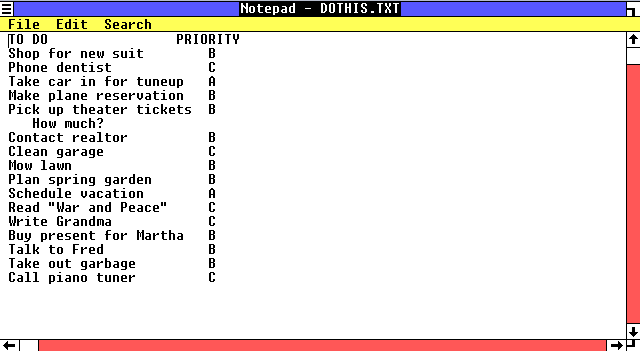
I wrote a (very) short history of Windows for the Register, focusing on the launch of Windows 1.0 25 years ago.

image

I used Oracle VirtualBox to run Windows 1.0 under emulation since it more or less works. I found an old floppy with DOS 3.3 since Windows 1.0 does not run on DOS 6.2, the only version offered by MSDN. In the course of my experimentation I discovered that Virtual PC still supports floppy drives but no longer surfaces this in the UI. You have to use a script. Program Manager Ben Armstrong says:

Most users of Windows Virtual PC do not need to use floppy disks with their virtual machines, as general usage of floppy disks has become rarer and rarer.

An odd remark in the context of an application designed for legacy software.

What of Windows itself? Its huge success is a matter of record, but it is hard to review its history without thinking how much better it could have been. Even in version 1.0 you can see the intermingling of applications, data and system files that proved so costly later on. It is also depressing to see how mistakes in the DOS/Windows era went on to infect the NT range.

Another observation. It took Microsoft 8 years to release a replacement for DOS/Windows – Windows NT in 1993 – and another 8 years to bring Windows NT to the mainstream on desktop and server with Windows XP in 2001. It is now 9 years later; will there ever be another ground-up rewrite, or do just get gradual improvements/bloat from now on?

I don’t count 64-bit Windows as a ground-up rewrite since it is really a port of the 32-bit version.

Finally, lest I be accused of being overly negative, it is also amazing to look at Windows 1.0, implemented in fewer than 100 files in a single directory, and Windows 7/Server 2008 R2, a platform on which you can run your entire business.

The cloud permeates Microsoft’s business more than we may realise

I’m in the habit of summarising Microsoft’s financial results in a simple table. Here is how it looks for the recently announced figures.

Quarter ending September 30 2010 vs quarter ending September 30 2009, $millions

Segment Revenue Change Profit Change
Client (Windows + Live) 4785 1905 3323 1840
Server and Tools 3959 409 1630 393
Online 527 40 -560 -83
Business (Office) 5126 612 3388 561
Entertainment and devices 1795 383 382 122

The Windows figures are excellent, mostly reflecting Microsoft’s success in delivering a successor to Windows XP that is good enough to drive upgrades.

I’m more impressed though with the Server and tools performance – which I assume is mostly Server – though noting that it now includes Windows Azure. Microsoft does not break out the Azure figures but said that it grew 40% over the previous quarter; not especially impressive given that Azure has not been out long and will have grown from a small base.

The Office figures, also good, include Sharepoint, Exchange and BPOS (Business Productivity Online Suite), which is to become Office 365. Microsoft reported “tripled number of business customers using cloud services.”

Online, essentially the search and advertising business, is poor as ever, though Microsoft says Bing gained market share in the USA. Entertainment and devices grew despite poor sales for Windows Mobile, caught between the decline of the old mobile OS and the launch of Windows Phone 7.

What can we conclude about the health of the company? The simple fact is that despite Apple, Google, and mis-steps in Windows, Mobile, and online, Microsoft is still a powerful money-making machine and performing well in many parts of its business. The company actually does a poor job of communicating its achievements in my experience. For example, the rather dull keynote from TechEd Berlin yesterday.

Of course Microsoft’s business is still largely dependent on an on-premise software model that many of us feel will inevitably decline. Still, my other reflection on these figures is that the cloud permeates Microsoft’s business more than a casual glance reveals.

The “Online” business is mainly Bing and advertising as far as I can tell; and despite CTO Ray Ozzie telling us back in 2005 of the importance of services financed by advertising, that business revolution has not come to pass as he imagined. I assume that Windows Live is no more successful than Online.

What is more important is that we are seeing Server and tools growing Azure and cloud-hosted virtualisation business, and Office growing hosted Exchange and SharePoint business. I’d expect both businesses to continue to grow, as Microsoft finally starts helping both itself and its customers with cloud migration.

That said, since the hosted business is not separated from the on-premise business, and since some is in the hands of partners, it is hard to judge its real significance.

Understanding the Silverlight controversy

There has been much discussion of the future of Microsoft’s Silverlight plugin since Server and Tools President Bob Muglia’s statement in a PDC interview that “Our strategy with Silverlight has shifted”, and spoke of HTML as the “only true cross platform solution”.

The debate was even reported on the BBC’s web site under the headline Coders decry Silverlight change.

It is unfortunate that headlines tend to think in binary; alive or dead. In other words, if Microsoft is repositioning Silverlight then it must be killing it.

That is not the case. Muglia did not say that Silverlight has no future, nor that it was unimportant. He affirmed that there will be another version of Silverlight for Windows and Mac, as well as highlighting that it is the development platform for Windows Phone.

Speaking personally for a moment, I have reviewed Silverlight favourably in the past and still regard it as a great achievement by Microsoft: the power of the .NET runtime, the elegance of C#, the flexible layout capabilities of XAML, integrated with a capable multimedia player, and wrapped in a lightweight package that in my experience installs quickly and easily.

Silverlight forms an excellent client for cloud services such as those delivered by the Azure platform which we heard about at PDC.

Perhaps it is the case that IE9 maestro Dean Hachamovitch tended towards the gleeful as he demonstrated features in HTML and JavaScript that previously would have required Silverlight or Flash. At the same time, IE9 is not yet released, and even when it is, will not match the capabilities or the tooling and libraries available for Silverlight.

The Silverlight press generated by PDC must have been disappointing and frustrating for Microsoft’s Silverlight team. I am reading reports of Developer VP Scott Guthrie’s remarks at the DevConnections conference this week.

The reports of my death are greatly exaggerated … I have more people working on Silverlight now than any time in Silverlight history … don’t believe everything you read on the internet.

I have great respect for Guthrie; you need only see the speed and manner with which he reacted to the recent ASP.NET security scare – not trying to diminish its importance, delivering practical advice, answering comments, and working with his team to come up with workarounds and a proper solution as quickly as possible – to appreciate his commitment and that he understands the needs of developers.

So were posts like my own Silverlight dream is over unfair and inaccurate? Well, there is always a risk of being misunderstood; but the problem, as I perceive it, is not primarily about Silverlight’s progress on Windows and Mac. The problem is that those two desktop platforms no longer have sufficient reach; or rather, even if they have sufficient reach today, they will not tomorrow. We have the rise of iOS and Android; an explosion of non-Windows tablets in the wings; we have a man like James Gardner, CTO at the UK’s Department for Work and Pensions, writing of Windows 7 that:

Personally, I think it likely this is  the last version of Windows anyone ever widely deploys

See also Cliff Saran’s comments at Computer Weekly.

In other words, Guthrie’s team can do a cracking job with Silverlight 5 for Windows and Mac – it could even merge Silverlight with WPF and make it the primary application platform for Windows – but that would still not address the concerns raised by what happened at PDC. If Silverlight remains imprisoned in Windows and Mac, it cannot deliver on its original promise.

What could Microsoft do to restore confidence in Silverlight? Something along these lines would make me change my mind:

  1. Announce Silverlight for Android.
  2. Nurture Silverlight for Symbian.
  3. Follow through on commitments for Silverlight on Moblin/MeeGo.
  4. Either implement Silverlight for Linux, or enter a deeper partnership with Novell’s Mono so that Microsoft-certified Silverlight runtimes appear on Linux in a timely manner alongside Microsoft’s releases.
  5. Come up with a solution for Silverlight on iOS. One idea is to follow Adobe with a native code compiler from Silverlight to iOS. Another would be a way of compiling XAML and C# to SVG and JavaScript. Neither would be perfect; but as it is, every company that starts deploying iPads or their successors is a customer that cannot use Silverlight.

Do I think Microsoft will implement the above? I doubt it. My interpretation of Muglia’s remarks is that Microsoft has decided not to go down that path, but to reserve Silverlight for Windows, Mac, and Windows Phone, and to invest in HTML for broad-reach applications.

That may well be the right decision; it is one that makes sense, though Microsoft was perhaps unwise to highlight it before IE9 is released. Further, cross-platform is not in Microsoft’s blood, and the path that Silverlight has taken is in line which what you would expect from a company built on Windows.

Silverlight is not dead, and for developers targeting Windows, Mac and Windows Phone it is as good as ever, and no doubt will be even better in its next version. But failing another change of heart, it will never now be WPF Everywhere; and PDC 2010 was when that truth sank home.

Update: this is pretty much what Guthrie says in his latest post:

Where our strategy has shifted since we first started working on Silverlight is that the number of Internet connected devices out there in the world has increased significantly in the last 2 years (not just with phones, but also with embedded devices like TVs), and trying to get a single implementation of a runtime across all of them is no longer really practical (many of the devices are closed platforms that do not allow extensibility).  This is true for any single runtime implementation – whether it is Silverlight, Flash, Java, Cocoa, a specific HTML5 implementation, or something else.  If people want to have maximum reach across *all* devices then HTML will provide the broadest reach (this is true with HTML4 today – and will eventually be true with HTML5 in the future).  One of the things we as a company are working hard on is making sure we have the best browser and HTML5 implementation on Windows devices through the great work we are doing with IE9.

Reflections on Microsoft PDC 2010

I’m in Seattle airport waiting to head home – so here are some quick reflections on Microsoft’s Professional Developers Conference 2010.

Let’s start with the content. There was a clear focus on two things: Windows Azure, and Windows Phone 7.

On the Azure front, the cloud platform, Microsoft impressed. Features are being added rapidly, and it looks solid and interesting. The announcements at PDC mean that Azure provides pretty much the complete Windows Server platform, should you want it. You will get elevated privileges for complete control over a server instance; and full IIS functionality including support for multiple web sites and the ability to install modules. You will also be able to remote desktop into your Azure servers, which is going to make Windows admins feel more comfortable with Azure.

The new virtual machine role is also a big deal, even though in some ways it goes against the multi-tenanted philosophy by leaving the customer responsible for patches and updates. Businesses with existing virtual servers can simply move them to Azure if they no longer wish to run their own hardware. There are also existing tools for migrating physical servers to virtual.

I asked Bob Muglia, president of server and tools at Microsoft, whether having all these VMs maintained by customers and potentially compromised with malware posed a security threat to the platform. He assured me that they are fully isolated, and that the main danger is to the customer who might consume unexpected amounts of bandwidth.

Simply running on an Azure VM does not take full advantage of the platform though. It makes more sense to hook into Azure services such as SQL Azure, or the non-relational storage services, and deploy to Azure web or worker roles where Microsoft take care of maintenance. There is also a range of middleware services called AppFabric; see here for a few notes on these.

If there was one gap in the Azure story at PDC, it was a lack of partner announcements. Microsoft says there are more than 20,000 applications running on Azure, but we did not hear much about them, or about notable large customers embracing Azure. There is still a lot of resistance to the cloud among customers. I asked some attendees at lunch whether they expect to use Azure; the answer was “no, we have our own datacenter”.

I think the partner announcements will come. Microsoft is firmly behind Azure now, and it makes sense for its customers. I expect Azure to succeed; but whether it will do well enough to counter-balance the cost to Microsoft of migration away from on-premise servers is an open question.

Alongside Azure, though hardly mentioned at PDC, is the hosted application business originally called BPOS and now called Office 365. This is not currently hosted on Azure, though Muglia told me that most of it will in time move there. There are some potential synergies here, for example in Azure workflow applications that handle SharePoint forms or documents.

Microsoft’s business is primarily based on partners selling Windows hardware and licenses for on-premise or client software. Another open question is how easily the company can re-orient itself to be a cloud platform and services company. It is a massive shift.

What about Windows Phone? Microsoft has some problems here, and they are not primarily to do with the phone itself, which is decent. There are a few issues over the design of the launch devices, and features that are lacking initially. Further, while the Silverlight and XNA SDK forms a strong development platform, there is a need for a native code SDK and I expect this will follow at some point.

The key issue though is that outside the Microsoft bubble there is not much interest in the phone. Google Android meets the needs of the OEM hardware and operator partners, being open and easily customised. Apple owns the market for high-end devices with the design quality and ease of use that comes from single-vendor control of the whole stack. The momentum behind these platforms is such that it will not be easy for Microsoft to grab much market share, or attention from third-party app developers. It deserves to do well; but I will not be surprised if it under-performs relative to its quality.

There was also some good material to be found on the PDC sidelines, as it were. Andes Hejlsberg presented on new asynchronous features coming in C# 5.0, which look like a breakthrough in making concurrent programming safer and easier. He also showed a bit of Microsoft’s work on compiler as a service, which has huge potential. Patrick Smaccia has an enthusiastic report on the C# presentation. Herb Sutter gave a brilliant talk on lambdas.

The PDC site lets you stream pretty much all the sessions and seems to work very well. The player application is written in Silverlight. Note that there are twice as many sessions as appear in the schedule, since many were pre-recorded and only show in the full session list.

Why did Microsoft run such a small event, with only around 1000 attendees? I asked a couple of people about this; the answer seems to be partly as a cost-saving measure – it is much cheaper to run an event on the Microsoft campus than to hire an external venue and pay transport and expenses for all the speakers and staff – and partly to emphasise the virtual aspect of PDC, with a global audience tuning in.

This does not altogether make sense to me. Microsoft is still generating a ton of cash, as we heard in the earnings call at the event, and PDC is a key opportunity to market its platform to developers and influencers, so it should not worry too much about the cost. Second, you can do virtual as well as physical; they are not alternatives. You get more engagement from people who are actually present.

One of the features of the player is that you see how many are currently streaming the content. I tuned into Mark Russinovich’s excellent session on Azure – he says he has “drunk the cloud kool-aid” – while it was being streamed live, and was surprised to see only around 300 virtual attendees. If that figure is accurate, it is disappointing, though I am sure there will be thousands of further views after the event.

Finally, what about all the IE9/HTML 5 vs Silverlight discussion generated at PDC? Clearly Microsoft’s messaging went badly awry here, and frankly the company has only itself to blame. It cannot be surprised if after making a huge noise about how IE9 forms a great client for web applications, standards-based and integrated with Windows, that people question what sort of role is envisaged for Silverlight. It did not help that a planned session on Silverlight futures was apparently cancelled, probably for innocent reasons such as not being quite ready to show, but increasing speculation that Silverlight is now getting downplayed.

Microsoft chose to say nothing on the subject, other than some remarks by Bob Muglia to freelance journalist Mary-Jo Foley which seem to confirm that yes, Silverlight is no longer Microsoft’s key technology for cross-platform web applications.

If that was not quite the message Microsoft intended, then why not clarify the matter to press, myself included, as we sat in the press room on Microsoft’s campus?

My take is that while Silverlight is by no means dead, it seems destined for a lesser role than was once envisaged – a shame, as it is an excellent cross-platform .NET client.
Microsoft’s Silverlight dream is over

Remember “WPF Everywhere”? Microsoft’s strategy was to create a small cross-platform runtime that would run .NET applications on every popular platform, as well as forming a powerful multimedia player. Initially just a browser plug-in, Silverlight 3 and 4 took it to the next level, supporting out of browser applications that integrate with the desktop.

The pace of Silverlight development was unusually fast, from version 1.0 in 2007 to version 4.0 in April 2010, and Microsoft bragged about how many developer requests it satisfied with the latest version.

Silverlight has many strong features, performs well, and to me is the lightweight .NET client Microsoft should have done much earlier. That said, there have always been holes in the Silverlight story. One is Linux support, where Microsoft partnered with Novell’s open source Mono project but without conviction. More important, device support has been lacking. Silverlight never appeared for Windows Mobile; there is a Symbian port that nobody talks about; a version for Intel’s Moblin/Meego was promised but has gone quiet – though it may yet turn up – and there is no sign of a port for Android. Silverlight is no more welcome on Apple’s iOS (iPhone and iPad), of course, than Adobe’s Flash; but whereas Adobe has fought hard to get Flash content onto iOS one way or another, such as through its native code packager, Microsoft has shown no sign of even trying.

In the early days of Silverlight, simply supporting Windows and Mac accounted for most of what people wanted from a cross-platform client. That is no longer the case.

Further, despite a few isolated wins, Silverlight has done nothing to dent the position of Adobe Flash as a cross-platform multimedia and now application runtime. Silverlight has advantages, such as the ability to code in C# rather than ActionScript, but the Flash runtime has the reach and the partners. At the recent MAX conference RIM talked up Flash on the Blackberry tablet, the Playbook, and Google talked up Flash on Google TV. I have not heard similar partner announcements for Silverlight.

Why has not Microsoft done more to support Silverlight? It does look as if reports of internal factions were correct. Why continue the uphill struggle with Silverlight, when a fast HTML 5 browser, in the form of IE9, meets many of the same needs and will work across the Apple and Google platforms without needing a non-standard runtime?

Here at PDC Microsoft has been conspicuously quiet about Silverlight, other than in the context of Windows Phone 7 development. IE9 man Dean Hachamovitch remarked that “accelerating only pieces of the browser holds back the web”, and last night Microsoft watcher Mary-Jo Foley got Server and Tools president Bob Muglia to admit that “our strategy has shifted” away from Silverlight and towards HTML 5 as the cross-platform client runtime, noting that this was a route to running on Apple’s mobile devices.

The Silverlight cross-platform dream is over, it seems, but let me add that Silverlight, like Microsoft itself, is not dead yet. Microsoft is proud of its virtual PDC streaming application, which is built in Silverlight. The new portal for Windows Azure development and management is Silverlight. The forthcoming Visual Studio Lightswitch generates Silverlight apps. And to repeat, Silverlight is the development platform for Windows Phone 7, about which we have heard a lot at PDC.

Let’s not forget that IE9 is still a preview, and HTML 5 is not a realistic cross-platform application runtime yet, if you need broad reach.

Muglia’s remarks, along with others here at PDC, are still significant. They suggest that Microsoft’s investment in Silverlight is now slowing. Further, if Microsoft itself is downplaying Silverlight’s role, it will tend to push developers towards Adobe Flash. Alternatively, if developers do migrate towards HTML 5, they will not necessarily focus on IE9. Browsers like Google Chrome are available now, and will probably stay ahead of IE in respect of HTML 5 support.

I hope these latest reports will trigger further clarification of Microsoft’s plans for Silverlight. I’d also guess that if Windows Phone 7 is a big success, then Silverlight on the Web will also get a boost – though judging from the early days in the UK, the new phone is making a quiet start.

Finally, if Microsoft is really betting on HTML 5, expect news on tools and libraries to support this new enthusiasm – maybe at the Mix conference scheduled for April 2011.

AppFabric – Microsoft’s new middleware

I took the opportunity here at Microsoft PDC to find out what Microsoft means by AppFabric. Is it a product? a brand? a platform?

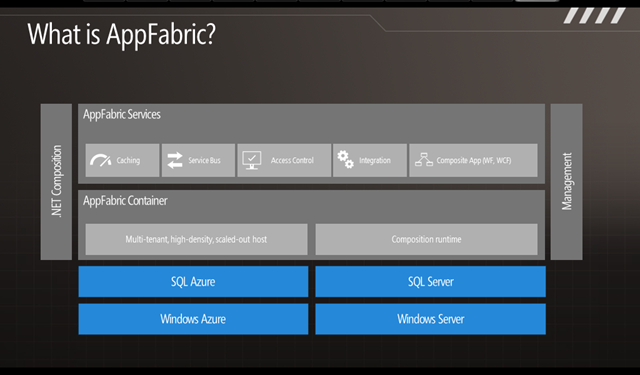
The explanation I was given is that AppFabric is Microsoft’s middleware brand. You will normally see the work in conjunction with something more specific, as in “AppFabric Caching” (once known as Project Velocity) or “AppFabric Composition Runtime” (once known as Project Dublin. The chart below was shown at a PDC AppFabric session:

image

Of course if you add in the Windows Azure prefix you get a typical Microsoft mouthful such as “Windows Azure AppFabric Access Control Service.”

Various AppFabric pieces run on Microsoft’s on-premise servers, though the emphasis here at PDC is on AppFabric as part of the Windows Azure cloud platform. On the AppFabric stand in the PDC exhibition room, I was told that AppFabric in Azure is now likely to get new features ahead of the on-premise versions. The interesting reflection is that cloud customers may be getting a stronger and more up-to-date platform than those on traditional on-premise servers.

Windows Phone 7 battles indifference in London

Today is launch day for Windows Phone 7 in the UK – but the hoped-for crowds of people waiting to buy the new phone failed to appear.

They are billed as the handsets that could topple the iPhone. Yet as Microsoft’s Windows 7 phones went on sale this morning there was not a queue in sight.

reported the London Evening Standard.

The device also suffered faint praise from the influential Wall Street Journal reviewer Walt Mossberg. Although he called the user interface “novel and attractive”, he complained about missing features:

Microsoft has inexplicably omitted from Windows Phone 7 key features now common, or becoming so, on competitive phones. These missing features include copy and paste, visual voicemail, multitasking of third-party apps, and the ability to do video calling and to use the phone to connect other devices to the Internet. The Android phones and the iPhone handle all these things today.

adding that

I couldn’t find a killer innovation that would be likely to make iPhone or Android users envious, except possibly for dedicated Xbox users.

Is he right? In some ways it does not matter; perception is reality. That said, none of his missing features strike me as deal-breakers for a majority of users. You can also argue that Microsoft has learnt from Apple not to put every possible feature into the first release, but rather to make the features it does implement work as well as possible and to build on that in the future.

The problem is that there is so much momentum around Google Android and Apple iPhone that the average consumer looking for a smartphone will need a lot of persuading before paying out for Windows Phone 7, or even really noticing it. Microsoft needed rave reviews, not so-so ones. There is a danger that the new phone may suffer the same fate as Palm’s webOS devices, well liked by those who take the trouble to explore them, but absent from the mainstream of consumer consciousness.

I’ve had a device for a few days, and it has been favourably received by people I’ve shown it to. Some of the games look great – The Harvest, for example, a Microsoft exclusive. The Facebook integration is also appealing to fans of that site, and feels deeper than Facebook apps on other devices. Windows Phone 7 does have distinctive features.

I’ll be reviewing the device properly in due course. What is more interesting than my opinions though is how the phone is received in the market. I had expected more interest from the curious on day one of retail release.

Update: Microsoft found a queue or two for its press release today. Big in Australia?

Which mobile platforms will fail?

Gartner’s Nick Jones addressed this question in a blog post yesterday. He refers to the “rule of three” which conjectures that no more than three large vendors can succeed in a mature market. If this applies in mobile, then we will see no more than three survivors, after failures and consolidation, from the following group plus any I’ve missed. I have shown platforms that have common ownership and are already slated to be replaced in strikeout format.

  • Apple iOS
  • Google Android
  • Samsung Bada
  • Maemo MeeGo
  • RIM BlackBerry OS BlackBerry Tablet OS (QNX)
  • HP/Palm WebOS
  • Symbian
  • Windows Mobile Windows Phone 7 and successors

Jones says that success requires differentiation, critical mass, and a large handset manufacturer. I am not sure that the last two are really distinct. It is easy to fall into the tautology trap: to be successful a platform needs to be successful. Quite so; but what we are after is the magic ingredient(s) that make it so.

Drawing up a list like this is hard, since some operating systems are more distinct than others. Android, Bada, MeeGo and WebOS are all Linux-based; iOS is also a Unix-like OS. Windows Mobile and Windows Phone 7 are both based on Windows CE.

While it seems obvious that not all the above will prosper, I am not sure that the rule of three applies. I agree that it is unlikely that mobile app vendors will want to support and build 8 or more versions of each app in order to cover the whole market; but this problem does not apply to web apps, and cross-platform frameworks and runtimes can solve the problem to some extent – things like Adobe AIR for mobile, PhoneGap and Appcelerator. Further, there will probably always be mobile devices on which few if any apps are installed, where the user will not care about the OS or application store.

Still, pick your winners. Gartner is betting on iOS and Android, predicting decline for RIM and Symbian, and projecting a small 3.9% share for Microsoft by 2014.

I am sure there will be surprises. The question of mobile OS market share should not be seen in isolation, but as part of a bigger picture in which cloud+device dominates computing. Microsoft has an opportunity here, because in theory it can offer smooth migration to existing Microsoft-platform businesses, taking advantage of their investment – or lock-in – to Active Directory, Exchange, Office and .NET. In the cloud that makes Microsoft BPOS and Azure attractive, while a mobile device with great support for Exchange and SharePoint, for example, is attractive to businesses that already use these platforms.

The cloud will be a big influence at the consumer end too. There is talk of a Facebook phone which could disrupt the market; but I wonder if we will see the existing Facebook and Microsoft partnership strengthen once people realise that Windows Phone 7 has, from what I have seen, the best Facebook integration out there.

So there are two reasons why Gartner may have under-rated Microsoft’s prospects. Equally, you can argue that Microsoft is too late into this market, with Android perfectly positioned to occupy the same position with respect to Apple that worked so well for Microsoft on the desktop.

It is all too early to call. The best advice is to build in the cloud and plan for change when it comes to devices.

A useful Windows Phone 7 app in a couple of hours – Where’s my Train

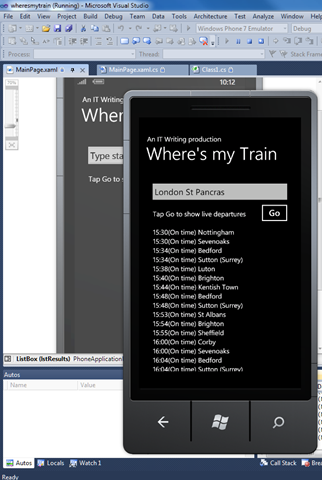
I was interested to see that National Rail Enquiries has published a web service for its live departure boards. These give you reports on the next trains to depart from any given station, including information on late running.

Given that this is Windows Phone 7 week, I could not resist trying it out. I have a minimalist UI – you type in a station and hit Go. In version two you will just press Enter. It fetches the live train departures and displays them in a list. Version two might have a scrollbar too. Still, I’m pleased with the results, which could actually prove useful when I am running for a train.

image

Confession: it is currently hardcoded for just a few stations. That’s because you need to look up the station code in this table. I need to embed this database in my app somehow.

The coding is pretty simple though. It may help that the National Rail Enquiries web service is based on .NET, which is also why it does SOAP and WSDL, to the disappointment of those looking for REST. All the hard stuff is done by Add Service Reference in Visual Studio. The web service call is asynchronous, but there is a code completion wizard to add the necessary event handler.

Could be a money spinner if I can get it out quickly – but unfortunately the terms and conditions appear to prohibit its distribution:

This Web Site is for your personal and non-commercial use. You may not at any time modify, store, copy (including for example screen scraping), extract, reutilise, distribute, transmit, display, perform, reproduce, publish, license, create derivative works from, transfer, or sell, distribute or create any information, products or services obtained from, linked to or using this Web Site and any data therein or that may provide users with the ability to do the same.

These terms are bit puzzling, because on one interpretation they do not permit any use of the web service, even though it is stated that:

For the purposes of these Terms & Conditions the term Web Site also includes the web services, XML and any other data source supplying the Web Site.

Oh well. It still shows how quickly you can knock together a client for a web service and make something useful, although mine is really only a proof of concept. I reckon it would be almost as easy in Adobe AIR too – and then it would run on Android.

There is a National Rail Enquiries app for iPhone which costs $7.99 and likely uses the same web service.

Windows Phone 7 gets decent launch, Stephen Fry’s blessing

I was not able to attend the press conference for Windows Phone 7 in person but watched the live webcast from New York. I was unconvinced by the phrase “Always delightful, wonderfully mine” which formed the basis of Microsoft CEO Steve Ballmer’s lead-in, but it got better.

image

Corporate VP Joe Belfiore did a live demo, explained how the team had aimed to simplify the phone and make it where possible seem one step ahead of the user, predicting the information you would want or the next step you wish to take. He also spent some time on enterprise features, especially Office and Exchange integration, which interested me as there is some ambiguity in how Microsoft is positioning the launch devices; consumer is the focus yet business-oriented features keep cropping up.

image

One of the 5 HTC phones announced today is the HTC 7 Pro which has a keyboard and seems mainly aimed at business users.

Ralph de la Vega from AT&T said that his company will offer Windows Phone 7 from November 8th in USA, initially from LG, but with  with 3 devices – LG, HTC, Samsung – available a few weeks later.

Belfiore’s demo looked good, despite a couple of failures from which he made a good recovery. He announced that the much-discussed Copy and Paste feature, which will be absent from the first release, will come as an automatic update early in 2011.

He also spent some time on the Xbox Live integration, which is one feature that is distinctive to Windows Phone 7 and strikes me as a smart move. A couple of XNA games were demoed and look good, one called Ilo and Milo that uses the accelerometer:

image

and a familiar one from EA, The Sims:

image

The best part of Microsoft’s launch though was not in the USA but in the UK. Celebrity Stephen Fry, known for his love of all things Apple, got up and and praised the phone.

image

The BBC’s Rory Cellan-Jones caught some of this on video, and I am going to quote extensively because it touches on something I’ve been tracking for years: Microsoft’s belated recognition of the importance of design:

I made no secret of my dislike of Microsoft over many years. I did think that analogy of a building site, of a Sixties grey office, is essentially what the environments they were making then were. Whatever I may think of this device (and I’m going to come to that in a moment) I think we can all admire the humility which which Microsoft have admitted to the fact that they now, I think, get it. They get the fact that all human beings whether they work in enterprise or in small businesses or are self employed, are human beings first.

You don’t judge the machines you use or the houses you live in or the offices where you work, simply by listing their functions. The first thing you do as a human being, whether you work for a large office or a small one, is say how you feel about it.

What I was always excited by when Apple produced things and then when HTC and other OEMs started making fascinating and enjoyable Androids, and even when RIM came out with the Torch, I felt pleasure using them. These are things, we carry them around at all times and our lives flow through and out of them. And the first feeling we should have is one of delight, so when I heard Mr Ballmer use the word “delight” I thought, oh what joy there is in heaven when a sinner repents. Because let’s be frank, Microsoft were grey, they were featureless, they did concentrate so much on enterprise and tickboxes for function, that they forgot that even the greyest number-cruncher in the corporation is a human being first, a father, a husband, a mother, a daughter, whatever, and that their experiences are based on feeling and emotion.

So when they did send me one of these about a week or so ago – I’ve got a few of them, and I’m not being paid – my first feeling was that it was just fun to play with. And I know that’s childish, but isn’t that how you think of cars and many other things we spend our lives doing? That it’s fun to drive. Yes you want it to be economical, yes you want it to get from A to B, yes you want various things.

People buy things because they feel that emotional engagement, they feel the pleasure of using it. I have felt enormous pleasure using this phone. Yes, because I’m not a paid spokesman, because I’m not any kind of spokesman for Microsoft, I can say that it has deficiencies; but then that was the thing about the iPhone that everybody felt, people who had Windows Mobile 5, as it then was, they laughed to scorn the iPhone when it arrived because it didn’t have all these functions. But if you remember the tedious horror of drilling down through the menus just to get a wireless connection, on an old WinMob phone, you will understand that it wasn’t about that, people embraced the iPhone because it was simple, it was closed, it was clear.

Now the closed environment is something you’re all going to be speaking about, the ecosystem, you’re all going to be speaking about how it positions itself against RIM and it positions itself, crucially, against the iPhone and the Android, and that’s a decision that only the market and the next year can make.

He added on Twitter:

Some will call me traitor, but I was pleased to stand on stage ad welcome Windows Mobile 7 into the world. Used it for a week. Like it.

This was a great PR coup for Microsoft, but more important, it shows the impact of something I wrote about in 2008: Bill Buxton’s arrival at Microsoft and his work to introduce design-consciousness to Microsoft and its OEMs:

Everybody in that food chain gets it now. Everybody’s motivated to fix it. Thinking about the holistic experience is much easier now than it was two years ago. What you’re going to see with Mobile 7 is going to give evidence of progress.

I thought the launch was good enough to make people want to try this phone; and considering Microsoft’s current position in the market that is a good result for the company.